Looking for specific financial advice?
This blog provides general educational content. For personalized advice tailored to your unique situation, book a free consultation with our team of ASIC-licensed financial advisers.
What If Growing Your Business Meant Giving Up a Piece of It Forever, Instead of Just Paying It Back?
Every growing business eventually needs capital beyond what it's generating internally, for equipment, stock, hiring, or expansion. The two broad paths, debt and equity, solve the funding problem in fundamentally different ways, and the difference isn't just about interest rates versus ownership percentages. A business loan is a fixed, repayable obligation regardless of how the business performs. Equity funding shares both the upside and the risk with an investor, but permanently changes who owns and has a say in the business. Getting this choice wrong doesn't just cost money, it can shape the business's trajectory and your own role in it for years.
TL;DR
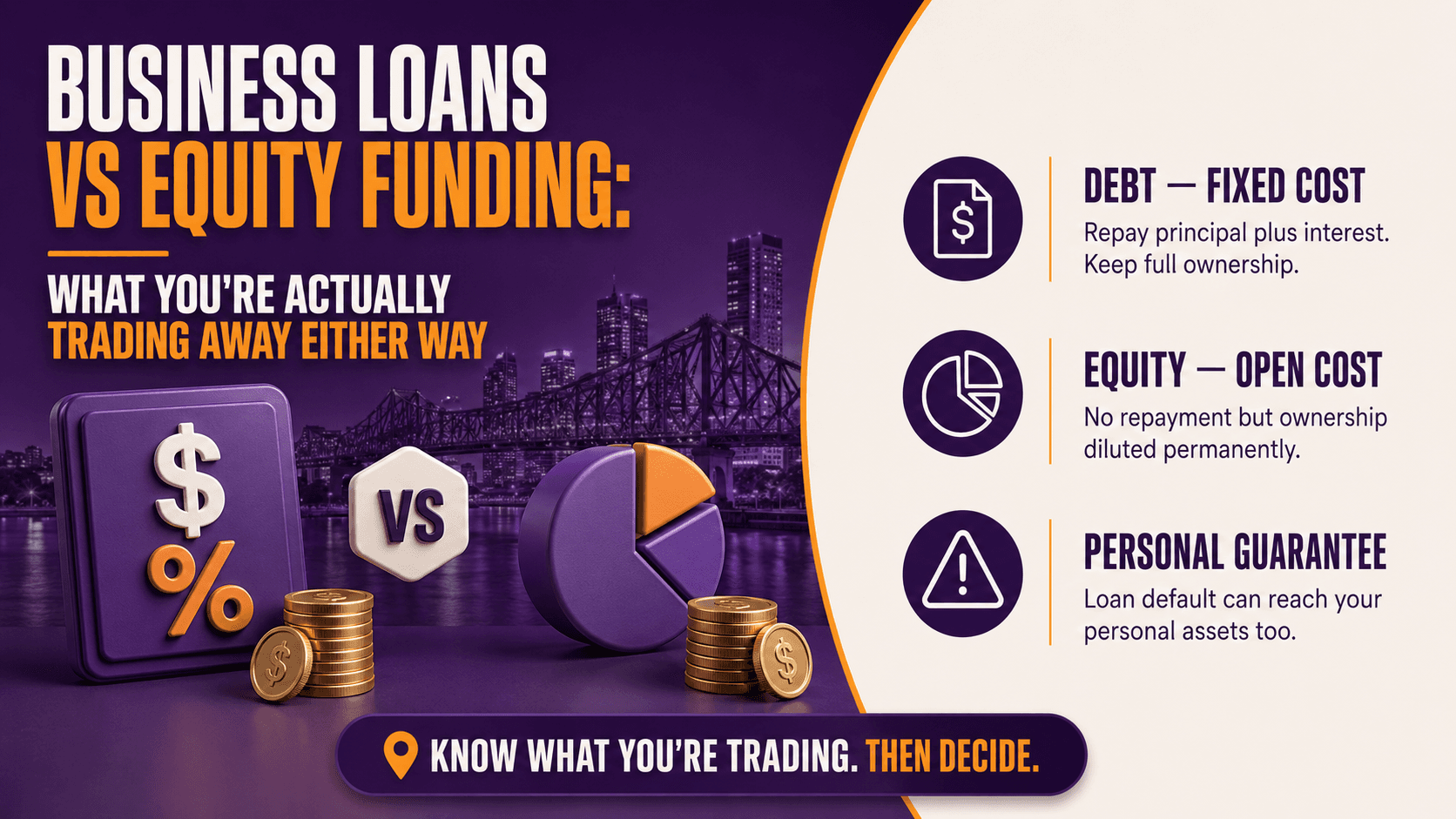
A business loan is repayable debt. You owe the principal plus interest regardless of how the business performs, but you retain full ownership and control.
Equity funding means selling a portion of ownership in exchange for capital. The investor shares in the business's upside (and downside), but you permanently dilute your ownership and decision-making control.
Personal guarantees are common on small business loans, meaning a loan default can expose your personal assets, not just the business's. This is a genuine risk debt funding carries that equity typically doesn't.
Equity investors often bring more than capital, experience, networks, and credibility, but they also bring expectations, oversight, and a say in major decisions that a lender generally doesn't.
The cost comparison isn't just interest rate versus no interest. Equity given away today has an opportunity cost equal to whatever that stake is worth if the business succeeds, which can far exceed the total interest on an equivalent loan.
Cash flow timing matters. Loans require regular repayments regardless of revenue timing, while equity funding doesn't create the same fixed repayment pressure during lean periods.
The right choice often depends on how confident you are in near-term cash flow, how much control matters to you, and whether the business genuinely needs more than capital (like an investor's expertise or network).
Bottom line: debt costs you a fixed, known amount and lets you keep the business; equity costs you an unknown, potentially much larger amount over time in exchange for shared risk and often genuine strategic value. The right answer depends on which trade-off actually fits your situation.
Jump to a Section
How Business Loans Actually Work
How Equity Funding Actually Works
The Real Cost of Equity vs the Real Cost of Debt
Control and Decision-Making: The Part Often Underestimated
Which Suits Which Situation?
Worked Example: Same Growth Need, Two Funding Paths
Common Mistakes
FAQ
How Business Loans Actually Work
A business loan provides capital that must be repaid with interest according to an agreed schedule, regardless of how the business subsequently performs. Lenders assess the application based on the business's (and often the owner's personal) financial position, cash flow, and ability to service the debt, and many small business loans require a personal guarantee from the owner, meaning that if the business can't repay and its assets don't cover the shortfall, the lender can pursue the owner's personal assets to recover the debt.
This structure means debt funding carries a genuinely asymmetric risk profile for the owner: if the business does exceptionally well, the lender still only receives the agreed interest, no more. But if the business struggles, the repayment obligation doesn't shrink to match, and can extend to personal assets under a guarantee.
Weighing up a business loan and want to understand the real risk, not just the advertised rate? A free 15-minute chat can walk through it. Call 1800 942 843.
Bottom line: a loan's cost is capped and known upfront, but the obligation to repay it doesn't flex downward if the business underperforms. That fixed nature is both its main advantage and its main risk.
How Equity Funding Actually Works
Equity funding means selling a portion of business ownership, shares in a company, or units in a trust structure, depending on how the business is set up, in exchange for capital. The investor becomes a part-owner, sharing in future profits, and typically in the value created if the business is eventually sold, in proportion to their stake. Unlike a lender, an equity investor has no automatic right to be repaid a fixed amount. Their return depends entirely on how the business performs and whether there's a future sale or profit distribution event that realises value on their stake.
Equity investors, particularly angel investors or venture capital, often also bring experience, industry networks, and credibility that can genuinely help a business grow beyond just the capital itself, but this comes bundled with an expectation of input into major decisions, sometimes including board representation or approval rights over significant business decisions.
Bottom line: equity funding trades a fixed repayment obligation for a permanent share of ownership and, usually, a permanent seat at the decision-making table for the investor. The capital and the control implications arrive together, not separately.
The Real Cost of Equity vs the Real Cost of Debt
This is the comparison most business owners underestimate: a loan's cost is capped at the principal plus interest, fully knowable in advance. Equity's cost is open-ended. If you sell 20% of your business for a given amount of capital today, and the business later becomes significantly more valuable, that 20% stake is now worth a proportionally larger amount, representing a genuine cost to you that can far exceed what the equivalent capital would have cost as debt with interest.
This doesn't mean equity is always the more expensive choice. For a business that might have failed or grown much more slowly without the investor's involvement (capital, expertise, or network), the trade may be entirely worth it. But it means the comparison shouldn't be reduced to "interest rate versus free money." Equity funding has a genuine cost, it's just contingent and realised later rather than fixed and paid immediately.
Trying to work out whether the equity you'd be giving away is actually worth more than an equivalent loan over time? Email clientservices@whatifadvice.com.au and we'll help run the comparison properly.
Bottom line: the "cost" of equity isn't in the term sheet. It's in what that ownership stake turns out to be worth down the track, which is precisely why it deserves at least as much scrutiny as a loan's interest rate, not less.
Control and Decision-Making: The Part Often Underestimated
Beyond the financial comparison, equity funding fundamentally changes who has a say in the business. Depending on the size of the stake and the specific agreement, an equity investor may have rights to board representation, approval over major decisions (like taking on additional debt, making large purchases, or bringing in further investors), and visibility into financial performance that a lender typically doesn't require to the same degree.
For business owners who value full autonomy over how the business is run, this loss of unilateral control can be a significant, sometimes underappreciated cost of equity funding, one that persists for as long as the investor holds their stake, regardless of how the business subsequently performs.
Not sure how much control you'd actually be giving up under a specific equity offer? Book a free 15-minute chat online and we'll help you read the terms properly.
Bottom line: debt funding leaves your decision-making authority fully intact as long as you're meeting repayment obligations; equity funding generally means sharing that authority permanently, in proportion to the stake sold. A trade-off worth weighing as seriously as the financial terms.
Which Suits Which Situation?
Broadly, debt funding tends to suit businesses with predictable, reliable cash flow capable of servicing regular repayments, where the owner wants to retain full control and doesn't need the investor's expertise or network beyond the capital itself. Equity funding tends to suit businesses with higher growth potential but less immediate cash flow certainty (common in early-stage or rapidly scaling businesses), where genuine strategic value from the investor's involvement (not just capital) meaningfully improves the business's prospects, and where the owner is comfortable sharing both upside and decision-making control.
Many businesses use a blend over time, starting with equity to fund early growth when cash flow is uncertain, then shifting toward debt funding once revenue is more predictable and the cost of further dilution becomes harder to justify relative to a loan's fixed cost.
Bottom line: the right funding type isn't fixed for the life of the business. It depends on the specific stage, cash flow certainty, and whether what's genuinely needed is capital alone, or capital plus strategic involvement.
Worked Example: Same Growth Need, Two Funding Paths
Path A, Nadia (business loan): Nadia's established business needs capital to purchase new equipment, expanding capacity for an already-proven, reliably profitable service line. She takes out a business loan secured partly against the equipment itself, with a personal guarantee for the remainder. Repayments are fixed and manageable against her predictable existing revenue, and she retains full ownership and decision-making control throughout. The total cost of the loan (principal plus interest) is known from the outset.
Path B, Marcus (equity funding): Marcus's business has a promising but unproven growth opportunity requiring capital, industry connections, and expertise he doesn't currently have, with less certain near-term cash flow to support loan repayments. He brings in an angel investor for a meaningful equity stake, gaining not just capital but genuine strategic guidance and introductions that help the business scale faster than he could have alone. Years later, if the business has grown substantially, the value of the stake he gave away may represent a considerably larger amount than an equivalent loan would have cost in interest, but without that investment, the growth opportunity may not have been achievable at all given his cash flow constraints and skill gaps at the time.
Bottom line: Nadia's situation suited debt because her cash flow was predictable and she didn't need more than capital; Marcus's situation suited equity because his opportunity needed more than capital and his cash flow couldn't have supported the debt servicing required. Same funding decision, genuinely different right answers.
Common Mistakes
Comparing only interest rate to "free" equity capital. Equity isn't free. Its cost is contingent and often larger, just realised later rather than upfront.
Taking on debt without a realistic view of cash flow certainty. A loan's fixed repayment obligation doesn't flex if revenue is less predictable than expected.
Giving away equity without properly valuing what the business (and the stake) might be worth later. Underpricing an early equity stake can mean giving away disproportionate value relative to the capital raised.
Not understanding the full scope of a personal guarantee before signing. This can expose personal assets well beyond what the business itself can cover in a default scenario.
Accepting equity investment without clarifying decision-making rights upfront. Vague or unaddressed control terms in an agreement can create serious friction later once the investor's expectations become clearer.
Assuming the funding choice is permanent and can't evolve. Many businesses appropriately shift between debt and equity as they move through different stages and levels of cash flow certainty.
FAQ
Is a business loan always cheaper than giving up equity? Not necessarily in every case. While a loan's cost is capped and known, if equity funding enables growth or success that wouldn't otherwise have been achievable, the trade can be genuinely worthwhile despite the potentially larger eventual cost of the stake given away.
What is a personal guarantee, and how risky is it really? A personal guarantee means you personally commit to repaying the loan if the business can't, potentially exposing personal assets like your home. This is a genuine, serious commitment that should be fully understood, not treated as routine paperwork.
Can I negotiate the terms of an equity investment, like how much control the investor gets? Yes, generally. The specific rights and control terms attached to an equity investment are negotiated as part of the agreement, and getting this right (ideally with legal advice) matters as much as the valuation and amount raised.
Do all business loans require a personal guarantee? Not necessarily. Some loans, particularly those secured against significant business assets, may not require one, though many small business loans do, especially for newer or less established businesses.
Is equity funding only available to tech startups, or can any business use it? Any business structured to accept outside investors (typically a company structure) can pursue equity funding, though the availability of interested investors and the terms offered vary considerably by industry, growth potential, and stage of the business.
How do I know how much equity to give away for a given amount of capital? This depends on the business's current valuation, the investor's assessment of risk and potential return, and negotiation. A professional valuation and advice can help avoid giving away a disproportionate stake relative to the capital raised.
Can I raise both debt and equity at the same time? Yes. Many businesses use a combination, using equity to fund higher-risk growth initiatives while using more conventional debt for predictable, asset-backed needs like equipment purchases.
What happens if I can't repay a business loan? Consequences depend on the loan structure and whether a personal guarantee applies, potentially including recovery action against business or personal assets. This is a serious scenario worth understanding fully before taking on debt, not something to consider only if things go wrong.
Do equity investors expect to eventually be bought out, or do they hold their stake indefinitely? This varies by investor and agreement. Some expect an eventual exit event (like a business sale) to realise their return, while others may be comfortable holding a stake longer-term, and this should ideally be clarified as part of the initial agreement.
Is it possible to raise equity funding without giving up majority control of my business? Yes. Many equity funding arrangements involve a minority stake, allowing the founder to retain majority ownership and control while still bringing in outside capital and investor involvement.
Ready to Work Out Which Trade-Off Fits?
Ready to work out whether debt, equity, or a blend actually fits your business's current stage and cash flow reality? This is a decision with consequences well beyond the immediate capital raised, worth a proper conversation before committing to either path.
Call us: 1800 942 843
Book online: free 15-minute chat, no cost, no pressure
Still asking what if you just take whichever offer comes first? Debt and equity solve the same problem in very different ways. Know which trade-off you're actually making.
WIAA has advised 200+ business clients across our Toowong, Grange, and Melbourne CBD offices, operating under AFSL 528250 as an Authorised Representative of Beryllium Advisers Pty Ltd.
General Advice Disclaimer: This article contains general information only and does not take into account your personal objectives, financial situation, or needs. It does not constitute legal, financial, or investment advice, and should not be relied upon as such. Business loan and equity funding terms vary significantly by lender, investor, and agreement, and should be reviewed with a qualified financial adviser, accountant, and solicitor before entering into any funding arrangement.