Looking for specific financial advice?
This blog provides general educational content. For personalized advice tailored to your unique situation, book a free consultation with our team of ASIC-licensed financial advisers.
What If You Had $100,000 to Invest Right Now, Would You Put It All In Today, or Drip It In Over a Year?
This is one of the most common investing questions, and the honest answer disappoints people who want a definitive rule: it depends what you're actually optimising for. Dollar-cost averaging (DCA), investing a fixed amount at regular intervals rather than all at once, feels intuitively safer, especially after a period of market volatility. The maths, though, tells a more nuanced story than "DCA is the safe choice." Understanding what DCA actually does, and doesn't do, matters more than picking a side in the debate.
TL;DR
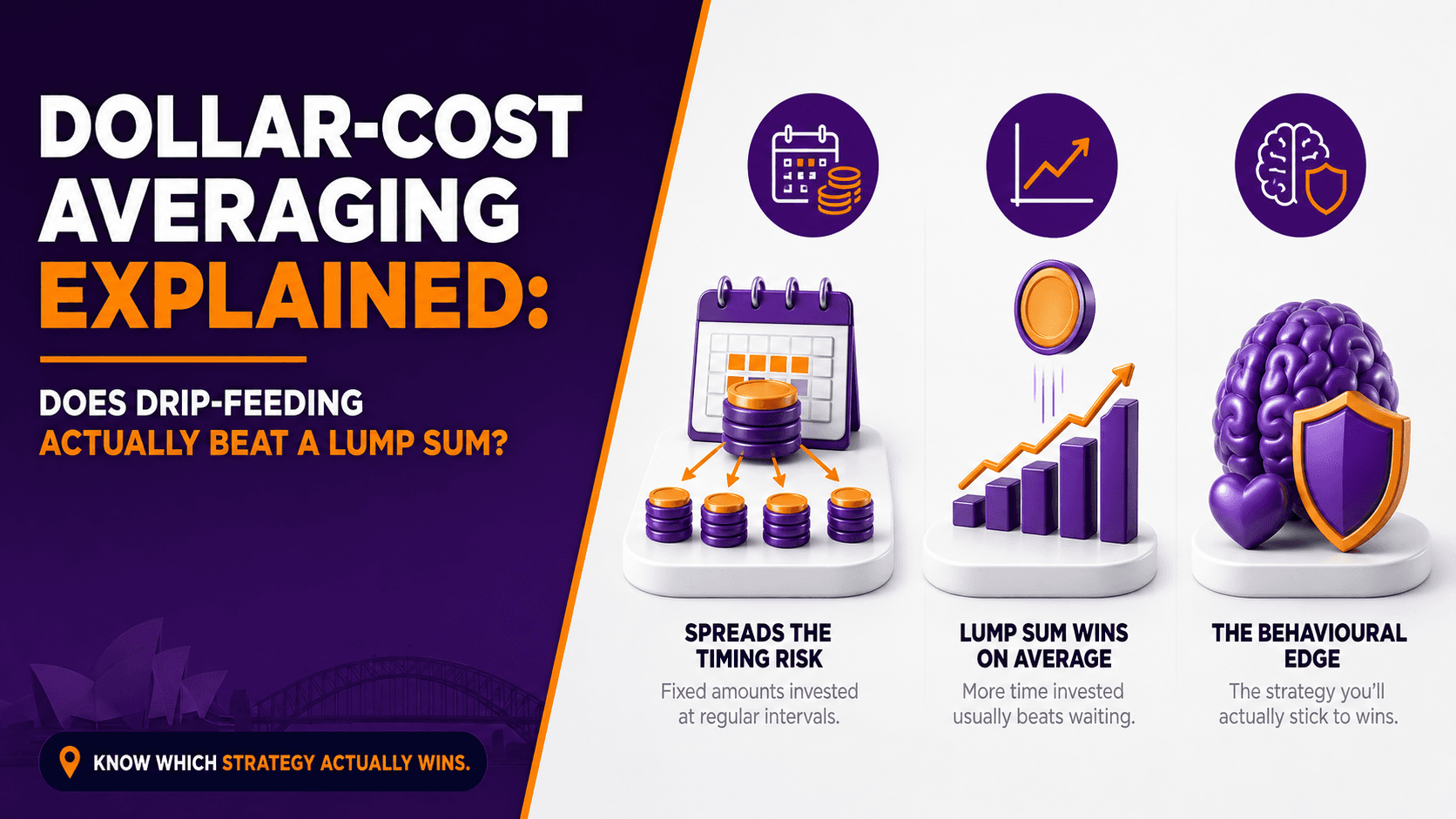
Dollar-cost averaging means investing a fixed dollar amount at regular intervals (weekly, monthly) regardless of market price, rather than investing a lump sum all at once.
DCA reduces the risk of bad timing. You avoid the specific scenario of investing everything the day before a major downturn.
Historically, lump sum investing has outperformed DCA more often than not over long time horizons, simply because markets trend upward over time and being invested longer generally means more time compounding.
DCA's real value is often behavioural, not mathematical. It makes investing large amounts feel less risky, which can be the difference between someone actually investing at all versus sitting in cash indefinitely out of fear.
If you're investing new income as you earn it (like regular super contributions or a savings plan), you're already dollar-cost averaging by default. This isn't an either/or choice in that context.
DCA can increase transaction costs slightly if each investment incurs brokerage, depending on the platform and investment vehicle used.
The right choice depends on whether you have a lump sum sitting in cash right now, versus investing money as it's earned. These are genuinely different situations.
Bottom line: DCA isn't a magic risk-reduction formula. It's a trade-off between statistically higher expected returns (lump sum) and lower regret risk and easier behaviour (DCA), and the right answer depends on your specific situation and temperament.
Jump to a Section
What Dollar-Cost Averaging Actually Is
The Maths: Why Lump Sum Often Wins on Average
The Behavioural Case for DCA
When DCA Genuinely Makes Sense
DCA and Super: You're Probably Already Doing It
Worked Example: Same $60,000, Two Approaches
Common Mistakes
FAQ
What Dollar-Cost Averaging Actually Is
Dollar-cost averaging means splitting an investment amount into equal portions and investing each portion at regular intervals, for example, investing $5,000 a month for 12 months instead of investing $60,000 in one transaction today. Because you're buying at different prices over time, you end up with an average purchase price across the period, rather than being fully exposed to whatever the market price happens to be on a single day.
The appeal is straightforward: if the market falls significantly right after you invest a lump sum, that specific bad-timing outcome stings in a way that's hard to shake, even if it's statistically unlikely to be catastrophic over a long horizon. DCA spreads that timing risk across multiple entry points instead of concentrating it in one.
Weighing up a lump sum vs drip-feeding an investment? A free 15-minute chat can walk through which fits your specific situation. Call 1800 942 843.
Bottom line: DCA doesn't change what the market does. It changes when and how you're exposed to it, spreading a single timing decision across many smaller ones instead.
The Maths: Why Lump Sum Often Wins on Average
This is the part that surprises people: extensive historical analysis, a widely cited finding in investment research, has generally found that lump sum investing outperforms DCA more often than not over long time horizons, in markets that trend upward over time. The logic is straightforward: since markets have historically risen over most extended periods, money invested sooner has more time exposed to that upward trend, while money sitting in cash waiting to be gradually deployed misses out on potential growth during the waiting period.
This doesn't mean lump sum investing always wins in any given period. In a market downturn immediately following a lump sum investment, DCA would have produced a better outcome for that specific period. It means that, averaged across many historical periods, lump sum has had a statistical edge more often than not.
Bottom line: DCA isn't the mathematically superior strategy on average. It's a strategy that trades some expected return for a smoother, less regret-prone ride, which is a legitimate trade-off, just not a free one.
The Behavioural Case for DCA
The maths doesn't tell the whole story, because investing isn't a purely mathematical exercise, it's also a behavioural one. For many people, the prospect of investing a large lump sum right before a downturn is emotionally difficult enough that it leads to a worse outcome than either strategy on paper: sitting in cash indefinitely, too anxious to invest at all. In that context, DCA's real value isn't statistical outperformance, it's making the decision to actually start investing feel manageable enough that the money gets invested at all, rather than sitting on the sidelines earning minimal returns while "waiting for the right time."
There's also a genuine psychological benefit in reduced regret: if markets fall after a DCA start, only a portion of the total amount was exposed at the worst price point, which can feel considerably less painful than a full lump sum hit, even if the long-run numerical outcome ends up similar.
Bottom line: if DCA is the difference between investing and not investing at all, it's very likely the better choice for you personally. The "right" strategy is the one you'll actually stick to.
When DCA Genuinely Makes Sense
DCA tends to make the most practical sense when:
You're investing a lump sum currently sitting in cash (an inheritance, redundancy payout, or sale proceeds) and want to reduce single-point timing risk.
You're emotionally uncomfortable with the idea of a lump sum investment and would otherwise delay investing indefinitely.
Market volatility is unusually elevated, and spreading entry points feels like a reasonable way to manage short-term uncertainty (though this can also just be a form of market timing in disguise).
You want a structured, automatic habit that removes ongoing decision-making from the process entirely.
Bottom line: DCA is most valuable as a tool for managing your own behaviour and risk tolerance around a specific lump sum, not as a universally superior investment strategy.
DCA and Super: You're Probably Already Doing It
Here's a detail that often gets missed in the DCA-vs-lump-sum debate: if you're a regular employee receiving Superannuation Guarantee contributions every payslip, or you make regular personal contributions, you're already dollar-cost averaging by default. New money is hitting your super investment options at regular intervals throughout the year, regardless of what the market's doing on any given day.
This means the DCA-vs-lump-sum question mostly applies to money that already exists in a lump sum (savings, an inheritance, sale proceeds), not to ongoing income being invested progressively, where the "choice" doesn't really apply in the same way.
Want to check whether your super contribution structure and broader investment strategy are actually working together? Email clientservices@whatifadvice.com.au and we'll take a look.
Bottom line: most working Australians are already dollar-cost averaging through their regular super contributions, whether they've thought about it that way or not. The strategic decision really only kicks in when you're sitting on a genuine lump sum.
Worked Example: Same $60,000, Two Approaches
(Outcomes for any specific 12-month period are unpredictable and depend entirely on actual market movements during that window. This example illustrates the mechanics and behavioural trade-off, not a guaranteed result either way.)
Investor A, Grace (lump sum): Receives a $60,000 inheritance and invests the full amount immediately into a diversified ETF portfolio. The market experiences a modest dip in the following two months before recovering and trending upward over the following year. Because her full amount was invested from day one, she captures the full extent of the subsequent recovery and growth.
Investor B, Leon (DCA over 12 months): Receives a similar $60,000 inheritance but splits it into 12 monthly instalments of $5,000, investing progressively over the year. During the early months, some instalments are invested at slightly lower prices during the same dip Grace experienced, and some at higher prices later as the market recovers. His average purchase price ends up close to, but not identical to, Grace's single entry price. Crucially, Leon reports feeling considerably less anxious throughout the year, since only a portion of his money was ever exposed to any single day's price.
Bottom line: over any specific period, one approach will mathematically outperform the other by chance. The more useful question is which approach you can actually commit to without second-guessing yourself halfway through.
Common Mistakes
Treating DCA as a way to "time the market" while pretending it isn't. Deliberately delaying instalments because you think you can predict short-term dips is market timing wearing a DCA costume.
Assuming DCA guarantees a better outcome than lump sum. Historically, it hasn't, on average. It manages risk and regret, not returns.
Extending a DCA period indefinitely out of ongoing anxiety. A drip-feed plan that keeps getting extended past its original timeframe often reflects unresolved discomfort with investing generally, worth addressing directly rather than endlessly deferring.
Ignoring brokerage costs on frequent small purchases. Depending on your platform, multiple smaller transactions can add up in fees compared to a single lump sum trade.
Confusing "already DCA-ing via super" with having a broader investment strategy. Regular super contributions are a form of DCA, but they don't replace a considered strategy for any additional lump sums you're separately deciding how to invest.
Choosing DCA purely because it "feels safer" without understanding the return trade-off. A reasonable choice, but an informed one, not simply the default "safe" option by assumption.
FAQ
Is dollar-cost averaging guaranteed to reduce risk? It reduces the specific risk of bad single-point timing, but it doesn't reduce overall market risk. Your money is still exposed to market movements over the DCA period, just spread across multiple entry points.
How long should a DCA period be? There's no fixed rule. Common approaches spread a lump sum over anywhere from a few months to a year or more, generally balancing meaningful risk-spreading against not delaying market exposure for too long.
Does DCA work for any investment, or just shares/ETFs? It can apply to any investment with a fluctuating price, though it's most commonly discussed in the context of shares, ETFs, and managed funds.
Is DCA the same as automatic regular investing plans offered by platforms? Broadly yes. Many platforms offer automated regular investment features that are effectively a DCA structure, deducting a set amount at regular intervals into a chosen investment.
If I have a lump sum, is there a "correct" answer between DCA and lump sum investing? Not universally. Historical averages favour lump sum investing, but the right choice for you also depends on your personal risk tolerance, time horizon, and how you'd handle a downturn shortly after investing.
Does dollar-cost averaging apply to superannuation contributions? Yes, effectively. Regular Superannuation Guarantee or personal contributions are invested progressively over time, which functions as DCA by default.
Can DCA be combined with a lump sum approach? Yes. Some investors invest a portion as a lump sum immediately and DCA the remainder over a set period, which can balance the statistical edge of lump sum investing with some of DCA's risk-spreading and behavioural benefits.
Does market volatility make DCA more or less useful? Higher volatility can make DCA's risk-spreading feel more valuable psychologically, though it doesn't change the underlying statistical relationship between DCA and lump sum outcomes over the long run.
Is DCA relevant if I'm investing for a short time horizon? DCA's risk-spreading benefit is generally more relevant over longer horizons. For very short time horizons, the choice of investment vehicle and risk level matters more than the DCA-vs-lump-sum decision itself.
Should I use DCA if I'm nervous about investing a large amount at once? This is exactly the situation where DCA often makes the most sense. If the alternative is delaying investing indefinitely out of anxiety, a structured DCA plan getting the money invested progressively is generally better than staying in cash.
Ready to Work Out What Fits?
Ready to figure out whether a lump sum, a DCA plan, or a blend actually fits your situation and comfort level? This is a genuinely personal decision that depends on your timeframe, temperament, and what you're invested for, worth a proper conversation rather than a rule of thumb.
Call us: 1800 942 843
Book online: free 15-minute chat, no cost, no pressure
Still asking what if you wait for the perfect moment to invest? There isn't one. There's just the strategy you can actually stick with.
WIAA has advised 1,000+ clients across our Toowong, Grange, and Melbourne CBD offices, operating under AFSL 528250 as an Authorised Representative of Beryllium Advisers Pty Ltd.
General Advice Disclaimer: This article contains general information only and does not take into account your personal objectives, financial situation, or needs. It does not constitute personal financial advice, and should not be relied upon as such. References to historical investment performance and studies are general in nature, illustrative only, and past performance is not a reliable indicator of future performance. You should seek personal financial advice before making investment decisions.