Looking for specific financial advice?
This blog provides general educational content. For personalized advice tailored to your unique situation, book a free consultation with our team of ASIC-licensed financial advisers.
What If Your Suburb Was Built for Two Completely Different Kinds of Wealth?
Docklands is Melbourne's newest waterfront precinct, purpose-built around corporate office towers along Victoria Harbour, home to major employers including national banks and financial services headquarters, alongside a genuinely large stock of high-rise apartments. That combination has produced two distinct groups of Docklands residents with very different financial planning needs: corporate and finance professionals often on structured salary-plus-bonus packages, and investors who've bought into the area's apartment market specifically to lease to that same working population. This piece covers each group's actual planning priorities in turn, rather than trying to force them into a single shared story.
TL;DR
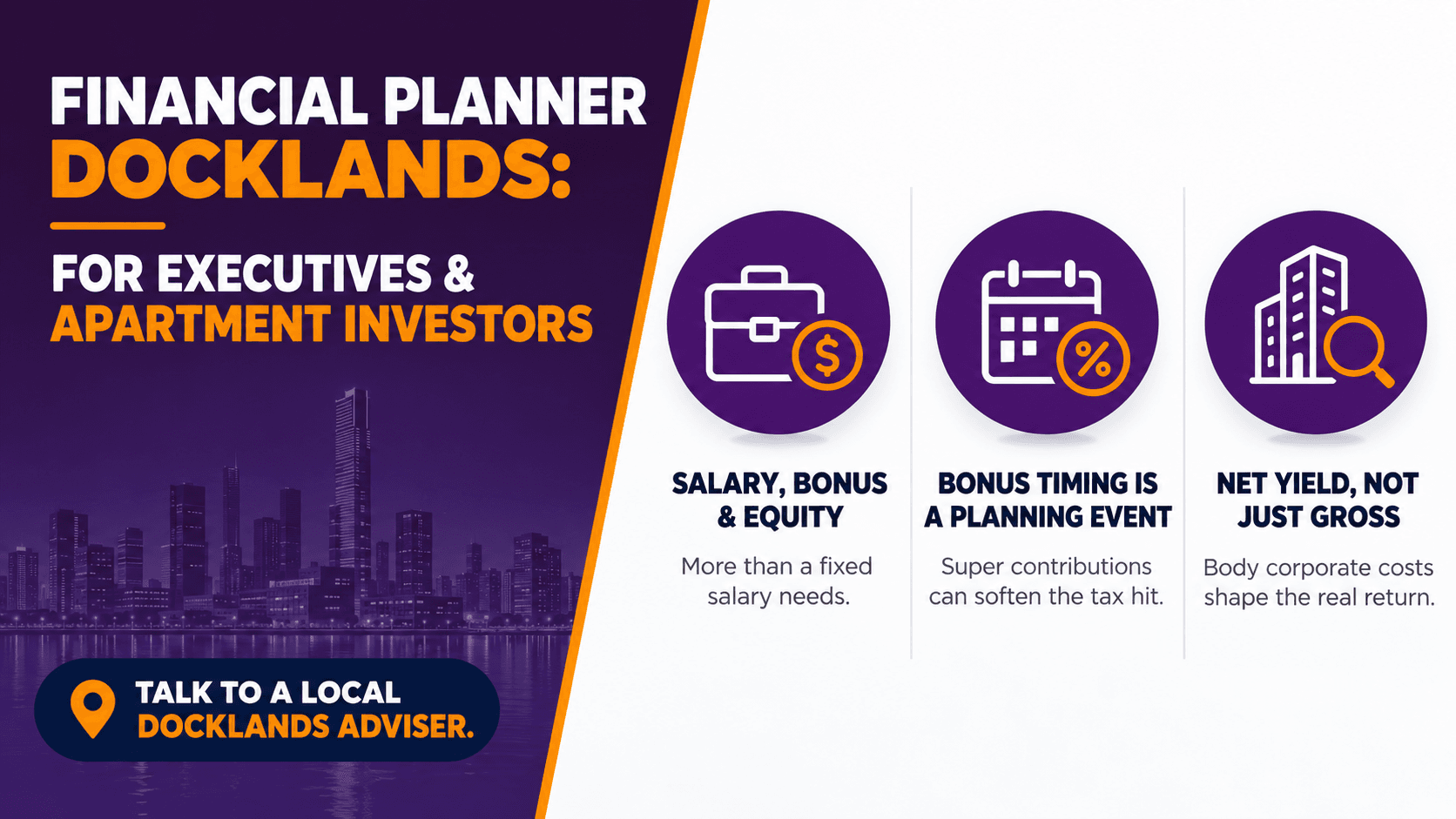
Corporate and finance professionals in Docklands often have salary-plus-bonus income structures, sometimes including equity or share-based components, which need specific tax and structuring consideration beyond a standard fixed salary.
Bonus and variable remuneration timing can meaningfully affect tax outcomes and superannuation contribution strategy, worth planning around deliberately rather than treated as a simple annual windfall.
Apartment investors in Docklands are typically assessing rental yield in a market with high renter turnover, weighed against unit-specific risks including body corporate costs and a still-maturing owner-occupier market relative to established Melbourne suburbs.
Docklands' apartment stock skews toward renters rather than owner-occupiers, which affects both investment yield assumptions and how the local property market tends to move relative to more owner-occupied suburbs.
Corporate professionals often benefit from coordinating salary packaging, super, and investment strategy together, particularly where bonus or equity components add complexity beyond a standard salary.
Investors should factor in body corporate costs and building age specific to Docklands' high-rise stock when assessing genuine net yield, not just headline rental figures.
Docklands is a short, roughly 5 to 10 minute trip from WIAA's Melbourne CBD office, making in-person consultations genuinely convenient.
Bottom line: Docklands' population splits between corporate professionals needing structured income planning and investors needing careful yield assessment in a renter-heavy apartment market, and matching advice to the right group matters more than a generic suburb overview.
On This Page
Corporate and Finance Professionals: Structuring Salary, Bonus, and Equity
Why Bonus Timing Matters for Tax and Super
A Docklands Executive's Bonus Year
For Investors: Assessing Yield in a Renter-Heavy Market
Body Corporate and Building Considerations for Docklands Apartments
A Docklands Investor's Net Yield Check
Common Mistakes
FAQ
Corporate and Finance Professionals: Structuring Salary, Bonus, and Equity
Docklands' proximity to major corporate and financial services employers means a significant share of local residents work in roles with structured remuneration packages beyond a simple fixed salary, including annual bonuses, share or equity-based components, and sometimes salary packaging arrangements. This income structure benefits from deliberate planning: understanding how bonus timing interacts with marginal tax rates, whether equity components carry specific tax treatment or vesting considerations, and how superannuation contribution strategy should be adjusted around variable, rather than purely fixed, income.
Bonus and equity components add genuine complexity to standard salary planning. A free 15-minute chat with WIAA can review your specific remuneration structure. Call 1800 942 843 or book online.
Bottom line: a salary-plus-bonus-plus-equity package needs more deliberate planning than a simple fixed salary, and Docklands' corporate resident base makes this a genuinely common local planning need.
Why Bonus Timing Matters for Tax and Super
A significant annual bonus, common in Docklands' corporate and finance-heavy resident base, can meaningfully affect a year's total taxable income, sometimes pushing part of that income into a higher marginal tax bracket for the year it's received. Planning around this, including considering additional concessional superannuation contributions in a higher-bonus year to manage taxable income, or timing other deductions or contributions deliberately, can produce a more efficient overall outcome than treating a bonus as simply extra spending money once it lands. Equity and share-based components (employee share schemes, restricted stock units, or options) carry their own specific tax and vesting rules that vary genuinely by scheme type, and shouldn't be assumed to follow a single general pattern.
Bottom line: a bonus isn't just extra income to enjoy, it's a planning event worth structuring around deliberately, particularly regarding super contributions and overall tax position for that year.
A Docklands Executive's Bonus Year
Sarah works as an executive at a financial services firm headquartered in Docklands, earning a base salary plus an annual bonus that varies year to year, along with a share-based long-term incentive component. In a year her bonus came in considerably higher than expected, working with WIAA she structured an additional concessional super contribution timed to land before the end of that financial year, reducing the amount of the bonus taxed at her top marginal rate, and separately had the vesting schedule and tax treatment of her equity component reviewed as part of her broader plan, since she'd previously assumed it was taxed the same way as her salary.
Bottom line: for Docklands' corporate professionals, a bonus is a planning event with a genuine decision window attached, not a number that simply lands in an account and gets spent.
For Investors: Assessing Yield in a Renter-Heavy Market
Docklands' apartment market has a notably high proportion of renters relative to owner-occupiers compared to many established Melbourne suburbs, driven partly by the area's relatively recent development and partly by its appeal to corporate tenants seeking a short commute. For investors, this generally supports genuine rental demand, but that headline yield needs to be weighed against Docklands-specific considerations: body corporate costs on larger, amenity-heavy buildings, and a market that can be more sensitive to new apartment supply coming online than an established, more owner-occupied suburb.
Assessing a specific Docklands building's body corporate costs and financial health is a genuinely important step before investing. A free 15-minute chat can help think through what to check. Email clientservices@whatifadvice.com.au or book online.
Bottom line: Docklands' strong rental demand is a genuine positive for investors, but net yield needs to properly account for body corporate costs and the area's ongoing exposure to new supply.
Body Corporate and Building Considerations for Docklands Apartments
Docklands' high-rise buildings, often featuring extensive shared amenities like pools, gyms, and concierge services, generally carry higher body corporate fees than a smaller or more modest building, a cost that directly affects net rental yield and needs to be factored into any investment assessment beyond the advertised gross rental figure. Building age and body corporate financial health, including sinking fund adequacy for eventual major repairs, are also worth reviewing specifically for any building being considered. A renter-heavy suburb like Docklands can also behave differently in the property market than a more owner-occupied one, sometimes showing different price growth patterns and being more directly affected by new apartment supply entering the market, worth understanding as a genuinely different dynamic rather than assumed to mirror a traditional suburban market.
Bottom line: Docklands' amenity-rich buildings often mean higher body corporate costs, and factoring this properly into net yield calculations avoids an overly optimistic view of an investment's real return.
A Docklands Investor's Net Yield Check
Marcus was considering a one-bedroom apartment near Victoria Harbour, advertised with a strong headline rental yield. Before committing, he requested the building's body corporate financial statements and found the fees, reflecting the building's pool, gym, and concierge services, were meaningfully higher than a comparable unit in a more modest building nearby. Once he recalculated his expected net yield against those actual costs rather than the advertised gross figure, and checked the sinking fund's adequacy for an ageing lift system flagged in the building's records, the investment still stacked up, but at a noticeably thinner margin than the listing had suggested.
Bottom line: the advertised yield on a Docklands apartment is a starting point, not the answer, and the body corporate statements are where the real number actually lives.
Common Mistakes
Treating a bonus as simple extra income rather than a planning opportunity. Deliberate timing around super contributions and tax position can produce a meaningfully better outcome.
Not understanding the tax treatment of equity or share-based remuneration components. These often carry specific rules distinct from standard salary income, and distinct from each other depending on scheme type.
Investors focusing only on advertised gross rental yield. Body corporate costs, particularly in amenity-heavy buildings, materially affect real net return.
Not accounting for Docklands' renter-heavy ownership mix when assessing investment risk. This creates a genuinely different market dynamic to an owner-occupied suburb.
Overlooking building age and sinking fund health when investing in a Docklands apartment. These affect the likelihood and scale of future body corporate costs.
Whether you're navigating a structured corporate remuneration package or assessing a specific Docklands apartment as an investment, the right advice depends on which conversation actually applies to you. A free 15-minute chat can help. Call 1800 942 843.
FAQ
How should I plan around an annual bonus for tax purposes? Generally by considering the bonus's effect on your marginal tax rate for that year and weighing options like additional concessional super contributions, worth planning ahead of receiving the bonus rather than after.
Does share-based remuneration get taxed differently to salary? Often, yes, equity and share-based components can carry specific tax treatment and vesting rules distinct from standard salary income, and these rules vary by scheme type, worth reviewing specifically for your particular arrangement.
Is Docklands a good suburb for property investment given its renter-heavy market? This can genuinely support strong rental demand, though net yield needs to properly account for body corporate costs and the area's sensitivity to new apartment supply.
Why are body corporate fees often higher in Docklands than other Melbourne suburbs? Docklands' buildings often include extensive shared amenities like pools, gyms, and concierge services, which generally increase ongoing body corporate costs compared to more modest buildings.
Does a renter-heavy suburb behave differently in the property market than an owner-occupied one? It can, sometimes showing different price growth patterns and greater sensitivity to new supply, worth understanding as a genuinely different market dynamic rather than assumed to mirror an owner-occupied suburb.
Should I coordinate my super contributions with my bonus payment timing? This can be a genuinely effective strategy, particularly in a higher-bonus year, worth discussing directly given how it interacts with your overall tax position.
What should I check about a Docklands building's body corporate before investing? Generally its financial statements, sinking fund adequacy, any known upcoming special levies, and the building's general age and amenity level relative to its ongoing fee structure.
Does WIAA help both corporate professionals and apartment investors in Docklands? Yes, both structured income and remuneration planning, and property investment yield assessment, are areas WIAA supports, tailored to whichever situation actually applies.
How far is Docklands from WIAA's Melbourne office? Docklands is a short, roughly 5 to 10 minute trip from WIAA's Melbourne CBD office, making in-person consultations genuinely convenient.
How do I get started with a financial review for my specific Docklands situation? A free 15-minute chat is the easiest starting point, allowing WIAA to understand whether your situation sits closer to the corporate professional or apartment investor profile before recommending next steps.
Ready to Get Advice for Your Specific Docklands Situation?
Whether you're navigating a bonus-and-equity remuneration package or assessing a specific apartment as an investment, Docklands' two resident groups need genuinely different advice. A free 15-minute chat can help.
Call us: 1800 942 843
Book online: free 15-minute chat, no cost, no pressure
Still asking what if.
WIAA has helped Docklands' corporate professionals and apartment investors alike build the right financial approach for their specific situation, from our Melbourne CBD office. WIAA operates under AFSL 528250 as an Authorised Representative of Beryllium Advisers Pty Ltd.
General Advice Disclaimer: This article contains general information only and does not take into account your personal objectives, financial situation, or needs. It is not personal financial, tax, or legal advice and should not be relied upon as such. Remuneration structures, body corporate fees, and rental yield figures vary by individual arrangement and property and should be verified directly for your specific circumstances.