Looking for specific financial advice?
This blog provides general educational content. For personalized advice tailored to your unique situation, book a free consultation with our team of ASIC-licensed financial advisers.
What If the Tax on Your Dividend Was Already Paid Before You Got It?
Australia runs one of the only dividend systems in the world where company tax already paid gets handed back to shareholders as a credit against their own tax bill. Most people who hold Australian shares have seen "franking credits" on a statement without ever fully understanding what they are or why they exist. The short version: it's the government's way of making sure company profits aren't taxed twice, once at the company level, then again at the shareholder level. The mechanics of exactly how that credit lands in your tax return, though, depend entirely on your own tax bracket. For a broader comparison of how franking credits factor into ETFs, LICs, and managed funds specifically, our dedicated comparison guide covers that ground.
TL;DR
Franking credits represent company tax already paid on a dividend before it reaches you, and they're attached to the dividend as a credit against your own tax.
Australian companies pay tax at 25% or 30% depending on size, and a "fully franked" dividend carries a credit for tax paid at that full rate.
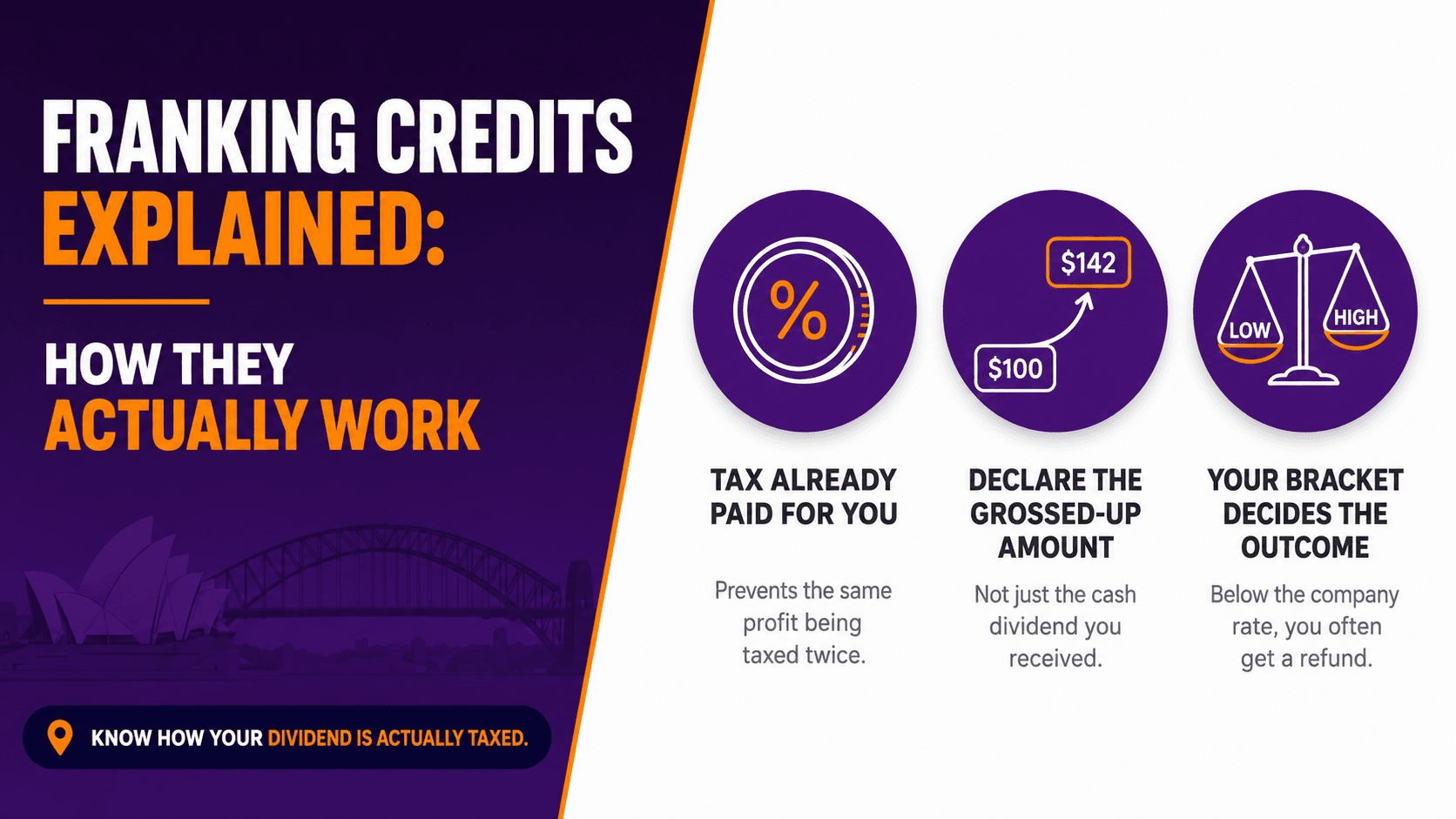
Franked dividends are "grossed up" for tax purposes, meaning your assessable income includes both the cash dividend and the credit itself.
Whether you get a refund or just a reduction depends on your marginal tax rate: below the company tax rate, you generally get money back; above it, the credit just reduces what you owe.
Unfranked dividends carry no credit, generally because the company hasn't paid Australian tax on that portion of profit, often relevant for companies with overseas earnings.
Retirees and low-income earners often benefit most, since a marginal tax rate below the franking rate typically means the credit is refunded as cash.
SMSFs in pension phase can be particularly affected by franking credit refunds, since fund-level tax in that phase is often 0%, though this depends on the fund's specific circumstances.
Bottom line: a franking credit isn't a bonus, it's tax the company already paid on your behalf, and what happens to it in your return depends entirely on whether your own tax rate sits above or below the rate the company paid.
On This Page
What a Franking Credit Actually Is
Franked vs Partially Franked vs Unfranked Dividends
How the Gross-Up and Credit Actually Work on Your Tax Return
Why Your Tax Bracket Determines the Outcome
Franking Credits for Retirees and SMSFs
Worked Example: Same Dividend, Three Different Outcomes
Common Mistakes
FAQ
What a Franking Credit Actually Is
Australia uses a dividend imputation system, which exists to avoid double taxation on company profits. Without it, a company would pay tax on its profit, then the shareholder would pay tax again on the dividend from that same profit, taxing the same dollar twice. Instead, when an Australian company pays tax and then distributes some of that after-tax profit as a dividend, it can attach a franking credit representing the tax it already paid on that amount. The shareholder then includes both the dividend and the credit in their taxable income, but gets the credit back against their own tax bill.
Not sure how much of your investment income is actually franked versus unfranked? A free 15-minute chat with WIAA can walk through your specific portfolio. Call 1800 942 843 or book online.
Bottom line: the credit exists to prevent the same profit being taxed once at the company and again at the individual, not as an extra reward for holding shares.
Franked vs Partially Franked vs Unfranked Dividends
Not every dividend carries the same franking treatment:
Fully franked, the entire dividend has a franking credit attached, generally meaning the company paid full Australian company tax on that profit.
Partially franked, only part of the dividend carries a credit, common when a company has a mix of Australian and overseas earnings, or hasn't paid tax on the full amount for another reason.
Unfranked, no credit attached at all, often because the underlying profit wasn't taxed in Australia, such as income sourced overseas.
A company's franking level generally depends on how much Australian tax it's actually paid relative to the profit being distributed, tracked through what's called a franking account.
Bottom line: the level of franking on a dividend reflects how much Australian company tax was actually paid on the profit behind it, not a fixed feature of the company itself.
How the Gross-Up and Credit Actually Work on Your Tax Return
This is the part that trips most people up. Say you receive a $700 fully franked dividend from a company that paid the 30% company tax rate. The franking credit attached is calculated to represent the tax already paid, in this case $300, meaning the company's pre-tax profit behind your dividend was $1,000. On your tax return, you don't just declare the $700 cash you received, you gross up and declare the full $1,000, then claim the $300 franking credit as a credit against your tax payable.
This matters because your assessable income appears higher than the cash you actually received, which can affect things like income tests for other purposes, even though the $300 difference comes back to you as a tax credit or refund.
The gross-up mechanic is one of the most commonly misunderstood parts of an investment tax return. A free 15-minute chat can walk through exactly how it applies to your holdings. Email tax@whatifadvice.com.au or book online.
Bottom line: you're taxed on the full pre-tax profit, then credited for the tax already paid on it, which is why the numbers on a dividend statement look larger than the cash you actually banked.
Why Your Tax Bracket Determines the Outcome
What actually happens with a franking credit depends entirely on where your marginal tax rate sits relative to the company tax rate the credit represents:
If your marginal rate is higher than the company tax rate, the franking credit reduces your tax bill, but you'll still owe additional tax on the difference.
If your marginal rate is lower than the company tax rate, generally the case for retirees, low-income earners, or funds in pension phase, the credit can exceed the tax you actually owe, and the excess is generally refunded as cash.
If your marginal rate roughly matches the company tax rate, the credit broadly offsets the tax owed on that income, with little or no net tax payable and little or no refund.
This is why the same $700 fully franked dividend can produce a genuinely different outcome for a high-income earner, a middle-income earner, and a retiree, despite all three receiving an identical dividend.
Bottom line: the franking credit itself never changes, but what happens to it in your tax return depends entirely on your own tax rate relative to the company tax rate.
Franking Credits for Retirees and SMSFs
Retirees and superannuation funds in pension phase are frequently the biggest beneficiaries of franking credit refunds, since fund-level tax on pension phase earnings is often 0%, well below the company tax rate the credits represent. This can mean the entire franking credit attached to a dividend is refunded as cash, rather than merely offsetting tax owed. This dynamic has made franking credits a genuinely significant income source for some SMSFs and retirees, and it's part of why franking credit policy has periodically been a subject of political debate in Australia.
The specific outcome depends on the fund's tax rate, its accumulation versus pension phase status, and other income and deductions in that financial year, so this is worth reviewing on a case-by-case basis rather than assuming a blanket outcome.
How franking credits interact with your super fund's tax position, particularly around pension phase, is a common area SMSF trustees get wrong. A free 15-minute chat can check yours. Call 1800 942 843.
Bottom line: franking credit refunds can be a genuinely material part of retirement income for some investors, but the outcome depends on the fund's specific tax position, not a fixed rule.
Worked Example: Same Dividend, Three Different Outcomes
Three investors each hold shares that pay a $700 fully franked dividend, with a $300 franking credit attached (grossed-up taxable amount: $1,000), from a company taxed at 30%.
Investor A (high marginal rate, well above 30%): declares $1,000 in assessable income, owes tax at their marginal rate on that full amount, and applies the $300 credit against it. Result: still owes additional tax on the difference between their marginal rate and the 30% already paid.
Investor B (marginal rate roughly at 30%): declares $1,000, owes roughly $300 in tax on it, and the $300 credit largely offsets that liability. Result: close to a wash, minimal additional tax or refund.
Investor C (retiree, marginal rate well below 30%, say an effective rate around 0 to 15%): declares $1,000, but owes considerably less than $300 in tax on it at their lower rate. Result: the excess credit is refunded as cash, meaning Investor C receives more back than the $300 credit itself covers what they actually owed.
Outcome: an identical $700 dividend produces three different net tax positions purely because of the tax bracket each investor sits in.
Bottom line: the same dividend can mean owing more tax, roughly breaking even, or receiving a cash refund, entirely dependent on the recipient's own tax position.
Common Mistakes
Only looking at the cash dividend received, not the grossed-up figure. The grossed-up amount is what actually shows up as assessable income.
Assuming all dividends carry the same franking level. Partially franked and unfranked dividends are common, particularly from companies with overseas income.
Not accounting for franking credits when comparing investment income to other income types. The grossed-up figure can affect income-tested calculations even though it's not cash in hand.
Assuming franking credit refunds work the same way inside an SMSF as for an individual. Fund tax rate and phase materially change the outcome.
Ignoring franking credits when comparing Australian shares to international shares or unfranked investments. The after-tax return comparison looks very different once franking is factored in.
Franking credits can materially change the actual after-tax return on Australian shares, particularly for retirees. A free 15-minute chat can factor them properly into your investment planning. Call 1800 942 843.
FAQ
What is a franking credit in simple terms? It's a credit representing company tax already paid on a dividend before you received it, which you can then use to reduce or, in some cases, receive a refund against your own tax.
Why do I declare more than the cash dividend I received? Because you're taxed on the grossed-up amount, the dividend plus the franking credit, which represents the company's pre-tax profit behind that dividend, not just the cash paid to you.
Can I get a cash refund from franking credits? Generally, yes, if your marginal tax rate is below the company tax rate the credit represents, meaning the credit exceeds what you actually owe in tax.
What's the difference between franked and unfranked dividends? A franked dividend has tax already paid on it at the company level, with a credit attached. An unfranked dividend has no credit attached, often because the underlying profit wasn't taxed in Australia.
Do all Australian companies pay franked dividends? No. Franking depends on how much Australian company tax the company has actually paid relative to the profit it's distributing, tracked through its franking account.
Are franking credits relevant if I hold shares through an ETF? Yes, generally. ETFs holding Australian shares that pay franked dividends can pass those franking credits through to unit holders, though the specifics depend on the fund's structure.
Do franking credits affect my super fund the same way as my personal tax return? Not exactly. Super funds have their own tax rates depending on accumulation or pension phase, which changes how much of a franking credit ends up refunded versus simply offsetting tax owed.
Is there a limit to how much franking credit refund I can receive? Refund treatment depends on current tax law and your specific circumstances, and eligibility rules can be subject to change, so this is worth verifying against current ATO guidance for your situation.
Do I need to do anything to claim franking credits, or are they automatic? Franking credits are generally reported on your dividend statement and applied automatically when you lodge, provided the dividend information is correctly included in your tax return.
Why do retirees talk about franking credits so much? Because a lower marginal tax rate in retirement, or a fund in pension phase, often means franking credits are refunded as cash rather than merely offsetting tax, making them a more visible part of income.
Ready to Understand What Franking Credits Actually Mean for Your Portfolio?
Franking credits can significantly change the real after-tax return on Australian shares, and the outcome is different for everyone depending on their tax position. A free 15-minute chat can walk through what applies to you.
Call us: 1800 942 843
Email: tax@whatifadvice.com.au
Book online: free 15-minute chat, no cost, no pressure
Still asking what if.
WIAA has helped Australians understand what's actually happening in their investment tax position, not just what's on the statement, across Toowong, Grange, and Melbourne CBD. WIAA operates under AFSL 528250 as an Authorised Representative of Beryllium Advisers Pty Ltd.
General Advice Disclaimer: This article contains general information only and does not take into account your personal objectives, financial situation, or needs. It is not personal financial advice or tax advice and should not be relied upon as such. Franking credit rules, refund eligibility, and company and superannuation tax rates are subject to change and should be verified with the ATO or a registered tax agent for your specific circumstances.