Looking for specific financial advice?
This blog provides general educational content. For personalized advice tailored to your unique situation, book a free consultation with our team of ASIC-licensed financial advisers.
What If Paying Off Your HECS Debt Early Was Actually the Wrong Financial Move?
HECS/HELP debt gets treated very differently to almost any other kind of debt Australians carry, no interest in the traditional sense, repayments tied to income rather than a fixed schedule, and an emotional weight that often outpaces its actual financial cost. That combination leads to two equally common mistakes: people who obsessively rush to pay it off at the expense of higher-value uses of their money, and people who ignore it entirely and get an unpleasant surprise at tax time or when applying for a home loan. The right answer depends on genuinely comparing HECS to your other options, not on how uncomfortable having "debt" feels.
TL;DR
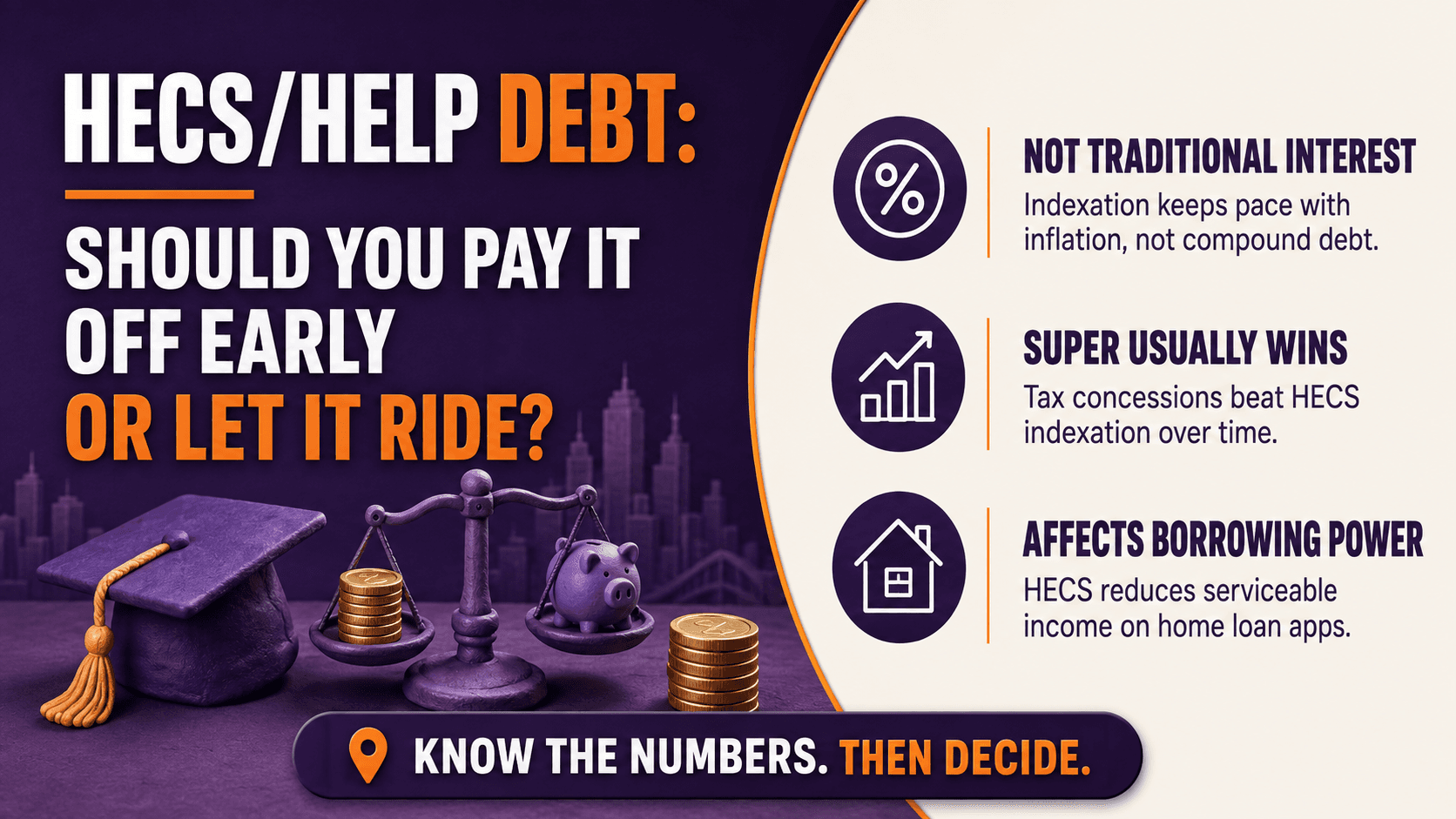
HECS/HELP debt has no traditional interest rate. Instead it's subject to indexation, adjusted annually, which has historically been tied to measures like CPI (with recent legislative changes affecting exactly how it's calculated, always verify the current method).
Compulsory repayments are automatically deducted once your income exceeds a repayment threshold, calculated as a percentage of your income that increases in bands as income rises. Thresholds and rates change and should be verified each financial year.
Voluntary early repayments reduce your balance directly, but Australia removed the voluntary repayment bonus discount some years ago, meaning there's generally no discount incentive for paying extra, unlike in the past.
HECS debt is factored into home loan borrowing power calculations by lenders, since it affects your net income available for loan repayments. This can meaningfully affect how much you can borrow.
For many people, the comparison isn't "HECS vs nothing." It's "extra HECS repayment vs extra super contribution vs extra mortgage repayment vs investing," and HECS often doesn't win that comparison given its indexation is typically lower than achievable investment returns over time.
HECS debt doesn't appear on a traditional credit report and doesn't affect your credit score the way a personal loan or credit card does, but it still affects serviceability assessments for other borrowing.
If you're not planning to work in Australia long-term or are leaving the income-testing system, the repayment dynamics can differ. This is a genuinely different scenario worth separate consideration.
Bottom line: HECS behaves more like a graduate tax than a traditional debt, and treating it with the same urgency as a credit card or personal loan often means directing money away from better uses of it.
Jump to a Section
How HECS/HELP Actually Works
Compulsory Repayments vs Voluntary Repayments
Indexation: Why It's Not the Same as Interest
HECS and Home Loan Borrowing Power
The Real Comparison: HECS vs Super vs Investing vs Mortgage
Worked Example: Two Approaches to the Same Debt
Common Mistakes
FAQ
How HECS/HELP Actually Works
A HECS-HELP (or other HELP loan type) debt is what the government fronts for eligible university or vocational study costs, which you then repay through the tax system once your income crosses a set threshold. Unlike a bank loan, there's no fixed repayment schedule, no application process for "the loan," and no traditional interest charged. Instead, the outstanding balance is adjusted annually through indexation, intended broadly to maintain the debt's real value over time rather than to generate a profit margin the way commercial interest does.
Because repayments are collected automatically through the tax system based on income, many people experience HECS repayment passively. It's simply withheld progressively from pay, similar to income tax itself, rather than something actively managed like a personal loan repayment.
Not sure exactly where your HECS balance and repayment situation currently stands? A free 15-minute chat can walk through the numbers. Call 1800 942 843.
Bottom line: HECS is structurally closer to an income-contingent, government-administered obligation than a conventional loan, which is exactly why it needs a different mental model than "debt I should rush to eliminate."
Compulsory Repayments vs Voluntary Repayments
Compulsory repayments happen automatically once your income exceeds the current repayment threshold, calculated as a percentage of your income that increases through income bands, meaning higher earners repay a larger percentage, not just a larger dollar amount. These repayments are collected via your employer's PAYG withholding and reconciled at tax time, similar to how income tax itself works.
Voluntary repayments are additional amounts you choose to pay directly toward your HECS balance, on top of what's compulsorily withheld. Importantly, Australia previously offered a discount/bonus for voluntary repayments, but this was removed some years ago, meaning there's currently no financial incentive built into the system to pay extra beyond simply reducing your balance faster. This changes the calculation considerably compared to when the bonus existed.
Considering a voluntary lump sum repayment and want to check whether it's actually your best option right now? Email clientservices@whatifadvice.com.au and we'll run the comparison.
Bottom line: without a repayment bonus, voluntary extra HECS repayments need to be judged purely on their own merits against other uses of that money, not on an incentive that no longer exists.
Indexation: Why It's Not the Same as Interest
HECS debt doesn't accrue interest in the traditional compounding sense that a mortgage or credit card does. Instead, the balance is adjusted annually via indexation, historically linked to CPI (inflation), with legislative changes in recent years affecting exactly how this is calculated (including moves toward using the lower of CPI or the Wage Price Index in certain circumstances). Given this is an area that's seen recent legislative reform and could change further, the specific current indexation method and rate should always be verified directly with the ATO or Services Australia rather than assumed from prior years' figures.
The practical implication: HECS is generally intended to broadly keep pace with the cost of living, rather than compound aggressively the way commercial debt does, which is a meaningfully different cost profile than most other debts people carry.
Bottom line: HECS indexation is designed to preserve the debt's real value over time, not to generate the kind of compounding cost that makes credit card or personal loan debt genuinely urgent to eliminate.
HECS and Home Loan Borrowing Power
Even though HECS doesn't appear on your credit report and doesn't affect your credit score like a personal loan would, lenders do factor it into serviceability assessments for a mortgage application, since compulsory HECS repayments reduce your net income available to service a home loan. A larger HECS balance combined with a higher income (pushing you into higher compulsory repayment bands) can meaningfully reduce your calculated borrowing power in a lender's assessment, even though the HECS balance itself isn't "debt" in the traditional sense a lender is worried about defaulting.
This is a genuinely relevant, often-overlooked factor for anyone planning a property purchase in the near term while still carrying a meaningful HECS balance.
Planning to apply for a home loan while still carrying a HECS balance? Worth checking your borrowing power before you're mid-application. Book a free 15-minute chat online or call 1800 942 843.
Bottom line: if you're planning to apply for a home loan soon, your HECS balance and repayment obligations are absolutely part of the lender's calculation, worth understanding this before you're mid-application and surprised by a lower borrowing capacity than expected.
The Real Comparison: HECS vs Super vs Investing vs Mortgage
This is where the "should I pay it off early" question actually gets answered properly, by comparing HECS to genuine alternatives for the same dollar:
Option | General Character | Relevant Comparison Point |
Extra HECS repayment | Reduces balance, no bonus discount, indexation-linked growth avoided | Compare to indexation rate specifically, not a rate you assume is "interest" |
Extra super contribution | Concessional tax treatment, long-term compounding, locked until retirement | Often outperforms HECS repayment for long time horizons, given tax concessions |
Extra mortgage repayment | Reduces interest at your actual mortgage rate | Directly comparable if your mortgage rate exceeds HECS indexation, which it usually does |
General investing | Market-linked returns, full flexibility, no tax concession | Comparable if expected returns exceed HECS indexation over your timeframe |
Because HECS indexation has historically been notably lower than typical mortgage interest rates, superannuation long-term returns, or general investment returns, extra HECS repayments are frequently one of the lower-priority uses of spare money for many borrowers, purely on the numbers, though personal risk tolerance, debt-averseness, and upcoming borrowing plans (like the home loan point above) are legitimate additional factors beyond pure arithmetic.
Bottom line: the "should I pay off HECS early" question isn't really about HECS in isolation. It's about what else that same dollar could be doing, and HECS often isn't the most numerically efficient destination for it.
Worked Example: Two Approaches to the Same Debt
(Outcomes depend heavily on individual income, super caps, indexation rates, and investment returns in force during the relevant years. This illustrates the comparison mechanics only, not a universal recommendation, and both approaches have legitimate psychological and personal-preference merit beyond pure numbers.)
Approach A, Tom (aggressive HECS repayment): Tom has a $35,000 HECS balance and directs an extra $500/month specifically toward voluntary HECS repayments for three years, prioritising "debt freedom" over other options. He clears his balance faster than compulsory repayments alone would, but with no repayment bonus in the current system, the benefit is limited to avoiding indexation on the amount repaid early, and he has no additional super contributions or investments to show for that same money over the period.
Approach B, Sarah (redirect to super instead): Sarah has a similar $35,000 HECS balance, makes only her compulsory repayments through the tax system, and instead directs the equivalent $500/month into additional concessional super contributions over the same three years. She benefits from the concessional tax treatment on those contributions and multi-decade compounding inside super, while her HECS balance reduces more slowly through compulsory repayments and indexation, but she generally comes out ahead on total wealth over a long horizon, given super's tax advantages and typical long-term returns compared to HECS indexation.
Bottom line: neither approach is "wrong," but the numbers generally favour directing spare money toward higher-return, tax-advantaged options over accelerating HECS repayment specifically. The deciding factor is usually personal comfort with carrying the balance, not the maths itself.
Common Mistakes
Treating HECS like a credit card or personal loan that needs urgent elimination. Its structure and indexation profile are genuinely different, and the urgency often isn't justified by the numbers.
Assuming there's still a bonus for voluntary early repayment. This incentive was removed some years back. Check the current rules rather than repeating outdated advice.
Not accounting for HECS in home loan planning. A larger balance and higher income can reduce borrowing power more than people expect, and it's worth checking well before applying.
Ignoring how compulsory repayment thresholds and rates change annually. What applied last financial year may not apply this one. Always verify current figures with the ATO or Services Australia rather than relying on last year's numbers.
Comparing HECS only to "doing nothing" rather than genuine alternatives. The relevant comparison is against super, investing, or higher-interest debt, not against an assumption that HECS is automatically the top priority.
Not considering personal risk tolerance and comfort with debt. The numbers often favour not rushing repayment, but if carrying a HECS balance is a genuine source of stress, that's a legitimate factor too, worth weighing alongside the maths.
FAQ
Does HECS debt charge interest like a bank loan? No. It's adjusted through indexation rather than traditional compounding interest, though the specific indexation method has changed through recent legislation and should be verified currently rather than assumed.
Is there still a bonus for paying HECS off early? No. The voluntary repayment bonus/discount was removed some years ago, meaning there's currently no built-in financial incentive for making extra voluntary repayments beyond reducing your balance faster.
Does my HECS debt affect my credit score? No. HECS debt doesn't appear on a standard credit report or affect your credit score the way a personal loan or credit card would, though it's still factored into lender serviceability assessments for home loans.
What income threshold triggers compulsory HECS repayments? This changes periodically and should be checked against the current financial year's figures via the ATO or Services Australia, since relying on an old threshold can lead to inaccurate expectations about your take-home pay.
Should I pay off HECS before buying a home? Not necessarily for the debt's own sake, but it's worth understanding how your current balance affects a lender's borrowing power calculation before applying. This is a strategic timing question worth discussing with an adviser or broker.
Is it better to put extra money into super or pay off HECS faster? For many people over a long time horizon, superannuation's tax concessions and compounding often outperform accelerating HECS repayment, though this depends on your specific age, income, and super contribution caps. Worth modelling for your situation specifically.
Does HECS debt get forgiven if I move overseas? Generally no. Australians with HECS debt living overseas are still required to report worldwide income and make repayments if they meet the threshold, under rules established specifically to capture this scenario.
What happens to my HECS debt if I die? Outstanding HECS debt is generally not passed on to your estate or family to repay. It's typically discharged upon death, though this is worth confirming against current rules for your specific circumstances.
Can I have HECS debt from multiple degrees combined into one balance? Yes. HELP debt from different eligible courses of study is generally combined into a single overall balance for repayment and indexation purposes.
Is HECS debt considered when applying for other types of credit, like a car loan? It can be, depending on the lender's specific serviceability assessment process, similar to how it factors into home loan applications, since it affects your net available income.
Ready to Run the Numbers on Your Own Situation?
Ready to work out whether paying extra off your HECS is actually your best move, or whether that money would do more for you elsewhere? This is a genuinely common question with a numbers-based answer specific to your income, goals, and timeline, worth running properly rather than guessing.
Call us: 1800 942 843
Book online: free 15-minute chat, no cost, no pressure
Still asking what if being "debt-free" feels better than being wealthier? That's a legitimate feeling. Just make sure you're choosing it deliberately, with the numbers in front of you, not by default.
WIAA has advised 1,000+ clients across our Toowong, Grange, and Melbourne CBD offices, operating under AFSL 528250 as an Authorised Representative of Beryllium Advisers Pty Ltd.
General Advice Disclaimer: This article contains general information only and does not take into account your personal objectives, financial situation, or needs. It does not constitute personal financial advice, and should not be relied upon as such. HECS/HELP repayment thresholds, rates, and indexation methodology are set by legislation, change periodically, and should be verified with the ATO or Services Australia before relying on any figures for your own planning.