Looking for specific financial advice?
This blog provides general educational content. For personalized advice tailored to your unique situation, book a free consultation with our team of ASIC-licensed financial advisers.
Setting up an SMSF is often framed as taking control of your retirement savings, which is true, but control comes bundled with a set of legal obligations most new trustees don't fully appreciate until something goes wrong. Becoming an SMSF trustee makes you personally legally responsible for compliance, and the ATO can penalise you directly, not just the fund, if things aren't managed properly. Here's what you're actually agreeing to.
TL;DR
Becoming an SMSF trustee means taking on personal legal responsibility for the fund's compliance, not just its investment performance, and the ATO can penalise trustees directly, including financially, even for unintentional breaches.
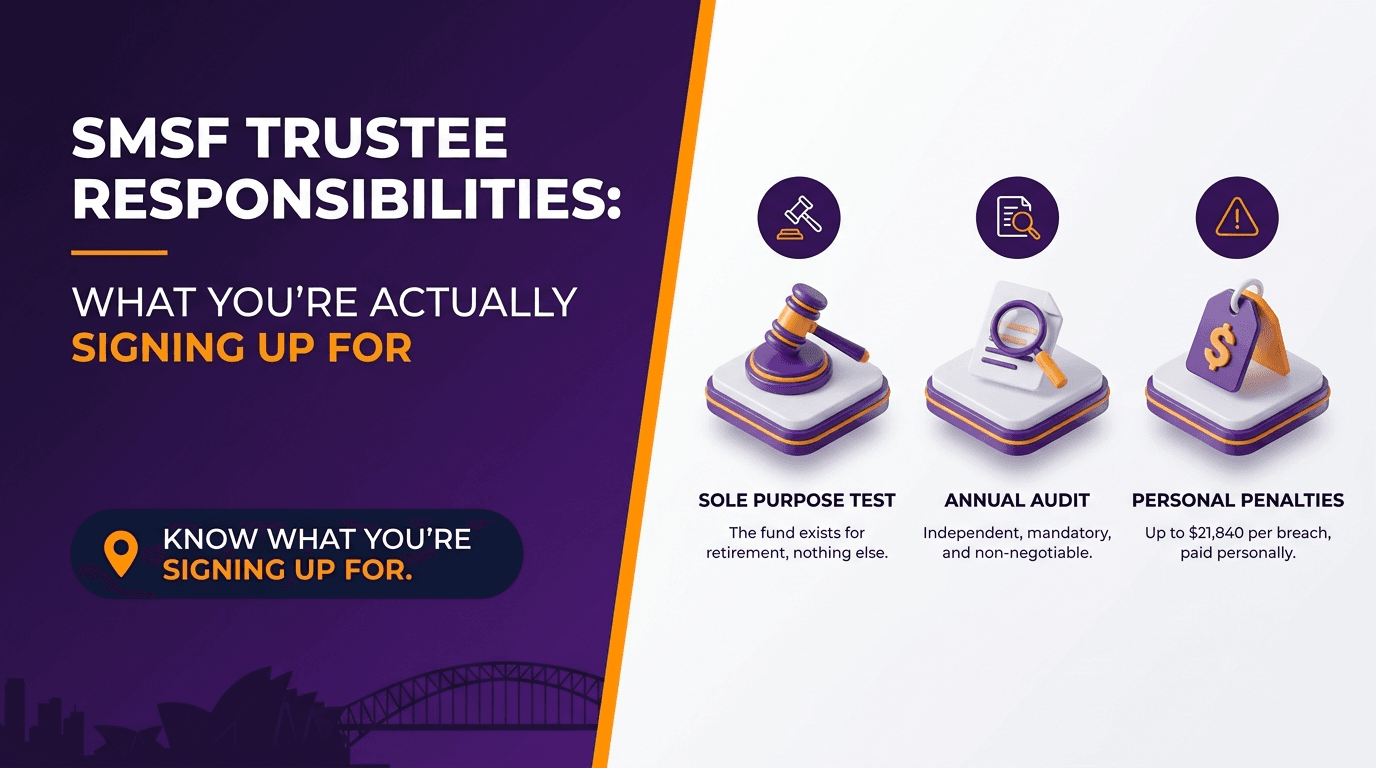
The fund must be run for the sole purpose of providing retirement benefits, not personal benefit along the way
Trustees must prepare and maintain a documented investment strategy, reviewed regularly, not written once and forgotten
Annual independent audits are mandatory, along with strict record keeping obligations
Administrative penalties are currently calculated at $364 per penalty unit (effective 1 July 2026), with individual breaches ranging from $1,820 up to $21,840 depending on severity
Penalties are levied on trustees personally and cannot be paid from the fund itself
The Sole Purpose Test
Every SMSF must satisfy the sole purpose test: the fund exists to provide retirement benefits to members, or benefits to their dependents if a member dies, and nothing else. This sounds simple until real-world temptation shows up. Using fund assets for personal benefit before retirement, such as living in a fund-owned property or borrowing fund money informally, breaches this test even if the trustee intends to "pay it back later."
Common sole purpose test breaches include:
Personal use of fund assets, such as artwork, property, or vehicles
Providing financial assistance to members or relatives from the fund
Acquiring assets from related parties at above market value, effectively transferring personal benefit into the fund
Investment Strategy Obligations
Trustees must prepare and maintain a written investment strategy covering the fund's objectives, risk, diversification, liquidity, and whether the fund should hold insurance for each member. This isn't a document you write once at setup and forget. It needs to be reviewed regularly, particularly whenever member circumstances change, and the trustee's consideration of insurance for each member needs to be specifically documented, not just implied.
A frequently overlooked point: an investment strategy that exists on paper but doesn't reflect what the fund is actually invested in is itself a compliance problem, not just a paperwork formality.
Record Keeping and Reporting Duties
SMSF trustees carry ongoing administrative obligations that don't pause between financial years:
Accurate financial records maintained continuously, not reconstructed at tax time
Annual SMSF return lodgement, with persistent late or non-lodgement risking loss of the fund's complying status entirely
Market-based asset valuations, particularly for property, unlisted shares and collectibles, which the ATO scrutinises closely
Trustee declarations signed within 21 days of becoming a trustee and retained for at least 10 years
Ongoing residency compliance, since a fund that fails Australian residency requirements can lose its complying status, a particular risk for trustees who move overseas without planning for it in advance
If you're planning an extended period overseas, or already are, this is exactly the kind of SMSF compliance issue that catches people out unintentionally. Our financial advisers and registered tax agents can review your fund's residency position and flag any risk before it becomes a bigger problem. Call 1800 942 843 or email clientservices@whatifadvice.com.au.
The Annual Independent Audit
Every SMSF must be audited annually by an independent, ATO-approved SMSF auditor, covering both the fund's financial statements and its compliance with superannuation law. This isn't optional and isn't something the trustee's own accountant can sign off on, independence is a legal requirement of the audit itself. An adverse audit finding, particularly one involving a contravention, can be reported directly to the ATO by the auditor, regardless of what the trustee would prefer.
If the idea of your own accountant not being allowed anywhere near your SMSF audit is news to you, it's worth getting the structure checked properly rather than finding out at audit time. Our registered tax agents can review your fund's audit readiness before your auditor does it for you. Call 1800 942 843 or email tax@whatifadvice.com.au.
Penalties for Getting It Wrong
This is the part that surprises new trustees most: penalties apply to trustees personally, not the fund, and cannot be reimbursed from fund assets. Administrative penalties are calculated in penalty units, currently valued at $364 each (effective from 1 July 2026), with the number of units depending on the severity of the specific breach.
Breach Type | Penalty Units | Approximate Penalty |
Failing to sign a trustee declaration in time | Up to 60 units | Up to $21,840 |
Failure to prepare financial statements | 10 units | $3,640 |
Non-compliance with operating standards (e.g. investment strategy) | 20 units | $7,280 |
Lower-level administrative breaches | 5 units | $1,820 |
For a fund with individual trustees rather than a corporate trustee, penalties are levied on each trustee separately, which effectively multiplies the exposure for a two-member fund. Beyond financial penalties, the ATO can also issue rectification directions, require trustees to complete an education course, or in serious or repeated cases, disqualify a trustee entirely.
FAQs
Can penalties be paid from the SMSF itself rather than personally?
No, administrative penalties must be paid personally by the trustees and cannot be reimbursed from fund assets under any circumstances.
Does a corporate trustee reduce personal liability compared to individual trustees?
A corporate trustee structure means penalties are levied on the company, with directors jointly and severally liable, whereas individual trustee structures see penalties applied to each trustee separately, which can increase total exposure for multi-member funds.
What happens if my SMSF fails the residency test?
A fund that fails to meet Australian residency requirements risks losing its complying status, which triggers significant tax consequences, including assets and income being taxed at the top marginal rate.
Do I need to update my investment strategy every year even if nothing has changed?
The strategy should be reviewed regularly and whenever circumstances materially change, rather than left untouched indefinitely, even in years where nothing appears to have shifted.
Can I be penalised for a breach I didn't realise was happening?
Yes, many SMSF penalties arise from unintentional breaches, misunderstanding rules, poor advice, or managing everything without professional support, rather than deliberate non-compliance.
What should I do if I think my SMSF has already breached a rule?
Get it reviewed before your next audit rather than waiting to see if it surfaces on its own. Auditors are required to report contraventions to the ATO regardless of trustee preference, and the ATO's response to a voluntarily disclosed, promptly corrected breach is typically more favourable than one it uncovers first.
Still asking what if your SMSF is actually as compliant as you think it is? Our financial advisers and registered tax agents can review your fund's structure, strategy documentation, and compliance position before it becomes an ATO problem. What If Advice operates under AFSL 528250.
This information is general in nature and does not take into account your personal objectives, financial situation or needs. Before acting on this information, consider its appropriateness and seek personal advice from a licensed adviser or registered tax agent.