Looking for specific financial advice?
This blog provides general educational content. For personalized advice tailored to your unique situation, book a free consultation with our team of ASIC-licensed financial advisers.
Income Protection Insurance in Australia: What's Actually Covered in 2026
If illness or injury stopped you working tomorrow, income protection insurance is what's meant to keep money coming in while you're not. But what it actually pays, for how long, and under what conditions has changed over recent years, and a lot of people are still working from an outdated understanding of how much of their income is actually replaced.
TL;DR: The Key Points
Income protection insurance replaces part of your income if illness or injury stops you working, but the details of how much and for how long are more specific than most policies make obvious upfront.
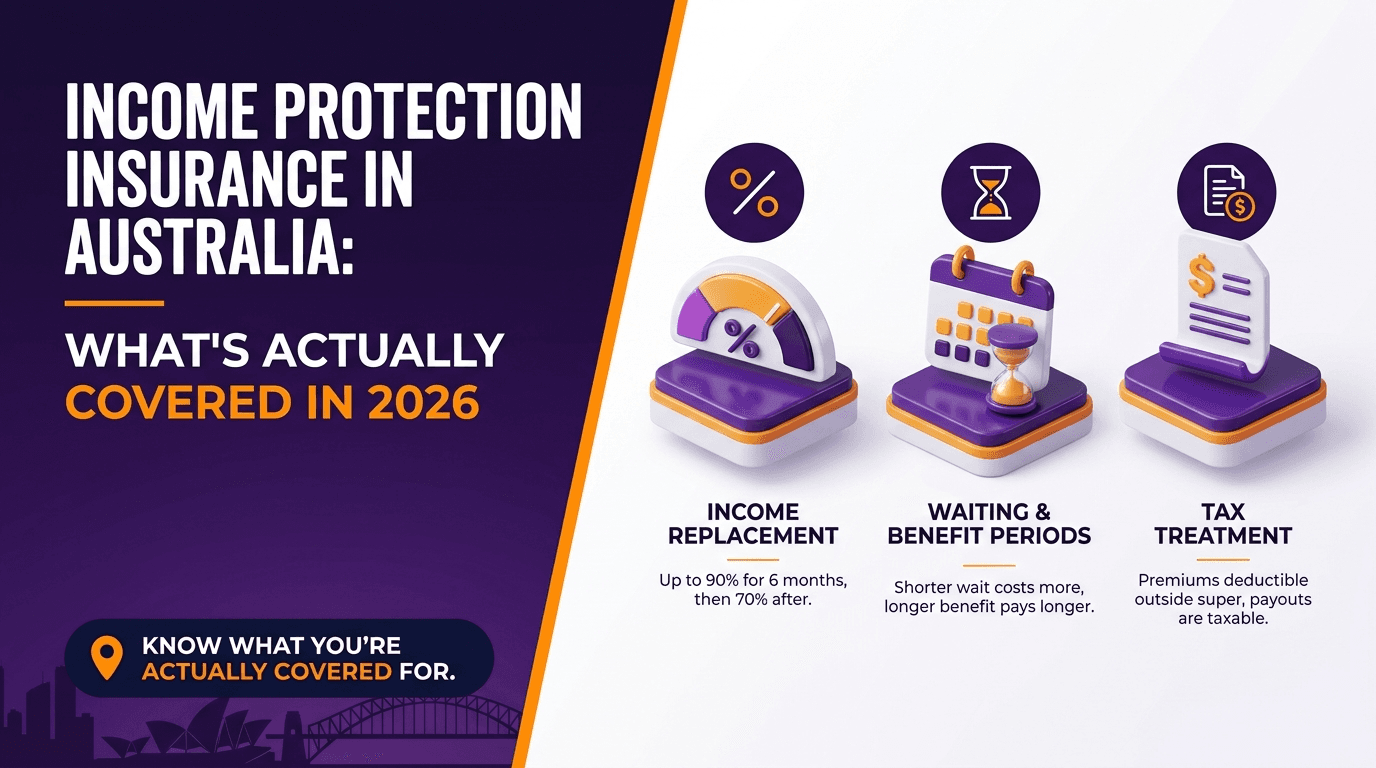
Current APRA settings for new policies generally allow up to 90% of income replacement for the first six months of a claim, stepping down to up to 70% thereafter
Agreed value policies have largely been phased out for new cover, with indemnity-style policies (based on income at time of claim) now standard
Premiums are generally tax deductible when held outside super and paid personally, but not when paid from within super
Benefit payments are treated as assessable income and must be declared, regardless of how the policy is held
Waiting periods and benefit periods you choose materially affect both premium cost and what you'd actually receive if you claimed
Jump to a Section
What Income Protection Actually Covers
How Much of Your Income Gets Replaced
Waiting Periods and Benefit Periods
Inside Super vs Outside Super
Tax Treatment of Premiums and Payouts
FAQ
What Income Protection Actually Covers
Income protection insurance pays a regular monthly benefit if illness or injury stops you from working, covering the practical stuff: mortgage or rent, bills, groceries, and ongoing living costs while you're unable to earn. It's different from TPD insurance, which pays a lump sum for permanent incapacity, and different again from life insurance, which protects the people who depend on you rather than you directly. Many people hold more than one of these together, since each addresses a different risk rather than one replacing the other.
To be considered eligible for a claim, you generally need to be:
Not working at all, paid or unpaid, with no capacity to work
Following the treatment plan and advice of a qualified medical practitioner
Meeting the specific definition of disability in your policy, which varies between insurers
How Much of Your Income Gets Replaced
This is where a lot of assumptions go wrong. APRA's current expectations for new individual disability income insurance (IDII) policies allow for income replacement of up to 90% of earnings for the first six months of a claim, stepping down to up to 70% thereafter, taking into account all benefits payable under the policy. Older policies written before these settings applied may still carry different structures, which is exactly why it's worth checking your actual policy wording rather than assuming a flat percentage.
Agreed value policies, which locked in a benefit amount based on income at the time you took out the policy, have largely been phased out for new business since March 2020. Most new income protection cover is now indemnity-style, meaning your benefit is calculated based on your income at the time you actually claim, not when you first took out the policy. For anyone whose income has changed significantly since taking out cover, this distinction matters more than most people realise.
Considering how these rules apply to your specific policy? Our financial advisers can review your current cover against the latest settings and flag anything worth adjusting. Call 1800 942 843 or email clientservices@whatifadvice.com.au.
Waiting Periods and Benefit Periods
Two structural choices affect both what you pay and what you'd receive:
Feature | Shorter Option | Longer Option |
Waiting period | 14 or 30 days (higher premium) | 90 days or more (lower premium) |
Benefit period | 2 years (lower premium) | To age 65 or 70 (higher premium) |
A shorter waiting period means the benefit kicks in sooner but costs more. A longer benefit period protects against a genuinely long-term interruption to earning capacity, which matters more for some occupations and life stages than others. There's no universally correct combination, it depends on your cash reserves, debts, and how long you could realistically cover expenses without the policy paying out.
Inside Super vs Outside Super
Income protection can be held either personally (outside super) or through your superannuation fund (inside super). Each comes with trade-offs:
Outside super:
Premiums are generally tax deductible when paid personally
Broader range of policy features and definitions available
Premiums paid from your own cash flow, not your retirement savings
Inside super:
Can improve day-to-day cash flow, since premiums come from your super balance rather than your take-home pay
Premiums paid this way are not personally tax deductible, though the fund itself may claim a deduction
Additional superannuation law rules can affect when and how benefits are released, particularly if your employment status changes
Neither option is automatically better. It depends on your cash flow priorities, how much you're comfortable eroding your super balance over time, and what policy features actually matter to you.
Not sure whether your current inside-super or outside-super setup is actually the right fit for your cash flow? Our financial advisers can model both options against your actual numbers. Call 1800 942 843 or email clientservices@whatifadvice.com.au.
Tax Treatment of Premiums and Payouts
The tax treatment of income protection catches people out because it works in two opposite directions at once. Premiums paid personally for income-replacement cover are generally tax deductible. At the same time, any benefit payments you receive are treated as assessable income and must be included in your tax return, whether paid as a regular benefit or a lump sum. People who claim the deduction on the way in sometimes forget to budget for tax on the way out, which is worth planning for rather than discovering at claim time.
Cover that pays a capital sum for permanent injury or TPD is treated differently again, generally as capital rather than income, which is a separate conversation from standard income protection.
FAQ
How much of my income will income protection actually replace?
Current settings for new policies generally allow up to 90% of income for the first six months of a claim, stepping down to up to 70% after that, though older policies may differ. Check your specific policy wording to confirm what applies to you.
Is income protection still available as an agreed value policy?
Agreed value cover has largely been phased out for new policies, with indemnity-style cover, based on income at time of claim, now the standard structure for new business.
Are income protection premiums tax deductible?
Generally yes, when the policy is for income replacement and premiums are paid personally outside super. Premiums paid from within super are not personally deductible, though the fund may claim the deduction itself.
Do I pay tax on income protection payments if I claim?
Yes, benefit payments are treated as assessable income and must be declared in your tax return, regardless of whether the policy is held inside or outside super.
Should I hold income protection inside or outside super?
It depends on your cash flow, how much you're comfortable drawing from your super balance over time, and which policy features and definitions matter most to you. There's no single correct answer for everyone.
If I'm already on claim, does a change to insurer terms or APRA rules affect my existing benefit?
Generally no. Changes to policy settings and APRA standards apply to new policies and, in some cases, to policy renewals or variations going forward, but they do not retrospectively rewrite the terms of a benefit you are already receiving under your existing contract. That said, insurers can and do make changes at renewal for some policy features, so an active claim is not automatically shielded from every future change to the broader policy, only from having its current benefit terms rewritten mid-claim. If you are on claim and receive any notice about a change to your policy, it is worth having that specific notice reviewed rather than assuming it does or doesn't affect you.
Still asking what if illness or injury stopped your income tomorrow?
Our financial advisers can review your current income protection cover against current settings and make sure it still fits your situation.
Call 1800 942 843 or email clientservices@whatifadvice.com.au to book a review.
What If Advice operates under AFSL 528250.
General Advice Disclaimer: This information is general in nature and does not take into account your personal objectives, financial situation or needs. Before acting on this information, consider its appropriateness and seek personal financial advice from a licensed adviser.