Looking for specific financial advice?
This blog provides general educational content. For personalized advice tailored to your unique situation, book a free consultation with our team of ASIC-licensed financial advisers.
What If Your US Shares Are Costing You More in Tax Than You Think?
Buying international shares has never been easier, a few taps in a brokerage app and an Australian investor can hold Apple, Nvidia, or a US-listed ETF alongside their ASX portfolio. What doesn't come with that convenience is a clear explanation of how differently those holdings are taxed. No franking credits, foreign withholding tax taken before the dividend even arrives, foreign exchange gains and losses layered into every capital gain, and reporting obligations that catch people out at tax time. This guide covers what actually changes once a portfolio crosses the border. If you're weighing up Australian versus international holdings, our franking credits guide covers the domestic side of this comparison in full.
TL;DR
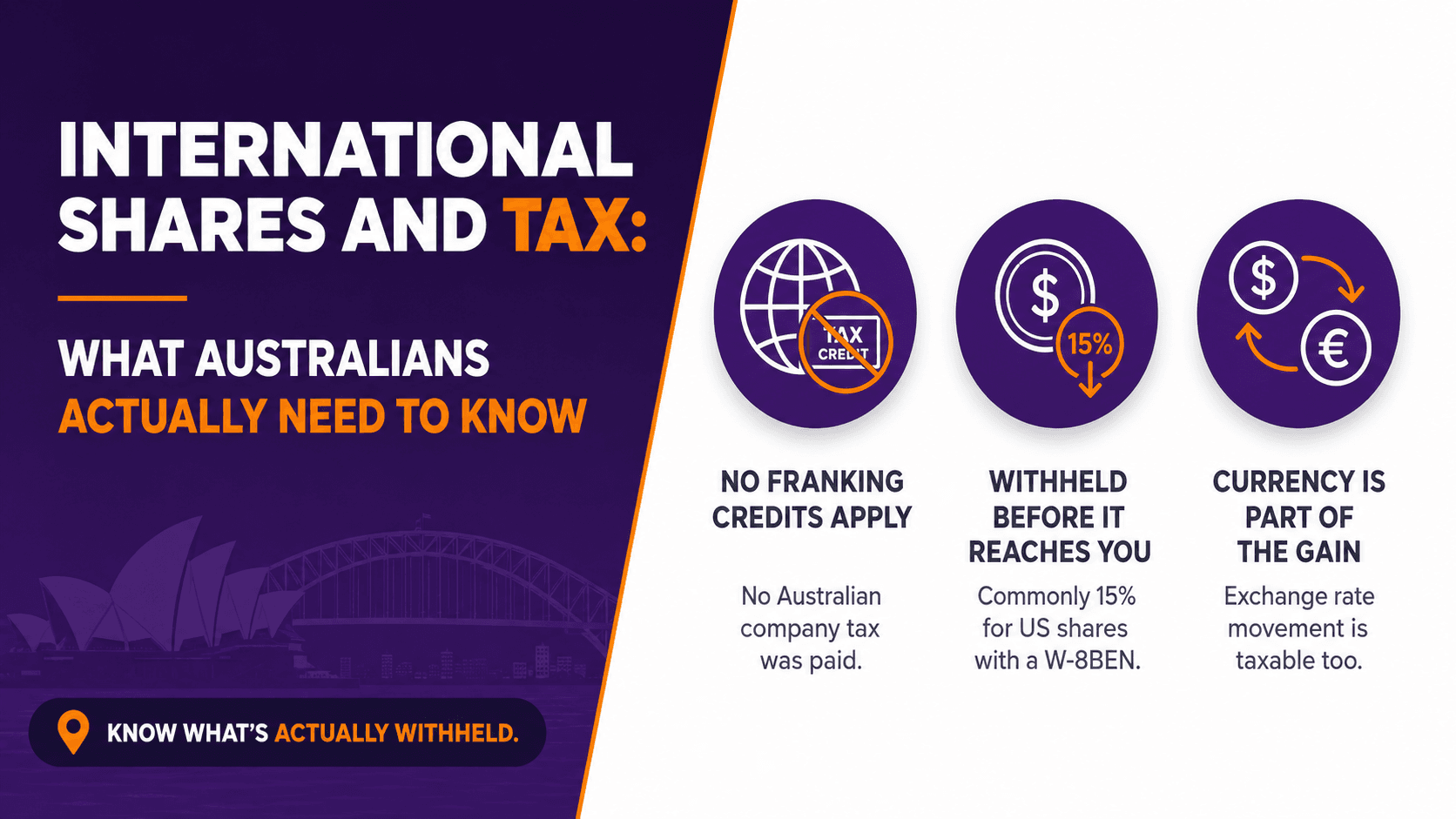
Franking credits don't apply to international shares, since franking only exists for tax paid to the Australian government, foreign dividends carry no equivalent credit.
Foreign withholding tax is generally deducted at the source before the dividend reaches you, commonly around 15% for US shares held through a properly lodged W-8BEN form, though rates vary by country.
A foreign tax offset can generally be claimed in your Australian return for tax already withheld overseas, reducing the risk of the same income being taxed twice.
Capital gains on foreign shares are calculated in Australian dollars, meaning currency movement between purchase and sale is baked into the gain or loss, separate from the share price movement itself.
The 12-month CGT discount generally still applies to international shares held by individuals, the same as domestic holdings, provided the standard holding period is met (the same mechanic covered in more depth in our crypto tax guide).
Foreign investment fund (FIF) style considerations can apply to certain offshore fund structures, which is a genuinely complex area worth professional advice rather than assumption.
All foreign income generally needs to be declared, even if tax was already withheld overseas, since Australia taxes residents on worldwide income.
Bottom line: international shares aren't taxed like a foreign version of an ASX holding, they run on a different set of rules entirely, and most of those rules work against you unless you understand them upfront.
On This Page
Why Franking Credits Don't Apply to International Shares
How Foreign Withholding Tax Actually Works
Claiming the Foreign Tax Offset
Capital Gains and the Currency Layer
What "FIF Attribution" Actually Means
Reporting Obligations That Catch People Out
Worked Example: A US Dividend From Start to Finish
Common Mistakes
FAQ
Why Franking Credits Don't Apply to International Shares
Franking credits exist specifically because Australian companies pay Australian company tax, and the imputation system passes that tax paid back to shareholders as a credit. International companies don't pay Australian company tax, so there's no Australian tax paid to pass back. A dividend from a US or European company is either unfranked by definition or subject to that country's own tax and withholding system instead, an entirely separate mechanism from Australian franking.
This matters for anyone comparing yield between an ASX-listed fully franked dividend and an equivalent-looking international dividend, since the headline yield doesn't tell the full after-tax story on either side.
Comparing the real after-tax return between Australian and international holdings is a common blind spot in DIY portfolios. A free 15-minute chat with WIAA can walk through your actual mix. Call 1800 942 843 or book online.
Bottom line: no Australian company tax was paid, so there's no Australian credit to receive, international dividends run on a completely different tax mechanism from the start.
How Foreign Withholding Tax Actually Works
Most countries apply their own withholding tax to dividends paid to foreign investors, deducted automatically before the dividend reaches the investor's account. For US shares, this is commonly 15% for Australian investors, provided a W-8BEN form has been correctly lodged with the broker, confirming Australian tax residency under the US-Australia tax treaty. Without a valid W-8BEN on file, the default withholding rate can be significantly higher, commonly around 30%.
Withholding rates vary by country and by the specific tax treaty Australia has in place with that country, so a UK, European, or Asian holding may carry a different withholding rate entirely. This is deducted at the source, meaning the dividend an investor actually receives is already net of this tax before it even lands in their account.
Bottom line: foreign withholding tax is taken before the money reaches you, and the rate depends heavily on whether the right paperwork, like a W-8BEN, is actually on file with the broker.
Claiming the Foreign Tax Offset
Since Australia taxes residents on worldwide income, foreign dividend income generally still needs to be declared in full in an Australian tax return, even though tax was already withheld overseas. To avoid effectively paying tax twice on the same income, a foreign tax offset can generally be claimed for the tax already paid overseas, reducing the Australian tax payable on that same income.
This offset generally has to be calculated and claimed correctly, it isn't always applied automatically, and the amount that can be claimed can be subject to specific limits and calculation rules.
Foreign tax offsets are one of the most commonly under-claimed items in DIY tax returns involving international shares. A free 15-minute chat can check whether yours are being captured correctly. Email tax@whatifadvice.com.au or book online.
Bottom line: the tax withheld overseas isn't lost, but it also isn't automatically reflected in your Australian return unless the foreign tax offset is specifically claimed.
Capital Gains and the Currency Layer
Capital gains tax on international shares works on the same fundamental structure as domestic shares, buy price versus sell price, with the 12-month CGT discount generally still available to individuals who meet the standard holding period. The added complexity is currency: because CGT is calculated in Australian dollars, both the purchase and sale need to be converted to AUD at the relevant exchange rates, meaning currency movement between those two dates becomes part of the taxable gain or loss, entirely separate from how the share price itself performed.
This means it's genuinely possible for a share to be flat or even down in its local currency, but produce a taxable capital gain once converted to AUD, if the Australian dollar weakened over the holding period, or the reverse if it strengthened.
Bottom line: the gain or loss reported to the ATO isn't just about how the share performed, it's about how the share performed combined with how the currency moved over the same period.
What "FIF Attribution" Actually Means
In plain terms, Foreign Investment Fund (FIF) attribution rules are a set of ATO provisions that can require an investor to declare a share of an offshore fund's growth as income each year, even if nothing was actually sold or distributed, rather than simply waiting to be taxed when the investment is eventually sold. Whether these rules apply at all depends heavily on the specific offshore structure involved, and there are common exemptions that mean many everyday international holdings never trigger them. Given how much this depends on the exact structure, this is genuinely a case-by-case question for a tax professional rather than something to self-assess from a general description.
Bottom line: FIF attribution is about the possibility of being taxed on offshore fund growth you haven't actually received yet, whether it applies to a specific holding is a question worth asking a tax professional directly, not guessing at.
Reporting Obligations That Catch People Out
A few specific reporting issues come up repeatedly with international shares:
All foreign dividend income generally needs to be declared, even small amounts, and even though tax was already withheld overseas.
Foreign investment fund style rules can apply to certain offshore managed fund or ETF-style structures held directly overseas, which is a complex area that depends heavily on the specific structure and is worth professional review rather than assumption.
Brokerage statements from international platforms don't always present information in a format that maps neatly to Australian tax return categories, increasing the risk of misreporting.
Currency conversion for every individual transaction is technically required for accurate reporting, which becomes genuinely difficult to track manually across a busy trading history.
International share reporting is one of the more error-prone areas of a DIY tax return, generally not from missing income, but from misreporting how it's categorised. A free 15-minute chat can help set up a system that actually holds up. Call 1800 942 843.
Bottom line: the income itself is rarely the problem, correctly categorising and converting it for an Australian tax return is where most people go wrong.
Worked Example: A US Dividend From Start to Finish
Daniel, an Australian resident, holds US shares that pay a USD $500 dividend. With a valid W-8BEN on file, 15% US withholding tax applies, meaning $75 USD is withheld at source and Daniel receives USD $425 in his account.
For his Australian tax return, Daniel needs to declare the full USD $500 (converted to AUD at the applicable exchange rate) as foreign income, not just the USD $425 he actually received. He then claims a foreign tax offset for the USD $75 already withheld in the US (also converted to AUD), which reduces his Australian tax payable on that income.
Separately, when Daniel eventually sells the shares, his capital gain or loss is calculated by converting both his original AUD purchase cost and his AUD sale proceeds at the respective exchange rates on each date, meaning currency movement over his holding period becomes part of the taxable outcome, regardless of how the share price itself moved in USD terms.
Outcome: Daniel pays tax on the full pre-withholding dividend amount, receives a partial offset for tax already paid in the US, and later faces a currency-adjusted capital gain calculation entirely separate from the dividend treatment.
Bottom line: a single US dividend touches three separate tax mechanics, withholding, foreign income declaration, and eventually a currency-adjusted capital gain, none of which work the same way as an ASX holding.
Common Mistakes
Assuming international dividends are franked or come with an equivalent Australian credit. They don't, franking is specific to Australian company tax paid.
Declaring only the net dividend received, not the full pre-withholding amount. The full amount generally needs to be declared, with the foreign tax offset claimed separately.
Not lodging a W-8BEN, or letting it lapse. This can mean paying a significantly higher default withholding rate than necessary on US shares.
Ignoring currency movement in capital gains calculations. The AUD-converted gain or loss can differ meaningfully from what the share price alone suggests.
Assuming an offshore ETF or fund is taxed the same way as a simple international share. Certain structures can trigger different rules that are worth checking specifically rather than assuming.
International shares add genuine tax complexity that most DIY portfolios aren't set up to handle correctly. A free 15-minute chat can check your current holdings are being reported properly. Call 1800 942 843.
FAQ
Do international shares get franking credits like Australian shares? No. Franking credits represent Australian company tax paid, and international companies don't pay Australian company tax, so there's no equivalent credit on foreign dividends.
What is a W-8BEN form and do I need one? It's a form confirming your Australian tax residency to a US broker, generally required to access the reduced US withholding tax rate on dividends rather than the higher default rate.
Do I need to declare foreign dividend income if tax was already withheld overseas? Generally, yes. Australia taxes residents on worldwide income, so the full amount generally needs to be declared, with a foreign tax offset claimed separately for tax already paid overseas.
How does currency movement affect capital gains on international shares? Since CGT is calculated in Australian dollars, both the purchase and sale are converted at the relevant exchange rates, meaning currency movement over the holding period becomes part of the taxable gain or loss.
Does the CGT discount still apply to international shares? Generally, yes, the same 12-month holding period discount available to individuals for domestic shares generally applies to international shares as well, subject to the usual eligibility rules.
What's the difference between withholding tax and the foreign tax offset? Withholding tax is deducted overseas before you receive the dividend. The foreign tax offset is a separate claim made in your Australian return to reduce double taxation on that same income.
Are international ETFs taxed the same way as individual international shares? Not always. Depending on the structure, some offshore fund arrangements can trigger additional considerations, which is worth checking against the specific fund rather than assuming standard treatment.
Do I need to convert every individual dividend and transaction to AUD myself? Technically, yes, for accurate reporting, though many brokers and tax software tools can assist with this conversion, it's worth confirming the figures rather than assuming automatic accuracy.
Is US withholding tax the same rate for every country? No. Withholding rates vary by country and by the specific tax treaty Australia holds with that country, so the rate applicable to US shares doesn't necessarily apply to other international holdings.
Should I hold international shares directly or through an Australian-domiciled fund? This depends on individual circumstances, including reporting complexity tolerance, cost, and diversification goals, and is worth discussing directly given the added tax complexity of direct international holdings.
Ready to Make Sure Your International Shares Are Taxed Correctly?
International shares run on a genuinely different set of tax rules to ASX holdings, and it's an easy area to get wrong without meaning to. A free 15-minute chat can check your current reporting is on track.
Call us: 1800 942 843
Email: tax@whatifadvice.com.au
Book online: free 15-minute chat, no cost, no pressure
Still asking what if.
WIAA has helped Australians navigate the tax complexity of international share portfolios, not just domestic ones, across Toowong, Grange, and Melbourne CBD. WIAA operates under AFSL 528250 as an Authorised Representative of Beryllium Advisers Pty Ltd.
General Advice Disclaimer: This article contains general information only and does not take into account your personal objectives, financial situation, or needs. It is not personal financial advice or tax advice and should not be relied upon as such. Foreign withholding tax rates, tax treaty terms, and foreign investment fund rules are subject to change and vary by country and structure, and should be verified with the ATO or a registered tax agent for your specific circumstances.