Looking for specific financial advice?
This blog provides general educational content. For personalized advice tailored to your unique situation, book a free consultation with our team of ASIC-licensed financial advisers.
What If the "Property vs Shares" Debate Is Asking the Wrong Question?
Australians have argued about property versus shares for decades, usually with someone waving a chart showing one has outperformed the other over some conveniently chosen period. The honest answer is that both have built genuine wealth for people, and both have also gone badly for people who didn't understand what they were actually taking on. The more useful question isn't which one wins, it's which trade-offs you're actually equipped to carry: leverage and illiquidity, or volatility and liquidity. This guide lays out both, honestly, without a scoreboard at the end.
TL;DR
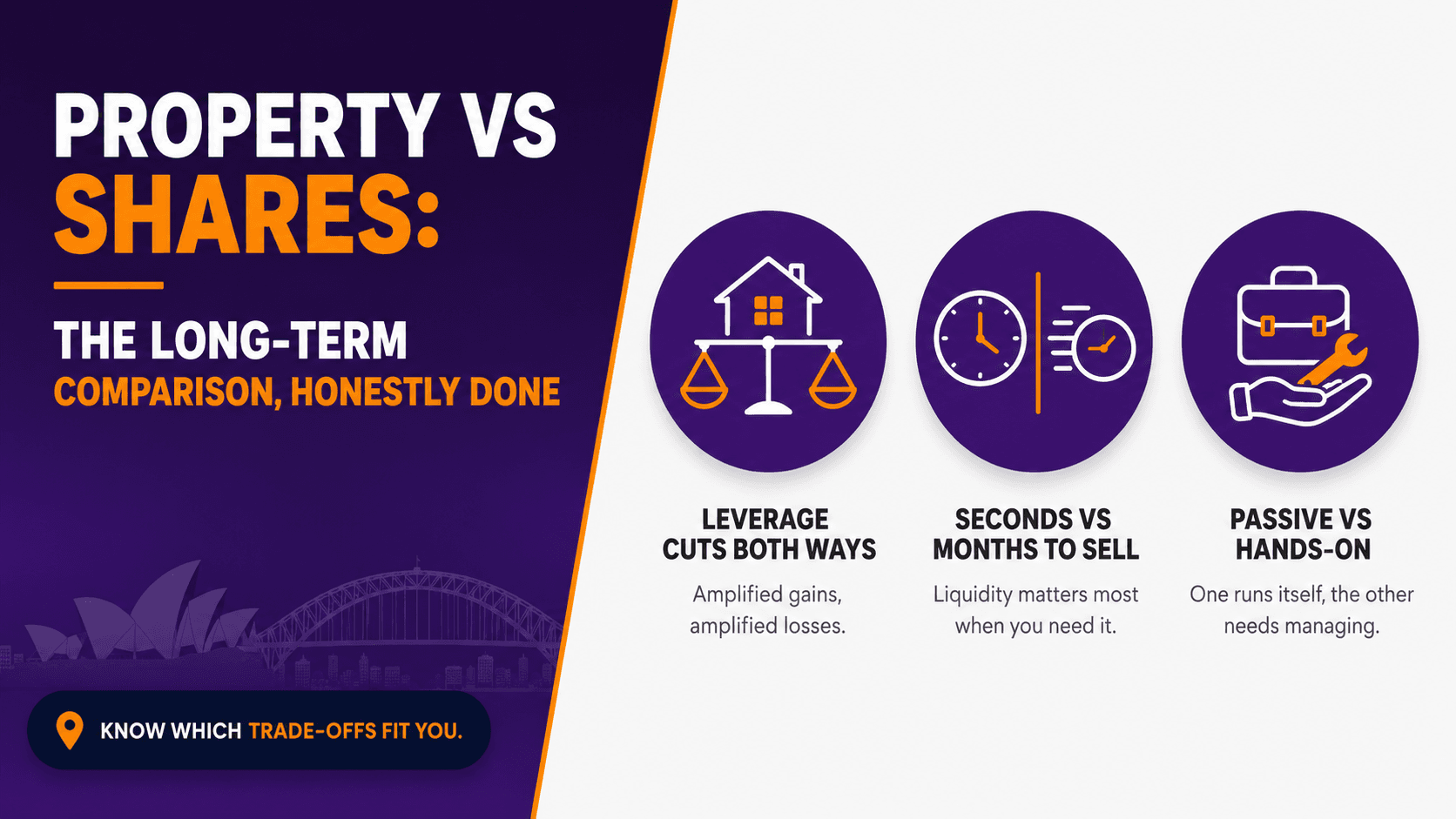
Property typically involves significant leverage, often 80% or more borrowed, meaning gains and losses are amplified relative to the deposit actually invested.
Shares are generally far more liquid, tradeable in seconds, while property can take weeks or months to sell, with substantial transaction costs either way.
Volatility looks different, not necessarily lower, in property. Prices move less visibly day to day, but that doesn't mean less risk, it means less frequent, harder-to-ignore repricing.
Transaction costs differ enormously: buying and selling property involves stamp duty, agent fees, and legal costs commonly running into tens of thousands of dollars, while share trades cost a fraction of that.
Tax treatment has meaningful differences, including negative gearing and land tax considerations specific to property, versus franking credits (covered in full in our dedicated guide) and simpler CGT mechanics for shares.
Effort and involvement differ significantly. Property ownership generally involves active management (tenants, maintenance, insurance), while a share portfolio can run largely passively.
Diversification is far easier and cheaper with shares, since a single property is one large, concentrated, illiquid asset, while a share portfolio can spread risk across dozens of companies for a similar dollar outlay.
Bottom line: property and shares solve different problems and demand different tolerances, and the honest comparison is about fit, not a universal winner.
On This Page
Why Leverage Changes the Whole Conversation
Liquidity: The Difference Between Seconds and Months
Volatility Looks Different, Not Necessarily Lower
The Real Cost of Buying and Selling Each
Tax Treatment: Where They Genuinely Differ
Effort, Involvement, and What You're Actually Signing Up For
Worked Example: Same Starting Capital, Two Different Paths
Common Mistakes
FAQ
Why Leverage Changes the Whole Conversation
Property investing is almost always a leveraged decision. A 20% deposit on a $700,000 property means controlling the full $700,000 asset with $140,000 of actual capital, plus borrowed funds covering the rest. This amplifies outcomes in both directions, a relatively modest percentage gain in the property's value can represent a large percentage return on the deposit actually invested, but the reverse is equally true if the property's value falls or if holding costs outpace rental income.
Shares can also be bought with borrowed money through margin lending, but this is far less common in practice than property leverage, and most individual share investors buy with their own capital rather than borrowing against the position itself.
Bottom line: property's leveraged structure is what drives a lot of its long-term return story, and it's also exactly what makes the downside more severe if things go wrong.
Liquidity: The Difference Between Seconds and Months
A share can generally be sold within seconds during market hours, with proceeds settling within a few business days. A property sale typically takes weeks to prepare, market, and settle, and that's after a decision to sell has already been made, itself sometimes a slow process if the market is soft or the property needs work before listing.
This liquidity gap matters most in situations that demand access to cash quickly, a job loss, a health event, or simply a change in plans. A share portfolio can generally be partially liquidated, selling exactly what's needed, while a property is an all-or-nothing asset that can't easily be sold in part.
Not sure how liquid your current asset mix actually is if circumstances changed quickly? A free 15-minute chat with WIAA can map out your actual flexibility. Call 1800 942 843 or book online.
Bottom line: shares can be turned into cash almost immediately and in any amount needed, property generally can't, and that difference matters most exactly when you need it to.
Volatility Looks Different, Not Necessarily Lower
Shares are priced continuously and publicly, so volatility is visible daily, a share portfolio's value can swing noticeably in a single trading session. Property isn't priced this way. Valuations happen infrequently, often only when a sale, refinance, or formal valuation occurs, which creates an illusion of stability that isn't necessarily accurate. Property values can and do fall, sometimes substantially in specific markets or periods, it's just repriced less often and less visibly than a share portfolio.
This distinction matters for investor psychology as much as for actual risk. A share portfolio's visible daily movement can prompt panic selling that a property's invisible, infrequent repricing doesn't, even though the underlying market risk in both cases is real.
Bottom line: property's apparent stability is partly a function of how rarely it's repriced, not necessarily evidence that it's actually less risky.
The Real Cost of Buying and Selling Each
Transaction costs differ enormously between the two:
Buying property typically involves stamp duty (varying by state, commonly tens of thousands of dollars on an average property), legal and conveyancing fees, building and pest inspections, and loan establishment costs.
Selling property typically involves real estate agent commission (commonly 1.5 to 3% of sale price), marketing costs, and further legal fees.
Buying and selling shares typically involves brokerage fees, often a small flat fee or a small percentage per trade, a fraction of a percent in most cases through standard online brokers.
A property transaction cycle, buy and eventually sell, can easily run into tens of thousands of dollars in unavoidable costs before any actual gain or loss is considered. A comparable share transaction cycle typically costs a small fraction of that.
Bottom line: the cost of simply moving in and out of each asset class is dramatically different, and that cost has to be factored into any honest return comparison.
Tax Treatment: Where They Genuinely Differ
Both asset classes involve capital gains tax on sale, generally with the same 12-month discount available to individuals, but several tax mechanics diverge:
Negative gearing allows investment property losses (where holding costs exceed rental income) to offset other taxable income, a mechanic with no direct share market equivalent for most individual investors. This describes current, existing tax law rather than any proposed or announced change.
Franking credits apply to many Australian share dividends, an income stream with no property equivalent (see our dedicated franking credits guide for the full mechanics).
Land tax applies to property in most states above certain thresholds, an ongoing holding cost shares don't carry. These thresholds vary by state and are adjusted periodically, so current figures should be verified with your state revenue office or a tax professional rather than assumed from a general description.
Depreciation deductions are available on eligible property building and fixtures, another mechanic without a share market parallel.
Neither side is simply "more tax efficient" in the abstract, the mechanics are different enough that the answer depends on individual income, other holdings, and strategy.
Property and shares interact very differently with your overall tax position. A free 15-minute chat can map out how each would actually sit alongside your current situation. Email clientservices@whatifadvice.com.au or book online.
Bottom line: the tax mechanics genuinely differ, not just in rate but in kind, and the better outcome depends on individual circumstances rather than one asset class being universally more tax efficient.
Effort, Involvement, and What You're Actually Signing Up For
Owning an investment property generally involves ongoing active management: finding and managing tenants (directly or through a property manager, itself a cost), maintenance and repairs, insurance, and dealing with vacancy periods. Owning shares, particularly through diversified ETFs or managed funds, can be run almost entirely passively, with dividends reinvested and minimal ongoing decision-making required.
This isn't a universal rule, direct share stock-picking can be highly involved, and some investment properties run smoothly with minimal drama, but as a general pattern, property demands more hands-on involvement than a passive share portfolio.
Bottom line: property is generally a more active undertaking than a diversified share portfolio, and that time and effort cost is real even when it doesn't show up in a return calculation.
Worked Example: Same Starting Capital, Two Different Paths
(Figures are illustrative only, based on assumed average annual returns for demonstration purposes. Actual outcomes vary significantly and past or assumed performance is not indicative of future returns.)
Two investors each start with $140,000 in available capital.
Investor A uses the $140,000 as a 20% deposit on a $700,000 investment property, borrowing the remaining $560,000. Over 10 years, assuming the property appreciates at an average of 5% annually and rental income roughly covers holding costs, the property's value grows to approximately $1,140,000, an unrealised gain of $440,000 against an initial $140,000 outlay, before accounting for the loan balance, selling costs, and tax on eventual sale.
Investor B invests the $140,000 directly into a diversified share portfolio, without leverage. Assuming an average 8% annual total return (which includes dividends and franking credits reinvested), the portfolio grows to approximately $302,000 over the same 10 years, a gain of roughly $162,000, with no debt attached and full liquidity maintained throughout.
Investor A's outcome looks larger in raw dollar terms, but it's built on borrowed money, carries the ongoing cost and effort of property ownership, involves substantially higher transaction costs on eventual sale, and remains illiquid throughout. Investor B's outcome is smaller in raw dollars but debt-free, liquid at any point, and required minimal ongoing effort.
Outcome: Investor A's leveraged gain and Investor B's unleveraged gain aren't directly comparable without also weighing the debt, liquidity, effort, and risk each investor actually carried to get there.
Bottom line: a bigger dollar figure on one side doesn't automatically mean a better outcome once leverage, liquidity, and effort are honestly factored in.
Common Mistakes
Comparing raw returns without accounting for leverage. A leveraged property return and an unleveraged share return aren't measuring the same level of risk taken on.
Treating property's infrequent pricing as proof of lower volatility. It's less visible, not necessarily less real.
Ignoring transaction costs when comparing outcomes. Property's buying and selling costs are substantial and materially affect the actual net return.
Assuming one asset class is universally more tax efficient. The mechanics genuinely differ, and the better outcome depends on individual circumstances.
Underestimating the time and effort cost of property ownership. This doesn't show up in a return percentage but is a real and ongoing cost.
There's no universally correct answer between property and shares, only the answer that fits your actual capacity for leverage, liquidity needs, and involvement. A free 15-minute chat can help work out which fits you. Call 1800 942 843.
FAQ
Which has historically performed better, property or shares? Performance depends heavily on the specific time period, location, and assets compared, and raw historical averages don't account for leverage, costs, or effort, which is why a like-for-like comparison is more useful than a single headline figure.
Is property a safer investment than shares? Not necessarily. Property is repriced less frequently and less visibly, which can create an impression of stability, but property values can and do fall, and the illiquidity involved carries its own risk.
Can I invest in both property and shares? Yes, and many investors do, using both asset classes to diversify across different risk, liquidity, and tax characteristics rather than choosing exclusively between them.
Does negative gearing make property a better investment than shares? Negative gearing is a specific tax mechanic that can offset other income, but it generally only benefits an investor when the property is running at a loss, which isn't inherently a sign of a good investment on its own.
Is it easier to diversify with shares than property? Generally, yes. A share portfolio can spread capital across many companies and sectors for a relatively modest outlay, while property typically concentrates a large amount of capital into a single asset.
How much does it actually cost to buy and sell an investment property compared to shares? Property transaction costs, including stamp duty, agent fees, and legal costs, typically run into tens of thousands of dollars per transaction cycle, while share trading costs are typically a small fraction of that.
Is leverage always a bad thing in property investing? Not inherently, leverage amplifies outcomes in both directions, and can work in an investor's favour over time, but it also means losses are amplified if the property underperforms or costs exceed income.
Do shares provide passive income the way rental property does? Yes, generally through dividends, and for many share portfolios this can be a genuinely passive income stream requiring less ongoing management than a rental property.
Should a first-time investor choose property or shares? This depends heavily on available capital, risk tolerance, liquidity needs, and life stage, and is worth discussing directly rather than defaulting to whichever asset class is more commonly recommended anecdotally.
Is this comparison different for someone investing through superannuation? Yes, potentially significantly, since tax treatment, borrowing rules, and structuring differ inside super compared to investing outside it, which is worth treating as a separate, specific conversation.
Ready to Work Out Which Actually Fits Your Situation?
Property and shares solve different problems, and the right mix depends on your own capital, timeline, and tolerance for leverage and liquidity trade-offs. A free 15-minute chat can help map that out honestly.
Call us: 1800 942 843
Book online: free 15-minute chat, no cost, no pressure
Still asking what if.
WIAA has helped Australians weigh up property and shares honestly, without a sales agenda toward either, across Toowong, Grange, and Melbourne CBD. WIAA operates under AFSL 528250 as an Authorised Representative of Beryllium Advisers Pty Ltd.
General Advice Disclaimer: This article contains general information only and does not take into account your personal objectives, financial situation, or needs. It is not personal financial advice and should not be relied upon as such. Historical performance figures are illustrative and not indicative of future returns. Tax treatment, including negative gearing, land tax, and CGT rules, is subject to change and varies by state, and should be verified with a qualified adviser or the ATO for your specific circumstances.