Looking for specific financial advice?
This blog provides general educational content. For personalized advice tailored to your unique situation, book a free consultation with our team of ASIC-licensed financial advisers.
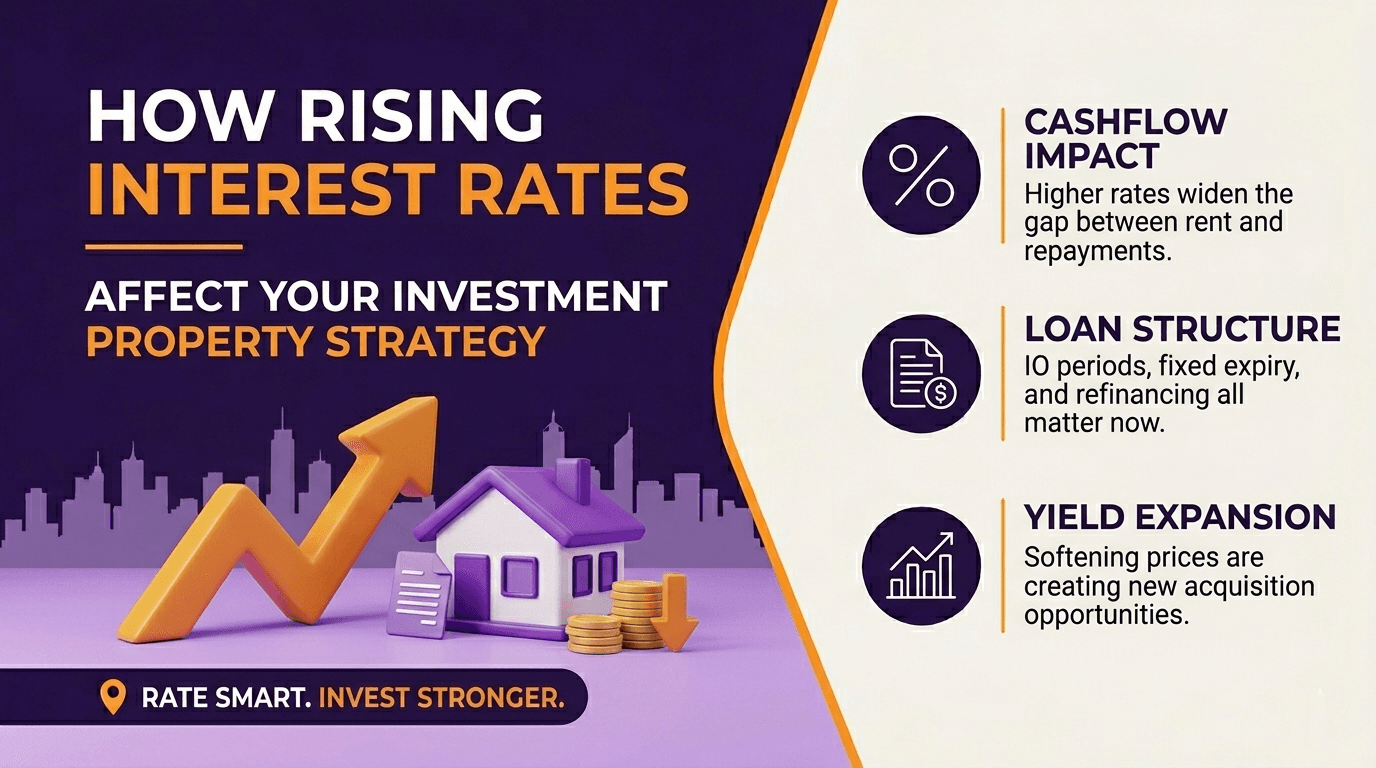
How Rising Interest Rates Affect Your Investment Property Strategy
What if rising interest rates are the best thing that's happened to your investment property strategy, or the biggest threat to it? For some investors, the current rate environment creates genuine cashflow stress, stretching budgets and forcing difficult decisions about whether to hold, restructure, or sell. For others, rising rates create buying opportunities, expanding yields and softening competition from overleveraged investors who cannot hold on. Which category you fall into depends less on the rate itself and more on how your portfolio was structured before rates moved.
TL;DR: How Rising Rates Change the Equation
Higher rates increase interest costs directly, widening the gap between rental income and loan repayments
Negatively geared properties become more negatively geared, increasing the tax benefit but also the cashflow shortfall
Positively geared properties can turn negative as rates rise, changing the entire investment proposition
Property values in some markets soften as borrowing capacity reduces and vendor discounts widen
Rental yields expand as property prices soften while rents remain sticky or continue rising
The strategic response depends on your loan structure, cashflow buffer, portfolio composition, and time horizon
The specific moves that protect investors — refinancing, PAYG withholding variation, rent reviews, depreciation optimisation — are covered in the strategic moves section below
Bottom line: Rising rates are not uniformly bad for property investors. They reward disciplined structuring and create genuine opportunities for investors with strong cashflow positions and available capital.
Jump to a Section
What Rising Rates Actually Cost in Dollar Terms
How Negative Gearing Changes in a Rising Rate Environment
Loan Structure: The Most Important Variable
Rental Yields: The Offsetting Factor
Portfolio Review: The Four Questions to Ask Now
The Strategic Moves That Protect Investors — start here if you're under pressure
Two Investor Examples: Under Pressure and Well-Positioned
Common Mistakes Investors Make When Rates Are Rising
FAQ
Ready to Review Your Investment Property Strategy?
What Rising Rates Actually Cost in Dollar Terms
The most immediate impact of rising interest rates is straightforward: higher repayments on variable rate loans. Understanding the dollar impact at current rates clarifies the true scale of the challenge.
Investment property loans are typically priced at a margin above owner-occupier loans. In the current environment, variable investment property rates commonly sit in the high 5% to low 7% range depending on LVR, loan type, and lender. Always verify current rates with your lender or mortgage broker.
The impact of rate rises on a $700,000 investment loan:
Cash Rate Environment | Approximate Investment Rate | Monthly Interest (IO) | Annual Interest Cost |
Low rate era (2021) | ~2.5% | ~$1,458 | ~$17,500 |
Current environment | ~6.2% | ~$3,617 | ~$43,400 |
Further 0.5% increase | ~6.7% | ~$3,908 | ~$46,900 |
Note: Interest rates change frequently. The figures above reflect approximate conditions at time of writing. Always verify current investment property lending rates with your lender or mortgage broker before making any loan decisions.
The difference between the low-rate era and the current environment on a single $700,000 loan is approximately $25,900 per year in additional interest costs. For investors with multiple properties or higher loan balances, this compounds across the portfolio.
For a property generating $26,000 in annual rent, a jump from $17,500 to $43,400 in interest costs turns a modestly positive cashflow position into a significant annual shortfall before other expenses are counted.
Bottom line: The cashflow impact of rising rates is substantial and concrete. Every investor should calculate their current annualised interest cost and compare it to rental income before making any portfolio decisions.
Run those numbers for your own loan balance and you'll have your specific cashflow impact. If the number is uncomfortable, the strategic moves section below covers the steps to reduce it. Or book a free 15-min chat with WIAA now. Call 1800 942 843 or email clientservices@whatifadvice.com.au.
How Negative Gearing Changes in a Rising Rate Environment
Rising interest rates change the economics of negative gearing in two simultaneous ways, one beneficial and one not.
The beneficial change: higher interest costs produce larger tax deductions. A property that was losing $8,000 per year at 3% rates might lose $28,000 per year at 6.5% rates. At a 37% marginal rate, the tax saving on that additional loss is approximately $7,400 per year. The ATO effectively subsidises a meaningful portion of the rate increase for higher-income investors.
The challenging change: the pre-tax cashflow shortfall still widens even after the tax benefit. An investor needs to fund the shortfall from other income sources, typically salary, before receiving the tax benefit at year end (or fortnightly via a PAYG withholding variation).
The net cost calculation for a $700,000 loan at current rates versus the low-rate era:
Additional annual interest cost: approximately $25,900
Tax saving on additional deduction at 37%: approximately $9,583
Net additional out-of-pocket cost after tax: approximately $16,317 per year
For investors without sufficient salary or other income to absorb this shortfall, rising rates create genuine cashflow stress regardless of the eventual tax benefit.
What if the rate rises that are hurting your cashflow are simultaneously building your tax deductions to their highest-ever level, and you're receiving none of that benefit until July? A PAYG withholding variation fixes exactly that, moving the tax benefit into each pay cycle.
Note: For established residential properties purchased after 7:30pm AEST on 12 May 2026, the announced 2026 Budget changes from 2027 would restrict negative gearing losses to rental income only, not salary. These changes are announced but not yet legislated. Properties purchased before that date are fully grandfathered.
Bottom line: Rising rates increase the tax benefit of negative gearing but also increase the pre-tax cashflow shortfall. Investors need sufficient income to bridge the gap between rent received and total costs paid.
Loan Structure: The Most Important Variable
This is the variable with the most leverage on your cashflow in a rising rate environment, and the one most investors set once and never revisit.
How your loan is structured has more impact on your cashflow in a rising rate environment than almost any other single factor. Two decisions matter most.
Interest Only vs Principal and Interest
Interest-only loans reduce the monthly repayment obligation but do not reduce the loan balance. In a rising rate environment, IO loans look attractive from a cashflow perspective but create a structural risk.
Loan Type | Monthly Repayment ($700K, 6.5%) | Annual Cost | Loan Balance After 10 Years |
Interest only | $3,792 | $45,500 | $700,000 (unchanged) |
Principal and interest (25yr) | $4,716 | $56,600 | ~$544,000 |
The IO loan saves $924 per month but the investor builds no equity through repayment. When the IO period ends (typically 5 years), the loan reverts to P&I on the remaining balance over a shorter term, often producing a payment shock that is worse than the original repayment would have been.
Many investors who fixed loans at low rates during 2021 and 2022 are now facing IO period expiry at significantly higher rates, a compounding stress that adds the equivalent of several extra rate hikes in a single month.
Fixed vs Variable
Fixed rate loans provided certainty during the recent rate hiking cycle but at the cost of flexibility. Investors who fixed at low rates have been protected during the rises. Those whose fixed periods have since expired are now facing the full impact of variable rates.
In the current environment, the fixed vs variable decision requires specific advice based on your rate expectations, loan term, and the cost of breaking a fixed loan. No general rule applies across all situations.
Bottom line: Loan structure is not a set-and-forget decision. Annual review of IO periods, fixed rate expiry dates, and principal repayment schedules is essential in a volatile rate environment.
Rental Yields: The Offsetting Factor
Rising interest rates do not only create costs. They also create a structural shift in property yields that benefits investors who entered the market with strong fundamentals or who can acquire in the current environment.
How yields expand in a rising rate environment:
Property prices soften as borrowing capacity reduces, meaning buyers can acquire the same property for less
Rents remain sticky or continue rising due to ongoing rental undersupply and lower homeownership rates as buyers are priced out
The combination of lower prices and stable or rising rents means the gross yield on new acquisitions expands
In the current environment, combined capital city vendor discounts have widened and auction clearance rates have softened below 60% in Sydney and Melbourne specifically, creating a buyer's market in those cities for well-capitalised investors.
For an investor who purchased a $700,000 Brisbane property in 2021 at a 3.5% gross yield ($24,500 annual rent), that same property may now offer:
Current estimated value: approximately $850,000 to $900,000 (after strong growth)
Current market rent (reflecting rising rents): approximately $30,000 to $33,000 per year
Current gross yield on original purchase price: approximately 4.3% to 4.7%
The combination of capital growth and rental growth has improved the yield position significantly even as interest rates have risen.
What if the properties you've been watching in Sydney or Melbourne for the last three years are now priced at levels that actually work, because rates have done what no negotiation ever could?
Bottom line: Rising rates compress new investor entry returns in the short term but also expand yields through price softening and rental growth. Investors with existing equity and strong cashflow are better positioned to take advantage of this than those who are stretched.
Portfolio Review: The Four Questions to Ask Now
Every investor in a rising rate environment should work through four specific questions about their portfolio.
1. What Is My Current Cashflow Position on Each Property?
This is the calculation most investors haven't run since rates moved. Run it now for each property before answering the three questions that follow:
Annual rental income
Less annual interest cost (at current rate)
Less annual other expenses (rates, insurance, management, repairs, depreciation)
Equals net rental income or loss before tax
This tells you your true pre-tax cashflow position.
2. What Is My Buffer if Rates Rise Further?
Model the impact of a further 0.5% and 1.0% increase on your loan repayments. If rates rise further, can you still service all loans comfortably from your combined income and rental receipts? If not, which properties are the vulnerability?
3. Do I Have Any IO Period Expiry Coming?
IO period expiry at current rates can add $400 to $1,000+ per month in repayments on a $700,000 loan. If an IO period is expiring within 12 to 24 months, refinancing or extending the IO term may be worth exploring, subject to lender policies and serviceability assessment.
4. Is Each Property Still Worth Holding?
In a rising rate environment, properties that were marginal performers in a low-rate world become clear underperformers. A property with a yield below 3%, minimal capital growth over 5 years, and persistent cashflow drag may be worth selling and reinvesting the capital in a better-positioned asset.
Bottom line: Rising rates create the conditions for a useful portfolio audit. Properties that pass the cashflow and growth test in a high-rate environment are genuine quality assets. Those that fail deserve scrutiny.
If any of these four questions produced an uncomfortable answer, that's the starting point for a strategy conversation. Book a free 15-min portfolio review chat with WIAA. Phone 1800 942 843 or book online.
The Strategic Moves That Protect Investors
This is the section that matters most if you're under cashflow pressure. Every move below has been used by WIAA clients to reduce their effective out-of-pocket property holding costs, without selling. Most investors who work through this list find at least two or three that apply to their specific situation.
Refinance to a more competitive rate. Investment property lending is competitive. Many investors are paying rates significantly above the best available. A mortgage broker review can identify savings of 0.5% to 1.0% on existing loans, worth $3,500 to $7,000 per year on a $700,000 loan.
Maximise rental income. Property managers in many markets have been conservative on rent reviews. An independent market rent assessment may confirm current rent is below market. Even a $50 per week increase adds $2,600 per year in rental income.
Apply for a PAYG withholding variation. Investors with significant rental losses can apply to the ATO to reduce the tax withheld from their salary, receiving the benefit of their deductions across each pay cycle rather than waiting for the annual tax return.
Review depreciation claims. Many investors are not maximising depreciation deductions. A current quantity surveyor report for properties purchased or improved in recent years can uncover thousands of dollars in additional annual deductions.
Build or preserve a cashflow buffer. A buffer of 3 to 6 months of total holding costs per property provides resilience against rate rises, vacancy periods, and unexpected maintenance without forcing distressed decisions.
Consider fixing a portion of your loan. If further rate rises are anticipated, fixing a portion of the loan provides certainty on that component while retaining some variable exposure for flexibility.
Identify acquisition opportunities. Softening values in Sydney and Melbourne in the current environment represent genuine acquisition opportunities for investors with available equity and strong cashflow positions.
Bottom line: Rising rate environments reward active management. Investors who review their loan rates, rental income, depreciation claims, and portfolio composition regularly come out of rate cycles in materially better shape than those who wait passively.
WIAA's team regularly works with property investors on exactly these moves. Most clients find 2 to 3 that apply. Single-issue property strategy advice starts at $1,500. Book a free 15-min scoping chat or email clientservices@whatifadvice.com.au.
Two Investor Examples: Under Pressure and Well-Positioned
Example 1: David, 44, Three-Property Portfolio Under Cashflow Pressure
David's situation is one of the most common patterns among stretched investors. The solution set is the same for most of them.
David has three investment properties with combined loans of $2.1 million on variable interest-only rates. As rates have risen, his combined annual interest cost has increased from approximately $55,000 to $130,000. His combined annual rental income is $96,000.
His cashflow position before other expenses: a pre-tax shortfall of $34,000 per year across the portfolio. After depreciation, management fees, rates, and insurance, his total rental loss is approximately $68,000 per year.
His strategic response:
Engages a mortgage broker who identifies refinancing savings of approximately 0.65% across two of the three loans, saving approximately $8,800 per year
Obtains a PAYG withholding variation, receiving approximately $25,000 of his tax benefit fortnightly rather than as a July refund
Commissions a new quantity surveyor report on the most recent acquisition, identifying an additional $7,200 in annual depreciation deductions
Reviews rent on all three properties and implements increases totalling $130 per week across the portfolio, adding $6,760 per year in rental income
Combined impact: David's effective out-of-pocket annual cost reduces from approximately $46,000 post-tax to approximately $28,000 post-tax, a saving of around $18,000 per year without selling anything.
Example 2: Christine, 39, Well-Positioned Investor Looking to Acquire
Christine's situation is the flip side. Rising rates have been uncomfortable but haven't stretched her past the point of opportunity.
Christine has one investment property in Brisbane purchased in 2019 with a $420,000 loan now at 65% LVR due to capital growth. Her cashflow is strained but manageable. She has $180,000 in available equity.
Her strategic assessment in the current environment:
Sydney and Melbourne markets have softened with vendor discounts widening
Yields on well-located units in outer Sydney suburbs have expanded from approximately 3.2% to 4.1%
Her Brisbane property equity provides borrowing capacity for a second acquisition
Christine engages a mortgage broker to assess her serviceability at current rates for a second property at approximately $750,000 in an outer Sydney suburb offering 4.1% gross yield.
Her analysis confirms the acquisition is serviceable, though tightly. She builds a 6-month buffer before proceeding and structures the new loan as principal and interest from day one to avoid IO period risk. She also implements a PAYG withholding variation to manage the combined cashflow position across both properties.
The rising rate environment has created an acquisition opportunity in Sydney that did not exist at lower rates, when prices were higher and yields were compressed.
Common Mistakes Investors Make When Rates Are Rising
Not reviewing loan rates since the rate rises began. Many investors are paying well above the best available rate on existing loans. A mortgage broker review is the fastest way to identify and act on savings.
Ignoring IO period expiry dates. Investors with IO loans expiring within 12 to 24 months who have not modelled the P&I reversion impact are carrying hidden cashflow risk.
Assuming rental income covers increased costs. In many markets, rent increases have not kept pace with interest rate rises. Running the actual numbers is essential, not assuming the position is neutral.
Selling without modelling the alternatives. Some investors sell under cashflow pressure without first exploring refinancing, PAYG withholding variation, rent reviews, and depreciation optimisation. These measures often resolve the cashflow issue without forcing a sale.
Not building a cashflow buffer before rates rose further. Investors who depleted buffers during the low-rate era and then faced rising rates without reserves have been forced into reactive decisions.
Dismissing acquisition opportunities. Rising rate environments soften prices and expand yields in some markets. Investors with strong cashflow positions who dismiss the current environment as uniformly negative miss genuine opportunities.
Treating all properties equally. Not every property in a portfolio performs equally in a rising rate environment. A granular review of each property's cashflow, yield, and growth trajectory is more useful than a portfolio-wide generalisation.
FAQ
How do rising interest rates affect investment property values? Rising rates reduce borrowing capacity across the market, which typically softens demand and prices in overvalued or highly leveraged markets. The impact is uneven: some markets and property types are more sensitive than others. Rental demand often increases as rising rates price buyers out of ownership, supporting yields even as values soften.
Should I fix my investment property loan rate? This depends on your rate expectations, the current fixed vs variable spread, your loan term, and whether you need flexibility to refinance or sell. There is no universal answer. A mortgage broker who regularly works with investors can model both scenarios against your specific position.
Does negative gearing still make sense when interest rates are high? Yes, though the dynamics change. Higher interest costs produce larger deductions, increasing the tax benefit. However, the pre-tax cashflow shortfall also widens. The net after-tax cost increases as rates rise, though less than the gross cost. Investors need sufficient income from other sources to bridge the pre-tax gap.
Is now a good time to buy an investment property? Rising rates create both challenges and opportunities depending on the market and the investor's financial position. Softening values and expanding yields in some markets present genuine acquisition opportunities for investors with strong cashflow and available equity. For investors already stretched by rising costs on existing properties, acquiring further is typically inadvisable until the position stabilises.
How do I stress-test my investment property for higher interest rates? Most financial advisers recommend stress-testing at a minimum of 2% to 3% above your current rate when assessing whether a property is genuinely serviceable. Always verify the current RBA cash rate at rba.gov.au before applying this calculation, as the rate may have moved since publication. At a cash rate of 4.35% (verify current), this implies testing serviceability at investment property rates of 8% to 9%.
What rental yield do I need to make an investment property work at current rates? With investment property lending rates commonly in the high 5% to low 7% range, gross yields below 3.5% to 4% typically mean the property is significantly negatively geared even before non-interest expenses are counted. Yields of 4.5% to 5.5%+ provide a meaningfully smaller cashflow shortfall and greater resilience to further rate rises.
Should I sell my investment property when interest rates are high? Not automatically. The right decision depends on your specific cashflow position, equity, time horizon, and the property's long-term growth prospects. For many investors, refinancing, rent reviews, depreciation optimisation, and PAYG withholding variations resolve the cashflow issue without selling. Selling under rate pressure often crystallises a CGT event and removes a long-term growth asset. Always model the alternatives before deciding to sell.
How do I reduce the cashflow impact of rising rates on my investment property? The four most effective moves are: refinancing to a better rate (a 0.5% saving on a $700,000 loan is worth $3,500 per year), applying for a PAYG withholding variation to receive your tax benefit fortnightly rather than in July, commissioning a quantity surveyor report to maximise depreciation claims, and implementing a market rent review if rent has not been increased recently. Most investors find at least two of these apply to their situation.
Can I get my tax benefit from negative gearing before the end of financial year? Yes, through a PAYG withholding variation. You apply to the ATO to reduce the tax withheld from your salary based on your expected rental losses for the year. Instead of waiting for a July refund, the tax saving is distributed across each pay cycle. WIAA's registered tax agents lodge these applications for clients across Australia — it's one of the most useful cashflow tools for negatively geared investors.
Ready to Review Your Investment Property Strategy?
Rising rates have changed the numbers on every investment property. For some investors, the priority is protecting cashflow and preserving the portfolio. For others, the softening market is creating genuine acquisition opportunity. Both situations benefit from a clear-eyed review.
Still asking what if about your property portfolio in the current rate environment? Let's run the numbers.
Two ways to start, depending on where you sit:
Under cashflow pressure? Book a free 15-min chat to work through the specific moves for your portfolio. Call 1800 942 843 or book online.
Looking to acquire in the current environment? Email clientservices@whatifadvice.com.au with your equity position and target market and we'll give you an initial read.
WIAA has advised 1,000+ Australians on property and investment strategy, with offices in Brisbane and Melbourne and virtual advice Australia-wide. AFSL 528250.
General Advice Disclaimer: This information is general in nature and does not take into account your personal financial situation, needs, or objectives. You should consider whether it is appropriate for you and seek personal financial advice before making any decisions. Interest rate movements and property market conditions change frequently. The 2026 Budget negative gearing measures referenced are announced but not yet legislated. Always verify current rates, rules, and market conditions before making investment decisions. What If Advice is an Authorised Representative under Beryllium Advisers Pty Ltd, AFSL 528250.