Looking for specific financial advice?
This blog provides general educational content. For personalized advice tailored to your unique situation, book a free consultation with our team of ASIC-licensed financial advisers.
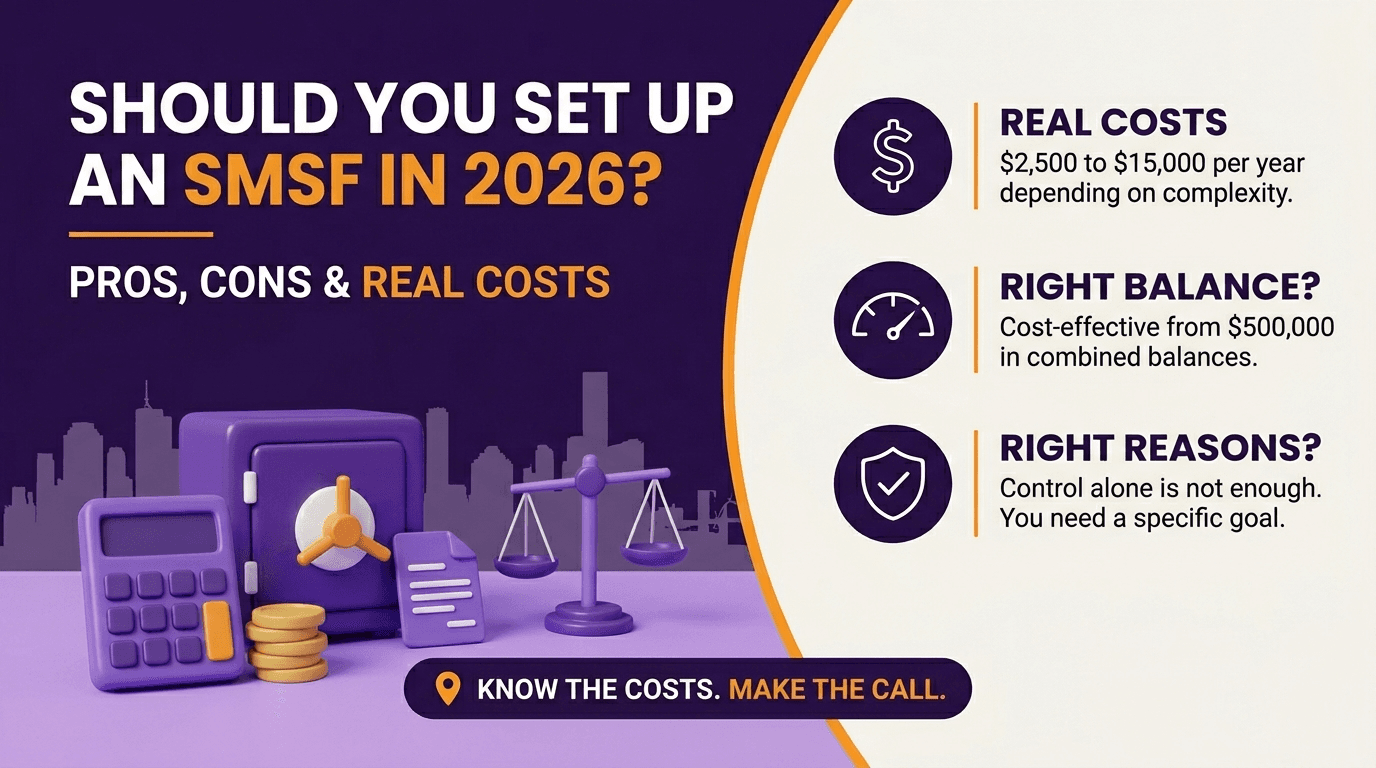
Should You Set Up an SMSF in 2026? Pros, Cons & Real Costs
What if the "more control" you're looking for from an SMSF is going to cost you $5,000 to $15,000 per year, 100+ hours of your time, and full personal liability for every compliance obligation, before you've made a single investment decision? Over 600,000 SMSFs hold more than $900 billion in assets, making them the largest segment of the Australian superannuation system by assets. That scale signals a serious financial structure used by serious investors, not a DIY alternative to a bad industry fund. This guide gives you the complete picture, the genuine advantages and the genuine costs and risks, so you can make an informed decision rather than a fashionable one. The genuine advantages of an SMSF are real and valuable for the right person. The question is whether you are that person.
TL;DR: The Honest Answer
Setup costs range from $1,000 to $3,500 depending on trustee structure and service level
Annual running costs range from $2,500 to $7,000 for a straightforward fund and $7,000 to $15,000+ for complex funds with property or borrowing arrangements
The minimum balance where an SMSF becomes cost-competitive with industry and retail funds is generally $200,000 to $500,000 in combined member balances
SMSF trustees spend an average of more than 100 hours per year managing their fund
The genuine advantages include investment flexibility, direct property ownership, estate planning control, and cost efficiency at higher balances
An SMSF is not right for most Australians and should only be established after proper professional advice
Bottom line: An SMSF is a powerful structure for the right person at the right balance with the right reasons. It is an expensive, time-consuming, compliance-heavy mistake for everyone else.
Before you read further: Most people who ask us about SMSFs are not good candidates. Not because they're doing anything wrong, but because the economics don't work below $500,000 in combined balances, and "more control" is rarely a sufficient reason on its own. If you're in your 30s or early 40s with a single super balance below $250,000, the James example near the bottom of this guide is probably your story. Jump there first.
Jump to a Section
What Is an SMSF and How Does It Differ?
The Real Costs: Setup and Ongoing
The Minimum Balance Question
The Genuine Advantages of an SMSF
The Genuine Risks and Disadvantages
Who an SMSF Actually Suits — start here if you want the direct answer
Two SMSF Examples: Good Candidate and Poor Candidate
Common Mistakes Australians Make About SMSFs
FAQ
Ready to Find Out If an SMSF Is Right for You?
What Is an SMSF and How Does It Differ From Other Super Funds?
A self-managed superannuation fund is a private superannuation fund with up to six members, all of whom are also trustees (or directors of a corporate trustee). Unlike industry or retail funds where a professional trustee manages the fund, SMSF trustees are personally responsible for all investment decisions, compliance obligations, and administrative requirements.
The differences between an SMSF and a professionally managed fund are substantial. This table is the most useful starting point before evaluating the economics:
Feature | SMSF | Industry or Retail Fund |
Trustee | You (and up to 5 others) | Professional trustee |
Investment control | Full discretion within SIS Act rules | Limited to fund's menu |
Direct property | Yes, including business real property | Generally no |
Listed shares | Yes, direct holdings | Yes, through pooled investments |
Compliance responsibility | Entirely on trustees | Handled by fund |
Annual audit | Mandatory, independent auditor | Handled by fund |
Cost structure | Largely fixed regardless of balance | Percentage of balance |
Time commitment | 100+ hours per year | Minimal |
Insurance | Must be sourced separately | Often default cover included |
The fixed cost structure is what makes SMSFs cost-competitive at higher balances and cost-inefficient at lower ones. A $2,500 to $7,000 annual running cost represents 0.5% of a $500,000 fund but 1.7% of a $150,000 fund, before investment costs are counted.
Bottom line: An SMSF shifts the full burden of compliance, investment management, and administration from a professional trustee to you personally. The question is whether the control and flexibility that comes with that burden is worth it for your situation.
The Real Costs: Setup and Ongoing
One of the most common misconceptions about SMSFs is underestimating what they actually cost to run. Here is the complete cost picture for 2026.
Setup Costs
Cost Item | Indicative Range |
Trust deed and establishment | $500 to $1,500 |
Corporate trustee setup (ASIC registration) | $611 (ASIC fee) plus professional fees |
Professional setup fee (accountant or administrator) | $500 to $1,500 |
Total setup cost (individual trustees) | $1,000 to $2,500 |
Total setup cost (corporate trustee) | $1,500 to $3,500+ |
A corporate trustee structure (where a company acts as trustee rather than individuals) adds cost but provides significantly better asset protection and administrative flexibility, particularly for estate planning. Most professional advisers recommend corporate trustee structures for this reason.
Annual Running Costs
Cost Item | Indicative Range |
ATO supervisory levy | $374 per year |
ASIC annual review fee (corporate trustee) | ~$63 per year |
Independent audit | $450 to $600 |
Accounting and administration | $1,500 to $4,000 |
Tax return lodgement | Included in accounting or $300 to $600 separately |
Financial advice (investment strategy) | $2,000 to $5,000+ if used |
Total mandatory compliance costs | Approximately $2,400 to $5,400 |
Total all-inclusive annual costs (simple fund) | $2,500 to $7,000 |
Total all-inclusive annual costs (complex fund) | $7,000 to $15,000+ |
Complex funds include those with direct property, limited recourse borrowing arrangements, members in both accumulation and pension phase, or multiple asset classes requiring more intensive administration.
The Hidden Cost: Your Time
This is the cost most SMSF comparisons omit. SMSF trustees spend an average of more than 100 hours per year managing their fund. For a professional earning $150 per hour, that represents $15,000 in personal time annually, a real economic cost even if it does not appear on a fee statement.
What if the "cheaper" SMSF is actually costing you 3.5% of your balance per year instead of the 0.5% you're paying now, because the fixed running costs are too high relative to your balance? That's the number most SMSF comparisons don't show upfront.
Bottom line: The true annual cost of running an SMSF including your time can easily exceed $20,000 per year for a complex fund. At lower balances, this cost is almost certainly higher than a well-managed industry or retail fund alternative.
The Minimum Balance Question
There is no legal minimum balance for an SMSF. The ATO does not set one. But the economics are clear.
The consensus among regulators, advisers, and industry bodies is that an SMSF becomes cost-competitive with industry and retail funds at approximately $200,000 to $500,000 in combined member balances.
How the cost efficiency shifts with balance:
Combined Balance | Annual Running Cost (Simple Fund) | Cost as % of Balance |
$100,000 | $3,500 | 3.50% |
$200,000 | $3,500 | 1.75% |
$300,000 | $3,500 | 1.17% |
$500,000 | $4,000 | 0.80% |
$750,000 | $4,500 | 0.60% |
$1,000,000 | $5,000 | 0.50% |
Most quality industry funds charge members fees of 0.5% to 0.8% of their balance annually. An SMSF becomes cost-competitive around the $500,000 to $750,000 mark on fees alone, with greater relative advantage as the balance grows.
The ATO's own case studies suggest an SMSF can be appropriate for couples with combined balances as low as $172,000 in specific circumstances, but only where both members are highly engaged, financially knowledgeable, and have strong surplus cashflow.
Bottom line: Below $200,000 in combined balances, an SMSF is almost always more expensive than a retail or industry fund alternative. Between $200,000 and $500,000, it may be cost-competitive depending on the structure. Above $500,000, the economics increasingly favour the SMSF for the right investor.
Not sure where your balance sits relative to the cost-effectiveness threshold? WIAA's financial advisers can give you a straight answer on whether an SMSF makes sense for your balance and goals. Free 15-min chat: call 1800 942 843 or book online.
The Genuine Advantages of an SMSF
When an SMSF is appropriate, the advantages are real and often significant.
1. Investment Flexibility
SMSFs can invest in a broader range of assets than most industry or retail funds, including:
Direct shares on the ASX and international exchanges
Direct residential and commercial property
Business real property (including your own business premises)
Unlisted investments including private equity and unlisted trusts
Collectibles (art, wine, coins) under strict ATO rules
Term deposits, managed funds, and ETFs
For investors with specific investment goals, such as holding a commercial property used by their own business, no other super structure accommodates this.
2. Business Real Property Ownership
One of the most compelling reasons to establish an SMSF for business owners is the ability to purchase business premises within the fund and lease them back to the business. This creates several advantages:
Lease payments go into super rather than to a landlord
The property grows inside a concessionally taxed structure
On retirement, the property can be sold tax-free from the pension phase
The business secures its premises without requiring personal capital
3. Estate Planning Control
SMSFs offer greater flexibility in structuring death benefits than retail or industry funds, including reversionary pensions that automatically continue to a nominated beneficiary, non-lapsing binding death benefit nominations, pension commutation and recontribution strategies to reduce the taxable component, and testamentary trust integration. For members with complex family situations, blended families, or significant balances, this control can be worth a meaningful amount in tax savings and dispute avoidance.
4. Cost Efficiency at Higher Balances
At balances above $500,000 to $750,000, the fixed-fee structure of an SMSF typically produces a lower annual fee as a percentage of assets than percentage-based industry or retail fund fees. At $2,000,000, paying $6,000 in annual costs represents 0.3%, compared to 0.5% to 0.8% at a retail fund.
5. Tax Timing Control
SMSF trustees control when capital gains are realised, which assets are sold, and how income is timed. This provides tax planning flexibility that pooled funds cannot offer individual members.
Bottom line: The genuine advantages of an SMSF are real and meaningful at the right balance and for the right investor profile. They do not justify the structure for most Australians.
The Genuine Risks and Disadvantages
This is where honest SMSF guidance is most valuable and most often lacking. These risks are as real as the advantages.
1. Full Trustee Responsibility
SMSF trustees are personally responsible for compliance with the Superannuation Industry (Supervision) Act. Breaches can result in administrative penalties of up to $16,500 per breach, fund disqualification, the fund being made non-complying (resulting in a 47% tax on the entire fund balance), and personal liability for investment losses where the investment strategy was not properly documented. The compliance framework is detailed and demanding. Trustees cannot delegate responsibility to an accountant and then ignore their obligations.
2. No Compensation Scheme
Industry and retail super funds are covered by the government's financial claims scheme and other protective mechanisms. SMSF members have no equivalent safety net. If an SMSF suffers fraud, theft, or major investment loss, there is no government compensation available.
3. Insurance Gaps
When you leave an industry fund for an SMSF, default life insurance and TPD cover typically lapses. Sourcing equivalent cover outside super is often more expensive, and many SMSF members simply go without adequate cover, creating significant personal and family financial risk.
What if your industry fund lets you go without telling your insurance cover lapses? That's exactly what happens when most people switch to an SMSF without first replacing their life and TPD cover. It's the most common and most dangerous oversight in SMSF setup.
4. Limited Recourse Borrowing Complexity
LRBAs allow an SMSF to borrow to purchase an asset, typically property. While the strategy can be powerful, the complexity is significant: legal fees of $2,000 to $5,000 for the bare trust structure, higher interest rates than standard property loans, strict ATO rules on the asset held and related party dealings, substantially increased annual compliance costs, and refinancing can be difficult. Many SMSF property strategies that appear compelling in isolation produce poor outcomes when borrowing costs, running costs, and the opportunity cost of the locked capital are properly modelled.
5. Winding Up Costs
Closing an SMSF costs $1,500 to $3,000 and requires completion of a full audit and tax return for the final year. It is not as simple as rolling the balance elsewhere. For members who set up an SMSF at a low balance and later want to consolidate, the wind-up cost adds to an already suboptimal outcome.
Bottom line: The risks and obligations of an SMSF are as real as the advantages. An SMSF is a serious commitment, not an upgrade.
Who an SMSF Actually Suits
Everything above explains the mechanics and costs. This section answers the question in the title.
The more of these boxes you tick, the stronger the case. The fewer you tick, the more honest you need to be about whether the structure suits you.
Strong candidates for an SMSF:
Combined member balances of $500,000 or more (couples) or $300,000+ (individuals with specific investment goals)
Genuine investment reasons, such as direct property, business real property, or a specific investment strategy not available in retail or industry funds
Time and genuine interest in managing the fund actively
Financial literacy sufficient to understand investment strategy, compliance obligations, and trustee duties
Strong cashflow to absorb running costs without eroding the fund's investment performance
Complex estate planning needs that benefit from the SMSF's flexibility
Equally important. Be honest about these. Poor candidates for an SMSF:
Combined balances below $200,000
No specific investment reason beyond general dissatisfaction with current fund
Limited time or interest in ongoing management
Reliance on default insurance cover from a current fund
Expectation that the accountant will manage everything and the trustee can be passive
Proximity to retirement with a short investment horizon
Bottom line: The most common reason people set up an SMSF is a vague desire for "more control." This is rarely sufficient justification on its own. A specific, legitimate investment reason plus the right balance is the correct starting point.
Tick most of the "strong candidate" boxes? Or most of the "poor candidate" boxes? Book a free 15-min chat with WIAA and we'll give you a direct assessment of your specific situation, including telling you if an SMSF isn't right for you. Phone 1800 942 843 or book online.
Two SMSF Examples: Good Candidate and Poor Candidate
Example 1: Robert and Helen — Good Candidates
Robert is 52 and runs an accounting practice from a commercial suite. Helen is 50 and works part-time. Combined super is $820,000. Robert wants to purchase the commercial suite his practice leases, currently valued at $650,000.
Their SMSF case:
Combined balance of $820,000 is well above the cost-effectiveness threshold
The business real property purchase is a specific, legitimate investment reason
Lease payments of $48,000 per year will flow into the SMSF rather than to a landlord
The property will grow inside a concessionally taxed structure
Robert is financially literate and genuinely interested in managing the fund
Estate planning benefits for a relatively complex family situation
Their adviser recommends an SMSF with a corporate trustee structure. Annual running costs of approximately $6,500 (including the property complexity premium) represent 0.79% of their balance. Robert and Helen's current industry fund charges 0.65%, making the cost difference modest relative to the investment flexibility gained.
Example 2: James — A Poor Candidate
James is 34, single, with $185,000 in super. He has been reading about SMSFs online and is attracted by the idea of buying an investment property inside super.
His adviser's assessment:
Balance of $185,000 is below the recommended minimum
Annual SMSF costs of approximately $3,500 represent 1.9% of his balance
To purchase a property inside the SMSF, he would need an LRBA, adding $2,000 to $5,000 in setup costs and higher annual compliance costs
His current industry fund charges 0.52%, saving approximately $2,700 per year compared to an SMSF at his balance
His insurance cover through the industry fund would lapse on establishment
He has limited time and moderate financial literacy for the compliance demands
Recommendation: continue with the current industry fund. Review the SMSF question when his balance reaches $400,000 to $500,000. In the meantime, focus on maximising concessional contributions and optimising the investment option within the existing fund.
If James had set up the SMSF anyway, the combination of running costs ($3,500), insurance lapse, and LRBA setup costs ($2,000 to $5,000) would have put him $7,000 to $10,000 behind his industry fund position in year one alone, before any investment return difference.
Common Mistakes Australians Make About SMSFs
Setting one up based on a general desire for control rather than a specific investment reason. Control for its own sake does not justify the costs and compliance burden.
Establishing at too low a balance. An SMSF with $150,000 in combined balances will almost certainly underperform a quality industry fund on fees alone for several years.
Not accounting for time as a real cost. 100+ hours per year is a genuine economic cost that most SMSF comparisons ignore.
Letting insurance lapse on exit from an industry fund. Life and TPD cover should be replaced before or immediately upon establishment, not after.
Treating the accountant as the trustee. Accountants manage compliance. Trustees make decisions. Passive trustees who leave everything to the accountant create compliance risk and potentially personal liability.
Underestimating LRBA complexity. Borrowing to purchase property inside an SMSF sounds attractive but adds substantial cost, complexity, and ATO scrutiny.
Not getting advice before setting up. The ATO recommends seeking advice before establishing an SMSF. Given the compliance obligations and the cost of getting it wrong, this is not optional guidance.
FAQ
What is the minimum super balance for an SMSF?
There is no legal minimum. However, most regulators and advisers recommend at least $200,000 in combined member balances for an SMSF to be cost-competitive with industry and retail fund alternatives. Below $200,000, fixed annual running costs typically erode returns significantly.
Is an SMSF worth it at $300,000?
Possibly, but only with a specific investment reason beyond "more control" and only if both members are genuinely engaged with the compliance obligations. At $300,000, annual SMSF costs of $3,500 represent 1.17% of the balance, compared to 0.5% to 0.8% at a quality industry fund. The economics are marginal without a compelling investment reason.
What's the difference between an SMSF and an industry super fund?
An SMSF gives you full investment control and full compliance responsibility. An industry fund provides professional management, default insurance cover, regulatory protection, and a percentage-based fee structure that is cheaper at lower balances. The choice is essentially between control and simplicity, weighted against costs, time, and compliance burden.
How much does it cost to run an SMSF each year?
Annual running costs for a simple SMSF typically range from $2,500 to $7,000, covering the ATO supervisory levy ($374), ASIC fee (~$63), independent audit ($450 to $600), and accounting and administration. Complex funds with property or borrowing arrangements can cost $7,000 to $15,000+ annually.
Can I buy property in an SMSF?
Yes, subject to strict ATO rules. The property must meet the sole purpose test. You cannot purchase residential property from a related party or live in property owned by your SMSF. Business real property can be purchased from a related party and leased back to the business at market rates.
Can my SMSF borrow money to buy an investment property?
Yes, through a limited recourse borrowing arrangement. The structure adds $2,000 to $5,000 in legal setup costs, higher annual compliance costs, and strict ATO rules on the asset held. Not all SMSF lenders offer competitive rates, and the strategy requires careful modelling before proceeding.
Do I need financial advice to set up an SMSF?
There is no legal requirement. However, receiving advice on whether an SMSF is appropriate for your situation, and how to invest within it, requires a licensed financial adviser. The ATO strongly recommends professional advice before establishing an SMSF given the compliance obligations and cost of getting it wrong.
What are the penalties for SMSF compliance breaches?
Penalties range from administrative fines of up to $16,500 per breach to fund disqualification and, in serious cases, the fund being made non-complying, resulting in a 47% tax on the entire fund balance. Trustees are personally responsible for compliance regardless of whether they have engaged an accountant or administrator.
How do I close down an SMSF?
Winding up an SMSF typically costs $1,500 to $3,000 and requires completion of a final year audit and tax return before the balance can be rolled to another fund. It is not a simple process and the wind-up cost should be factored into any decision to establish.
Ready to Find Out If an SMSF Is Right for You?
The SMSF decision is one that benefits enormously from professional assessment of your specific balance, goals, and circumstances, not a general guide. WIAA's financial advisers set SMSFs up for clients who genuinely suit them. We also tell clients honestly when they don't.
Still asking what if about an SMSF? The right answer depends on your balance, your reasons, and your appetite for compliance. Let's find out which camp you're in.
Two ways to start:
Free 15-min assessment chat: call 1800 942 843 and tell us your combined balance, your reason for considering an SMSF, and your current fund. We'll give you an honest initial read.
Not ready to call? Email clientservices@whatifadvice.com.au with your situation and we'll come back to you.
WIAA combines registered tax agents and AFSL-licensed financial advisers under one roof. Offices in Brisbane and Melbourne, virtual nationwide. AFSL 528250.
General Advice Disclaimer: This information is general in nature and does not take into account your personal financial situation, needs, or objectives. You should consider whether it is appropriate for you and seek personal financial advice before making any decisions. SMSF rules, costs, and ATO compliance requirements are subject to change. Always verify current rules and costs with a licensed financial adviser and registered tax agent before establishing an SMSF. What If Advice is an Authorised Representative under Beryllium Advisers Pty Ltd, AFSL 528250.