Looking for specific financial advice?
This blog provides general educational content. For personalized advice tailored to your unique situation, book a free consultation with our team of ASIC-licensed financial advisers.
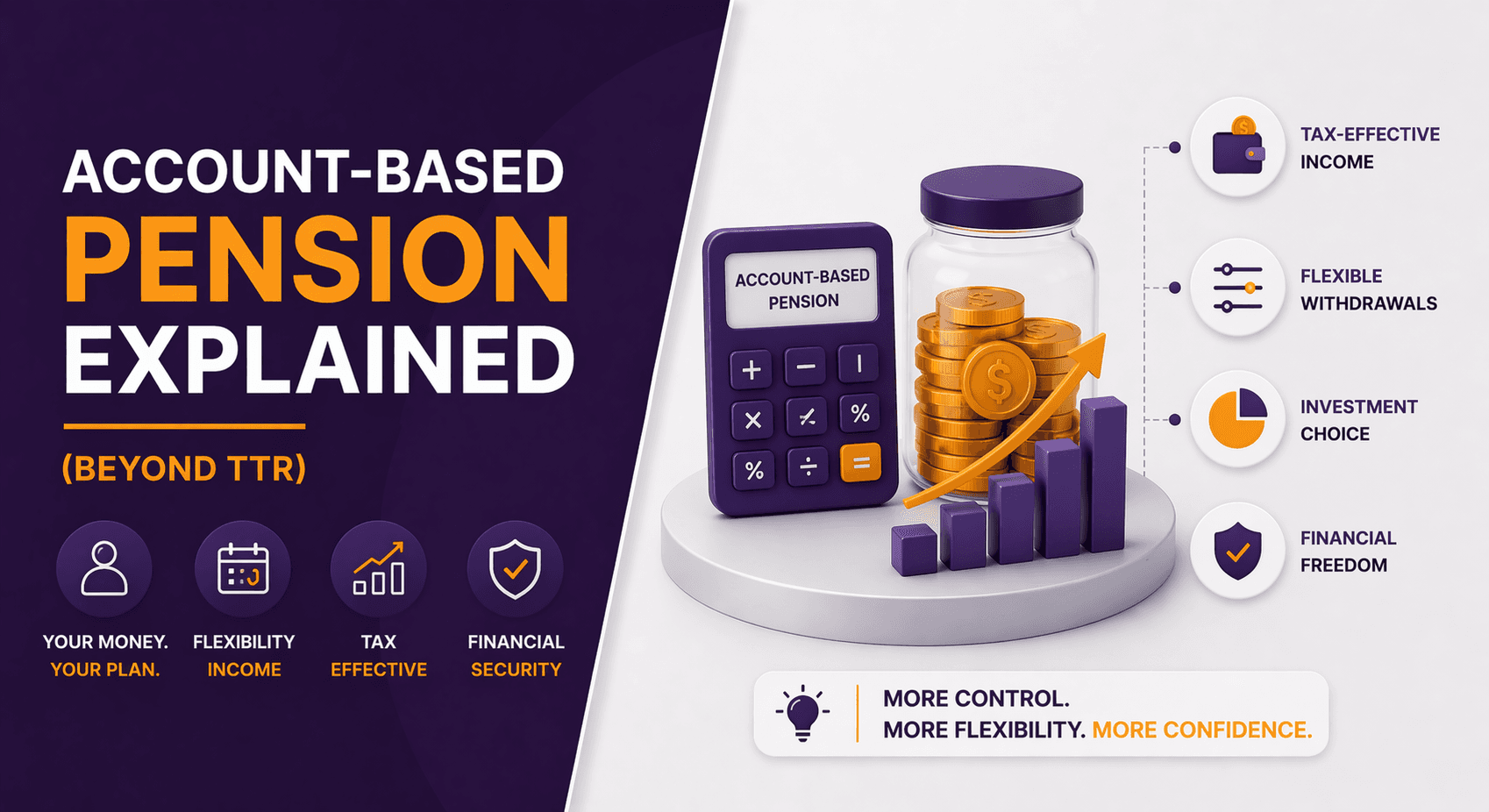
Account-Based Pension Explained (Beyond TTR)
If you’ve reached retirement age and want to start drawing income from your super, an account-based pension is the most common structure in Australia.
But many people confuse it with a Transition to Retirement (TTR) pension. They are not the same.
This guide explains how an account-based pension works, how it differs from TTR, what the tax rules are, and how it fits into a broader retirement income strategy.
What Is an Account-Based Pension?
An account-based pension is a retirement income stream funded by your superannuation.
When you retire (or meet a condition of release under current super rules), you can transfer part or all of your super balance into a pension account. From there:
You receive regular income payments.
The remaining balance stays invested.
Earnings inside the pension phase are generally tax-free (subject to current ATO rules).
It is called “account-based” because your income depends on the balance of your account.
How Is It Different from a TTR Pension?
A Transition to Retirement (TTR) pension allows you to draw limited income from super while still working.
Here’s the key difference:
Feature | TTR Pension | Account-Based Pension |
Must be retired? | No | Yes (or meet full condition of release) |
Max withdrawal limit | 10% per year | No maximum |
Minimum withdrawal | Yes | Yes |
Tax on earnings | Taxed (unless retired) | Generally tax-free |
Purpose | Supplement income before retirement | Fund retirement |
In short:
TTR is a pre-retirement strategy.
Account-based pension is a retirement income strategy.
When Can You Start an Account-Based Pension?
You must meet a condition of release, typically:
Reaching preservation age and retiring permanently
Turning 65 (even if still working)
Certain permanent incapacity conditions
Preservation age depends on your date of birth (currently between 55–60 for most Australians).
How Income Payments Work
When you start an account-based pension:
You choose how much of your super to transfer.
You select an investment option.
You choose how often to receive payments (monthly, quarterly, annually).
Minimum Drawdown Rules
The government sets minimum annual withdrawal rates (subject to change):
Age | Minimum Drawdown |
Under 65 | 4% |
65–74 | 5% |
75–79 | 6% |
80–84 | 7% |
85–89 | 9% |
90–94 | 11% |
95+ | 14% |
These percentages apply to your account balance at 1 July each year.
There is no maximum withdrawal limit (unlike TTR).
Tax on an Account-Based Pension
Tax treatment is one of the key advantages.
If you are 60 or over, pension payments are generally tax-free.
Investment earnings inside the pension phase are generally tax-free.
Lump sum withdrawals may also be tax-free after age 60.
However, the Transfer Balance Cap limits how much can be moved into pension phase (currently indexed and subject to ATO limits).
Amounts above the cap must remain in accumulation phase, where earnings are taxed at 15%.
How It Affects the Age Pension
An account-based pension counts under both:
Income test
Assets test
Services Australia assesses:
The account balance (assets test)
Deemed income (income test)
The way you structure withdrawals can influence Age Pension entitlements, so modelling is important.
Investment Strategy in Pension Phase
Many retirees assume they must move to conservative investments.
That is not always appropriate.
If retirement could last 25–30 years, growth assets such as Australian and global shares may still play a role.
A common structure is:
1–3 years of income in cash
Defensive assets for medium term
Growth assets for long-term sustainability
This helps manage volatility while supporting longevity.
Risks to Consider
An account-based pension is flexible, but it carries risks:
Market risk
Longevity risk (outliving savings)
Inflation risk
Withdrawal rate risk
Because there is no guaranteed lifetime income, sustainability modelling is critical.
Example Scenario
Mark and Julie, both 67, retire with $900,000 in combined super.
They transfer $800,000 into account-based pensions and leave $100,000 in accumulation.
At a 5% withdrawal rate:
Annual income = $40,000
Combined with part Age Pension, total income may exceed $65,000–$75,000 depending on assets
Their investment allocation must balance income needs with long-term growth.
Common Mistakes
Drawing the minimum without assessing sustainability
Moving entirely to cash
Ignoring the Transfer Balance Cap
Failing to update beneficiary nominations
Not reviewing annually
FAQs
1. Is an account-based pension the same as a super pension?
Yes. An account-based pension is the most common type of super pension in retirement.
2. Can I take lump sums from an account-based pension?
Yes, subject to fund rules and super legislation.
3. Is there a maximum withdrawal limit?
No maximum applies once fully retired, but minimum drawdowns apply.
4. Does an account-based pension reduce my Age Pension?
It can, depending on your total assets and deemed income under Services Australia rules.
5. What happens when the balance runs out?
Payments stop when the account balance reaches zero. It does not provide guaranteed lifetime income.
6. Can I keep investing while drawing income?
Yes. The remaining balance stays invested according to your chosen allocation.
Structure Your Super for Sustainable Retirement Income
Starting an account-based pension is straightforward. Structuring it correctly is not.
The timing, withdrawal rate, tax position, Age Pension interaction and investment allocation all affect long-term sustainability.
At What If Advice, we help Australians model retirement income scenarios and design pension structures aligned with current ATO and Services Australia rules.
If you’re considering moving your super into pension phase, seek strategic advice before making changes.
Book a retirement income consultation with What If Advice.
General Advice Disclaimer
This article provides general information only and does not take into account your personal objectives, financial situation or needs. Before making any financial decisions, consider whether the information is appropriate to your circumstances and seek personal advice from a licensed financial adviser. Superannuation, taxation and Age Pension rules are subject to change under current ATO and Services Australia regulations.