Looking for specific financial advice?
This blog provides general educational content. For personalized advice tailored to your unique situation, book a free consultation with our team of ASIC-licensed financial advisers.
Age Pension and Account-Based Pensions: Practical Examples for Australians
If you’re drawing income from an account-based pension, it will affect your Age Pension, but not always in the way you expect.
Some retirees assume:
“More income = less pension”
That’s not always true.
Centrelink uses deeming rules, not your actual withdrawals, which means your pension outcome depends on how your super is structured and assessed.
Let’s break it down with real-world examples.
What Is an Account-Based Pension?
An account-based pension is a retirement income stream created from your super.
Once you retire (or reach preservation age), you can:
Convert your super into a pension account
Withdraw regular income
You must withdraw a minimum amount each year, based on your age (ATO rules).
How Centrelink Treats Account-Based Pensions
After you reach Age Pension age:
1. It Counts as an Asset
Your pension balance is included in the assets test.
2. It Is Deemed for Income
Centrelink does not use your actual withdrawals.
Instead, it applies deeming rates to estimate income.
This is critical.
Even if you withdraw $40,000
Centrelink might only assess $8,000–$12,000 as income
Subject to current Services Australia rules.
Why This Matters
Because:
You can withdraw more income
Without proportionally reducing your Age Pension
This creates planning opportunities most people completely miss.
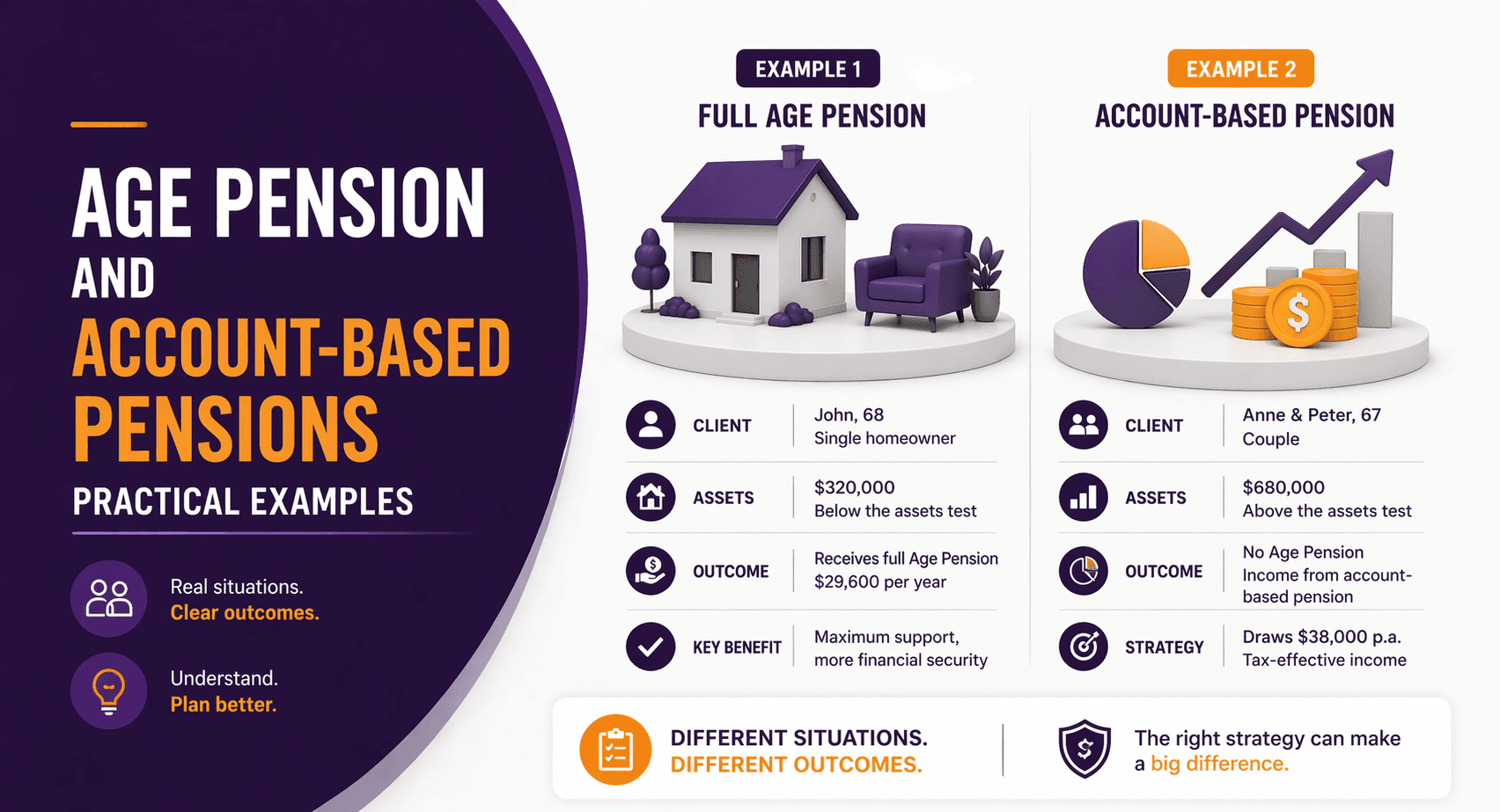
Practical Examples
Example 1: Moderate Super Balance (Part Pension)
Scenario:
Single homeowner
$400,000 in account-based pension
Withdraws $30,000/year
Centrelink treatment:
Assets: $400,000 = reduces pension
Deemed income: approx. $8,000–$10,000
Outcome:
Eligible for part Age Pension
Total income = pension + super withdrawals
Key insight:
Actual withdrawals don’t directly reduce the pension.
Example 2: Higher Balance (No Pension → Partial Later)
Scenario:
Couple with $800,000 combined
Initially above threshold
Outcome at start:
No Age Pension
After 3–5 years:
Balance reduces to $600,000
New outcome:
Eligible for part pension
Strategy:
Drawdown gradually to move into eligibility range.
Example 3: Low Balance (Near Full Pension)
Scenario:
Single retiree
$250,000 in pension account
Withdraws minimum only
Outcome:
Close to full Age Pension
Super acts as a supplement
This is where:
Pension provides stability
Super provides flexibility
Assets Test vs Income Test: Which One Applies?
Centrelink applies both:
Test | What It Looks At |
Assets test | Total value of your pension account |
Income test | Deemed income from that balance |
You receive the lower pension result from the two tests.
Minimum Drawdown Rules (Important)
You must withdraw a minimum percentage each year:
Age | Minimum Drawdown |
Under 65 | 4% |
65–74 | 5% |
75–79 | 6% |
(Subject to current ATO rules)
This ensures:
Your super is gradually used
It’s not just sitting untouched
Strategic Insights Most People Miss
1. Withdrawals Don’t Equal Assessable Income
Centrelink ignores your actual drawdowns.
2. Lowering Your Balance Can Increase Pension
Over time:
Less assets = higher pension
3. Structure Matters More Than Amount
Where your money sits:
Super
Cash
Investments
Can change outcomes significantly.
4. Timing Is Everything
The interaction evolves over:
Years, not months
Common Mistakes
1. Taking too little or too much
No strategy = inefficient income.
2. Misunderstanding deeming
People assume real income is assessed.
3. Ignoring thresholds
Small changes can shift eligibility.
4. Not reviewing annually
Your pension should be reviewed every year.
When Should You Get Advice?
You should consider professional advice if:
You’re starting an account-based pension
You’re close to Age Pension thresholds
You want to optimise total retirement income
Because small structural changes can mean:
Thousands per year difference
FAQs
1. Does an account-based pension reduce my Age Pension?
Yes, but indirectly. It is counted as an asset and deemed for income, which can reduce your entitlement.
2. Does Centrelink use my actual pension withdrawals?
No. Centrelink applies deeming rates to estimate income.
3. Can I still get a full Age Pension with super?
Yes, if your total assets are below the lower threshold.
4. Should I withdraw more to reduce my assets?
It depends. The goal is to maximise total income, not just pension eligibility.
5. What happens as my pension balance decreases?
You may become eligible for a higher Age Pension over time.
6. Is my home counted in the assets test?
Your principal residence is generally exempt (subject to current Services Australia rules).
7. What is the biggest advantage of an account-based pension?
Flexibility. You control how much income you withdraw.
Not Sure How Your Super Impacts Your Age Pension?
The way your account-based pension is structured can significantly affect your retirement income.
At What If Advice, we help Australians:
Understand Centrelink rules clearly
Structure pension drawdowns effectively
Maximise total retirement income
Book a strategy session to get clarity on your position and next steps.
Disclaimer
This information is general in nature and does not take into account your personal objectives, financial situation, or needs. You should consider whether it is appropriate for your circumstances and seek professional advice. Rules relating to Centrelink, the ATO, and Services Australia are subject to change.