Looking for specific financial advice?
This blog provides general educational content. For personalized advice tailored to your unique situation, book a free consultation with our team of ASIC-licensed financial advisers.
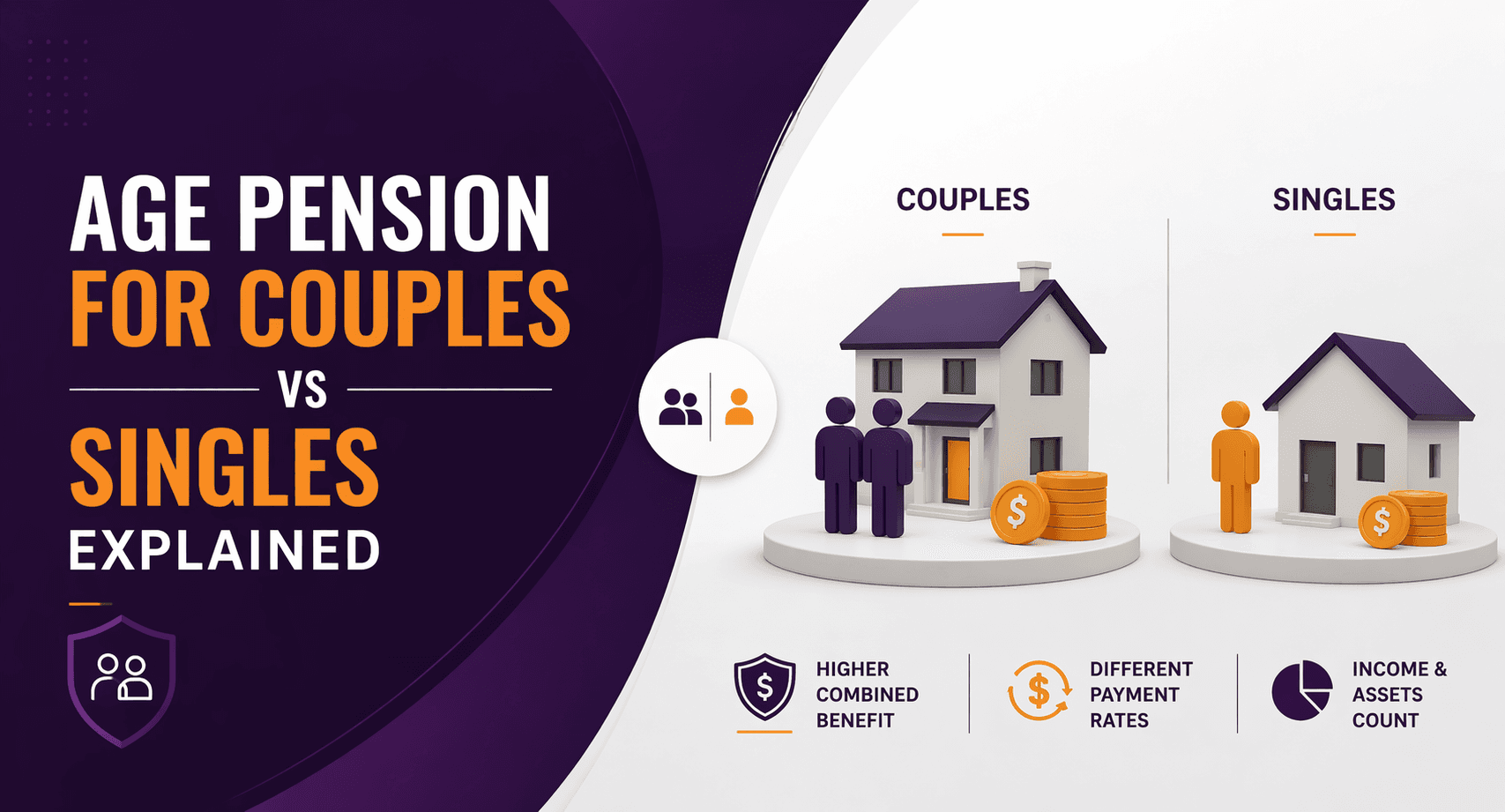
Age Pension for Couples vs Singles Explained
The Age Pension in Australia is designed to provide financial support to retirees who meet eligibility criteria.
However, the amount you receive depends not only on your assets and income, but also on whether you are single or part of a couple.
Payment rates, income thresholds and asset limits all differ depending on your relationship status.
Understanding these differences can help retirees plan their finances more effectively.
(All figures subject to current Services Australia rules.)
Maximum Age Pension Payments
Age Pension payments are higher for couples combined but lower per person compared to singles.
This reflects the assumption that couples share certain living costs.
Example payment structure (subject to updates):
Household Type | Maximum Fortnightly Payment |
Single | Higher per individual |
Couple (each) | Lower per individual |
Couple (combined) | Higher combined amount |
Although couples receive more in total, each individual receives less than a single pensioner.
Why Couples Receive Less Per Person
Government policy assumes couples share living costs such as:
Housing
Utilities
Food
Insurance
Because of these shared expenses, the pension system provides a combined household payment rather than two full individual payments.
This is why the per-person payment for couples is lower than for singles.
Income Test Differences
The Age Pension income test applies different thresholds depending on relationship status.
Example income-free areas:
Household Type | Income-Free Area (Fortnight) |
Single | Higher threshold |
Couple (combined) | Slightly higher combined threshold |
Once income exceeds these thresholds, pension payments reduce according to the taper rate.
The taper rate typically reduces payments by 50 cents for every $1 of income above the threshold (subject to Services Australia rules).
Assets Test Differences
The Age Pension assets test also varies depending on whether you are single or part of a couple.
Example asset thresholds:
Household Type | Asset Threshold |
Single homeowner | Lower threshold |
Couple homeowners | Higher combined threshold |
Assets counted may include:
Superannuation (after pension age)
Investments
Savings
Investment property
Vehicles and other valuables
Your principal residence is generally exempt from the assets test.
Example Scenario
Consider two retirees with identical financial assets.
Scenario A: Single Retiree
Assets: $450,000
Income: modest investment income
The pension reduction is assessed using single thresholds.
Scenario B: Couple
Combined assets: $450,000
Same income level
The pension assessment uses couple thresholds, which may produce a different outcome.
In some cases couples may receive a higher combined payment than two singles with the same assets.
What Counts as a Couple?
Services Australia generally considers you part of a couple if you:
Are married
Are in a de facto relationship
Live together as partners
Couples are assessed jointly, meaning:
Combined income is assessed
Combined assets are assessed
Even if finances are kept separate, pension eligibility is calculated at the household level.
What Happens if One Partner Enters Aged Care?
Special pension rules may apply if one partner enters residential aged care.
In these situations:
Pension payments may change
Assets and income may be assessed differently
Professional advice is often useful when circumstances change.
Why Understanding Pension Status Matters
Relationship status affects:
Pension eligibility thresholds
Income assessment
Asset limits
Retirement income planning strategies
For couples, coordinating finances and superannuation can improve long-term outcomes.
Common Misunderstandings
Retirees often assume:
Couples automatically receive double the single pension
Relationship status does not affect asset thresholds
Pension payments remain fixed regardless of household income
In reality, Age Pension rules can change significantly depending on household structure.
FAQs
1. Do couples receive double the Age Pension?
No. Couples receive a higher combined payment than singles, but each partner receives less individually.
2. Are assets assessed separately for couples?
No. Assets are generally assessed on a combined basis.
3. Can one partner receive the Age Pension while the other does not?
In some cases, yes, depending on age and eligibility criteria.
4. Does relationship status affect the income test?
Yes. Couples have different income thresholds compared to singles.
5. What happens if a couple separates?
If relationship status changes, Age Pension eligibility may be reassessed under single thresholds.
6. Do both partners need to reach pension age?
Not necessarily. One partner may qualify earlier depending on age and circumstances.
Understand How Pension Rules Affect Your Household
Age Pension payments depend on income, assets and relationship status. Understanding how these rules interact can help retirees plan more effectively.
At What If Advice, we help Australians structure retirement income strategies that consider superannuation, investments and Age Pension eligibility under current Services Australia regulations.
If you want clarity on how pension rules apply to your situation, strategic advice can help.
Book a retirement income and Age Pension strategy consultation with What If Advice.
General Advice Disclaimer
This article provides general information only and does not take into account your personal objectives, financial situation or needs. Before making financial decisions, consider whether the information is appropriate to your circumstances and seek personal advice from a licensed financial adviser. Age Pension, taxation and superannuation rules are subject to change under current Services Australia and ATO regulations.