Looking for specific financial advice?
This blog provides general educational content. For personalized advice tailored to your unique situation, book a free consultation with our team of ASIC-licensed financial advisers.
What If the Conversation You're Avoiding Is the One That Protects You Both?
Binding Financial Agreements, commonly called prenups, carry a certain stigma in Australia, as though raising one signals a lack of trust or an expectation the relationship will fail. In practice, a BFA is a legal tool for clarity, setting out in advance how assets would be divided if a relationship ends, which can genuinely protect both parties, not just the one with more to lose. This guide covers what a BFA actually does, when it's used, and what makes one legally solid enough to survive a court challenge. For business owners specifically, our Buy/Sell Agreements guide covers a related idea, formalising arrangements before conflict, with the same independent-legal-advice requirement, from the business-partnership side rather than the relationship side.
TL;DR
A Binding Financial Agreement (BFA) is a legal agreement under the Family Law Act setting out how assets, and sometimes spousal maintenance, would be divided if a marriage or de facto relationship ends.
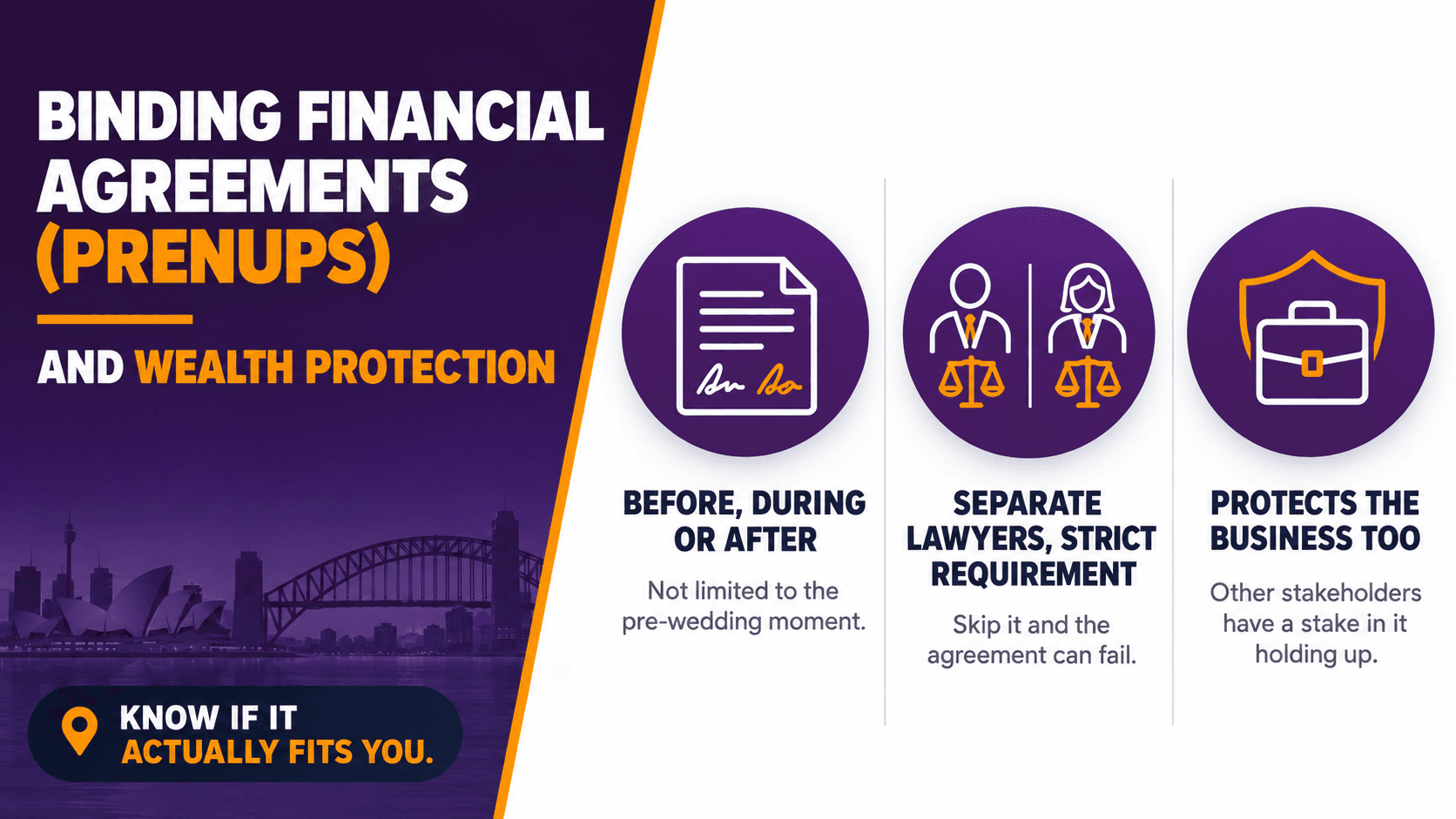
BFAs can be entered into before, during, or after a relationship, not just before marriage, despite the common "prenup" framing implying it only happens beforehand.
Independent legal advice for both parties is a strict legal requirement, not just best practice, a BFA without it is a common way the agreement ends up unenforceable.
A BFA can be set aside by a court in certain circumstances, including fraud, one party's financial position changing significantly, or if it was signed under duress or without proper disclosure.
Business owners and people entering a relationship with pre-existing assets (an inheritance, a family business, a property portfolio) commonly use BFAs specifically to protect those assets in the event of separation.
A BFA isn't automatically "unromantic" or adversarial. For many couples, particularly second relationships or blended families, it's a practical tool that provides clarity for both parties, not just protection for one.
Costs vary depending on complexity, but a properly drafted BFA with both parties receiving independent legal advice is a genuine investment worth budgeting for given what's actually at stake.
Bottom line: a BFA's value isn't in assuming a relationship will fail, it's in removing ambiguity and reducing the risk of a drawn-out, costly dispute later, provided it's drafted properly and both parties genuinely understand what they're signing.
On This Page
What a Binding Financial Agreement Actually Covers
When BFAs Are Used, It's Not Just Before Marriage
What Makes a BFA Legally Enforceable
When a Court Can Set a BFA Aside
BFAs as a Wealth Protection Tool for Business Owners
Worked Example: Protecting a Family Business Before Marriage
Common Mistakes
FAQ
What a Binding Financial Agreement Actually Covers
A Binding Financial Agreement is a formal, legally recognised agreement under the Family Law Act, setting out how property, financial resources, and sometimes spousal maintenance would be divided between two people if their marriage or de facto relationship ends. It can address specific assets a party wants protected, such as a family business, an inheritance, or property owned before the relationship began, and can also set out how assets acquired during the relationship would be treated, providing considerably more certainty than relying on a court's discretionary property division process after separation.
Not sure whether a BFA is genuinely relevant to your situation, or how it might interact with your broader financial and business structure? A free 15-minute chat with WIAA can help you think it through. Call 1800 942 843 or book online.
Bottom line: a BFA sets out, in writing and in advance, how assets would be divided, replacing the uncertainty of a court's discretionary process with an agreement both parties understood and accepted upfront.
When BFAs Are Used, It's Not Just Before Marriage
Despite the popular "prenup" framing, a BFA can be entered into at different points:
Before marriage or before moving in together (de facto), the most commonly recognised use, setting terms before the relationship formally begins.
During a marriage or de facto relationship, sometimes prompted by a significant change in circumstances, an inheritance received, a business started, or simply a couple deciding to formalise financial arrangements partway through.
After separation, but before divorce is finalised, used to formally settle financial matters between the parties.
Bottom line: a BFA isn't limited to the "before the wedding" moment popular culture associates with prenups, it's a tool that can be used at any of several points in a relationship's timeline.
What Makes a BFA Legally Enforceable
For a BFA to be legally binding, several strict requirements generally need to be met: each party must receive independent legal advice from a separate solicitor before signing, both parties must provide full and honest financial disclosure to each other, the agreement must be in writing and signed by both parties, and each party's solicitor must provide a signed statement confirming the advice was given. Skipping or shortcutting any of these requirements, particularly the independent legal advice requirement, is one of the most common reasons a BFA later fails to hold up if challenged.
A BFA's enforceability depends entirely on getting the legal process right, not just having a signed document. A free 15-minute chat can help you understand how a BFA would fit alongside your broader financial and structuring position. Email clientservices@whatifadvice.com.au or book online.
Bottom line: a BFA is only as strong as the legal process behind it, independent advice and full disclosure aren't optional extras, they're what makes the agreement actually enforceable.
When a Court Can Set a BFA Aside
Even a properly executed BFA isn't entirely immune from challenge. A court can set aside a BFA in certain circumstances, including where the agreement was obtained through fraud or non-disclosure of significant assets, where one party was under duress or undue pressure when signing, where circumstances have changed so significantly since signing that enforcing the original agreement would cause genuine hardship, particularly where children are involved, or where the agreement itself is found to be void, voidable, or otherwise unenforceable under general contract law principles.
Bottom line: a BFA isn't an absolute, unchallengeable guarantee, and understanding the circumstances where it can be set aside is part of understanding what it genuinely protects against, and what it doesn't.
BFAs as a Wealth Protection Tool for Business Owners
For business owners, particularly those entering a relationship with an existing business, a family trust, or significant pre-relationship assets, a BFA is commonly used specifically to protect those assets from becoming part of a property pool divided in the event of separation. This is particularly relevant where a business involves other stakeholders, business partners, family members, who have a genuine interest in the business remaining outside the scope of a personal relationship breakdown. A BFA used this way is generally most effective when considered alongside the broader business structure itself, rather than as a standalone document disconnected from how the business is actually owned and operated.
Bottom line: a BFA can be a genuinely important part of protecting a business or pre-existing wealth from relationship breakdown risk, particularly where other stakeholders in that business have a genuine interest in its stability.
Worked Example: Protecting a Family Business Before Marriage
Michael owns a 40% share in a family manufacturing business, alongside his two siblings, ahead of his upcoming marriage to Claire. Both Michael's siblings, as co-owners of the business, are concerned about what would happen to their shared business if Michael's marriage were to later end without any agreement in place regarding his business interest.
Michael and Claire each engage separate solicitors, and after full financial disclosure from both parties, sign a BFA that specifically protects Michael's business shareholding and any future growth in that specific asset from being treated as divisible property, while clearly setting out how other jointly acquired assets during the marriage, such as their family home, would be treated if the relationship were to end.
Outcome: the BFA provided genuine certainty for Michael, Claire, and Michael's business co-owners, protecting the family business specifically while still fairly addressing how the couple's own jointly built assets would be handled, avoiding ambiguity that could otherwise have affected the broader business and its other stakeholders.
Bottom line: Michael's situation illustrates exactly why a BFA is often as much about protecting other stakeholders and existing structures as it is about the two people signing it.
Common Mistakes
Signing a BFA without genuinely independent legal advice from a separate solicitor. This is a strict legal requirement, not a formality, and skipping it is a common reason a BFA later fails to hold up.
Providing incomplete or inaccurate financial disclosure. Non-disclosure of significant assets is one of the clearest grounds for a court to set aside a BFA.
Assuming a BFA is a one-time document that never needs revisiting. Significant life changes can affect how appropriate an existing BFA remains.
Treating a BFA purely as a standalone legal document, disconnected from broader business or estate structuring. A BFA is most effective when it genuinely aligns with how assets are actually structured and owned.
Avoiding the BFA conversation entirely due to discomfort, without considering what's genuinely at stake for both parties. Clarity upfront generally serves both people better than ambiguity later.
A properly drafted BFA, aligned with your broader financial and business structure, is a genuine wealth protection tool worth considering carefully. A free 15-minute chat can help you think through whether it fits your situation. Call 1800 942 843.
FAQ
Can a BFA be signed after we're already married, not just before? Yes, a BFA can be entered into before, during, or after a marriage or de facto relationship, not only in the lead-up to a wedding.
Do both parties need their own lawyer for a BFA to be valid? Yes, this is a strict legal requirement, each party must receive independent legal advice from a separate solicitor before the agreement can be considered binding.
Can a court overturn a Binding Financial Agreement? Yes, in certain circumstances, including fraud, non-disclosure, duress, or significantly changed circumstances since signing, particularly where children's welfare is affected.
Is a BFA only relevant for wealthy people or business owners? No, while business owners and those with significant pre-existing assets commonly use BFAs, they can be relevant for anyone wanting clarity and certainty about how assets would be treated if a relationship ends.
Does a BFA cover superannuation as well as other assets? It can, superannuation splitting arrangements can form part of a BFA, generally addressed through a specific superannuation agreement component, alongside the broader financial agreement. Our guide on splitting super in a divorce covers how the super-specific mechanics work.
How much does a BFA typically cost? This varies depending on complexity, but should be budgeted for as a genuine legal investment, since both parties need separate, properly qualified legal advice for the agreement to be enforceable.
Can a BFA be updated or replaced later if circumstances change? Yes, generally, a new agreement can be entered into to reflect changed circumstances, though this again requires the same independent legal advice and disclosure requirements as the original agreement.
Is a BFA the same as a Will for estate planning purposes? No, these are different documents serving different purposes, a BFA addresses asset division in the event of relationship breakdown, while a Will addresses asset distribution after death, and both may be relevant to a comprehensive financial and estate plan.
Does having a BFA mean a relationship is likely to end? No, this is a common misconception, a BFA is a practical planning tool used by many couples specifically to provide clarity and reduce future conflict, not a prediction about the relationship's future.
Should a BFA be considered alongside business or trust structuring? Yes, generally, particularly for business owners, a BFA is most effective when it genuinely aligns with and accounts for how business and other assets are actually structured and owned.
Ready to Understand Whether a BFA Fits Your Situation?
Whether you're protecting a business, entering a second relationship, or simply want clarity for both parties, a Binding Financial Agreement is worth understanding properly before deciding whether it's right for you. A free 15-minute chat can help.
Call us: 1800 942 843
Book online: free 15-minute chat, no cost, no pressure
Still asking what if.
WIAA has helped Australians think through wealth protection and financial clarity in relationships, alongside broader business and estate structuring, across Toowong, Grange, and Melbourne CBD. WIAA operates under AFSL 528250 as an Authorised Representative of Beryllium Advisers Pty Ltd.
General Advice Disclaimer: This article contains general information only and does not take into account your personal objectives, financial situation, or needs. It is not legal advice and should not be relied upon as such. Binding Financial Agreements are complex legal documents governed by the Family Law Act, and their preparation, enforceability, and interaction with business or estate structures should be handled by a qualified family law solicitor.