Looking for specific financial advice?
This blog provides general educational content. For personalized advice tailored to your unique situation, book a free consultation with our team of ASIC-licensed financial advisers.
What If the "Safe" Part of Your Portfolio Doesn't Behave the Way You Think It Does?
Bonds and fixed income are usually introduced as the steady, defensive counterweight to shares, the part of a portfolio that holds its value when markets get volatile. That's broadly true, but it comes with a genuinely important nuance most people miss: bond prices move, sometimes significantly, and they move in the opposite direction to interest rates. Understanding why, and what that means for a portfolio holding bonds or fixed income funds, is the difference between fixed income doing its intended job and it quietly surprising an investor who assumed "defensive" meant "never loses value." If you're actually researching "investment bonds" as a tax-effective savings structure, often for a child's education, that's a completely different product to what this guide covers, see our Investment Bonds for Kids' Education Funding guide instead.
TL;DR
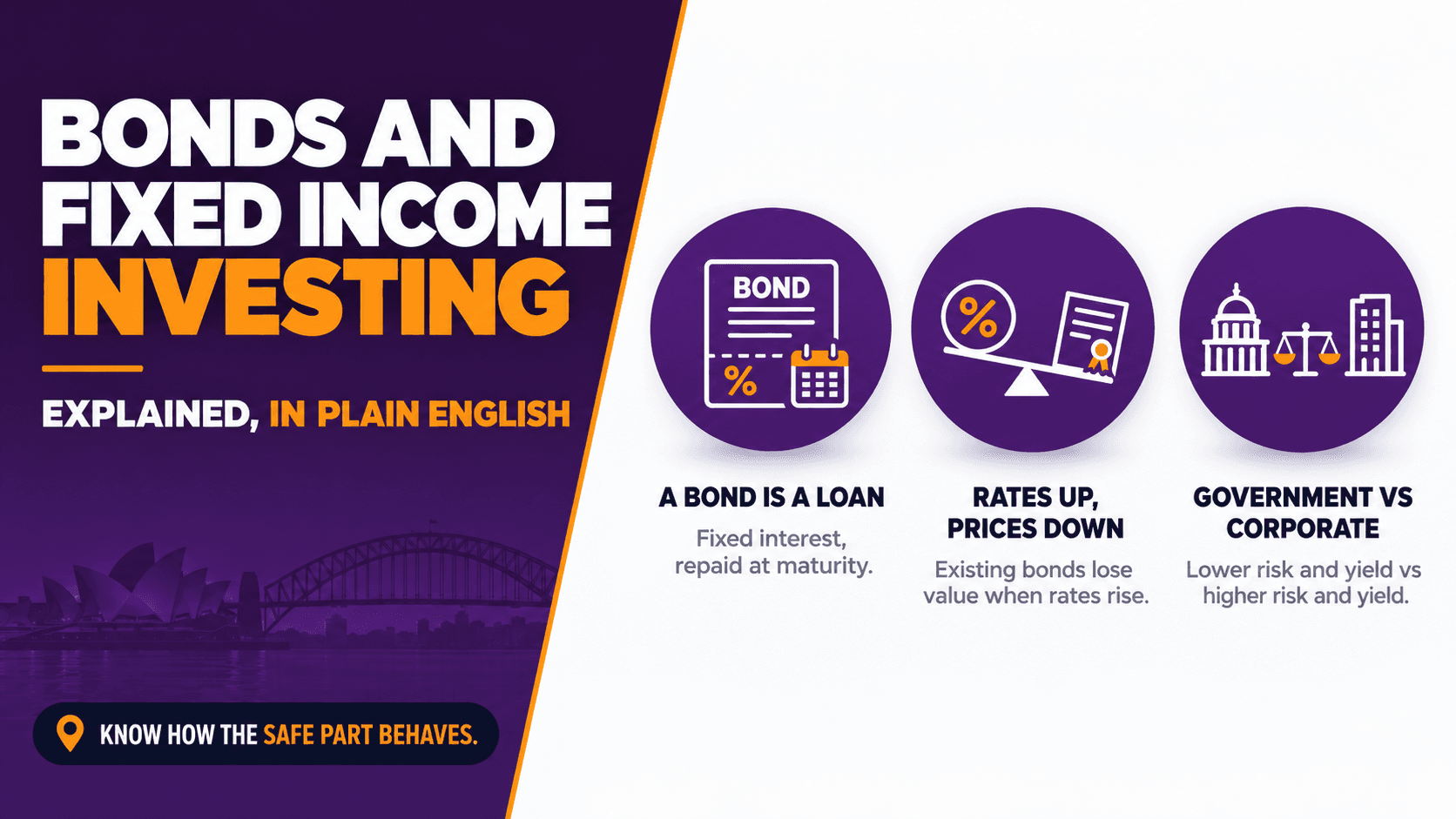
A bond is essentially a loan, an investor lends money to a government or company for a fixed period, receiving regular interest payments and the original amount back at maturity.
Bond prices and interest rates move inversely. When interest rates rise, existing bond prices generally fall, and vice versa, since newer bonds issued at higher rates make older, lower-rate bonds less attractive by comparison.
Government bonds (issued by the Australian government) are generally considered lower risk than corporate bonds (issued by companies), reflecting the different likelihood of default between a government and an individual business.
Bond duration measures sensitivity to interest rate changes, longer-duration bonds generally experience larger price swings for a given change in rates than shorter-duration bonds.
"Investment bonds," a different product entirely, despite the similar name, are a tax-paid insurance investment wrapper, not a loan to a government or company, and shouldn't be confused with the fixed income assets this guide actually covers.
Fixed income ETFs and funds offer a diversified, more accessible way to hold a broad spread of bonds without buying individual bonds directly, though they carry their own fee and tracking considerations.
Fixed income generally plays a defensive, income-generating role in a broader portfolio, reducing overall volatility alongside growth assets like shares, though it isn't risk-free, and shouldn't be assumed immune to loss.
Bottom line: bonds and fixed income genuinely do provide diversification and income, but they aren't a "set and forget, never loses value" asset class, understanding the interest rate relationship is essential to using them properly in a portfolio.
On This Page
What a Bond Actually Is
Why Bond Prices Move Inversely to Interest Rates
Government Bonds vs Corporate Bonds
Understanding Bond Duration and Interest Rate Sensitivity
Don't Confuse This With "Investment Bonds"
Fixed Income ETFs and Funds vs Direct Bonds
Worked Example: A Rate Rise and Its Effect on a Bond Holding
Common Mistakes
FAQ
What a Bond Actually Is
A bond is fundamentally a loan. An investor lends a fixed amount of money to a government or company for a defined period, receiving regular interest payments (often called the coupon) throughout that period, and the original amount lent back, the face value, at the bond's maturity date. This structure is what gives bonds their reputation for predictability, the interest payments and eventual repayment are generally known in advance, assuming the issuer doesn't default.
Not sure how bonds or fixed income might fit into your broader portfolio alongside shares? A free 15-minute chat with WIAA can help you think it through. Call 1800 942 843 or book online.
Bottom line: a bond is a loan with a defined interest rate and repayment date, the predictability of those known future payments is the foundation of what makes bonds behave differently to shares.
Why Bond Prices Move Inversely to Interest Rates
This is the single most important, and most commonly misunderstood, mechanic in fixed income investing. If an investor holds a bond paying a fixed interest rate, and broader interest rates then rise, newly issued bonds will offer that higher rate, making the investor's existing, lower-rate bond less attractive by comparison. To remain competitive if sold before maturity, that existing bond's price in the secondary market generally falls, so that its effective yield to a new buyer lines up with current market rates. The reverse happens when interest rates fall, existing higher-rate bonds become more attractive, and their market price generally rises.
Bottom line: rising interest rates generally push existing bond prices down, and falling rates generally push them up, this inverse relationship is the core mechanic anyone holding bonds needs to understand.
Government Bonds vs Corporate Bonds
Government bonds, issued by the Australian government (commonly referred to as Treasury bonds), are generally considered lower risk, since a government defaulting on its own currency-denominated debt is considered a lower likelihood event than an individual company defaulting.
Corporate bonds, issued by companies to raise capital, generally carry a higher risk of default than government bonds, and correspondingly tend to offer a higher interest rate (yield) to compensate investors for that additional risk.
Credit ratings, provided by rating agencies, assess the relative default risk of a specific bond issuer, generally used by investors to compare risk across different corporate (and some government) bond issuers.
Bottom line: government bonds generally sit at the lower-risk, lower-yield end of the fixed income spectrum, while corporate bonds offer potentially higher yield in exchange for genuinely higher default risk.
Understanding Bond Duration and Interest Rate Sensitivity
Duration is a measure of how sensitive a bond's price is to changes in interest rates, generally correlated with the bond's time to maturity, a bond with a longer time until maturity generally has a higher duration, and therefore experiences a larger price swing for a given change in interest rates than a shorter-duration bond. This means a 20-year government bond and a 2-year government bond, even from the same issuer, can behave very differently in price when interest rates move, despite both being considered low default-risk.
Understanding how duration affects your specific fixed income holdings is a genuinely important part of assessing interest rate risk in a portfolio. A free 15-minute chat can help review this. Email clientservices@whatifadvice.com.au or book online.
Bottom line: duration, not just whether a bond is government or corporate, is what determines how much a bond's price actually moves when interest rates change.
Don't Confuse This With "Investment Bonds"
This is a genuinely common point of confusion worth addressing directly: an "investment bond" in the Australian context is an entirely different product to the bonds and fixed income assets covered in this guide. An investment bond is a tax-paid life insurance investment wrapper, offering a specific tax structure after a holding period, generally used for estate planning or tax-effective savings purposes, not a loan to a government or company. If you're researching investment bonds as a savings vehicle, our dedicated guide on investment bonds for education funding covers that product specifically, a separate topic entirely from the fixed income asset class discussed here.
Bottom line: "bonds" (the fixed income asset class) and "investment bonds" (a specific tax-paid insurance wrapper product) share a name but are genuinely unrelated products, worth keeping clearly distinct.
Fixed Income ETFs and Funds vs Direct Bonds
Rather than purchasing individual bonds directly, which can require a larger minimum investment and more individual research, many investors access fixed income through ETFs or managed funds holding a diversified basket of bonds. This offers genuine diversification across many issuers and maturities in a single, more accessible investment, though it comes with its own considerations, management fees, and the fact that a bond fund's price can behave somewhat differently to holding an individual bond directly to maturity, since the fund itself doesn't have a fixed maturity date the way an individual bond does.
Bottom line: fixed income ETFs and funds offer accessible diversification across many bonds at once, though they operate somewhat differently to holding an individual bond directly through to its specific maturity date.
Worked Example: A Rate Rise and Its Effect on a Bond Holding
An investor holds a 10-year Australian government bond purchased at face value of $10,000, paying a fixed 3% annual interest rate. A year later, interest rates in the broader market rise significantly, and newly issued 10-year government bonds are now offering 4.5%.
If the investor wanted to sell their existing 3% bond before maturity, a buyer would only be willing to pay a reduced price for it, since a rational buyer could instead purchase a new bond offering a higher 4.5% rate for the same money. The investor's original bond's market price falls to reflect this, even though nothing about the bond's own fixed interest payments or its government issuer's creditworthiness has changed.
Outcome: the investor's bond is still paying its original, fixed 3% interest rate exactly as agreed, and will still return the full $10,000 face value at maturity if held to that point, but its current market price, if sold before maturity, has fallen purely due to the change in broader interest rates.
Bottom line: the investor's bond itself didn't become a worse investment, its mark-to-market price simply reflects a different interest rate environment than when it was purchased, a distinction that matters enormously depending on whether the investor plans to hold to maturity or sell early.
Common Mistakes
Assuming bonds never lose value. Bond prices move, sometimes significantly, particularly in response to interest rate changes, and a bond sold before maturity can realise a loss.
Confusing "investment bonds" with the bonds and fixed income asset class. These are genuinely different products despite the similar name.
Not considering duration when assessing interest rate risk. A longer-duration bond can behave very differently to a shorter-duration bond from the same issuer when rates move.
Assuming corporate bonds and government bonds carry the same risk level. Corporate bonds generally carry meaningfully higher default risk, reflected in their higher yield.
Treating a bond fund the same as holding an individual bond to maturity. A fund doesn't have the same fixed maturity date structure as an individual bond held directly.
Understanding how bonds and fixed income genuinely behave, not just their reputation as "the safe part" of a portfolio, is worth getting right before relying on them for a specific purpose. A free 15-minute chat can help you think through where fixed income fits in your own portfolio. Call 1800 942 843.
FAQ
Can I lose money investing in bonds? Yes, if sold before maturity during a period when interest rates have risen, a bond's market price can be lower than the purchase price, this is a genuine risk, not a theoretical one.
What's the difference between a bond's interest rate and its yield? The interest rate (coupon) is the fixed payment set when the bond is issued, while yield reflects the actual return based on the bond's current market price, which can differ from the original coupon rate once the bond is trading in the secondary market.
Are government bonds completely risk-free? They're generally considered very low default risk, but not entirely risk-free, their market price can still fluctuate with interest rate changes even if default risk itself is minimal.
Is an "investment bond" the same as a government or corporate bond? No, despite the similar name, an investment bond is a tax-paid insurance investment wrapper, a completely different product to the fixed income assets covered in this guide.
Should I hold bonds directly or through an ETF or fund? This depends on individual circumstances, direct bonds offer a fixed maturity date and known repayment, while funds offer broader diversification and accessibility but behave somewhat differently without that same fixed maturity structure.
Why do corporate bonds pay a higher interest rate than government bonds? To compensate investors for the generally higher risk of a company defaulting compared to a government, higher risk is generally compensated with higher potential yield.
What is bond duration and why does it matter? Duration measures how sensitive a bond's price is to interest rate changes, generally correlated with time to maturity, understanding it helps assess how much a specific bond's price might move if rates change.
Are bonds a good investment for retirees? Fixed income can play a genuinely useful role for retirees seeking income and reduced volatility, though the specific allocation and bond types should reflect individual circumstances and risk tolerance.
Do bond prices always fall when interest rates rise? Generally, yes, for existing bonds in the secondary market, this inverse relationship is a consistent and fundamental mechanic of how bonds are priced relative to prevailing rates.
How much of a portfolio should typically be in bonds or fixed income? This depends entirely on individual goals, risk tolerance, and timeframe, there's no universal percentage that applies to everyone, and it's worth assessing specifically for your own situation.
Ready to Understand Where Fixed Income Actually Fits in Your Portfolio?
Bonds genuinely offer diversification and income, but they aren't immune to loss, and understanding the interest rate relationship is essential to using them properly. A free 15-minute chat can help you think it through.
Call us: 1800 942 843
Book online: free 15-minute chat, no cost, no pressure
Still asking what if.
WIAA has helped Australians understand what fixed income actually does in a portfolio, beyond its "safe asset" reputation, across Toowong, Grange, and Melbourne CBD. WIAA operates under AFSL 528250 as an Authorised Representative of Beryllium Advisers Pty Ltd.
General Advice Disclaimer: This article contains general information only and does not take into account your personal objectives, financial situation, or needs. It is not personal financial advice and should not be relied upon as such. Bond prices, yields, and credit ratings change over time and should be verified with current market data or a qualified adviser before making any investment decision.