Looking for specific financial advice?
This blog provides general educational content. For personalized advice tailored to your unique situation, book a free consultation with our team of ASIC-licensed financial advisers.
What If You Find Your Next Home Before You've Sold Your Current One?
Timing a property purchase and sale to land on the same settlement date is genuinely difficult, and often comes down to luck as much as planning. A bridging loan exists to solve the gap in between, letting a buyer purchase before their existing property has sold, without needing to rely on that perfect timing. What it isn't is a free pass, bridging finance comes with genuinely higher interest costs and a structure that assumes the existing property sells within a defined window, and getting that assumption wrong is where bridging loans become expensive fast.
TL;DR
A bridging loan allows a buyer to purchase a new property before their existing property has sold, temporarily covering both properties at once.
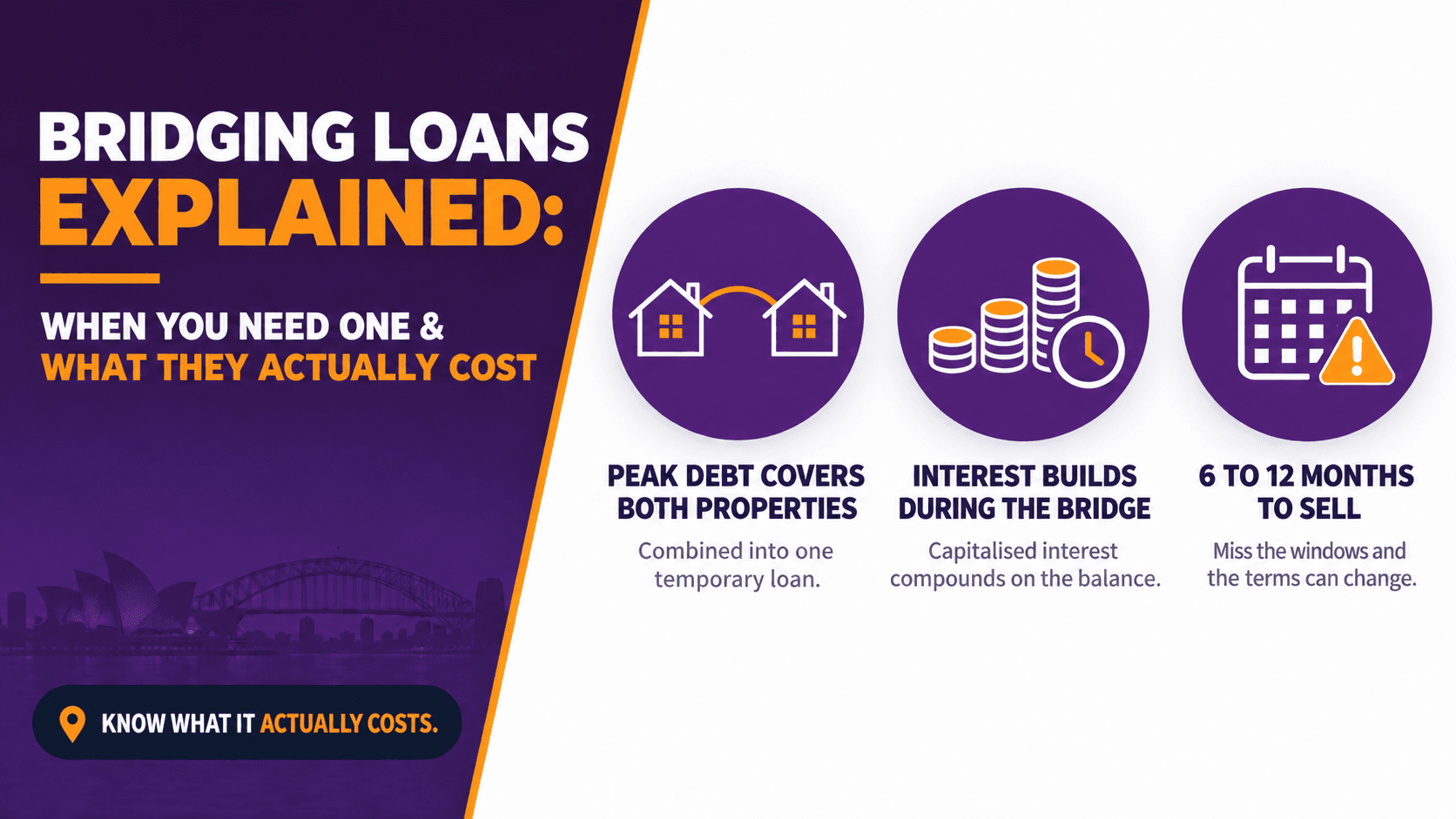
Peak debt is the combined loan amount covering both properties during the bridging period, generally the figure used to calculate interest during that time.
Interest during the bridging period is often capitalised, added to the loan balance rather than paid monthly, meaning the debt grows during the bridging term itself.
Bridging loan interest rates are typically higher than a standard home loan rate, reflecting the short-term, higher-risk nature of the lending.
Lenders generally require a defined bridging period, commonly 6 to 12 months, within which the existing property needs to sell, with consequences if that timeline isn't met.
End debt, the ongoing loan remaining once the existing property sells and its proceeds pay down the peak debt, becomes the standard, ongoing home loan going forward.
Bridging loans genuinely suit specific situations (a strong seller's market, a must-have property, genuine confidence in a fast sale) and are a poor fit for others (an uncertain or slow-moving market for the existing property).
Bottom line: a bridging loan solves a genuine timing problem, but it does so by charging a premium for that flexibility, and the real cost depends heavily on how quickly the existing property actually sells.
On This Page
How a Bridging Loan Actually Works
Peak Debt, Capitalised Interest, and End Debt
What Bridging Loans Actually Cost
When a Bridging Loan Genuinely Makes Sense
When It's a Poor Fit
What Happens If the Property Doesn't Sell in Time
Worked Example: The Real Cost of a Six-Month Bridge
Common Mistakes
FAQ
How a Bridging Loan Actually Works
A bridging loan temporarily funds the purchase of a new property while the buyer's existing property is still on the market, or under contract but not yet settled. Structurally, the lender combines the outstanding balance on the existing property with the loan needed for the new purchase into a single, larger peak debt, held for a defined bridging period. Once the existing property sells and settles, the sale proceeds are used to pay down that peak debt, leaving a smaller, ongoing end debt, which then continues as a standard home loan.
Not sure whether a bridging loan is the right tool for your specific timing situation? A free 15-minute chat with WIAA can walk through the numbers. Call 1800 942 843 or book online.
Bottom line: a bridging loan is fundamentally a temporary, larger loan covering two properties at once, designed to be paid down to a smaller ongoing loan once the first property actually sells.
Peak Debt, Capitalised Interest, and End Debt
Three specific terms are worth understanding clearly:
Peak debt is the combined total owed during the bridging period, the remaining balance on the existing property plus the loan for the new one, and it's generally the figure interest is calculated against during that period.
Capitalised interest refers to interest that's added to the loan balance rather than paid monthly out of pocket during the bridging period, common with bridging loans since the borrower is often managing two properties' worth of costs simultaneously. This means the debt itself grows during the bridging term, and that growth needs to be paid down once the existing property sells.
End debt is what remains once the existing property sells and its proceeds pay down the peak debt (including any capitalised interest accrued), becoming the ongoing loan balance going forward on the new property alone.
Bottom line: peak debt is the temporary, larger figure during the bridge, capitalised interest is the cost that quietly builds on top of it, and end debt is what's actually left once the dust settles.
What Bridging Loans Actually Cost
Bridging loan interest rates are typically higher than a standard variable or fixed home loan rate, reflecting the short-term nature and additional risk lenders take on. Specific rates and fee structures vary by lender and should be compared directly and verified at the time of application, rather than assumed from a general market figure. Beyond the headline interest rate, borrowers should also account for the effect of capitalised interest compounding onto the peak debt over the bridging period, and any application or establishment fees specific to bridging finance, which can differ from a standard home loan's fee structure.
Bridging loan costs vary significantly by lender and by how long the bridging period actually runs. A free 15-minute chat can help compare real options for your situation. Email clientservices@whatifadvice.com.au or book online.
Bottom line: the headline rate is only part of the cost, capitalised interest compounding over the bridging period and lender-specific fees both materially affect the true cost of a bridging loan.
When a Bridging Loan Genuinely Makes Sense
Bridging finance tends to suit specific situations well:
A strong, fast-moving seller's market, where genuine confidence exists that the existing property will sell within the bridging period.
A must-have property opportunity, where losing the new property to another buyer by waiting to sell first is a real and costly risk.
A buyer with sufficient serviceability and equity to comfortably support the peak debt during the bridging period, even before the existing property sells.
A genuinely temporary, defined gap, rather than an open-ended uncertainty about when the existing property might sell.
Bottom line: bridging finance is a genuinely useful tool specifically when there's real confidence in a fast, defined sale timeline, not a general solution for an uncertain or open-ended property transition.
When It's a Poor Fit
Bridging loans tend to work poorly in the opposite situations:
A slow or uncertain property market, where the existing property might take considerably longer than the bridging period to sell.
A borrower without sufficient buffer to absorb a longer-than-expected bridging period or a lower-than-expected sale price on the existing property.
A situation where the existing property has known issues that could delay a sale, such as needed repairs, unclear title matters, or a genuinely difficult-to-sell property type.
Bottom line: the risk in a bridging loan isn't the tool itself, it's what happens if the existing property takes longer to sell, or sells for less, than assumed when the bridge was first arranged.
What Happens If the Property Doesn't Sell in Time
If the existing property hasn't sold by the end of the agreed bridging period, the consequences depend on the specific lender's terms, but can include the bridging loan reverting to a higher standard variable rate, the lender requiring the property to be sold at a reduced price to achieve a sale, or in some cases refinancing being required to manage the ongoing debt. This scenario, an unsold property beyond the bridging window, is the single biggest risk in bridging finance, and it's exactly why realistic, conservative assumptions about the existing property's likely sale timeline matter more than optimistic ones when deciding whether to bridge at all.
Bottom line: the bridging period isn't just an administrative timeframe, it's the point at which the loan's cost and terms can change meaningfully if the existing property hasn't sold, which makes a realistic sale timeline the single most important input into the decision.
Worked Example: The Real Cost of a Six-Month Bridge
(The rate used below is illustrative only, for demonstration purposes. Actual bridging loan rates vary by lender and should be confirmed directly at the time of application, not assumed from this example.)
The Nguyens' existing property has a remaining loan balance of $350,000. They find a new property they want to buy for $750,000, and arrange a bridging loan with a peak debt of $1,100,000 (the existing $350,000 balance plus the new $750,000 purchase), with interest capitalised during the bridging period rather than paid monthly.
Over a six-month bridging period, at an illustrative bridging rate of around 8.5% (roughly 2 percentage points above a typical standard home loan rate at the time), the capitalised interest adds approximately $39,000 to their peak debt over the six months, on top of the $1,100,000 starting figure. Their existing property sells in month five for $480,000, with the sale proceeds used to pay down the peak debt (including the capitalised interest that's accrued), leaving an end debt on the new $750,000 property of roughly $659,000, reflecting the original purchase loan plus the additional capitalised interest cost from the five months of bridging, once the sale proceeds are applied.
Outcome: the Nguyens successfully secured their new property without a settlement-timing clash, but their end debt on the new property ended up meaningfully higher than a straightforward $750,000 loan would have been, specifically because of the capitalised interest accrued during the five-month bridge.
Bottom line: even a successful bridging outcome, where the existing property sells within the agreed window, still carries a real capitalised interest cost that ends up folded into the ongoing loan.
Common Mistakes
Assuming the existing property will sell faster than the local market realistically supports. An optimistic sale timeline is the single biggest risk factor in bridging finance.
Underestimating the effect of capitalised interest compounding over the bridging period. The debt grows during the bridge itself, not just from the two headline loan amounts.
Not comparing bridging loan rates and fees across multiple lenders. These vary meaningfully, and the headline rate isn't the only cost that differs.
Overestimating the eventual sale price of the existing property when calculating expected end debt. A lower-than-expected sale price directly increases the remaining end debt.
Not having a buffer plan if the bridging period expires before the existing property sells. Understanding what happens in that scenario before it happens is far better than discovering it under pressure.
Getting a realistic read on your existing property's likely sale timeline is the single most important input before taking on a bridging loan. A free 15-minute chat can help stress-test the numbers. Call 1800 942 843.
FAQ
How is a bridging loan different from a standard home loan? A bridging loan temporarily covers both an existing and a new property at once through a combined peak debt, generally with capitalised interest, whereas a standard home loan covers a single property with regular repayments from the outset.
How long does a bridging loan typically last? Bridging periods commonly run 6 to 12 months, though the specific term depends on the lender and the borrower's circumstances, and should be confirmed directly with the lender for the specific arrangement.
Do I need to make repayments during the bridging period? Often interest is capitalised rather than paid monthly during the bridging period, meaning it's added to the loan balance instead of requiring an out-of-pocket repayment, though this varies by lender and loan structure.
What happens if my existing property sells for less than expected? A lower sale price means less is available to pay down the peak debt, generally resulting in a higher end debt on the new property than originally anticipated.
What happens if my existing property doesn't sell within the bridging period? This depends on the specific lender's terms, but can include the loan reverting to a higher rate, a required price reduction to achieve a sale, or refinancing, making a realistic sale timeline important before entering a bridging arrangement.
Is a bridging loan more expensive than a standard home loan? Generally, yes, bridging loan interest rates are typically higher than standard home loan rates, reflecting the short-term and higher-risk nature of the lending, and this should be factored into the overall cost comparison.
Can I use a bridging loan if I haven't found a buyer for my existing property yet? This depends on the lender, some require the existing property to at least be on the market, while specific requirements around this vary and should be confirmed directly.
Is a bridging loan the same as buying subject to sale? No, these are different mechanisms, a bridging loan involves temporary finance covering both properties, while a subject-to-sale purchase makes the new purchase contract conditional on the existing property selling, without necessarily requiring bridging finance at all.
How is peak debt different from end debt? Peak debt is the combined, temporary total owed during the bridging period covering both properties, while end debt is what remains once the existing property sells and its proceeds pay down that peak debt.
Should I get pre-approval before looking for a bridging loan? Generally, yes, understanding lending capacity and likely terms before committing to a purchase timeline is worth doing early, particularly given the added complexity of bridging finance compared to a standard loan.
Ready to Work Out If a Bridging Loan Makes Sense for You?
Bridging finance can solve a genuine timing problem, but the real cost depends heavily on how realistic the sale timeline for your existing property actually is. A free 15-minute chat can help stress-test the numbers.
Call us: 1800 942 843
Book online: free 15-minute chat, no cost, no pressure
Still asking what if.
WIAA has helped Australians weigh up bridging finance against the real cost and risk involved, across Toowong, Grange, and Melbourne CBD. WIAA operates under AFSL 528250 as an Authorised Representative of Beryllium Advisers Pty Ltd.
General Advice Disclaimer: This article contains general information only and does not take into account your personal objectives, financial situation, or needs. It is not personal financial advice and should not be relied upon as such. Bridging loan rates, fees, and terms vary by lender and are subject to change, and should be verified directly with the relevant lender or a mortgage broker for your specific circumstances.