Looking for specific financial advice?
This blog provides general educational content. For personalized advice tailored to your unique situation, book a free consultation with our team of ASIC-licensed financial advisers.
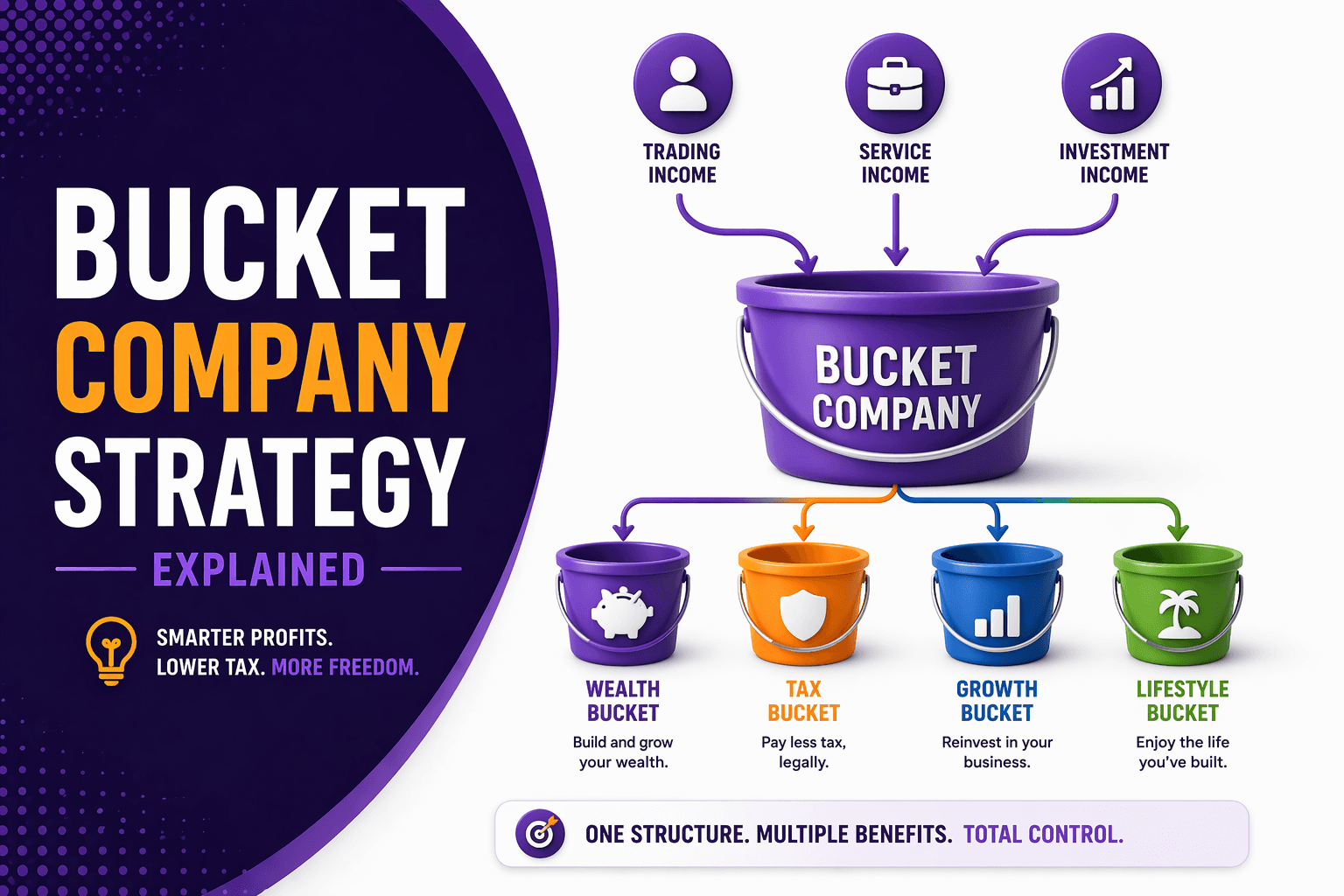
Bucket Company Strategy Explained for Australian Business Owners
A bucket company is one of the most common tax strategies used with discretionary trusts in Australia.
Used correctly, it can:
Cap tax at the company rate (typically 25%)
Retain profits for future use
Provide flexibility in distribution timing
Used incorrectly, it can:
Trigger Division 7A issues
Create compliance problems
Lead to unexpected tax outcomes
Here’s how it actually works.
What Is a Bucket Company?
A bucket company is:
A company used as a beneficiary of a discretionary trust to receive income distributions.
Instead of distributing all trust income to individuals:
Some income is distributed to a company
Tax is paid at the company rate
Why Use a Bucket Company?
1. Cap Tax at a Lower Rate
Individuals:
Taxed up to 45% + Medicare levy
Companies:
Typically taxed at 25% (for base rate entities, subject to ATO rules)
This creates a tax deferral opportunity
2. Retain Profits for Future Use
Income distributed to a bucket company:
Can be retained
Used later for:
Investment
Business expansion
Future dividends
3. Flexibility in Income Distribution
A discretionary trust allows:
Distribution to individuals or companies
You can choose:
Who receives income each year
Based on tax position
How a Bucket Company Structure Works
Basic Setup
Business operates through a trust
Trust generates profit
Income is distributed:
To individuals (up to tax thresholds)
Excess to bucket company
Example
Trust profit: $200,000
Distribution:
$80,000 to individual (lower tax bracket)
$120,000 to bucket company
Outcome:
Reduced overall tax burden
Remaining funds taxed at company rate
Where Things Get Risky: Division 7A
Here’s where people get into trouble.
If profits are:
Distributed to a company
But not actually paid (left as unpaid entitlement)
This creates:
Unpaid Present Entitlement (UPE)
ATO may treat this as:
A loan to the trust
Which can trigger:
Division 7A
What This Means
If not structured correctly:
The amount can be treated as a deemed dividend
Taxed in the hands of shareholders
How to Stay Compliant
1. Manage UPEs Properly
Options include:
Paying the amount to the company
Placing funds on complying loan terms
2. Use Division 7A Loan Agreements
If funds remain in the trust:
Must follow:
ATO benchmark interest rate
Minimum yearly repayments
Formal agreement
3. Keep Clean Documentation
You need:
Distribution resolutions
Loan agreements
Accurate accounting records
4. Review Annually
Bucket company strategies are:
Not “set and forget”
Must be reviewed each financial year
When a Bucket Company Makes Sense
It may be suitable if:
You operate through a discretionary trust
You’re generating significant profit
You want to defer personal tax
You’re reinvesting profits
When It May Not Be Suitable
Avoid or reconsider if:
Profits are low
You need all income personally
You don’t want additional compliance
You don’t understand Division 7A risks
Example Scenario
Without Bucket Company
Profit: $180,000
Distributed to individual
Taxed at marginal rates
With Bucket Company
$90,000 to individual
$90,000 to company
Outcome:
Lower immediate tax
Funds retained in company
Common Mistakes
1. Treating Company Money as Personal Money
This triggers Division 7A issues.
2. Ignoring UPE Rules
This is the most common compliance failure.
3. No Strategy for Retained Funds
Money sits idle with no purpose.
4. Overcomplicating Structures
More entities ≠ better outcomes.
Strategic Insight: Bucket Companies Are About Timing, Not Avoidance
This is not:
“Avoid tax forever”
It’s:
“Control when and how tax is paid”
Used correctly:
You defer tax
You manage cash flow
You build long-term wealth
Used poorly:
You create compliance risks
When Should You Get Advice?
You should seek advice if:
You operate a trust
Your profits are growing
You’re considering a company beneficiary
You’re unsure about Division 7A
Because:
The structure only works if it’s implemented properly.
FAQs
1. What is a bucket company?
A company used as a beneficiary of a trust to receive income distributions and cap tax at company rates.
2. How does a bucket company reduce tax?
By distributing income to a company taxed at a lower rate than individual marginal rates.
3. What is a UPE?
An unpaid present entitlement, income allocated but not paid to the beneficiary.
4. Does Division 7A apply to bucket companies?
Yes, particularly where UPEs are involved.
5. Can I access money in a bucket company?
Yes, but it must be done properly (e.g. dividends or loans).
6. Is a bucket company always beneficial?
No. It depends on profit levels, structure, and strategy.
7. What is the biggest risk?
Incorrect handling of UPEs and Division 7A compliance.
Using a Bucket Company or Thinking About It?
This strategy can be powerful, but only when structured correctly.
At What If Advice, we help business owners:
Implement bucket company strategies properly
Manage Division 7A compliance
Align tax strategy with long-term goals
Book a strategy session to ensure your structure works efficiently and compliantly.
Disclaimer
This information is general in nature and does not take into account your personal objectives, financial situation, or needs. You should consider whether it is appropriate for your circumstances and seek professional advice. Taxation laws, including Division 7A and trust distribution rules, are subject to change and ATO interpretation.