Looking for specific financial advice?
This blog provides general educational content. For personalized advice tailored to your unique situation, book a free consultation with our team of ASIC-licensed financial advisers.
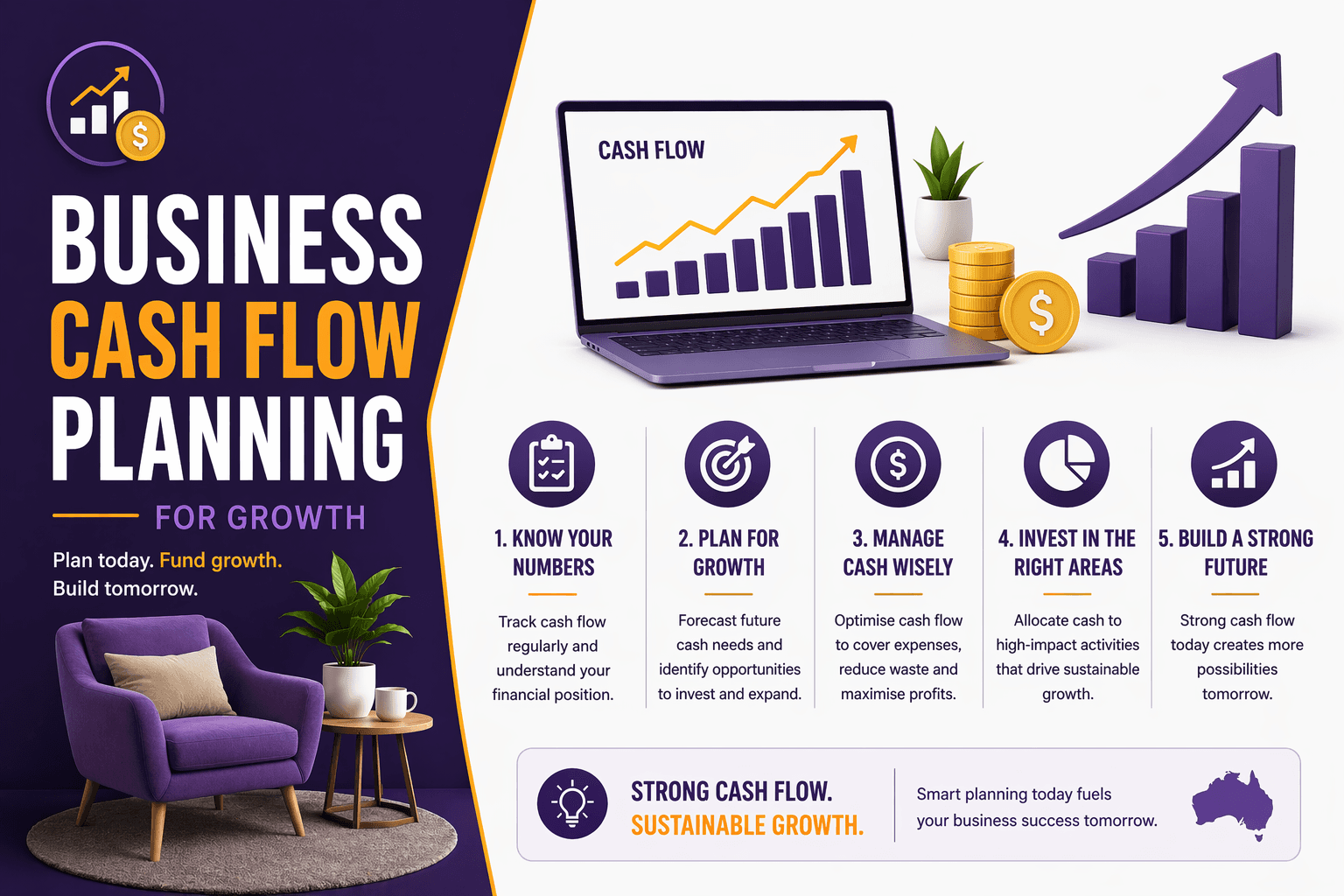
Business Cash Flow Planning for Growth in Australia
Profit is important. Cash flow is survival.
You can be profitable on paper and still run out of money.
You can also manage cash flow well and create the capacity to grow faster than your competitors.
Cash flow planning is what turns:
Revenue into usable capital
Business activity into sustainable growth
Here’s how to approach it properly.
What Is Cash Flow Planning?
Cash flow planning is the process of:
Tracking money coming in
Managing money going out
Forecasting future cash needs
It answers one critical question:
“Will I have enough cash when I need it?”
Cash Flow vs Profit (Why It Matters)
Profit | Cash Flow |
Accounting measure | Real money movement |
Can include unpaid invoices | Only counts actual cash |
Doesn’t guarantee liquidity | Determines survival |
Example:
$100,000 profit
$80,000 unpaid invoices
You don’t have $100,000 to spend.
Why Cash Flow Planning Drives Growth
1. Funds Expansion
Growth requires:
Hiring
Marketing
Inventory
All of which require cash upfront.
2. Reduces Risk
Poor cash flow leads to:
Missed payments
Debt reliance
Business stress
3. Improves Decision-Making
With clear cash visibility:
You invest confidently
You avoid reactive decisions
Step 1: Build a Cash Flow Forecast
Start with a simple 3–6 month forecast.
Include:
Expected income
Fixed expenses
Variable costs
Tax obligations
Example Forecast
Month | Cash In | Cash Out | Net |
Jan | $50,000 | $40,000 | +$10,000 |
Feb | $30,000 | $45,000 | -$15,000 |
This shows upcoming pressure before it happens.
Step 2: Improve Cash Inflows
1. Invoice Faster
Delay in invoicing = delay in cash.
2. Tighten Payment Terms
Shorter payment periods
Upfront deposits
3. Follow Up Outstanding Payments
Unpaid invoices are not assets. They’re problems.
4. Offer Incentives for Early Payment
Small discounts
Faster cash cycle
Step 3: Control Cash Outflows
1. Review Expenses Regularly
Cut:
Unused subscriptions
Inefficient costs
2. Negotiate Supplier Terms
Extend payment terms where possible.
3. Time Large Purchases Strategically
Avoid draining cash at the wrong time.
Step 4: Manage Working Capital
Working capital = current assets – current liabilities
In practical terms:
Inventory
Receivables
Payables
Optimising this improves:
Cash availability without increasing revenue
Step 5: Plan for Tax Obligations
One of the biggest mistakes:
Forgetting tax is coming
You should:
Set aside GST
Plan for income tax
Review BAS regularly
Subject to current ATO rules.
Step 6: Build a Cash Buffer
A buffer protects against:
Revenue dips
Unexpected costs
Typical target:
2–6 months of operating expenses
Step 7: Align Cash Flow With Growth Strategy
Growth without cash planning leads to:
Overextension
Debt reliance
Instead:
Match spending to cash availability
Scale sustainably
Example Scenario
Business Without Planning
Growing revenue
Poor cash tracking
Outcome:
Cash shortages
Stress despite growth
Business With Planning
Forecast in place
Controlled expenses
Strategic reinvestment
Outcome:
Stable growth
Predictable cash position
Same revenue. Completely different experience.
Common Cash Flow Mistakes
1. Confusing Profit with Cash
They are not the same thing.
2. No Forecasting
Operating blindly creates risk.
3. Over-investing Too Early
Growth without cash support leads to failure.
4. Ignoring Tax Liabilities
ATO doesn’t accept “cash flow issues” as an excuse.
5. Poor Debtor Management
Uncollected revenue kills cash flow.
Strategic Insight: Cash Flow Is Your Growth Engine
Most businesses focus on:
“How do I make more money?”
Better question:
“How do I control and deploy the money I already generate?”
Because:
Growth is funded by cash
Not just revenue
When Should You Get Advice?
You should consider advice if:
Your revenue is growing but cash feels tight
You’re planning to scale
You’re unsure how much you can safely reinvest
You want to improve financial control
Because:
Cash flow problems don’t show up gradually, they hit suddenly.
FAQs
1. What is cash flow planning?
It’s the process of managing and forecasting money coming in and going out of your business.
2. Why is cash flow more important than profit?
Because cash determines your ability to pay expenses and operate.
3. How far ahead should I forecast cash flow?
At least 3–6 months, ideally longer.
4. What is a cash flow buffer?
Savings set aside to cover expenses during low-income periods.
5. How can I improve cash flow quickly?
Invoice faster, collect payments sooner, and reduce unnecessary expenses.
6. Should I reinvest all profits into growth?
Not always. Balance growth with cash stability.
7. What is the biggest cash flow mistake?
Not planning ahead.
Growing Your Business, But Cash Feels Tight?
Growth should create opportunity, not stress.
At What If Advice, we help business owners:
Build clear cash flow strategies
Plan for sustainable growth
Improve financial control and confidence
Book a strategy session to take control of your cash flow, and your growth.
Disclaimer
This information is general in nature and does not take into account your personal objectives, financial situation, or needs. You should consider whether it is appropriate for your circumstances and seek professional advice. Financial and taxation rules are subject to change.