Looking for specific financial advice?
This blog provides general educational content. For personalized advice tailored to your unique situation, book a free consultation with our team of ASIC-licensed financial advisers.
What If Your $14,000 Course Fee Is Fully Deductible, or Not Deductible at All?
Two people enrol in courses costing the same amount. One gets back over $4,400 in tax. The other gets back $0. The difference isn't the course, the price, or the provider. It's the connection between the study and the job they're doing right now, and whether they paid the fees themselves. Self-education is one of the most valuable deductions available to employees, and one the ATO watches closely. This guide covers how to claim it correctly.
TL;DR
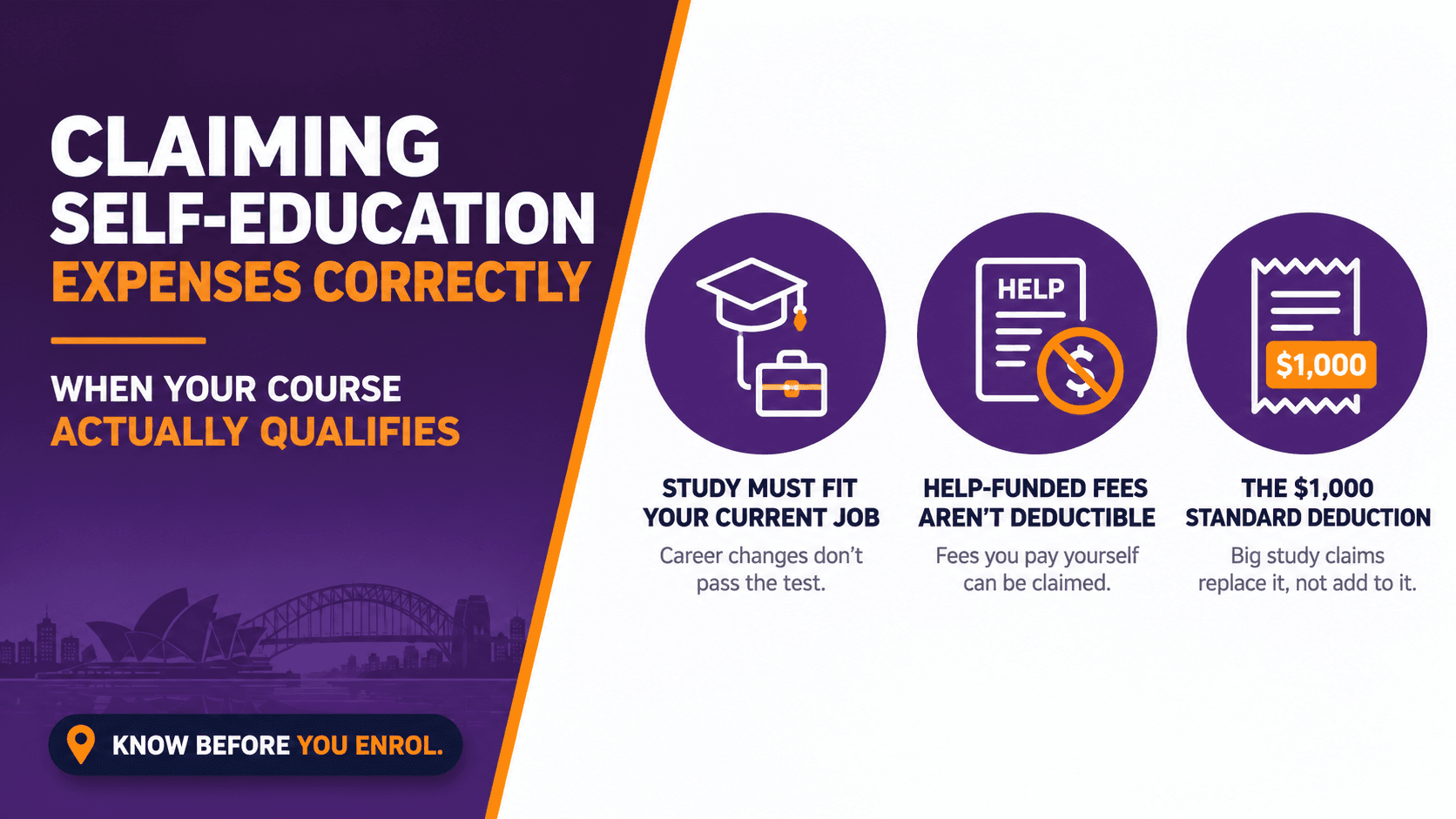
The study must connect to your current job. It has to maintain or improve skills you need now, or be likely to increase your income from your current work.
Study for a new job or a career change isn't deductible, however sensible the move.
Fees paid through HECS-HELP or FEE-HELP aren't deductible, and neither are HELP repayments. Fees you pay yourself can be.
The old $250 reduction is gone for expenses incurred from 1 July 2022, though outdated advice still repeats it.
Claimable costs include course fees, textbooks, stationery, digital subscriptions, the work-use portion of a laptop, and some travel.
In our worked example, a nurse's eligible study costs of $16,346 save about $5,231 in tax. Funding the same fees through FEE-HELP cuts that to about $751.
From 2026-27, self-education costs count toward the new $1,000 standard deduction, so a large study claim replaces it rather than adding to it.
Bottom line: self-education can be a large deduction, but only when the study connects to your current income and you pay for it yourself.
On This Page
The Connection Test: Does Your Study Qualify?
Where Claims Fail: Career Changes, New Jobs, and Grey Areas
What You Can and Can't Claim
The HELP Trap: Why Funding Method Matters
Travel to Study: Which Trips Count
Records, Timing, and the $250 Myth
Self-Education and the $1,000 Standard Deduction
Worked Example 1: Sophie, the Nurse Studying Critical Care
Worked Example 2: Two Retail Managers, Two Very Different Outcomes
Common Mistakes
FAQ
The Connection Test: Does Your Study Qualify?
The ATO's current ruling, TR 2024/3, replaced the long-standing TR 98/9. Self-education expenses are deductible when they're incurred to maintain or improve the knowledge or skills your current income-earning activities require. They can also qualify if the study leads to an increase in income from your current work.
In practice, ask yourself two questions:
Does this study maintain or improve skills I use in my current job? For example, an accountant completing a tax specialisation, or an electrician completing a solar installation course.
Is it likely to increase my income from my current work? For example, a nurse completing a qualification that's a formal requirement for a clinical nurse specialist role at the hospital where she already works. A real, identifiable opportunity for promotion in your current role can qualify. A vague hope of earning more someday generally won't.
If the honest answer to both is no, the claim generally fails.
Bottom line: the test is about your job today, not the job you want next.
Where Claims Fail: Career Changes, New Jobs, and Grey Areas
The ruling is clear that a deduction isn't available where study helps you get employment, obtain new employment, or open up a new income-earning activity. Future or dream jobs don't count.
Common situations where claims fail:
A career change. A retail manager studying software engineering to move into tech.
Study before you're working. If you aren't engaged in any income-earning activity when you incur the expense, it's generally not deductible.
General interest courses, such as a language or art class unrelated to your work.
Study partly connected to your work. Claims may be denied or apportioned when you're studying in one field and have picked up part-time or casual work in the same field. Only the connected portion may count.
Not sure whether your course passes the connection test? WIAA's registered tax agents can assess it before you lodge. Email tax@whatifadvice.com.au for a free 15-minute chat.
Bottom line: if the study opens a door to new work rather than improving your current work, expect the claim to fail.
What You Can and Can't Claim
Generally claimable (if the study qualifies) | Generally not claimable |
Course fees you pay yourself | Fees covered by HECS-HELP or FEE-HELP |
Textbooks, stationery, digital subscriptions | HELP repayments |
Work and study portion of internet and phone | Meals on a normal study day |
Laptop or equipment: items $300 or less immediately, dearer items over their effective life (study-use portion) | Childcare while you study |
Conference, seminar, and workshop fees | Costs your employer paid or reimbursed |
Some travel to and from your place of study | Study for a new career or job |
Accommodation and meals for required residential study away from home | Courses with no connection to current work |
Bottom line: the eligible list is broad, but every item depends on the study passing the connection test first.
The HELP Trap: Why Funding Method Matters
How you pay matters as much as what you study:
Fees you pay upfront yourself, including full fees or a Commonwealth supported place student contribution paid upfront, can be deductible if the study qualifies.
Fees covered by HECS-HELP or FEE-HELP aren't deductible. The tax law specifically denies a deduction for fees funded by HELP assistance.
HELP repayments made later through the tax system aren't deductible either.
For an expensive postgraduate course, this can be the single biggest factor in the claim. Worked Example 1 shows the difference in dollars. Paying upfront isn't automatically better. It ties up cash, and HELP debts are indexed rather than charged commercial interest, so the right funding choice depends on your full situation.
Bottom line: if fees go on a HELP loan, the largest part of a self-education claim usually disappears.
Travel to Study: Which Trips Count
Travel rules for self-education have their own quirks:
Generally claimable: travel from home to your place of study and back, and travel from work to your place of study.
Generally not claimable: the last leg home from your place of study when you travelled there directly from work.
Overnight study travel, such as a residential school or required interstate block, may let you claim accommodation and meals.
Car travel is generally claimed using the cents per kilometre or logbook method. The cents per kilometre rate is 88 cents for 2025-26 and 91 cents for 2026-27. The rate is set by the ATO and can change each year, so verify it before lodging.
Juggling work, study, and travel between them? A free 15-minute chat can help you get the travel component right. Call 1800 942 843 or book online.
Bottom line: some study travel counts and some doesn't, so log each trip, including where it started.
Records, Timing, and the $250 Myth
The $250 reduction no longer applies. Before 1 July 2022, allowable self-education expenses had to be reduced by $250. For expenses incurred from that date, you can claim all allowable expenses. Some guidance online still says otherwise, which is a good reason to check the date on any source before relying on it.
Keep these records:
Receipts and invoices for fees, books, and equipment.
Enrolment and course details, including subject outlines.
A note explaining how the course connects to your current role.
A travel log for study-related trips.
Your workings for apportioned costs like internet and laptop use.
Timing: claim expenses in the income year you incur them. Prepaid fees covering future periods can have timing rules, so check with your tax agent.
Bottom line: the paperwork is what turns a legitimate claim into a defensible one, and outdated rules can cost you money in either direction.
Self-Education and the $1,000 Standard Deduction
From the 2026-27 income year, eligible employees automatically receive a standard deduction of up to $1,000 for work-related expenses, with no receipts needed. Self-education costs count as work-related expenses, so any you claim reduce the standard deduction dollar for dollar. Your total work-related deduction is whichever is higher, your itemised claim or $1,000. You can't have both.
Two record-keeping changes also apply from 1 July 2026:
The $300 exception is gone. You can no longer claim up to $300 of work-related expenses without written evidence.
Claiming above the standard deduction means records for everything. If you itemise, you need written evidence for every work-related expense you claim, not just the amount above $1,000.
Because self-education costs often run well above $1,000, itemising will usually win, as Sophie's example shows. The ATO's detailed guidance on the standard deduction is still in draft, so verify current treatment with the ATO or a registered tax agent before lodging.
Bottom line: for most people paying for real study, the $1,000 standard deduction is the fallback, not the answer.
Worked Example 1: Sophie, the Nurse Studying Critical Care
Sophie is a registered nurse earning $92,000, which puts her on a 30% marginal rate plus the 2% Medicare levy (32% combined). She enrols in a postgraduate critical care qualification that improves skills she uses on the ward. She pays full fees upfront. Her 2025-26 claim:
Expense | Claim |
Course fees (paid upfront) | $14,000 |
Textbooks | $600 |
Laptop ($1,800, 2-year effective life, prime cost, held for the full year, 50% study and work use) | $450 |
Internet (25% of $960) | $240 |
Travel home to campus and back (1,200 km × 88c) | $1,056 |
Total | $16,346 |
Tax saving: $16,346 × 32% = $5,230.72. The deduction takes her taxable income to about $75,654, so she stays in the 30% bracket and the flat 32% calculation holds. A deduction this size could push someone else into a lower bracket, which would change the maths.
If Sophie used FEE-HELP instead: the $14,000 in fees comes off the claim, leaving $2,346. Her tax saving falls to $750.72, a difference of $4,480.
If she studies in 2026-27: with travel at 91 cents per km, her claim would be about $16,382. Itemising still wins by a wide margin, and defaulting to the $1,000 standard deduction would cost her roughly $4,900 in tax. Even on FEE-HELP, her remaining $2,382 of costs beats the default, but by only about $440, and she'd need written evidence for all of it.
Outcome: the course and the connection to her job are identical in every scenario. The funding method alone changes her deduction by $14,000. Paying upfront still meant finding $14,000 in cash, so the "better" option depends on her cash flow and other priorities.
Bottom line: before enrolling, compare the after-tax cost of paying upfront with deferring through HELP, not just the sticker price.
Weighing up upfront fees against FEE-HELP? We can run the after-tax numbers for your situation. Email tax@whatifadvice.com.au for a free 15-minute chat.
Worked Example 2: Two Retail Managers, Two Very Different Outcomes
Mia and Tom both earn $70,000 as retail store managers (32% including Medicare). Both spend $3,500 of their own money on study in 2025-26.
Mia completes a leadership and management diploma that improves the people management skills her current role requires. Her claim is $3,500, saving $1,120 in tax.
Tom starts a software development course to leave retail for a tech career. Because the study is aimed at new employment, his claim is $0.
Outcome: same cost, same salary, same job title. Mia's study improves the job she has, while Tom's is preparing for one he doesn't have yet. If Tom later lands a junior developer role and continues study that improves those skills, future costs could become deductible.
Bottom line: the same dollar spent on study can be fully deductible or not deductible at all, depending only on its connection to your current work.
Common Mistakes
Claiming study for a career change. Future or dream jobs don't count.
Claiming fees covered by HECS-HELP or FEE-HELP. You can only claim fees you've actually paid yourself.
Claiming HELP repayments. They aren't deductible.
Still applying the $250 reduction. It hasn't applied to expenses incurred from 1 July 2022, so applying it means under-claiming.
Claiming employer-paid or reimbursed courses. No out-of-pocket cost, no deduction.
Claiming 100% of a laptop or internet plan. Personal use has to be apportioned out.
Assuming study costs sit on top of the $1,000 standard deduction. From 2026-27, they reduce it. It's one or the other.
Not writing down how the course connects to your job. It's the first thing an ATO review will ask about.
Already lodged and worried a self-education claim won't hold up? Book a free 15-minute chat with WIAA's tax team to review it.
FAQ
Can I claim my university degree on tax?
Only if it has a sufficient connection to your current job, by maintaining or improving skills you need now or increasing your income from current work, and only for costs you've paid yourself.
Can I claim a course to change careers?
Generally no. Study that helps you get a new job or start a new income-earning activity isn't deductible.
Are HECS-HELP or FEE-HELP fees tax deductible?
No. Fees covered by these loans aren't deductible, and neither are HELP repayments.
Does the $250 self-education reduction still apply?
No. It was removed for expenses incurred from 1 July 2022. It only affects claims for 2021-22 or earlier years.
Can I claim study costs and the $1,000 standard deduction?
Not both. From 2026-27, self-education costs are work-related expenses that reduce the standard deduction dollar for dollar. You get whichever is higher.
Can I claim travel to and from university?
Often yes, including travel from home to your place of study and back, and from work to your place of study. The trip home from study after travelling there from work generally isn't claimable.
Can I claim my laptop if I use it for study?
Generally the study and work-use portion. Items costing $300 or less can be claimed immediately, while dearer items are claimed over their effective life.
What if my employer pays for my course?
You can't claim costs your employer paid or reimbursed. There may be fringe benefits tax implications for your employer instead.
I'm studying full-time and not working. Can I claim my course?
Generally no. Self-education expenses aren't deductible if you're not engaged in any income-earning activity when you incur them.
What records do I need for a self-education claim?
Receipts, enrolment details, a written note on how the course connects to your current role, and records of any study travel and apportioned costs. From 2026-27, if you itemise above the standard deduction, you need written evidence for every work-related expense you claim.
Ready to Claim Your Study Costs Correctly?
Self-education can be one of your biggest deductions, or one of the claims the ATO is most likely to question. Getting the connection test, funding method, and records right is what separates the two.
Call us: 1800 942 843
Email: tax@whatifadvice.com.au
Book online: free 15-minute chat, no cost, no pressure
Still asking what if?
WIAA helps Australians claim self-education and work-related deductions correctly across Toowong, Grange, and Melbourne CBD. WIAA is a registered tax agent practice with the Tax Practitioners Board and operates under AFSL 528250 as an Authorised Representative of Beryllium Advisers Pty Ltd.
General Advice Disclaimer: This article contains general information only and does not take into account your personal objectives, financial situation, or needs. It is not personal tax or financial advice and should not be relied upon as such. Self-education rules, the cents per kilometre rate, depreciation rules, HELP arrangements, record-keeping requirements, and the standard deduction for work-related expenses can change, and ATO guidance on the standard deduction is still in draft. Verify current rules with the ATO or a registered tax agent before lodging. Worked examples are illustrative and simplified. Seek professional advice for your own circumstances.