Looking for specific financial advice?
This blog provides general educational content. For personalized advice tailored to your unique situation, book a free consultation with our team of ASIC-licensed financial advisers.
What If the Car You Give Your Employee Costs the Business $9,777 a Year Before Anyone Turns the Key?
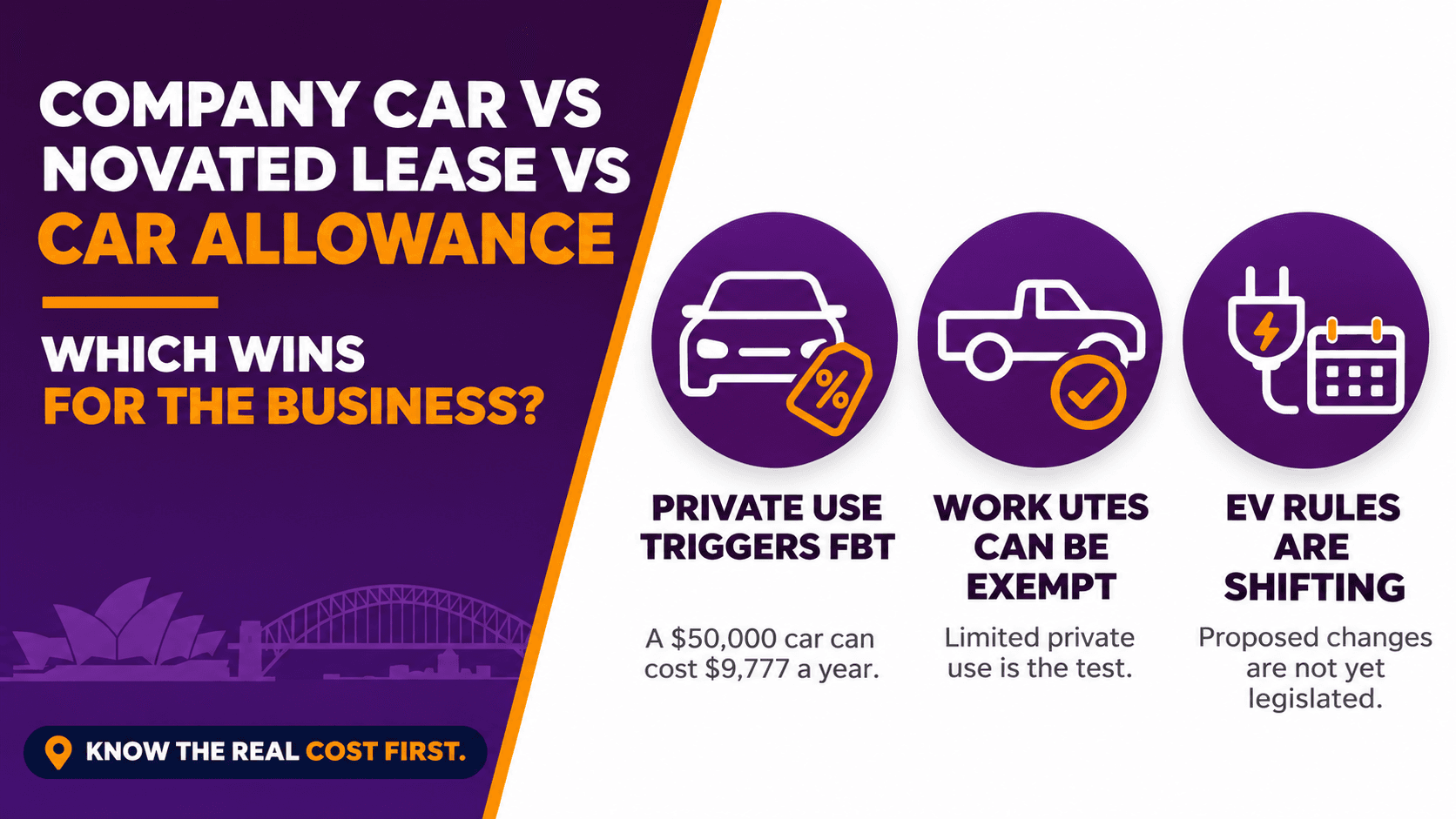
Give an employee a $50,000 petrol car for private use and FBT alone could cost the business around $9,777 a year, on top of running costs and depreciation. Pay a car allowance instead and there’s no FBT, but you’ll generally pay super on it. Offer a novated lease and the car costs the business almost nothing, but it adds payroll admin, and the EV benefit that made novated leases so popular is being wound back. There’s no single winner. The right answer depends on the vehicle, how it’s used, and what you’re trying to achieve.
TL;DR
A company car gives the business control and tax deductions, but private use generally triggers FBT at 47%, unless it’s an exempt work vehicle.
A novated lease is funded from the employee’s salary, so the business cost is mainly admin, and FBT is usually managed through employee contributions.
A car allowance is simple and FBT-free, but it’s taxed as income to the employee and generally attracts super guarantee and PAYG withholding.
Eligible work vehicles, such as many utes and vans with limited private use, can be FBT-exempt. For trade businesses, that often makes the company car the clear winner.
Eligible EVs are currently FBT-exempt until 31 March 2027. After that, a proposed $75,000 cap on the full exemption would apply, and later a 25% discount for new arrangements. These changes are announced but not yet legislated, and existing arrangements would be grandfathered.
In our worked example, a company car and a car allowance cost the business a similar amount, about $22,400 to $22,500 a year before tax, but leave the employee in very different positions.
Bottom line: the cheapest option on paper isn’t always the best one, because FBT, super, admin, and what the employee actually values all change the result.
On This Page
The Three Options at a Glance
Option 1: The Company Car
The Work Vehicle Exemption: Why Utes Often Win
Option 2: The Novated Lease
Option 3: The Car Allowance
The EV Factor: What’s Changing From April 2027
Worked Example 1: Jess, the Sales Manager
Worked Example 2: Liam’s EV Novated Lease, Before and After the Changes
Which Option Wins, and When
Common Mistakes
FAQ
The Three Options at a Glance
Company car | Novated lease | Car allowance | |
Who owns or leases the car | The business | The employee (lease novated to the employer) | The employee |
Who pays | The business | The employee, through their salary package | The business pays cash, the employee pays for the car |
FBT | Generally yes, unless exempt | Usually yes, often reduced to nil through employee contributions, while eligible EVs are currently exempt | No |
Super guarantee | Not on the car benefit | Calculated on pre-packaging salary, so packaging doesn’t reduce it | Generally yes |
PAYG withholding | No | Applies to the reduced cash salary | Yes, on the allowance |
Business tax deductions | Running costs, depreciation, and FBT paid | Salary costs | The allowance, as wages |
Admin burden | Highest: FBT returns, logbooks, asset management | Medium: payroll deductions and the provider relationship | Lowest |
Risk if the employee leaves | The business keeps the car | The lease generally returns to the employee | None |
Bottom line: each option moves cost, risk, and admin between the business and the employee in a different way.
Option 1: The Company Car
When the business owns or leases a car and makes it available for an employee’s private use, including commuting, it’s generally a car fringe benefit.
How FBT is generally calculated (statutory formula):
Taxable value = 20% × the car’s base value, adjusted for the days it’s available. The base value is generally the GST-inclusive purchase price.
FBT payable = taxable value × gross-up rate (2.0802 where GST credits are claimable) × 47%.
For a $50,000 car: $50,000 × 20% = $10,000 × 2.0802 × 47% = $9,777 a year. The operating cost method, which uses a logbook, can produce a lower figure for cars with high business use. Employee contributions from after-tax pay can also reduce the taxable value.
What the business gets:
Deductions for running costs, depreciation (subject to the car limit), and the FBT itself.
GST credits on the purchase and running costs, within limits.
Control of the asset. The car stays with the business if the employee leaves.
What it costs the business:
The car (or the capital tied up in it), the running costs, the FBT, and the admin, including an FBT return and records.
FBT rates, gross-up rates, the car limit, and GST rules can change, so verify current figures with the ATO or a registered tax agent.
Bottom line: a company car gives you control, but private use comes with a significant FBT bill unless an exemption applies.
The Work Vehicle Exemption: Why Utes Often Win
Some vehicles can be FBT-exempt even when an employee takes them home. This generally applies to certain work vehicles, such as:
Utes and panel vans designed to carry a tonne or more.
Vehicles that can carry nine or more passengers.
Some dual-cab utes and vans not designed mainly to carry passengers.
The exemption generally only applies if private use is limited to travel between home and work, travel that’s incidental to work, and minor, infrequent, and irregular private use. Weekend trips away usually don’t qualify.
For trade businesses, this is often the deciding factor. An exempt work ute can give the business deductions and GST credits without an FBT bill, which makes it hard for a novated lease or an allowance to compete.
Not sure if your work vehicles qualify for the FBT exemption? WIAA’s tax team can review your fleet and how it’s used. Email tax@whatifadvice.com.au for a free 15-minute chat.
Bottom line: if the vehicle is an eligible work vehicle and private use stays genuinely limited, the company car often wins outright.
Option 2: The Novated Lease
A novated lease is a three-way agreement between the employee, the employer, and a finance company. The employee leases the car, and the employer makes the lease and running cost payments from the employee’s salary package.
For the business:
There’s no vehicle cost on the balance sheet. The car is funded from the employee’s own pay.
FBT usually still applies to non-exempt vehicles, but it’s commonly reduced to nil through the employee contribution method. Under this method, the employee pays part of the costs from after-tax salary.
The employer claims the GST credits on the car and running costs, so the employee effectively avoids GST. That’s a big part of why staff ask for novated leases.
Super guarantee isn’t reduced. Since 2020, SG is calculated on pre-salary-sacrifice earnings, so packaging a car doesn’t lower the employer’s SG bill.
There’s payroll and provider admin, and the business may carry some FBT risk if the arrangement isn’t structured correctly.
If the employee leaves, the lease generally goes with them and the business steps out.
For businesses competing for staff, a novated lease can be a low-cost benefit to offer. Its value to the employee, however, depends heavily on the vehicle. That’s where the EV changes matter.
Bottom line: a novated lease costs the business little beyond admin, which makes it an attractive perk, but the employee carries both the cost and the risk.
Option 3: The Car Allowance
A car allowance is extra cash paid to the employee to cover their own vehicle.
For the business:
No FBT. It’s salary, not a fringe benefit.
It’s deductible as wages.
Super guarantee generally applies, because car allowances are generally part of ordinary time earnings. Reimbursements for actual business kilometres at a cents-per-kilometre rate are generally treated differently.
PAYG withholding applies.
Payroll tax may apply if the business is above its state threshold. Fringe benefits can also count toward payroll tax, so check with your state revenue office.
For the employee:
The allowance is taxable income at their marginal rate.
They can generally claim work-related car expenses using the cents per kilometre or logbook method, but only for business travel, not commuting.
Bottom line: a car allowance is the simplest option for the business, but it can be the least tax-effective for the employee.
The EV Factor: What’s Changing From April 2027
Since 1 July 2022, an FBT exemption has applied to eligible zero or low emissions vehicles provided by employers for employees’ private use, including through fleet and novated lease arrangements. It has been a major reason novated leases became so popular. Plug-in hybrids have already lost it. The exemption stopped applying to PHEVs from 1 April 2025, unless the employee had a financially binding commitment in place before then.
These changes are announced but not yet legislated:
Period | Proposed treatment for new arrangements |
Now to 31 March 2027 | Full FBT exemption for eligible EVs below the luxury car tax (LCT) threshold for fuel-efficient vehicles |
1 April 2027 to 31 March 2029 | Full exemption for EVs at $75,000 or less. EVs above $75,000 but below the LCT threshold receive a 25% FBT discount |
From 1 April 2029 | 25% FBT discount for all eligible EVs below the LCT threshold |
The 25% discount works out the same as applying a 15% statutory formula rate instead of 20%.
Existing arrangements are proposed to be grandfathered. An arrangement keeps the treatment that applied when it started, for its full term. So an EV of $75,000 or less leased before 1 April 2029 would keep the full exemption for the life of that lease. An EV between $75,000 and the LCT threshold leased before 1 April 2027 would do the same. The precise scope, including how variations or extensions to existing leases are treated, will depend on the final legislation.
The LCT threshold also changes each year, and has been reported as $91,661 for 2026-27. Verify current rules and thresholds with the ATO before committing to a lease.
Employees asking about EV novated leases before April 2027? We can help you understand the business-side implications. Call 1800 942 843 for a free 15-minute chat.
Bottom line: the EV advantage is real today, shrinks for new arrangements from April 2027 under the proposals, and the start date of any new lease matters.
Worked Example 1: Jess, the Sales Manager
A small company (25% base rate entity) wants to provide a vehicle for Jess, a sales manager on a 32% marginal rate including Medicare. The car is a $50,000 GST-inclusive petrol SUV with running costs of 7,700ayear(7,000 ex-GST). Jess drives about 5,000 business kilometres a year.
Option A: Company car, no employee contribution
Business cost | Annual amount |
Depreciation ($45,455 ex-GST over 8 years) | $5,682 |
Running costs (ex-GST) | $7,000 |
FBT ($10,000 × 2.0802 × 47%) | $9,777 |
Total before tax | $22,459 |
After 25% tax deduction | ≈ $16,844 |
Jess pays nothing personally and has a car for private use.
Option B: Car allowance of $20,000
Business cost | Annual amount |
Car allowance | $20,000 |
Super guarantee (12%) | $2,400 |
Total before tax | $22,400 |
After 25% tax deduction | ≈ $16,800 |
Jess’s side of the allowance:
After-tax allowance: $20,000 × 68% = $13,600
Tax saving on her work kilometres: 5,000 km × 88c = $4,400 deduction, × 32% = $1,408
Total available for her own car: ≈ $15,008
Her own car costs: about $6,250 depreciation plus $7,700 running, so ≈ $13,950 a year
She’s about $1,058 ahead, plus $2,400 in super
Outcome: for almost the same annual cost to the business, Option B gives Jess slightly more cash and $2,400 a year in super. But Option A’s annual figures leave out something important. The business has to find $50,000 upfront to buy the car, or pay finance costs if it borrows, while Option B ties up no business capital at all. Jess carries the car’s risk, finance, and admin under Option B, and the business loses control of the vehicle. Option A removes all of that for Jess but carries the FBT bill. A novated lease could cost the business even less, but Jess would be funding the car from her own package. These figures are simplified and illustrative, and the $20,000 allowance is set to match the company car’s cost so the comparison is like for like. The 88c per km rate, the 12% SG rate, and the FBT rates should all be verified for the current year.
Bottom line: at a similar annual cost, the allowance gave Jess more money and super and kept the business’s capital free, while the company car gave her convenience and the business control.
Worked Example 2: Liam’s EV Novated Lease, Before and After the Changes
Liam earns $120,000 (32% marginal rate including Medicare) and wants an EV through a novated lease. His employer is a small business that offers novated leases at no extra cost beyond admin.
Scenario 1: a $60,000 EV, under the current full exemption
Annual lease and running costs: $16,000, all paid from pre-tax salary because no FBT applies.
Liam’s income tax saving versus paying from after-tax pay: $16,000 × 32% = $5,120 a year.
FBT for the business: $0.
Reportable fringe benefit amount: ($60,000 × 20%) × 1.8868 = $22,642. This appears on Liam’s income statement and can affect income-tested items like HELP repayments and the Medicare levy surcharge, even though no FBT is payable.
Under the proposals, a $60,000 EV sits below the $75,000 cap. If the lease starts before 1 April 2029, it would generally keep the full exemption for the life of the lease.
Scenario 2: an $85,000 EV, lease starting on or after 1 April 2027 (proposed rules)
Taxable value: $85,000 × 20% = $17,000.
FBT before the discount: $17,000 × 2.0802 × 47% ≈ $16,621.
With the proposed 25% discount: ≈ $12,466 a year in FBT.
To reduce that FBT to nil under the employee contribution method, Liam would contribute about $12,750 a year from after-tax pay, the discounted taxable value ($17,000 × 75%). That’s money he no longer gets to package pre-tax, which substantially reduces his benefit compared with a fully exempt lease.
Had Liam signed the same $85,000 lease before 1 April 2027, it would generally keep the full exemption for its whole term under the proposed grandfathering.
Outcome: for the business, both scenarios cost little beyond admin, but its payroll process needs to handle the reporting correctly. For Liam, the value of a novated lease depends heavily on the car’s price and the lease start date under the proposed rules. These figures are simplified and illustrative, and the proposed EV changes are announced but not yet legislated.
Bottom line: a novated lease on a lower-priced EV is still a strong low-cost benefit for staff, but above $75,000, the start date could make the maths very different.
Want to model these options for your own team? Book a free 15-minute chat online or email tax@whatifadvice.com.au.
Which Option Wins, and When
Situation | Option that often wins |
Trade business, eligible work ute or van, limited private use | Company car (exempt work vehicle) |
Business wants to offer a car perk at near-zero cost | Novated lease |
Employee wants a lower-priced EV, under current rules or below the proposed cap | Novated lease |
Business wants simplicity, no FBT, no assets | Car allowance |
High business use, strong logbook records | Company car (operating cost method may reduce FBT) |
Employees already own suitable cars | Car allowance or cents per km reimbursement |
Business owner who is also an employee of their own company | Depends. See How Business Owners Should Pay Themselves |
Bottom line: match the option to the vehicle, the usage, and what your employees actually value, rather than picking one approach for everyone.
Common Mistakes
Assuming any ute is FBT-exempt. The exemption depends on the vehicle type and keeping private use genuinely limited.
Forgetting super on car allowances. Allowances are generally ordinary time earnings, so SG is generally payable.
Assuming salary packaging reduces super guarantee. SG is calculated on pre-sacrifice earnings.
Treating car allowances and business km reimbursements the same. They’re generally treated differently for super and tax.
Not keeping logbooks for company cars. Without one, the operating cost method generally isn’t available.
Getting novated lease employee contributions wrong. Errors can leave the business with an unexpected FBT bill.
Ignoring reportable fringe benefits on exempt EVs. No FBT doesn’t mean no reporting.
Treating plug-in hybrids like EVs. The exemption ended for new PHEV arrangements from 1 April 2025.
Planning around the proposed EV changes as if they’re law. They’re announced but not yet legislated, and the details could change.
Choosing one option for the whole team. Different roles and vehicles may suit different arrangements.
Reviewing how your business provides vehicles? A free 15-minute chat with WIAA’s tax team can help you compare the options properly. Call 1800 942 843.
FAQ
Is a company car or a car allowance cheaper for a business?
It depends. A company car for private use usually attracts FBT and ties up capital, while an allowance generally attracts super and PAYG withholding. The annual costs can come out similar, as in our worked example, but the employee’s position differs significantly.
Does a car allowance attract super guarantee?
Generally yes. Car allowances are generally ordinary time earnings. Reimbursements for actual business kilometres at a cents-per-kilometre rate are generally treated differently.
Does a novated lease cost the business anything?
Mainly admin and payroll processing. The car is funded from the employee’s salary package, though the business must manage FBT and reporting correctly. It doesn’t reduce the employer’s super guarantee.
Do I pay FBT on a work ute?
Not necessarily. Many eligible work vehicles are exempt if private use is limited to home-to-work travel and minor, infrequent, and irregular use.
Are electric cars FBT-exempt under a novated lease?
Eligible EVs below the LCT threshold are currently fully exempt until 31 March 2027. Proposed changes would cap the full exemption at $75,000 for new arrangements from 1 April 2027, and move all new arrangements to a 25% discount from 1 April 2029. Existing arrangements would keep the treatment that applied when they started. These changes are announced but not yet legislated.
Are plug-in hybrids still FBT-exempt?
Not for new arrangements. The exemption ended for PHEVs from 1 April 2025, unless there was a financially binding commitment in place before then.
What is a reportable fringe benefit?
It’s the grossed-up value of certain fringe benefits, shown on an employee’s income statement. It can apply even to FBT-exempt EVs and affects some income tests.
What happens to a novated lease if the employee leaves?
Generally the lease reverts to the employee, and the employer steps out of the arrangement. Check the lease terms.
Can a business owner have a novated lease?
If you’re an employee of your own company, potentially yes. Sole traders can’t, because there’s no employer to novate the lease to.
Is a car allowance taxable to the employee?
Yes. It’s assessable income, but the employee can generally claim deductions for business travel in their own car.
Ready to Find the Vehicle Option That Actually Works for Your Business?
The right choice depends on your vehicles, your team, and how the cars are used, and the EV rules are shifting. A free 15-minute chat can help you compare the real costs before you commit.
Call us: 1800 942 843
Email: tax@whatifadvice.com.au
Book online: free 15-minute chat, no cost, no pressure
Still asking what if?
WIAA helps small businesses structure employee benefits and manage FBT across Toowong, Grange, and Melbourne CBD. WIAA is a registered tax agent practice with the Tax Practitioners Board and operates under AFSL 528250 as an Authorised Representative of Beryllium Advisers Pty Ltd.
General Advice Disclaimer: This article contains general information only and does not take into account your personal objectives, financial situation, or needs. It is not personal tax or financial advice and should not be relied upon as such. FBT rates, gross-up rates, the car limit, the luxury car tax threshold, super guarantee rates, cents per kilometre rates, and payroll tax thresholds can change. Proposed changes to the electric car FBT exemption from 1 April 2027, including grandfathering of existing arrangements, are announced but not yet legislated, and may change or not proceed. Verify current rules with the ATO, your state revenue office, or a registered tax agent. Worked examples are illustrative and simplified. Seek professional advice for your own circumstances.