Looking for specific financial advice?
This blog provides general educational content. For personalized advice tailored to your unique situation, book a free consultation with our team of ASIC-licensed financial advisers.
What If the Worker You Call a Contractor Is Legally Your Employee, and Two Years of Super Is Already Owing?
A café pays a full-time barista $40 an hour on an ABN for two years. It looks simple: no super, no leave, no payroll. Then the arrangement is reviewed, and the barista is found to be an employee. The bill for super, interest, admin fees, and leave entitlements could come to around $33,600, before any penalties. An ABN, an invoice, or a contract with “contractor” in the title doesn’t decide whether someone is a contractor. The real relationship does, and different laws test it in different ways.
If you’re about to make your first hire, see Hiring Your First Employee: The Compliance Checklist. If you’re the contractor rather than the business, see Personal Services Income Rules: Are You Actually Running a Business?
TL;DR
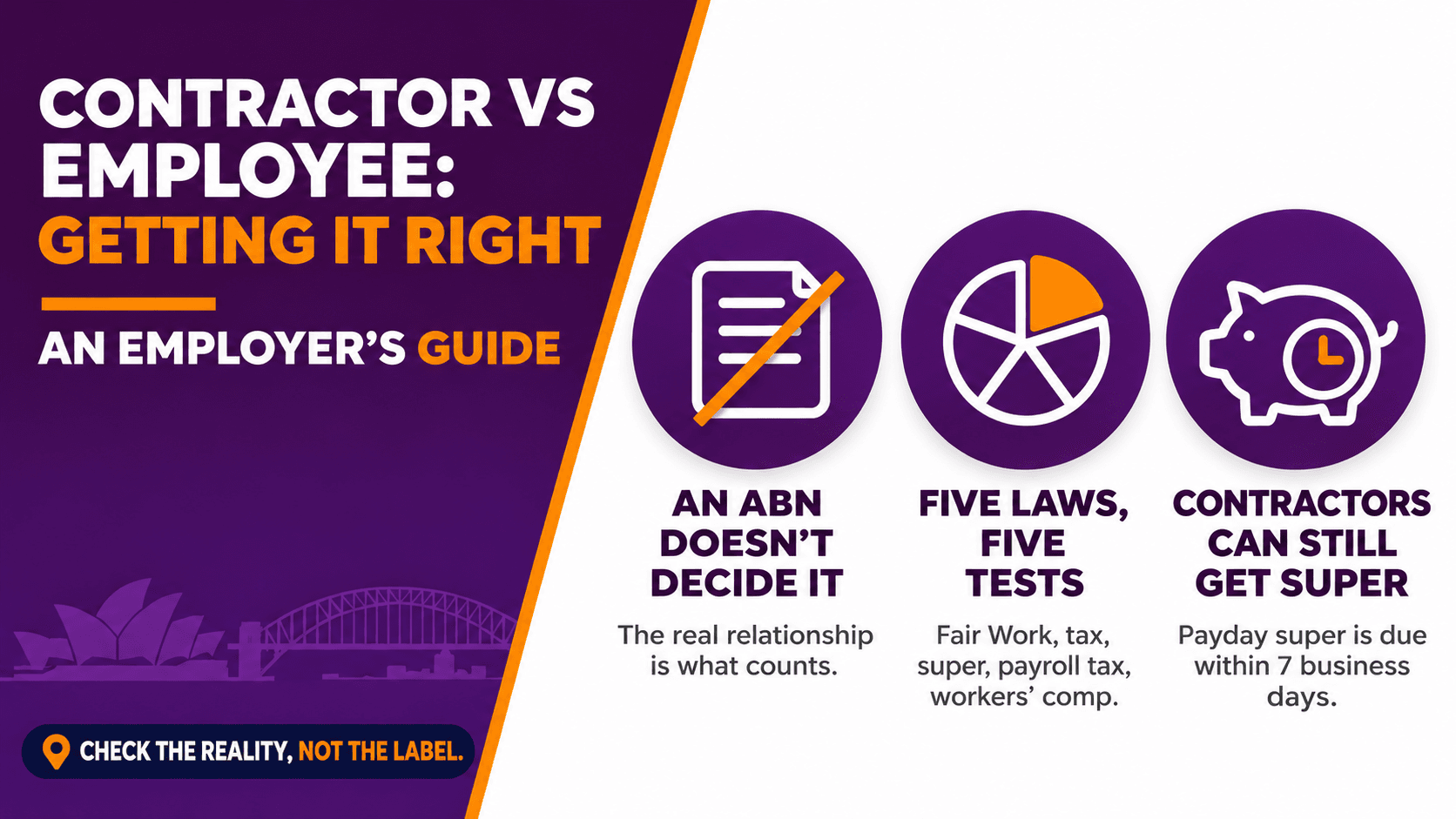
An ABN doesn’t make someone a contractor. Classification depends on the real working relationship, not the label.
Different laws use different tests. Fair Work, tax, super, payroll tax, and workers’ compensation can each reach different answers for the same worker.
Since 26 August 2024, the Fair Work Act generally looks at the whole relationship in practice, not just the written contract.
You may owe super guarantee to a genuine contractor if they’re paid wholly or principally for their labour. The SG rate is 12%.
Payday super started on 1 July 2026. Super is now due within 7 business days of each payday, and late super attracts a new charge that includes an administrative uplift of up to 60%.
In our worked example, two years of misclassification costs a café about $33,600 before Fair Work penalties.
Sham contracting, which means misrepresenting employment as contracting, carries significant civil penalties.
Bottom line: the classification question is answered by how the work actually happens, so check the substance of the relationship, not just the paperwork.
On This Page
Why “They Have an ABN” Isn’t the Answer
Five Laws, Different Tests
The Key Indicators: Employee or Contractor?
The Fair Work Act: The Whole Relationship in Practice
The Super Trap: When Genuine Contractors Still Get SG
Payroll Tax and Workers’ Compensation
What Misclassification Costs
Worked Example 1: The Café Barista on an ABN
Worked Example 2: The Genuine Contractor Who Still Gets Super
A Practical Classification Checklist
Common Mistakes
FAQ
Why “They Have an ABN” Isn’t the Answer
Many businesses assume that if a worker has an ABN, sends invoices, and signs a contractor agreement, they’re a contractor. None of these settle it. Courts and regulators look at the nature of the relationship.
The question is whether the worker is running their own business, or working in yours. Someone working regular hours, under your direction, using your equipment, with no ability to send someone else, and paid by the hour, can be an employee even with an ABN and a contract calling them a contractor.
Bottom line: labels and paperwork are evidence, but they don’t override how the arrangement actually works.
Five Laws, Different Tests
Area | Who sets the test | Key point |
Workplace rights (wages, leave, unfair dismissal) | Fair Work Act | Whole relationship in practice, since 26 August 2024 |
PAYG withholding | ATO (common law test, TR 2023/4) | Focuses heavily on the legal rights and obligations in the contract |
Super guarantee | ATO (common law plus an extended definition, SGR 2023/1) | Contractors paid mainly for labour can be employees for SG purposes |
Payroll tax | State revenue office | Contractor provisions can treat certain contractor payments as wages |
Workers’ compensation | State scheme | Each state has its own definition of “worker” |
A worker can be a contractor for one purpose and an employee for another. You need to check each regime separately.
Not sure how your contractors stack up across all five? WIAA’s tax team can help review the tax, super, and payroll tax side. Email tax@whatifadvice.com.au for a free 15-minute chat.
Bottom line: getting one test right doesn’t mean you’ve got them all right.
The Key Indicators: Employee or Contractor?
No single factor decides it. The overall picture matters.
Indicator | Points toward employee | Points toward contractor |
Control | You direct how, when, and where the work is done | They decide how the work is done |
Integration | Part of your business, often presented as your staff | Running their own business, serving others too |
Delegation | Must do the work personally | Can subcontract or send someone else |
Payment | Paid by the hour, day, or week | Paid for a result or a quoted job |
Tools and equipment | You supply them | They supply their own, at their cost |
Commercial risk | You bear the risk of mistakes | They fix defects at their own cost and can make or lose money |
Other clients | Work only or mainly for you | Advertise and work for multiple clients |
Ongoing relationship | Indefinite, regular hours | Specific tasks or projects |
Bottom line: if most indicators point to someone working in your business rather than running their own, treat that as a serious warning sign.
The Fair Work Act: The Whole Relationship in Practice
In 2022, the High Court decided two cases, Personnel Contracting and Jamsek, that focused classification heavily on the written contract. In response, Parliament amended the Fair Work Act.
From 26 August 2024, whether someone is an employee or independent contractor under the Fair Work Act is generally determined by the real substance, practical reality, and true nature of the relationship. The contract is only one part of the picture, and how the arrangement works in practice also counts.
A few points matter here:
Sham contracting is misrepresenting employment as an independent contracting arrangement. It’s prohibited and attracts significant civil penalties.
The defence for employers who misrepresent a relationship generally requires a reasonable belief that the arrangement was a contracting relationship.
Some contractors earning above a high-income threshold may be able to opt out of the new definition. Specific conditions apply.
The tax side hasn’t moved in the same way. For PAYG withholding, the ATO’s ruling TR 2023/4 still applies the contract-focused common law approach from the High Court cases. That’s one reason the answers can differ between laws.
WIAA isn’t a workplace relations law firm. For Fair Work classification questions, get advice from an employment lawyer or check with the Fair Work Ombudsman.
Bottom line: under the Fair Work Act, the way the relationship works day to day matters as much as what the contract says.
The Super Trap: When Genuine Contractors Still Get SG
This is where many businesses get caught. Under super guarantee law, a worker who is genuinely a contractor under the common law test can still be an employee for SG purposes. That happens when they’re engaged under a contract that is wholly or principally for their labour.
Under the ATO’s guidance (SGR 2023/1), this generally applies where:
The contract is mainly for the person’s labour, meaning their skills and effort, rather than a result or materials.
They must do the work personally, with no right to delegate.
They’re engaged as an individual, not through their own company or trust.
If those conditions are met, you generally need to pay super guarantee at the current rate of 12%, even though they’re a contractor for other purposes.
Payday super applies to these workers too. Since 1 July 2026:
SG is calculated on “qualifying earnings”, and the regime expressly covers amounts paid to workers who are employees for SG purposes only, like the contractors described above.
Contributions must reach the worker’s fund within 7 business days of each payday, or of each payment for a contractor caught by the extended definition, instead of quarterly.
Late or missed super attracts the new super guarantee charge, covered in the next sections.
Super guarantee rates, thresholds, and payday super rules can change, so verify current rules with the ATO.
Bottom line: “they’re a genuine contractor” doesn’t automatically mean “no super”, and under payday super the deadline arrives with every payment.
Payroll Tax and Workers’ Compensation
Payroll tax: most states have contractor provisions that can treat payments to certain contractors as taxable wages, unless an exemption applies. This affects businesses above their state’s payroll tax threshold. The rules differ between Queensland, Victoria, and other states, so check with the relevant state revenue office.
Workers’ compensation: each state scheme defines “worker” differently. In some states, a contractor can be covered as a worker even if they’re not an employee for other purposes. An uninsured worker can create significant liability if they’re injured.
Taxable payments reporting: businesses in certain industries, including building and construction, cleaning, courier, road freight, IT, and security, generally must lodge a Taxable Payments Annual Report (TPAR) of payments to contractors. This gives the ATO visibility of those payments.
Growing toward the payroll tax threshold with contractors on the books? A free 15-minute chat can help you understand your exposure. Call 1800 942 843.
Bottom line: payroll tax and workers’ compensation run on state rules, which can catch contractor arrangements that pass the federal tests.
What Misclassification Costs
If a worker you treated as a contractor turns out to be an employee, possible costs include:
Unpaid super guarantee, plus the super guarantee charge (SGC). How the charge works depends on when the earnings were paid (see the table below).
Unpaid leave and entitlements, such as annual leave, leave loading, personal leave, and award penalty rates or loadings.
Unpaid wages if award minimums weren’t met.
PAYG withholding penalties for amounts that should have been withheld.
Payroll tax and penalties, if applicable.
Workers’ compensation premiums and exposure if an injury occurs.
Fair Work penalties for sham contracting or underpayment.
The super guarantee charge: old rules vs payday super
Earnings paid up to 30 June 2026 | Paydays from 1 July 2026 | |
Interest component | Nominal interest of 10% a year | Notional earnings at the general interest charge (GIC) rate, compounding daily |
Admin component | $20 per employee per quarter | Administrative uplift of up to 60% of the shortfall plus notional earnings, which can be reduced, including for voluntary disclosure |
Tax deductible? | No | Yes, the charge itself, but GIC and late payment penalties on top of it aren’t |
The old rules still apply to past shortfalls, so a misclassification that started before July 2026 can be assessed under both regimes. These components and rates can change, so verify current rules with the ATO.
Bottom line: the costs add up quickly, and for shortfalls from 1 July 2026, the 60% uplift makes fixing a problem early far cheaper than waiting.
Worked Example 1: The Café Barista on an ABN
A Brisbane café engaged Mateo as a barista from 1 July 2024 to 30 June 2026. He worked 38 hours a week at $40 an hour, invoiced weekly on an ABN, worked rostered shifts, wore the café uniform, used the café’s equipment, and couldn’t send someone else in his place. That’s $79,040 a year.
On review, Mateo is found to be an employee. Simplified potential costs over the two years, assuming the ATO assesses the shortfall in late 2026. All of these shortfalls fall under the old SGC rules.
Item | Calculation | Amount |
Unpaid super guarantee | (79,040×11.5%for2024-25)+(79,040 × 12% for 2025-26) | $18,574 |
SGC nominal interest (illustrative, 10% a year) | Approximate, from the start of each quarter to assessment | ≈ $2,700 |
SGC admin fee | $20 × 8 quarters | $160 |
Annual leave owed | 4 weeks × 38 hrs × $40 × 2 years | $12,160 |
Total (before other penalties) | ≈ $33,600 |
Outcome: the café’s “simple” arrangement could cost about $33,600, before any award underpayment, PAYG penalties, payroll tax, or Fair Work penalties. Because these shortfalls are from before 1 July 2026, the SGC isn’t tax deductible, unlike super paid on time.
The leave figure can move in both directions. Leave loading could add to it. On the other hand, depending on the facts, Mateo might be found to be a casual employee who doesn’t accrue annual leave, or the café might be able to offset his above-award rate against some entitlements. That’s a question for an employment lawyer.
If the arrangement had kept running into 2026-27, the new charge would apply. A full year’s shortfall of 9,485(79,040 × 12%) could attract an administrative uplift of about $5,700 on its own, plus notional earnings, though the uplift can be reduced through voluntary disclosure and the charge would be deductible.
These figures are illustrative and simplified. Actual amounts depend on the award, ATO calculations, assessment timing, and the facts.
Bottom line: rostered hours, your uniform, your equipment, and no right to delegate is an employee pattern, whatever the invoice says.
Worked Example 2: The Genuine Contractor Who Still Gets Super
A software business engages Ruby, a sole trader developer with her own ABN, other clients, and her own equipment. Under the common law test, she’s a genuine contractor. But her contract is paid hourly for her development work, and it requires her to do the work personally, with no right to delegate.
Annual contract payments: $120,000
Possible SG liability under the extended definition: $120,000 × 12% = $14,400 a year
Under payday super: that super is due within 7 business days of each payment to Ruby, not quarterly.
Two alternative arrangements:
If the contract is for a defined result, at a fixed price, with a genuine right to delegate, it’s less likely to be principally for labour, and SG may not apply.
If Ruby contracts through her own company, the extended SG definition generally doesn’t apply, because the contract is with a company, not an individual. The arrangement still needs to reflect reality.
Outcome: the business had the classification right for Fair Work and PAYG, but missed $14,400 a year in super. Under payday super, every invoice it pays without super creates a new late-payment exposure. Many businesses address this by setting contractor rates that account for SG where it applies. These figures are simplified and illustrative.
Bottom line: a genuine contractor paid by the hour for their personal labour may still need super, so check the SG test separately from everything else.
Engaging contractors and unsure whether super applies? We can review your arrangements. Book a free 15-minute chat online or email tax@whatifadvice.com.au.
A Practical Classification Checklist
Before engaging someone as a contractor, ask:
Control: do they decide how the work is done, or do you?
Delegation: can they genuinely send someone else, and does that ever happen?
Payment: are they paid for results or for time?
Risk: do they bear the cost of fixing their own mistakes?
Tools: do they supply their own equipment at their own cost?
Independence: do they have other clients and run their own business?
Super: is the contract wholly or principally for their labour, as an individual? If so, can your payroll meet the 7 business day deadline for them?
State rules: do payroll tax contractor provisions or workers’ compensation definitions apply?
Practice: does the day-to-day reality match the written contract?
Review: has the arrangement changed over time, for example from project-based work into regular rostered hours?
Using the ATO’s employee/contractor decision tool is a useful starting point, but it doesn’t replace advice on complex arrangements.
Bottom line: classify at the start, document why, and recheck whenever the arrangement changes.
Common Mistakes
Relying on an ABN or contractor agreement. Neither decides classification on its own.
Assuming one test covers everything. Fair Work, tax, super, payroll tax, and workers’ compensation can each reach different answers.
Forgetting super for contractors paid principally for labour. The extended SG definition catches many genuine contractors.
Paying contractor super quarterly. Under payday super, it’s due within 7 business days of each payment.
Letting contractor arrangements drift. A short project that turns into years of rostered shifts can change the classification.
Ignoring state payroll tax contractor provisions. Contractor payments can count as taxable wages.
Assuming the old contract-focused approach still applies under Fair Work. Since 26 August 2024, the whole relationship generally counts.
Paying an “all-inclusive” rate without considering SG. If SG applies, it’s owed on top unless the arrangement is structured to account for it.
Not lodging a TPAR in industries that require it. It’s a reporting obligation in its own right.
Think you might have a classification problem already? It’s usually cheaper to fix early, especially now. Call 1800 942 843 for a free 15-minute chat.
FAQ
If a worker has an ABN, are they a contractor?
Not necessarily. Classification depends on the real working relationship, not whether the worker has an ABN.
Do I have to pay super for contractors?
Sometimes. If a contractor is engaged as an individual under a contract wholly or principally for their labour, super guarantee is generally payable, even if they’re otherwise a genuine contractor. Under payday super, it’s due within 7 business days of each payment.
What changed in the Fair Work Act definition of employee?
From 26 August 2024, the Fair Work Act generally looks at the real substance, practical reality, and true nature of the relationship, including how it works in practice, not just the written contract.
What is sham contracting?
Misrepresenting an employment relationship as an independent contracting arrangement. It’s prohibited under the Fair Work Act and carries significant penalties.
Can a worker be a contractor for tax but an employee for super?
Yes. Different laws use different tests, and the super guarantee has an extended definition for contractors paid principally for labour.
Do contractors count for payroll tax?
They can. Most states have contractor provisions that can treat certain contractor payments as taxable wages, unless an exemption applies.
What happens if I misclassify an employee as a contractor?
You may have to pay unpaid super, the super guarantee charge, leave entitlements, wages, and penalties. For earnings paid before 1 July 2026, the SG charge isn’t tax deductible. For paydays from 1 July 2026, the charge is deductible, but it includes an administrative uplift of up to 60%, and GIC and late payment penalties aren’t deductible.
Is the super guarantee charge tax deductible?
It depends on when the earnings were paid. Under the old rules, for earnings paid up to 30 June 2026, it isn’t. Under payday super, for paydays from 1 July 2026, the charge itself is deductible, but GIC and late payment penalties aren’t.
Does engaging a contractor through their company change things?
It can. The extended SG definition generally doesn’t apply to contracts with companies, but the arrangement still needs to reflect reality, and other laws may still apply.
What is a TPAR?
A Taxable Payments Annual Report, which businesses in certain industries must lodge to report payments made to contractors.
Ready to Make Sure Your Workers Are Classified Correctly?
Misclassification usually isn’t deliberate, but the costs can be the same either way, and payday super has raised the stakes. A free 15-minute chat can help you review your contractor arrangements before they turn into a backdated bill.
Call us: 1800 942 843
Email: tax@whatifadvice.com.au
Book online: free 15-minute chat, no cost, no pressure
Still asking what if?
WIAA helps small businesses get their tax, super, and payroll obligations right across Toowong, Grange, and Melbourne CBD. WIAA is a registered tax agent practice with the Tax Practitioners Board and operates under AFSL 528250 as an Authorised Representative of Beryllium Advisers Pty Ltd.
General Advice Disclaimer: This article contains general information only and does not take into account your personal objectives, financial situation, or needs. It is not personal tax, financial, or legal advice and should not be relied upon as such. Worker classification depends on the specific facts of each arrangement, and different laws apply different tests. Super guarantee rates, payday super rules, super guarantee charge components, payroll tax thresholds and contractor provisions, workers’ compensation definitions, and Fair Work rules can change and vary by state. Verify current rules with the ATO, the Fair Work Ombudsman, your state revenue office, or a qualified adviser. For workplace relations matters, seek advice from an employment lawyer. Worked examples are illustrative and simplified.