Looking for specific financial advice?
This blog provides general educational content. For personalized advice tailored to your unique situation, book a free consultation with our team of ASIC-licensed financial advisers.
Division 7A Explained for Company Directors (Australia)
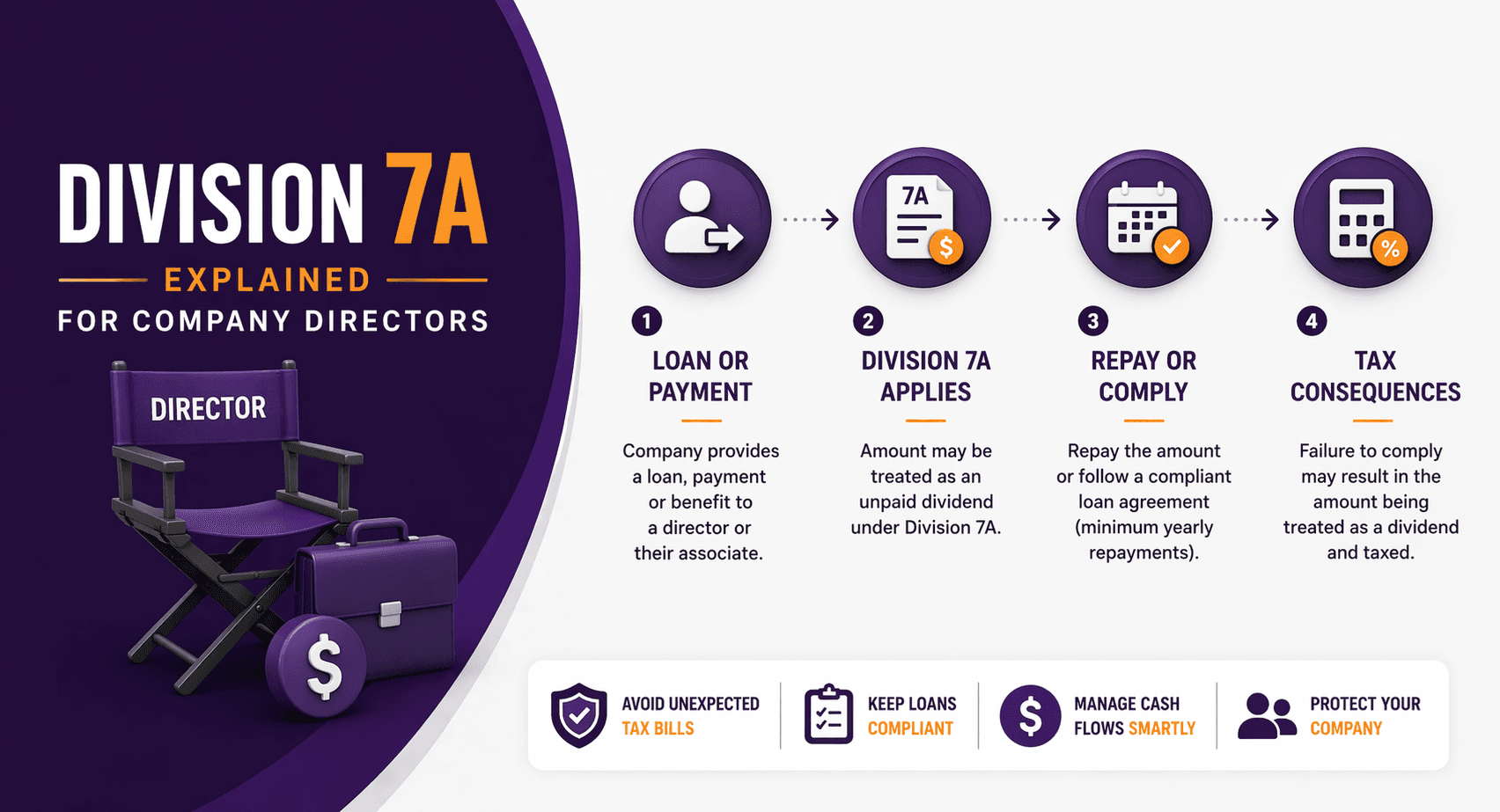
If you take money out of your company without structuring it properly, the ATO may treat it as a taxable dividend under Division 7A.
No paperwork. No planning. No mercy.
Division 7A exists to stop directors and shareholders from accessing company profits tax-free. If you’re running a company, you need to understand how it works.
What Is Division 7A?
Division 7A is part of the Income Tax Assessment Act 1936.
It applies when a private company provides:
Loans
Payments
Debt forgiveness
to:
Shareholders
Associates of shareholders
If not structured correctly, the ATO treats these as unfranked dividends.
Meaning:
You pay tax on the amount personally, without franking credits.
Why Division 7A Exists
Simple reason:
To stop people doing this:
Company earns profit
Instead of paying dividends- “loan” to director
Director uses money tax-free
Division 7A shuts that down.
When Division 7A Is Triggered
1. You Take Money Out of the Company
Example:
Director withdraws $50,000 for personal use
No salary, no dividend, no loan agreement
This can trigger Division 7A.
2. You Use Company Funds Personally
Example:
Company pays for personal expenses
No proper accounting treatment
3. You Have an Unpaid Loan Balance
If you owe money to your company at year-end:
It may be treated as a deemed dividend
4. Unpaid Present Entitlements (UPEs)
Where:
A trust allocates income to a company
But doesn’t actually pay it
This can also trigger Division 7A (subject to current ATO guidance).
What Happens If Division 7A Applies
The amount is treated as a:
Deemed unfranked dividend
This means:
Added to your personal income
Taxed at your marginal rate
No franking credits
Example
Scenario | Outcome |
Withdraw $80,000 | No structure |
ATO treatment | $80,000 deemed dividend |
Tax result | Full personal tax payable |
Not exactly the clever workaround people think it is.
How to Avoid Division 7A (Properly)
Option 1: Declare a Dividend
Formal dividend declaration
Includes franking credits (if available)
✔ Clean
✖ Still taxable
Option 2: Pay Salary or Wages
PAYG withholding applies
Tax deductible to company
✔ Structured
✔ Compliant
Option 3: Use a Complying Loan Agreement
This is the most common strategy.
To be compliant:
Written loan agreement
Interest charged at ATO benchmark rate
Minimum yearly repayments
Division 7A Loan Rules (Key Requirements)
Requirement | Detail |
Interest rate | ATO benchmark rate (updated yearly) |
Term | Max 7 years (unsecured) or 25 years (secured) |
Repayments | Minimum yearly repayments required |
Documentation | Must be in place before tax deadline |
Miss any of these - Division 7A risk.
Minimum Yearly Repayments (MYR)
If you have a Division 7A loan:
You must make minimum repayments each year
Fail to do so:
Entire loan can be treated as a deemed dividend
Common Mistakes Directors Make
1. Treating the company as a personal bank
It’s not. The ATO agrees.
2. No loan agreement in place
Handshake agreements don’t count.
3. Missing minimum repayments
This is one of the most common triggers.
4. Poor bookkeeping
If it’s not recorded properly, it’s a problem.
5. Ignoring UPE risks
Trust-company structures need careful handling.
Practical Scenario
Director Withdrawal Without Planning
Director withdraws $100,000
No loan agreement
No dividend declared
Result:
$100,000 taxed personally
No franking credits
Potential cash flow pressure
Director Withdrawal With Strategy
Loan agreement in place
Interest applied
Minimum repayments scheduled
Result:
No immediate tax
Structured repayment
Same action. Completely different outcome.
Strategic Insight: Division 7A Is a Timing and Structure Game
This isn’t about avoiding tax.
It’s about:
Timing income correctly
Structuring withdrawals properly
Managing cash flow
Done right:
You stay compliant
You stay flexible
Done wrong:
You get hit with unexpected tax bills
When Should You Get Advice?
You should seek advice if:
You’re taking money from your company
You have a shareholder loan balance
You operate a trust-company structure
You’re unsure about compliance
Because fixing Division 7A issues later is:
Messy
Expensive
Sometimes too late
FAQs
1. What is Division 7A in simple terms?
It’s a rule that prevents private company profits being accessed tax-free through loans or payments to shareholders.
2. What is a deemed dividend?
An amount treated as a dividend for tax purposes, even if no formal dividend was declared.
3. Can I borrow money from my company?
Yes, but only if it’s structured under a complying Division 7A loan agreement.
4. What happens if I don’t repay the loan?
The unpaid amount may be treated as a taxable dividend.
5. What is the Division 7A interest rate?
It’s the ATO benchmark interest rate, updated annually.
6. Does Division 7A apply to trusts?
Yes, particularly with unpaid present entitlements (UPEs), subject to ATO rules.
7. Can Division 7A be fixed after year-end?
Sometimes, but options are limited and often require professional advice.
Taking Money Out of Your Company? Do It Properly
Division 7A issues are one of the most common, and avoidable; tax problems for directors.
At What If Advice, we help business owners:
Structure withdrawals correctly
Stay compliant with ATO rules
Avoid unexpected tax bills
Book a strategy session to make sure your structure works for you, not against you.
Disclaimer
This information is general in nature and does not take into account your personal objectives, financial situation, or needs. You should consider whether it is appropriate for your circumstances and seek professional advice. Taxation laws, including Division 7A, are subject to change and ATO interpretation.