Looking for specific financial advice?
This blog provides general educational content. For personalized advice tailored to your unique situation, book a free consultation with our team of ASIC-licensed financial advisers.
What If the Sibling Doing the Most Ends Up With the Least to Show for It?
Caring for an aging parent rarely splits evenly between siblings. One adult child often ends up doing the bulk of the day-to-day care, driving to appointments, managing medications, handling the harder conversations, while others contribute money, occasional visits, or simply less overall. Left unaddressed, this imbalance has a well-worn way of curdling into genuine resentment, and in some families, a bitter dispute once an inheritance is eventually divided equally despite one sibling having carried most of the real burden for years. A family agreement, put in place early and honestly, is how this gets avoided. An unaddressed caregiving imbalance is also exactly the kind of situation that can later surface as a contested estate, our Family Provision Claims guide covers what happens when a family dispute like this ends up before a court.
TL;DR
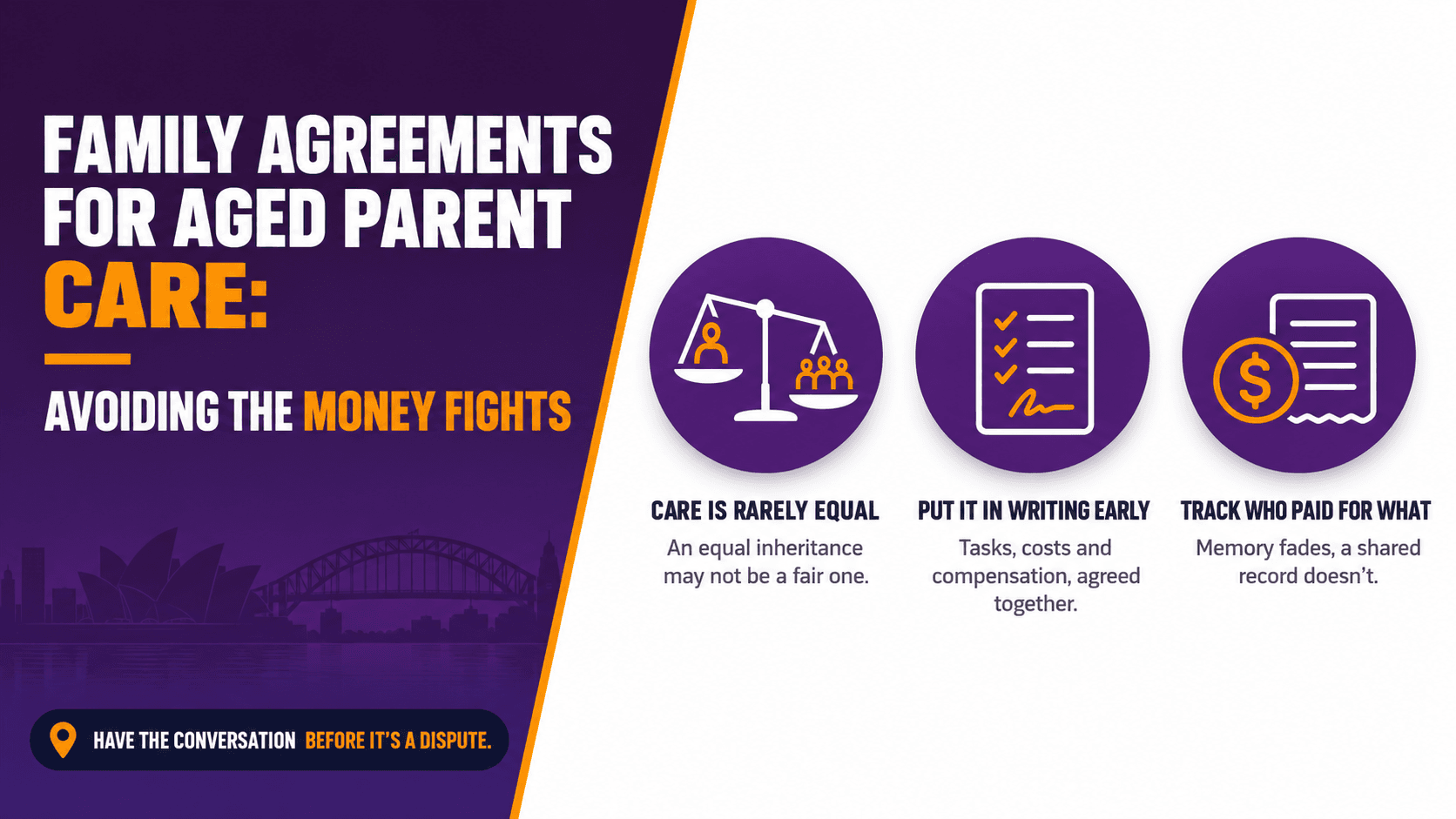
Caregiving contributions are rarely equal between siblings, and an equal eventual inheritance split can feel, and sometimes genuinely be, unfair to the sibling who carried the greater day-to-day burden.
A written family agreement, setting out who contributes what, in time, money, or both, reduces ambiguity and gives everyone a shared, documented understanding rather than relying on memory or assumption.
Financial contributions should be tracked properly from the start, ad hoc payments for a parent's care costs can become genuinely difficult to reconstruct and account for fairly years later.
A caregiving sibling can be compensated, formally and fairly, for their time and effort, though this needs to be documented and agreed by the family, not assumed or left unspoken.
Granny flat and informal living arrangements between a parent and an adult child carry specific legal and financial considerations worth formalising rather than left as an undocumented understanding.
Having the conversation early, before a health crisis forces decisions under pressure, produces a considerably better outcome than attempting to agree on arrangements for the first time in a moment of urgency.
A family agreement doesn't need to be adversarial. Approached well, it's a tool for fairness and clarity, not a sign of distrust between siblings.
Bottom line: the families who avoid a painful money fight later are usually the ones who had an honest, documented conversation about contributions and compensation early, not the ones who assumed everyone would naturally agree on fairness once the time came.
On This Page
Why Caregiving Contributions Are Rarely Equal
What a Family Agreement Should Actually Cover
Tracking Financial Contributions Properly
Compensating a Caregiving Sibling Fairly
Granny Flat Arrangements: A Specific Risk Worth Formalising
Worked Example: Three Siblings, One Agreement
Common Mistakes
FAQ
Why Caregiving Contributions Are Rarely Equal
It's genuinely common for one adult child, often based geographically closer, or simply the one who stepped up first, to take on the majority of a parent's day-to-day care: medical appointments, medication management, emotional support, and the countless smaller tasks that don't show up on a ledger but consume real time and energy. Other siblings may contribute financially, visit periodically, or genuinely have less capacity to help due to their own location, work, or family circumstances. None of this is inherently anyone's fault, but left unacknowledged, it creates a genuine imbalance that tends to surface later, often at the worst possible time, when an estate is eventually divided.
Not sure how to approach a conversation about uneven caregiving contributions with your siblings? A free 15-minute chat with WIAA can help you think through a fair starting framework. Call 1800 942 843 or book online.
Bottom line: unequal caregiving contributions are the norm, not the exception, and the problem isn't the imbalance itself, it's leaving it undiscussed and undocumented until it surfaces as a dispute.
What a Family Agreement Should Actually Cover
A written family care agreement generally addresses: who's responsible for which specific caregiving tasks and how that might change over time as a parent's needs evolve, how ongoing costs, medical, accommodation, in-home care, are shared or covered between siblings, whether and how a primary caregiving sibling is compensated for their time, and how decisions about the parent's care are actually made if siblings disagree. This doesn't need to be an overly formal legal document in every case, but it does need to be written down and agreed by everyone involved, rather than relying on verbal understanding or assumption.
Bottom line: a family agreement works best when it's specific and in writing, covering tasks, costs, and compensation explicitly, rather than left as a general, unwritten sense that "we'll figure it out fairly."
Tracking Financial Contributions Properly
Where siblings contribute financially toward a parent's care, whether through direct payments, covering specific costs, or an agreed regular contribution, keeping a clear, shared record of what's actually been paid, by whom, and for what, avoids a genuinely difficult reconstruction exercise years later when memories differ and receipts have been lost. This record also matters if an estate is eventually divided and one sibling's financial contributions toward a parent's care are intended to be factored into that division, a clear record makes this a straightforward calculation rather than a contested, memory-based argument.
Setting up a simple, shared system to track family contributions toward a parent's care avoids a lot of difficulty later. A free 15-minute chat can help set up something that actually works for your family. Email clientservices@whatifadvice.com.au or book online.
Bottom line: a shared, contemporaneous record of financial contributions is considerably more reliable, and considerably less likely to cause conflict, than trying to reconstruct who paid for what years after the fact.
Compensating a Caregiving Sibling Fairly
Where one sibling takes on substantially more of the day-to-day caregiving burden, families can agree to formally compensate that sibling, whether through a direct payment, an adjusted share of the eventual estate, or another agreed arrangement reflecting the genuine value of their time and effort. This needs to be discussed and agreed explicitly by all siblings, and ideally documented clearly, rather than assumed or left as an unspoken expectation that "it'll be sorted out somehow" when the parent eventually passes. An undocumented, unspoken expectation is precisely what tends to produce the most bitter disputes once an estate is actually divided.
Bottom line: if a caregiving sibling is meant to be compensated for their disproportionate contribution, that needs to be an explicit, documented family agreement, not a hopeful assumption on the caregiving sibling's part.
Granny Flat Arrangements: A Specific Risk Worth Formalising
Where a parent moves in with an adult child, or an adult child contributes financially toward building a granny flat or similar arrangement on a family property, this needs specific attention and formal documentation, since informal arrangements of this kind carry genuine legal and financial risk if not properly structured. Issues can arise around what happens to the contributed funds or the arrangement itself if the relationship breaks down, if the parent later needs residential aged care, or if the property is eventually sold, all of which are considerably easier to navigate if the arrangement was formalised from the outset rather than left as an informal family understanding.
Bottom line: granny flat and co-living arrangements between a parent and an adult child carry specific risks that are genuinely worth formalising properly, rather than relying on family goodwill alone.
Worked Example: Three Siblings, One Agreement
The Petrakis siblings, Ana, Nick, and Sophia, found themselves in an increasingly common situation as their mother's care needs grew. Ana, living closest, had become the primary day-to-day carer, managing medical appointments and daily support. Nick, living interstate, contributed financially toward their mother's in-home care costs. Sophia, with young children and demanding work commitments, contributed less of both time and money, though she visited regularly.
Rather than letting this imbalance go undiscussed, the siblings, with guidance from WIAA as part of a broader family financial conversation, put a written family agreement in place: documenting Ana's caregiving role and agreeing a modest ongoing payment to recognise her disproportionate time commitment, formalising Nick's financial contributions with a clear shared record, and agreeing that Ana's caregiving contribution would be specifically accounted for in how their mother's eventual estate was divided, rather than assumed to be automatically equal three ways.
Outcome: by addressing the imbalance explicitly and in writing while their mother was still well enough to be part of the conversation, the Petrakis siblings avoided the ambiguity and resentment that an unaddressed, unequal arrangement often produces once an estate is eventually divided.
Bottom line: the Petrakis family's agreement didn't eliminate the imbalance in contributions, it simply made that imbalance explicit, documented, and fairly accounted for, which is precisely what prevents it from becoming a dispute later.
Common Mistakes
Assuming an equal eventual inheritance split automatically accounts for unequal caregiving contributions. Without an explicit agreement, this assumption is exactly what tends to cause disputes.
Not keeping a clear record of financial contributions toward a parent's care. This becomes genuinely difficult to reconstruct fairly years later.
Leaving caregiver compensation as an unspoken expectation rather than a documented agreement. This is one of the most common sources of bitter family disputes once an estate is divided.
Setting up an informal granny flat or co-living arrangement without proper documentation. This carries genuine legal and financial risk if circumstances change.
Waiting until a health crisis forces the conversation. Addressing caregiving and cost-sharing arrangements early, while everyone can think clearly, produces considerably better outcomes than deciding under pressure.
Addressing caregiving contributions and compensation explicitly, while everyone's able to have a calm conversation, avoids a lot of difficulty later. A free 15-minute chat can help your family think through a fair framework. Call 1800 942 843.
FAQ
Can a caregiving sibling legally be compensated for their time? Yes, generally, through a family agreement that the siblings document and agree to, whether as a direct payment, an adjusted estate share, or another arrangement reflecting their contribution.
Does an equal inheritance split automatically account for unequal caregiving? No, not automatically, this is exactly the gap a family agreement is designed to address explicitly, rather than assuming fairness will simply work itself out later.
Should financial contributions toward a parent's care be documented? Yes, strongly recommended, a clear, shared, contemporaneous record avoids a difficult and potentially contentious reconstruction exercise years later.
Is a family care agreement a legal document? It can range from an informal but clearly written understanding to a more formal document, depending on the complexity of the family's situation and the value of the arrangements involved, worth discussing with a solicitor for more significant arrangements.
What should we do if a parent moves in with one sibling? This arrangement, and any financial contribution toward it such as a granny flat build, should generally be formally documented given the legal and financial risks of an informal arrangement.
What happens if siblings disagree about a parent's care decisions? A family agreement can include a process for how disagreements are resolved, which is considerably better established in advance than negotiated for the first time during a difficult or urgent situation.
Should this conversation happen before or after a parent needs significant care? Ideally before, addressing caregiving and cost-sharing arrangements early, while everyone can think clearly and the parent can potentially be involved, produces considerably better outcomes than deciding under pressure during a crisis.
Can a family agreement affect how an estate is eventually divided? Yes, it can specifically document how a caregiving sibling's contribution should be accounted for in an eventual estate division, which is worth discussing alongside broader Will and estate planning. An imbalance left unaddressed is also exactly the kind of situation our Family Provision Claims guide covers, should it later end up contested.
What if one sibling refuses to discuss or agree to a family arrangement? This is a genuinely difficult situation worth approaching carefully, sometimes with the help of a neutral professional facilitating the conversation, since an unresolved disagreement at this stage often resurfaces more painfully later.
Can WIAA help facilitate this kind of family conversation? Yes, helping families think through fair frameworks for caregiving contributions and how they interact with broader financial and estate planning is an area WIAA supports.
Ready to Have This Conversation Before It Becomes a Dispute?
Unequal caregiving contributions between siblings are normal, but leaving them undiscussed and undocumented is what turns them into a genuine family conflict later. A free 15-minute chat can help your family find a fair starting framework.
Call us: 1800 942 843
Book online: free 15-minute chat, no cost, no pressure
Still asking what if.
WIAA has helped Australian families have honest, documented conversations about caregiving and cost-sharing before resentment has a chance to set in, across Toowong, Grange, and Melbourne CBD. WIAA operates under AFSL 528250 as an Authorised Representative of Beryllium Advisers Pty Ltd.
General Advice Disclaimer: This article contains general information only and does not take into account your personal objectives, financial situation, or needs. It is not legal advice and should not be relied upon as such. Family care agreements, caregiver compensation arrangements, and co-living structures should be documented with appropriate legal guidance reflecting your family's specific circumstances.