Looking for specific financial advice?
This blog provides general educational content. For personalized advice tailored to your unique situation, book a free consultation with our team of ASIC-licensed financial advisers.
What If the Character That Sold You the House Is Also What Makes the Loan More Complicated?
Annerley and Highgate Hill, tucked in close to West End and the Princess Alexandra Hospital, have long been two of Brisbane's classic renovator's suburbs, full of older highset Queenslanders bought specifically for their bones and their potential. That character comes with a genuinely different financing conversation than a standard established-home purchase: construction and renovation loans work differently to a straightforward mortgage, and older Queenslanders carry specific structural quirks, stumps, asbestos, and termite risk among them, that affect both the loan and the insurance from day one.
TL;DR
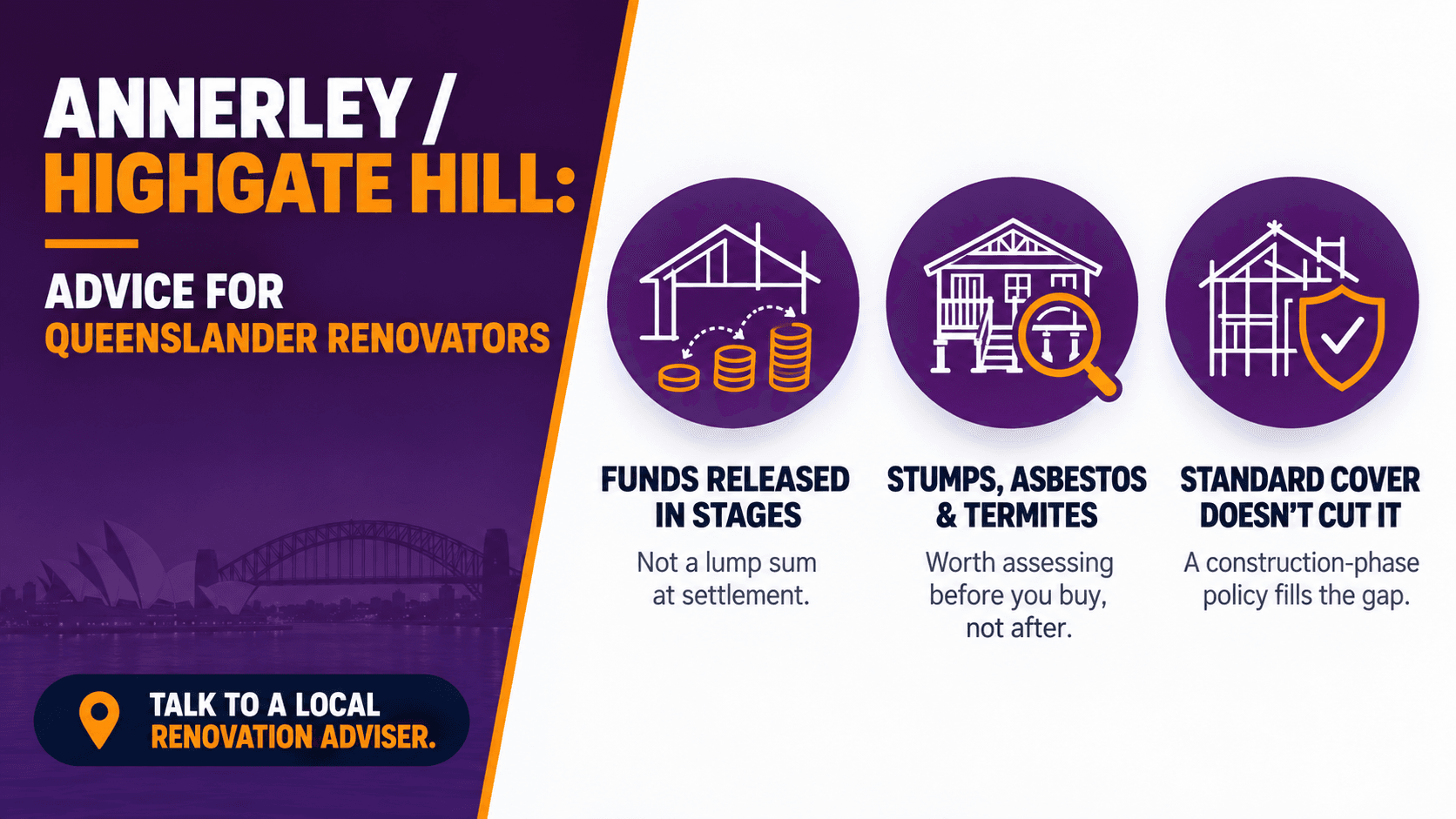
Renovation and construction loans are structured differently to a standard home loan, generally releasing funds in stages against completed work, rather than as a single lump sum at settlement.
Older Queenslanders commonly carry specific structural considerations, including timber stump condition, potential asbestos in original building materials, and termite risk, all worth assessing before finalising a purchase and loan.
A pre-purchase building and pest inspection is particularly important for character homes in this price bracket and age range, given how much these specific risks can affect both immediate cost and financing.
Insurance during a renovation often needs a specific renovation or construction-phase policy, since a standard home and contents policy may not adequately cover a property mid-renovation.
Lenders generally require a detailed scope of works and fixed-price building contract before approving a renovation or construction loan, not just a rough budget estimate.
Underestimating renovation costs is a common and costly mistake, particularly for character homes where unexpected issues (rot, non-compliant wiring, structural stump issues) are frequently uncovered once work begins.
Both suburbs sit a short, roughly 10 to 15 minute trip from WIAA's Toowong office, making in-person consultations straightforward for local renovators.
Bottom line: financing a Queenslander renovation in Annerley or Highgate Hill runs on genuinely different mechanics to a standard home purchase, and understanding the loan structure and the property's specific risks before committing avoids being caught out partway through the project.
On This Page
Why Renovation Loans Work Differently to a Standard Mortgage
Structural Quirks of Older Queenslanders to Assess Before Buying
Why a Thorough Building and Pest Inspection Matters More Here
Insuring a Property Mid-Renovation
What Lenders Actually Want to See Before Approving
Worked Example: A Highset Queenslander Renovation Budget
Common Mistakes
FAQ
Why Renovation Loans Work Differently to a Standard Mortgage
A standard home loan releases the full loan amount at settlement, against a completed property. A renovation or construction loan generally works differently, releasing funds in progressive stages tied to specific milestones of completed work, verified before each stage is released, rather than as a single upfront amount. This protects the lender against paying for work that hasn't actually been completed, but it also means a renovator needs a detailed, staged budget and building contract in place from the outset, not a rough estimate to be refined as the project goes.
Not sure how a renovation loan's staged funding would work for your specific project? A free 15-minute chat with WIAA can walk through the structure. Call 1800 942 843 or book online.
Bottom line: a renovation loan releases money as work is completed and verified, not all at once, which means the project's budget and contract need to be genuinely detailed before the loan can even be approved.
Structural Quirks of Older Queenslanders to Assess Before Buying
Annerley and Highgate Hill's classic highset Queenslanders often carry specific structural considerations that a newer property wouldn't: timber stump condition (stumps can deteriorate or shift over time, sometimes requiring re-stumping or reinforcement), potential asbestos-containing materials in original building components common in homes of this era, and termite risk, a genuinely significant consideration for older timber homes in a Brisbane climate. None of these are automatically disqualifying, plenty of character homes in both suburbs are structurally sound, but each is worth understanding clearly before finalising a purchase, since remediation costs can be substantial if issues are present.
Bottom line: an older Queenslander's character is exactly what makes it appealing, and exactly what makes stumps, asbestos, and termites worth genuinely assessing rather than assuming away.
Why a Thorough Building and Pest Inspection Matters More Here
Given the structural considerations specific to this housing stock, a building and pest inspection carries more weight in Annerley and Highgate Hill than it might for a newer, standard-construction property elsewhere. A thorough inspection should specifically address stump condition, evidence of past or active termite activity, and flag any suspected asbestos-containing materials for further specialist assessment. This inspection result also directly feeds into renovation budgeting, since issues identified here often become the first, and sometimes largest, line items in an actual renovation scope of works.
A thorough pre-purchase inspection genuinely shapes what a realistic renovation budget looks like for a character home. A free 15-minute chat can help think through how inspection findings should feed into your financing plan. Email clientservices@whatifadvice.com.au or book online.
Bottom line: a building and pest inspection isn't just a purchase formality here, it's the document that tells a renovator what they're actually budgeting for once work begins.
Insuring a Property Mid-Renovation
A standard home and contents insurance policy is often not adequately structured to cover a property actively undergoing significant renovation or construction work, gaps in cover can exist around uninstalled materials, partially completed structural work, or contractor-related risks. A specific renovation or construction-phase insurance policy is generally worth arranging for the duration of significant works, separate from, or as an addition to, the standard policy that resumes once the renovation is complete.
Bottom line: standard home insurance and an active renovation project don't automatically fit together, and confirming the right cover is in place for the construction phase specifically avoids a genuine gap in protection.
What Lenders Actually Want to See Before Approving
Before approving a renovation or construction loan, lenders generally require a detailed scope of works, a fixed-price building contract with a licensed builder, and often a valuation based on the property's expected completed value, rather than just its current, pre-renovation value. A vague budget estimate or an unlicensed or informal arrangement generally won't satisfy standard lending requirements, meaning the renovation plan needs to be genuinely locked down, contract and costings included, before finance can be finalised.
Bottom line: a renovation loan application needs considerably more documentation upfront than a standard mortgage, a real contract and a real scope of works, not a rough plan to be firmed up later.
Worked Example: A Highset Queenslander Renovation Budget
The Okafors purchase an older highset Queenslander in Highgate Hill, planning a substantial renovation to raise and build in underneath, adding additional living space. Their pre-purchase building and pest inspection flags some stump deterioration requiring partial re-stumping, and suspected asbestos in the original wall sheeting, both factored into their renovation budget from the outset rather than discovered mid-project.
Their lender requires a detailed scope of works and fixed-price contract with a licensed builder before approving their construction loan, structured to release funds in stages, foundation and re-stumping work, then the build-under stage, then fit-out, each verified before the next stage releases. They separately arrange a construction-phase insurance policy for the duration of the works, given their standard home and contents policy wouldn't adequately cover the property mid-renovation.
Outcome: because the Okafors budgeted for the known structural issues upfront, secured a detailed staged loan structure, and arranged appropriate renovation-phase insurance, their project proceeded without the financing or cover gaps that catch many renovators mid-project.
Bottom line: the Okafors' smooth renovation came down to treating the inspection findings, loan structure, and insurance as connected decisions made before the project started, not separate problems solved as they arose.
Common Mistakes
Underestimating renovation costs for an older character home. Structural issues like stump deterioration or asbestos removal are common and can be substantial once uncovered.
Assuming a standard home loan process applies to a renovation project. Construction and renovation loans require considerably more upfront documentation and release funds differently.
Skipping or under-scoping the building and pest inspection. This is the document that shapes a realistic renovation budget, not just a purchase formality.
Assuming standard home insurance covers a property mid-renovation. A specific renovation or construction-phase policy is generally needed to close the gap.
Starting renovation work without a locked-down scope and fixed-price contract. Lenders generally require this before releasing funds, and it protects the renovator from cost blowouts as much as it satisfies the lender.
Financing a Queenslander renovation in Annerley or Highgate Hill has specific moving parts worth getting right from the start. A free 15-minute chat can help map out the loan structure and budget properly. Call 1800 942 843.
FAQ
Do I need a different type of loan to renovate an older Queenslander? Generally, yes, a renovation or construction loan, which releases funds in stages against completed work, rather than a standard home loan structured as a single lump sum.
How common are stump and termite issues in Annerley and Highgate Hill Queenslanders? These are genuinely common considerations for older timber homes in this housing stock and climate, worth specifically assessing through a thorough building and pest inspection rather than assumed to be present or absent.
Does my standard home insurance cover my property while it's being renovated? Often not adequately, a specific renovation or construction-phase policy is generally worth arranging for the duration of significant works.
What does a lender need before approving a renovation loan? Generally a detailed scope of works, a fixed-price contract with a licensed builder, and a valuation reflecting the property's expected completed value.
Is asbestos automatically present in an older Queenslander? Not automatically, but it's a common material in homes of this era and should be specifically flagged and assessed by a qualified inspector rather than assumed either way.
How much should I budget beyond the fixed building contract price for a renovation? It's generally wise to budget a genuine contingency beyond the contracted price, particularly for older character homes where unexpected issues are frequently uncovered once work begins.
Can I renovate in stages to manage cash flow, rather than all at once? This is possible and common, though it's worth discussing directly with a lender and builder how a staged approach affects the loan structure and overall project timeline.
Is Annerley or Highgate Hill a better suburb for a renovation project? Both suburbs share similar character housing stock and considerations, and the better fit generally depends on individual property availability, budget, and specific lifestyle preferences rather than one suburb being universally better.
Should I get a specialist Queenslander inspector, or is a standard building inspector sufficient? An inspector experienced with older Queenslander construction specifically, stumps, asbestos, and timber condition, is generally worth seeking out given how central these issues are to this housing stock.
How far are Annerley and Highgate Hill from WIAA's nearest office? Both suburbs are a short, roughly 10 to 15 minute trip from WIAA's Toowong office, making in-person consultations straightforward for local renovators.
Ready to Structure Your Renovation Loan and Budget Properly?
Renovating an older Queenslander in Annerley or Highgate Hill comes with specific financing and structural considerations worth getting right from the start. A free 15-minute chat can help map it out.
Call us: 1800 942 843
Book online: free 15-minute chat, no cost, no pressure
Still asking what if.
WIAA has helped Annerley and Highgate Hill renovators structure their loans and budgets around the real risks of older Queenslander housing stock, from our nearby Toowong office. WIAA operates under AFSL 528250 as an Authorised Representative of Beryllium Advisers Pty Ltd.
General Advice Disclaimer: This article contains general information only and does not take into account your personal objectives, financial situation, or needs. It is not personal financial or legal advice and should not be relied upon as such. Building and pest inspection findings, renovation costs, and insurance requirements are specific to each property and should be assessed directly by a qualified inspector, builder, and insurer before proceeding.