Looking for specific financial advice?
This blog provides general educational content. For personalized advice tailored to your unique situation, book a free consultation with our team of ASIC-licensed financial advisers.
What If Your Income Runs on a Festival Calendar Instead of a Pay Calendar?
Southbank sits at the centre of Melbourne's arts and entertainment precinct, home to the Arts Centre, Hamer Hall, and a dense cluster of theatres and production companies. A meaningful share of local residents don't just have irregular income the way a freelancer or hospitality worker might, their income specifically follows a production and festival calendar: a season of work tied to a show's run, a grant-funded project with a defined start and end, a festival contract that pays out in a lump sum months after the work is done. For the general mechanics of budgeting and structuring genuinely irregular income, our Fitzroy and St Kilda guides cover that ground in depth. This piece focuses on what's specific to Southbank: income tied to production cycles rather than open-ended freelance or casual shift work, plus a note for local apartment investors.
TL;DR
Southbank's arts workforce, performers, production crew, and arts administrators, often has income tied to specific production or festival cycles rather than ongoing casual work, meaning income can be genuinely absent for months between engagements, not just variable week to week.
Grant and commission income carries its own timing quirks, funds are sometimes paid in a lump sum well before or after the actual work period, which needs to be planned around rather than assumed to arrive when the work happens.
Superannuation and income protection gaps, covered in more depth in our Fitzroy and St Kilda guides, apply here too, but the production-cycle nature of the work makes the gaps longer and more predictable in timing, which is actually easier to plan around once recognised.
Southbank's apartment market, like nearby Docklands, skews heavily toward renters, relevant context for investors assessing the local rental market.
Investors should weigh body corporate costs and building age in Southbank's high-rise stock against advertised rental yield, the same considerations covered in our Docklands guide.
Southbank is a short, roughly 5 minute walk from WIAA's Melbourne CBD office, making in-person consultations straightforward.
Bottom line: Southbank's arts workforce has a distinctive version of irregular income, tied to production and funding cycles rather than open-ended freelance work, and planning around the specific shape of that cycle matters more than generic irregular-income advice.
On This Page
Why Southbank's Income Pattern Is Different From Standard Freelance Work
Planning Around Grant and Commission Payment Timing
Superannuation and Income Protection: The Same Gaps, a More Predictable Shape
For Investors: Southbank's Renter-Heavy Apartment Market
Worked Example: Planning Around a Festival Season
Common Mistakes
FAQ
Why Southbank's Income Pattern Is Different From Standard Freelance Work
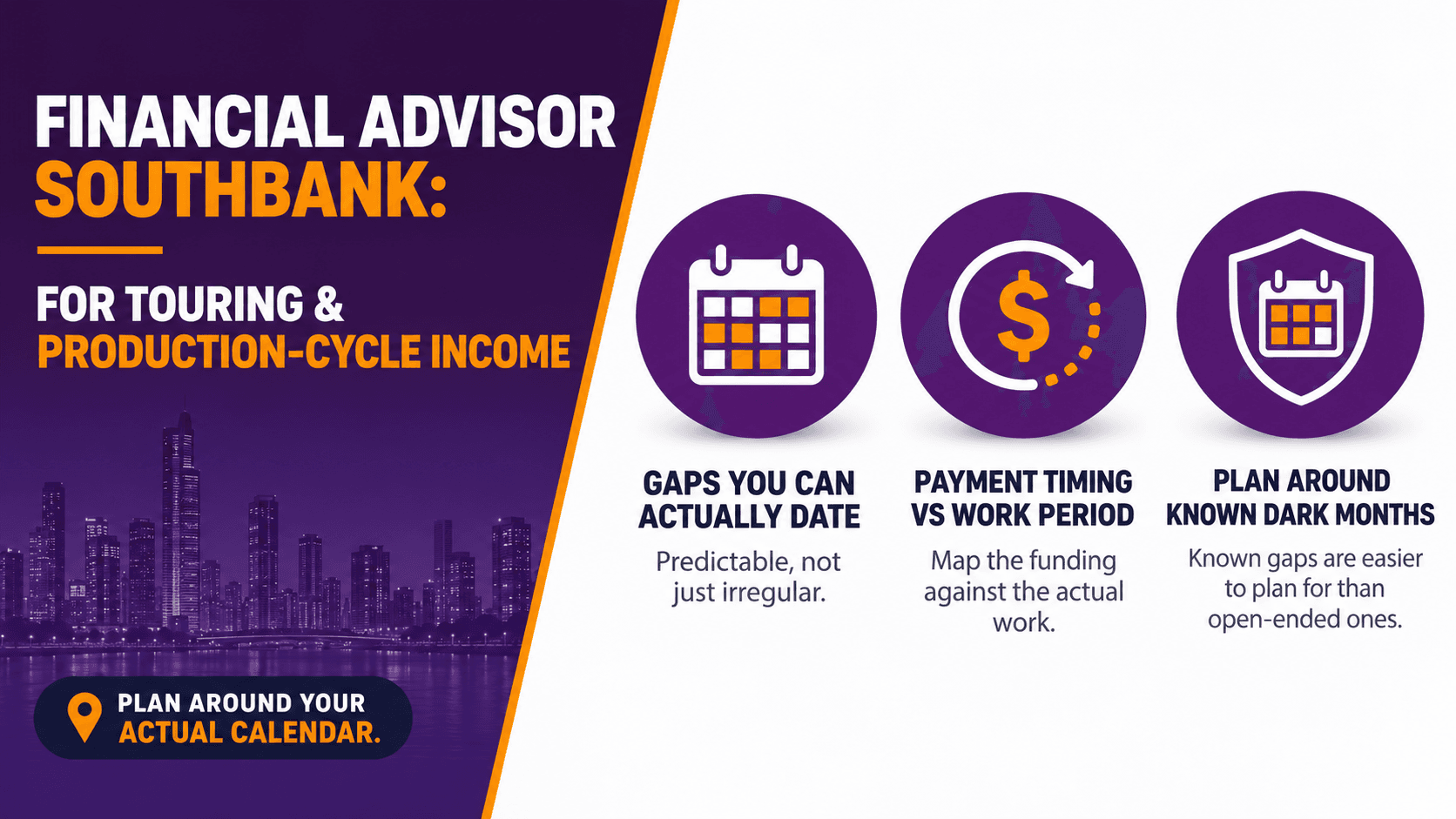
A freelancer or casual hospitality worker's income is irregular but generally continuous, some weeks are better than others. Southbank's performers, production crew, and arts administrators often face something different: genuine, predictable gaps, months with no income at all between a show's closing night and the next contract, or a festival season that concentrates a year's income into a few intense months. This isn't the same planning problem as smoothing a lumpy freelance income, it's planning around known, dated absences of income, which is actually more tractable once treated as its own specific pattern rather than folded into general "irregular income" advice.
Working around a production or festival calendar rather than a standard pay cycle? A free 15-minute chat with WIAA can help build a plan around your actual calendar. Call 1800 942 843 or book online.
Bottom line: Southbank's arts workforce isn't just dealing with variable income, it's dealing with predictable, dated gaps, and the planning approach should be built around that specific shape.
Planning Around Grant and Commission Payment Timing
Grant and commission-funded work carries a specific timing quirk worth understanding: funding is sometimes released well before the actual work period (an upfront grant instalment for a project starting months later), and sometimes well after (a final payment on delivery of a completed work). Treating a grant payment as available income for whenever it lands, rather than planning against when the associated work and expenses will actually occur, is a common way this timing mismatch causes cash flow problems.
Managing grant or commission income with payment timing that doesn't match your actual work period? Email tax@whatifadvice.com.au and we'll help you plan around it properly.
Bottom line: grant and commission income needs to be mapped against the work period it's actually funding, not treated as available the moment it arrives in an account.
Superannuation and Income Protection: The Same Gaps, a More Predictable Shape
Casual and project-based workers generally face the same superannuation contribution gaps and income protection complications covered in our Fitzroy and St Kilda guides, engagements below certain thresholds, employer contributions that don't consistently flow, and income protection policies built around a standard salary. What's different for Southbank's production-cycle workforce is that the gaps are often genuinely predictable in timing, a known dark period between contracted seasons, rather than unpredictable casual-shift variability, which makes proactively planning voluntary super contributions and a specific income buffer around those known gaps considerably more achievable than for genuinely unpredictable casual work.
Bottom line: the same super and insurance gaps other irregular-income workers face are, for this specific group, tied to dates you often already know in advance, which makes them worth planning around specifically rather than treating as an open-ended problem.
For Investors: Southbank's Renter-Heavy Apartment Market
Southbank's apartment market, like nearby Docklands, skews heavily toward renters rather than owner-occupiers, driven by a combination of international students and the area's own arts and hospitality workforce. This generally supports genuine rental demand, though the same considerations covered in our Docklands guide apply here: body corporate costs on larger buildings, and a market that can be sensitive to new supply, both need to be weighed against headline rental yield.
Considering a Southbank apartment as an investment and want to check the numbers properly? A free 15-minute chat can help. Call 1800 942 843.
Bottom line: Southbank's investor considerations largely mirror Docklands', body corporate costs and supply sensitivity matter more than the advertised gross yield.
Worked Example: Planning Around a Festival Season
Tomás works as a lighting technician, with the bulk of his annual income concentrated into a run of festival and theatre season contracts between February and June, followed by a quieter period with occasional short gigs through the rest of the year. Rather than treating his income as generally "irregular," working with WIAA he mapped his actual calendar: setting aside a specific portion of his February-to-June income as a deliberate buffer for the known quieter months, timing a voluntary super contribution to land after his highest-earning contract each year rather than leaving it to chance, and structuring an income protection policy around his documented multi-year contract history rather than assuming a standard policy would recognise his income pattern.
Outcome: because Tomás's income gaps were dated and predictable rather than open-ended, planning around them was more straightforward than for a fully unpredictable freelance income, once the specific shape of his calendar was actually mapped out rather than treated as generic irregularity.
Bottom line: a production-cycle income isn't just irregular, it's irregular in a knowable pattern, and that predictability is exactly what makes it plannable.
Common Mistakes
Treating production-cycle income as generically "irregular" rather than mapping its actual calendar. The specific timing of known income gaps is exactly what makes this group's income more plannable than open-ended freelance work.
Treating a grant or commission payment as available the moment it arrives. It needs to be mapped against the work period it's actually funding.
Assuming super and income protection gaps are unavoidable for this kind of work. The predictable timing of production-cycle gaps makes proactive planning genuinely achievable.
Investors focusing only on advertised gross rental yield. Body corporate costs and building-specific risk materially affect the real net return.
Not reviewing a building's tenant turnover and body corporate financial health before investing in Southbank. A higher-turnover renter market carries its own considerations.
Whether you're planning around a production season's income calendar or assessing a Southbank apartment as an investment, the right advice depends on which conversation actually applies to you. A free 15-minute chat can help. Call 1800 942 843.
FAQ
How is arts and production-cycle income different from standard freelance or casual income? It tends to involve genuinely predictable, dated gaps between contracts or seasons, rather than the more open-ended, week-to-week variability of casual or freelance work, which actually makes it more plannable once mapped out.
When should I expect a grant or commission payment relative to the work it funds? This varies significantly by funding body and arrangement, sometimes upfront, sometimes on completion, and should be checked directly against the specific grant or commission terms rather than assumed.
Am I still entitled to superannuation guarantee contributions between production contracts? Generally, yes, subject to standard eligibility rules for each specific engagement, though gaps between contracts are common and worth checking against expected entitlements. Our Fitzroy and St Kilda guides cover the general mechanics of this in more depth.
Can I get income protection insurance with a production-cycle income history? It's more complex to arrange than for a standard salaried employee, but a documented history of contracts and seasons can genuinely help demonstrate a pattern insurers can work with.
Is Southbank a good suburb for property investment given its renter population? This can genuinely support strong rental demand, though net yield needs to properly account for body corporate costs, similar to the considerations covered in our Docklands guide.
How far is Southbank from WIAA's Melbourne office? Southbank is a short, roughly 5 minute walk from WIAA's Melbourne CBD office.
Does WIAA help both arts workers with production-cycle income and property investors in Southbank? Yes, both are areas WIAA supports, tailored to whichever situation actually applies to you.
How do I get started with a financial review for my specific situation? A free 15-minute chat is the easiest starting point.
Ready to Plan Around Your Actual Calendar?
Whether your income runs on a production season, a festival calendar, or you're assessing a Southbank apartment as an investment, the right plan starts with your actual situation, not a generic template. A free 15-minute chat can help.
Call us: 1800 942 843
Book online: free 15-minute chat, no cost, no pressure
Still asking what if.
WIAA has helped Southbank's arts and production professionals, alongside local apartment investors, build financial plans that actually fit their situation, from our Melbourne CBD office. WIAA operates under AFSL 528250 as an Authorised Representative of Beryllium Advisers Pty Ltd.
General Advice Disclaimer: This article contains general information only and does not take into account your personal objectives, financial situation, or needs. It is not personal financial, tax, or legal advice and should not be relied upon as such. Superannuation entitlements, income protection eligibility, grant and commission payment terms, and body corporate costs vary by individual circumstances and should be verified directly for your specific situation.