Looking for specific financial advice?
This blog provides general educational content. For personalized advice tailored to your unique situation, book a free consultation with our team of ASIC-licensed financial advisers.
What If Your Property's River Views Are Also Its Biggest Financial Planning Risk?
Graceville, Chelmer, and Sherwood share a genuine identity as leafy, established, riverside family suburbs along Brisbane's train line, good schools, character homes, and a real sense of community, alongside proximity to the Brisbane River that's part of the appeal and, for some properties, a genuine flood risk factor with real financial planning implications. Add a train-line commuter lifestyle for many working residents, and this suburb trio has planning priorities that combine standard family financial fundamentals with two specific considerations worth taking seriously: flood-appropriate insurance, and the financial trade-offs of a rail-commute lifestyle.
A note on scope: WIAA doesn't sell general insurance policies directly. What follows is guidance on what to check and confirm with your own insurer, as part of a broader financial and risk review, not a substitute for that conversation.
TL;DR
Properties in flood-affected or flood-prone zones across this river corridor need insurance that's specifically and accurately assessed for that risk, not assumed adequate based on a standard policy.
Flood insurance and rebuild costs can differ meaningfully from bushfire or standard risk profiles, and getting the sum insured and coverage terms wrong can leave a real gap exactly when it matters most.
The area's strong train line access (Graceville, Chelmer, and Sherwood all have their own stations) supports a genuine commuter lifestyle, with financial planning implications around vehicle costs (or lack thereof) and how that factors into overall household budgeting.
Like many established Brisbane family suburbs, residents commonly juggle mortgage repayments, school fees, and retirement saving simultaneously, the standard family balancing act, layered on top of the area's specific property risk considerations.
This corridor's property market has a genuinely mixed track record with flood, not a simple "recovered and moved on" story. It's worth understanding honestly rather than assuming either full resilience or permanent damage.
Our Toowong office is a manageable trip from all three suburbs, generally 10 to 20 minutes by car depending on which suburb, or a straightforward train connection into the city that passes near our office area.
Bottom line: Graceville, Chelmer, and Sherwood residents get real lifestyle value from their riverside, train-line location, but that same location brings specific insurance and planning considerations that a generic financial plan won't automatically address.
On This Page
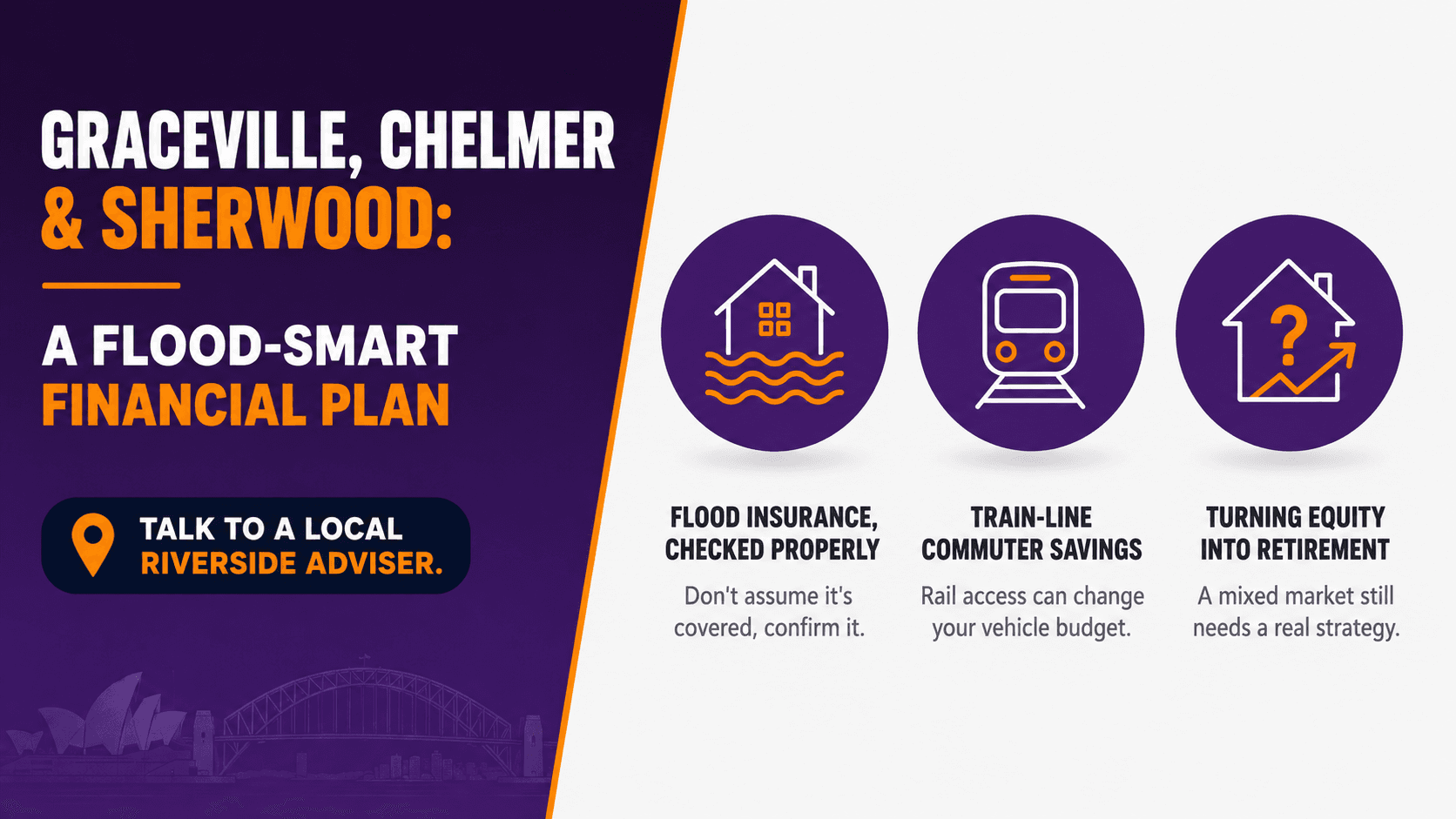
Flood Risk and Getting Insurance Actually Right
Rebuild Costs and Sum Insured Accuracy for Flood-Affected Areas
The Train-Line Commuter Financial Equation
Family Financial Planning Fundamentals for This Corridor
Property Value Reality and Turning Equity Into Retirement Income
Getting to WIAA's Toowong Office From Graceville/Chelmer/Sherwood
Worked Example: A Chelmer Household's Insurance Wake-Up Call
Common Mistakes
FAQ
Flood Risk and Getting Insurance Actually Right
Parts of Graceville, Chelmer, and Sherwood sit close enough to the Brisbane River that flood risk is a genuine, specific consideration, not a theoretical one, given the area's documented history, including both the 2011 and 2022 events. This makes it particularly important to confirm that home and contents insurance specifically covers flood (as distinct from storm or general water damage, which some policies treat differently), and that the policy's terms actually reflect your specific property's flood risk rating rather than a generic assumption of adequate coverage.
Not sure whether your current insurance actually reflects your property's flood risk properly? A free 15-minute chat at our nearby Toowong office can help you check what to look for. Call 1800 942 843.
Bottom line: flood cover isn't automatically bundled into every policy the same way, and for a property in this corridor, confirming exactly what your policy does and doesn't cover for flood specifically is a genuinely important step, not an assumption to skip.
Rebuild Costs and Sum Insured Accuracy for Flood-Affected Areas
Beyond simply having flood cover, the sum insured needs to reflect a realistic full rebuild cost for your specific property. An outdated or underestimated figure can leave a meaningful gap between what a policy pays out and what actually rebuilding would cost, particularly if the property has had renovations or extensions since the policy was last reviewed. For flood-affected areas specifically, rebuild considerations can also include any required changes to comply with updated building requirements for flood-prone zones, which may not be reflected in an older insurance assessment.
Had renovations or extensions since your policy was last reviewed? Email clientservices@whatifadvice.com.au and we'll help you think through what's worth checking with your insurer.
Bottom line: the sum insured figure is only useful if it's current and accurate. For properties in flood-affected zones, this is worth checking with particular care given both the genuine risk and the potential for rebuild requirements to have shifted over time.
The Train-Line Commuter Financial Equation
Graceville, Chelmer, and Sherwood each have their own train station, supporting a genuine commuter lifestyle into the Brisbane CBD without necessarily needing a car for daily work travel. This has real financial planning relevance, households relying primarily on the train for commuting may have lower ongoing vehicle costs than a comparable household in a suburb without rail access, which is worth factoring into broader budgeting and even into decisions like whether a second car (and its associated costs, including any novated lease consideration) is genuinely necessary.
Bottom line: strong train access in this corridor is a genuine financial advantage for commuting households, worth actively factoring into vehicle and transport cost decisions rather than defaulting to a two-car household budget by habit.
Family Financial Planning Fundamentals for This Corridor
Like many established Brisbane family suburbs, Graceville, Chelmer, and Sherwood residents commonly manage mortgage repayments, school costs (with several well-regarded local schools drawing families to the area specifically), and retirement saving simultaneously, the standard family balancing act familiar across much of suburban Brisbane, here layered on top of the corridor's specific property risk and commuter considerations covered above.
Bottom line: the fundamentals of family financial planning remain broadly consistent across Brisbane's family suburbs. What differs here is the additional layer of flood-risk insurance and commuter-cost considerations worth addressing alongside those fundamentals.
Property Value Reality and Turning Equity Into Retirement Income
This corridor's relationship with flood and property value is genuinely mixed, and worth being honest about rather than flattening into a simple story either way. Following the 2011 floods, the area recovered strongly and for some years afterward was cited as an example of riverside property resilience. More recent analysis following the 2022 floods, however, has identified Chelmer and Graceville specifically as carrying one of the more significant flood-related value penalties of any area in the country, reflecting the compounding effect of repeated flood events on buyer perception and pricing, even where the underlying suburb remains genuinely desirable for its schools, character, and train access. This is a live, evolving picture, not a settled one, and it's worth checking current data for your specific property and street rather than relying on either the "fully recovered" or "permanently damaged" version of the story.
For long-term owners who do have real equity, that equity still only becomes useful for retirement with an actual conversion strategy (downsizing, equity-access products, or complementary super growth), not by simply holding the property and assuming it will "work out," regardless of which direction the local market is trending.
Bottom line: this corridor's property values don't tell one simple story about flood risk, and neither should your retirement plan. Your equity needs a deliberate strategy either way, informed by current, accurate information about your specific property rather than a general assumption in either direction.
Getting to WIAA's Toowong Office From Graceville/Chelmer/Sherwood
All three suburbs are a manageable trip from our Toowong office, generally 10 to 20 minutes by car depending on which suburb and traffic conditions, with train connections also providing a straightforward option for residents without a car. Virtual consultations remain available for anyone who'd prefer to skip the trip.
Bottom line: the same train-line access that makes commuting to the city convenient also makes reaching our Toowong office straightforward, with virtual options available regardless.
Worked Example: A Chelmer Household's Insurance Wake-Up Call
The Petersens: A family in Chelmer with a property near the river, who had renewed the same home insurance policy for years without reviewing whether the sum insured still reflected current rebuild costs, or whether flood was specifically and adequately covered given their property's exact risk rating. During a broader financial review, checking their insurance surfaced a meaningful gap: their sum insured hadn't been updated since a renovation years earlier, and the flood coverage terms were less comprehensive than they'd assumed. Addressing this properly gave them genuine peace of mind that hadn't previously existed, despite having "always had insurance."
Bottom line: the Petersens weren't uninsured. They were under-insured in ways that only became clear once someone actually checked the specifics against their property's real characteristics and risk profile.
Common Mistakes
Assuming flood cover is automatically included and adequate in a standard home policy. This needs specific confirmation, not assumption, particularly for properties in this river corridor.
Letting a sum insured figure go stale after renovations or over time. An outdated figure can leave a meaningful shortfall if a rebuild is ever actually needed.
Defaulting to a two-car household budget without factoring in genuine train access. For commuting households, this corridor's rail access can meaningfully change the vehicle cost equation.
Treating property equity as automatically retirement-ready. Even in an area with a strong long-term reputation, values need an actual conversion strategy to support retirement income.
Assuming the local flood story is either fully resolved or permanently damaging. The actual picture is more mixed and specific to individual properties than either version suggests.
FAQ
Does standard home insurance automatically cover flood damage? Not always in the same way as other risks. Flood cover can be treated differently from storm or general water damage depending on the policy, so it's worth specifically confirming rather than assuming it's automatically included and adequate.
How do I know if my sum insured is still accurate? It's worth reviewing periodically, particularly after any renovation, extension, or significant time since the policy was first set up, to make sure the figure still reflects a realistic full rebuild cost for your current property.
How far are Graceville, Chelmer, and Sherwood from WIAA's nearest office? Generally 10 to 20 minutes by car from our Toowong office depending on the specific suburb and traffic, with train connections also providing a straightforward alternative.
Has property in this area recovered well despite past flood events? It's a mixed picture. The area recovered well after the 2011 floods for some years, but more recent analysis following the 2022 floods has identified specific, measurable value impacts for flood-affected properties in Chelmer and Graceville, so this is worth checking against current data for your specific property rather than assuming either a full recovery or a permanent hit.
Should I have a second car if I live near a train station in this corridor? This depends on your household's specific needs, but it's genuinely worth factoring in the cost savings of reduced car reliance when reviewing your broader budget, rather than assuming a second car is automatically necessary.
Can WIAA help review whether my property's insurance is adequate? While we don't sell general insurance directly, we can help you think through what to check and confirm with your insurer, as part of a broader financial and risk review.
Is it worth getting a financial review if I've lived in this area for a long time and feel financially secure? Often yes. Feeling secure and having your insurance, equity strategy, and retirement plan properly checked and coordinated are genuinely different things.
Does WIAA offer mortgage broking services for properties in Graceville, Chelmer, or Sherwood? Yes. Through our mortgage broking partnership, we can help assess purchasing or refinancing options for properties across this corridor.
What's a common financial planning oversight for long-term owners in this area? Not having an actual strategy for converting property equity into retirement income, regardless of which way local flood-risk pricing trends are currently moving.
How often should insurance be reviewed for a property in a flood-affected area? Regularly, and specifically after any renovation, extension, or meaningful time passing, given how easily a sum insured figure or coverage assumption can become outdated relative to the property's actual current characteristics and risk.
Ready to Get an Honest Picture of Where You Stand?
Ready to make sure your insurance, commuter budgeting, and equity strategy actually reflect the specific realities of living in this riverside train-line corridor, rather than an assumption either way? A quick conversation at our nearby Toowong office (or virtually) is a good place to start.
Call us: 1800 942 843
Book online: free 15-minute chat, no cost, no pressure
Still asking what if your insurance hasn't caught up with your actual property? A leafy riverside address deserves a plan that genuinely accounts for what makes it different, including the parts that aren't simple good news.
WIAA has advised 1,000+ clients across our Toowong, Grange, and Melbourne CBD offices, operating under AFSL 528250 as an Authorised Representative of Beryllium Advisers Pty Ltd.
General Advice Disclaimer: This article contains general information only and does not take into account your personal objectives, financial situation, or needs. It does not constitute personal financial or insurance advice, and should not be relied upon as such. WIAA does not sell general insurance products directly. You should confirm insurance coverage details directly with your insurer and seek personal financial advice tailored to your specific circumstances.