Looking for specific financial advice?
This blog provides general educational content. For personalized advice tailored to your unique situation, book a free consultation with our team of ASIC-licensed financial advisers.
What If Income You Earn Overseas Is Taxed in Australia Too?
You rent out a flat in London, or work remotely for a company in Singapore, or still receive a small pension from your years in New Zealand. None of it is paid in Australia, so it feels like it shouldn’t be the ATO’s business. If you’re an Australian tax resident, it almost certainly is. Australia taxes its residents on worldwide income. A remote worker earning $110,000 from an overseas employer, with no Australian tax withheld, could face a bill of around $26,000 at tax time. Understanding the rules, and how foreign tax offsets prevent double taxation, is the difference between a manageable return and an unpleasant surprise.
TL;DR
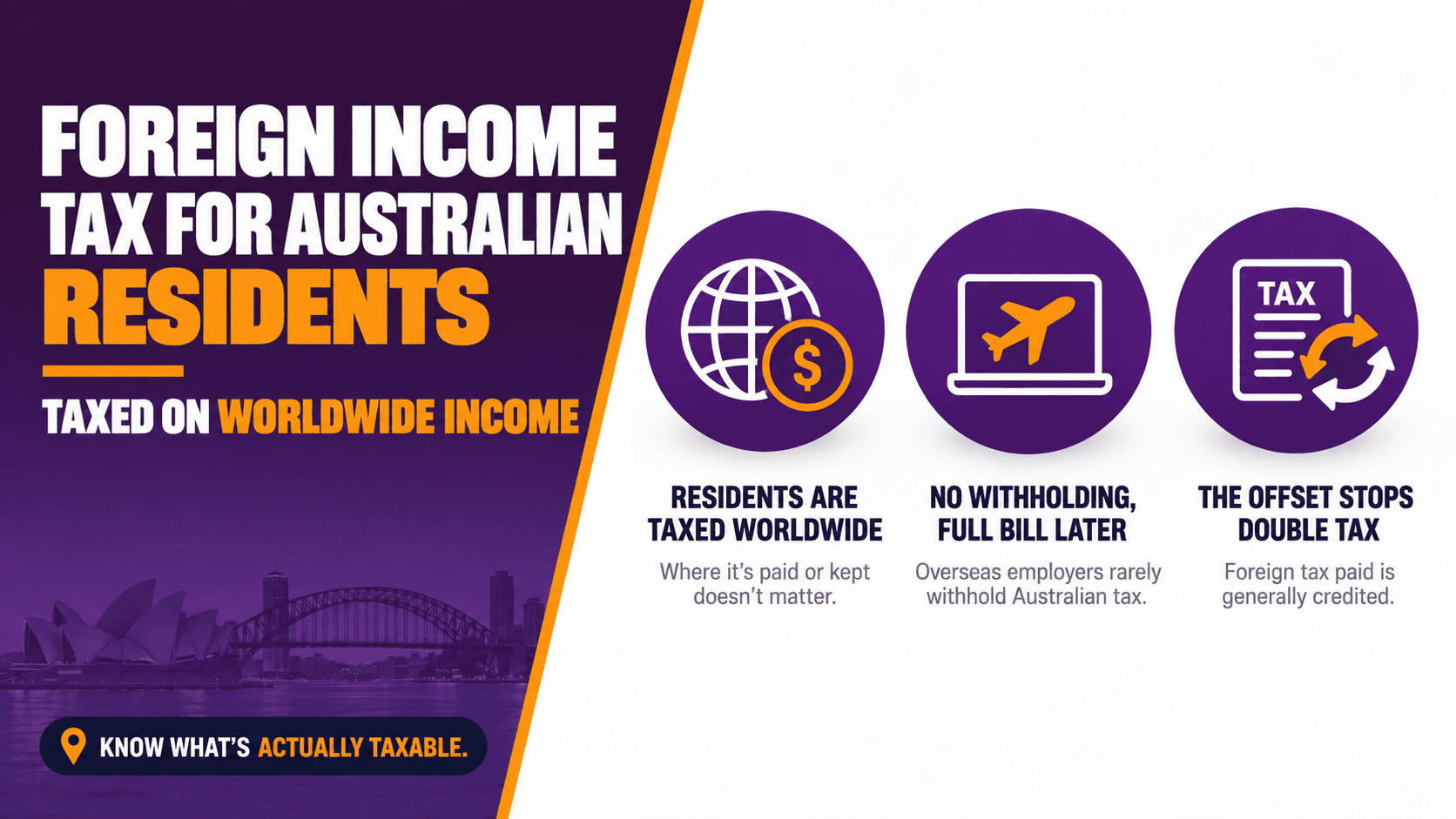
Australian tax residents are taxed on worldwide income, whether it’s paid into an overseas account or brought home.
Residency for tax isn’t about citizenship or visas. It’s determined by tests based on where you live and your ties to Australia.
Foreign employment income, rental income, pensions, and interest are generally assessable in your Australian return.
Everything must be converted to Australian dollars, using either the exchange rate on the day or an ATO average rate, depending on the income.
The foreign income tax offset (FITO) generally credits tax already paid overseas. Up to $1,000 can be claimed without calculating a limit.
Most temporary residents are generally exempt on most foreign income, with important exceptions.
The ATO receives overseas account information from many countries through international data-sharing agreements.
Bottom line: if you’re an Australian tax resident, foreign income generally belongs in your Australian return, and the foreign tax offset is what stops it being taxed twice.
On This Page
The Worldwide Income Rule
Are You an Australian Resident for Tax Purposes?
How Different Types of Foreign Income Are Treated
Converting Foreign Income to Australian Dollars
The Foreign Income Tax Offset: Avoiding Double Tax
Working Remotely for an Overseas Employer
Foreign Rental Property
Temporary Residents: A Different Set of Rules
The ATO Already Knows More Than You Think
Worked Example 1: Hannah’s London Flat
Worked Example 2: Marco’s Singapore Salary
Common Mistakes
FAQ
The Worldwide Income Rule
Australian tax residents must declare income from all sources, inside and outside Australia. It doesn’t matter whether the money stays overseas, goes into a foreign bank account, or is never transferred home. It also doesn’t matter whether you’ve already paid tax on it in another country, although that foreign tax is usually credited against your Australian tax.
Non-residents, by contrast, are generally only taxed in Australia on Australian-sourced income. That’s why residency is the first question to settle.
Bottom line: for residents, the question isn’t whether foreign income is taxable in Australia, it’s how much of the foreign tax already paid can be offset against it.
Are You an Australian Resident for Tax Purposes?
Tax residency is separate from citizenship, permanent residency, or visa status. The ATO applies four tests, and you’re generally a resident if you meet any one:
Test | In plain English |
Resides test | You live in Australia in the ordinary sense, based on factors like your home, family, work, and assets. This is the primary test. |
Domicile test | Your permanent home (domicile) is Australia, unless your permanent place of abode is overseas. |
183-day test | You’re in Australia for more than half the income year, unless your usual home is overseas and you don’t intend to live here. |
Commonwealth super fund test | Mainly for certain Australian government employees working overseas. |
Residency can be complex for people who move during the year, split time between countries, or are working overseas temporarily. A new, simpler individual residency test was announced in the 2021-22 Budget, but it was announced but not yet legislated at the time of writing. Verify the current rules with the ATO or a registered tax agent.
Not sure whether you’re an Australian tax resident? It’s the first question we’d sort out. Email tax@whatifadvice.com.au for a free 15-minute chat.
Bottom line: residency drives everything else, and it’s a test of your circumstances, not your passport.
How Different Types of Foreign Income Are Treated
Income type | Generally taxable for Australian residents? | Key point |
Foreign employment income | Yes | Limited exemptions apply in narrow cases (see below) |
Remote work for an overseas employer while living in Australia | Yes | Usually no Australian tax is withheld, so a bill can build up |
Foreign rental income | Yes | Australian deduction rules apply, and net losses can generally offset other income |
Foreign pensions (for example, UK or NZ) | Generally yes | Treatment depends on the pension type and the relevant tax treaty |
Foreign bank interest | Yes | Foreign withholding tax may apply |
Foreign business income | Yes | Can involve more complex rules |
Foreign shares and ETFs | Yes | See International Shares and Tax |
Transfers from foreign super or pension funds | Depends | Specific rules apply to earnings on transfers |
Australia has tax treaties, known as double tax agreements, with many countries. These can affect which country gets the first right to tax certain income and cap withholding rates. The treaty with the relevant country matters, especially for pensions.
Bottom line: almost every type of foreign income is assessable for residents, and the details depend on the income type and the treaty.
Converting Foreign Income to Australian Dollars
All foreign income, deductions, and foreign tax paid must be reported in Australian dollars. Generally, you can:
Use the exchange rate at the time of the transaction, such as the day each rent payment was received, or
Use an ATO average annual rate, which is often acceptable for income earned evenly over the year, like salary or regular rent.
Be consistent and keep your workings. Different countries also have different tax years. The UK’s runs from 6 April to 5 April, New Zealand’s from 1 April to 31 March, and the US uses the calendar year. Your Australian return covers 1 July to 30 June, so you may need to split figures from two foreign tax years. Exchange rates change daily, so use the correct published rates for the period.
Bottom line: convert everything to AUD and match it to the Australian financial year, not the foreign one.
The Foreign Income Tax Offset: Avoiding Double Tax
The foreign income tax offset (FITO) is a credit for foreign tax you’ve paid on income that’s also taxed in Australia. Here’s how it generally works:
The offset only applies to income that’s included in your Australian assessable income.
If your total foreign tax paid is $1,000 or less, you can generally claim it without further calculation.
If it’s more than $1,000, you either claim $1,000 or calculate your FITO limit. The limit is roughly the Australian tax on the foreign income.
Unused offsets are generally lost. Excess FITO can’t usually be refunded or carried forward to future years.
If the foreign tax rate is higher than your Australian rate, you won’t pay extra Australian tax on that income, but you won’t get the excess back. If the foreign rate is lower, you pay the difference in Australia. The $1,000 threshold and the rules can change, so verify the current rules with the ATO.
Bottom line: FITO generally means you pay the higher of the two countries’ rates on that income, not both.
Working Remotely for an Overseas Employer
This is one of the fastest-growing foreign income situations, and one where people often get caught out.
If you live and work in Australia for an overseas employer, your income is generally taxed in Australia like any other salary.
Your employer usually won’t withhold Australian tax, so the full liability lands when you lodge.
The ATO may enter you into PAYG instalments, which means regular payments toward next year’s tax.
Your employer may not pay Australian super. That affects your retirement savings, so it’s worth planning for separately. Worked Example 2 shows one way to close the gap.
If tax was withheld overseas even though you worked in Australia, you may need to claim a refund from that country rather than a FITO. Get advice on which applies.
There is a foreign employment income exemption, but it’s narrow. It generally applies only to specific types of work overseas, such as some government, aid, defence, or police roles, and only after a continuous period overseas. Most remote workers don’t qualify.
Earning from an overseas employer and not sure what you’ll owe? Call 1800 942 843 for a free 15-minute chat before your tax bill arrives.
Bottom line: if you work from Australia for an overseas company, plan as though nobody is withholding tax for you, because nobody probably is.
Foreign Rental Property
If you own property overseas and rent it out:
Rental income is assessable, converted to AUD.
Expenses are generally deductible under Australian rules, including loan interest, agent fees, repairs, insurance, and eligible depreciation.
A net foreign rental loss can generally offset other Australian income.
Foreign tax paid on the rent may be claimable as a FITO.
Selling the property may trigger Australian capital gains tax, calculated in AUD. Currency movements affect the gain. The main residence exemption has specific rules for property held while you were living in it overseas. Changes to the CGT discount have been announced but not yet legislated, so verify current treatment before selling.
Many people declare their overseas rent to the foreign tax authority but forget it’s also assessable in Australia, or claim deductions under the foreign country’s rules instead of Australia’s.
Bottom line: a foreign rental property is generally taxed in Australia like a local one, just with currency conversion and foreign tax credits added.
Temporary Residents: A Different Set of Rules
If you hold a temporary visa and meet the definition of a temporary resident:
Most foreign-sourced income is generally exempt from Australian tax.
Foreign employment income earned while you’re a temporary resident generally remains assessable.
You may not qualify as a temporary resident if your spouse is an Australian resident for social security purposes, even if you hold a temporary visa.
Capital gains on certain foreign assets may also be disregarded.
If your status changes, for example when you become a permanent resident, your foreign income generally becomes taxable from that point.
Recently moved to Australia, or just become a permanent resident? Our tax team can help you understand what’s taxable and when. Book a free 15-minute chat online or email tax@whatifadvice.com.au.
Bottom line: temporary residents get a generous exemption for most foreign income, but it has edges, and it ends when your status changes.
The ATO Already Knows More Than You Think
Australia participates in international information-sharing arrangements, including the Common Reporting Standard. Under these, financial institutions in participating countries report accounts held by Australian tax residents. International funds transfers are also reported to Australian authorities through AUSTRAC.
That means foreign bank accounts, overseas interest, and transfers home aren’t as invisible as many people assume. If you’ve left foreign income out of past returns, our How to Amend a Tax Return After You’ve Lodged It guide explains why fixing it voluntarily, before the ATO asks, usually costs less.
Bottom line: assume the ATO can see your foreign accounts, because in many cases it can.
Worked Example 1: Hannah’s London Flat
Hannah lives in Brisbane, earns $95,000 in salary, holds private hospital cover, and owns a flat in London that she rents out. For illustration, assume a rate of 1 GBP = 2.00 AUD, and that Hannah isn’t entitled to the UK personal allowance.
GBP | AUD | |
Rent received | £12,000 | $24,000 |
Expenses (agent £800, repairs £400, insurance £300, loan interest £2,500) | £4,000 | $8,000 |
Net rental income (Australian calculation) | £8,000 | $16,000 |
UK tax paid on the rent | £1,600 | $3,200 |
Why the UK figure is worked out differently. Australia lets Hannah deduct her loan interest in full. The UK doesn’t. It taxes her rent before interest, then gives a tax credit worth 20% of the interest. So her UK taxable profit is £10,500 (£12,000 less £1,500 of non-interest expenses). At the 20% basic rate that’s £2,100, less a £500 interest credit (20% of £2,500), giving £1,600. For a basic-rate UK taxpayer, that happens to match 20% of her £8,000 net figure. For a higher-rate UK taxpayer, it wouldn’t. It’s a good illustration of why you calculate each country’s tax under its own rules, rather than copying figures across. If Hannah were entitled to the UK personal allowance, as many UK nationals living abroad are, her UK tax could be nil. In that case there would be no FITO, and she’d pay the full Australian amount.
Australian side: the extra $16,000 keeps Hannah’s total income at $111,000, in the 30% bracket plus the 2% Medicare levy (32%).
Australian tax on the rental income: $16,000 × 32% = $5,120
FITO for UK tax paid: her UK tax ($3,200) is above $1,000, so she calculates her FITO limit. The full $3,200 is within the limit.
Net additional Australian tax: $5,120 − $3,200 = $1,920
Outcome: Hannah’s total tax on the rent across both countries is $5,120, the Australian amount, not $5,120 plus $3,200. She also has to split her UK figures across two UK tax years to match the Australian financial year, and keep her exchange-rate workings. If she didn’t hold private hospital cover, the Medicare levy surcharge could also apply at this income (see our Medicare Levy Surcharge and the Private Health Rebate guide). These figures are simplified and illustrative only. UK rules and allowances change, so verify them with a UK tax adviser or HMRC.
Bottom line: Hannah’s foreign tax isn’t wasted, it’s credited, but only because she declares the income and claims the offset properly.
Worked Example 2: Marco’s Singapore Salary
Marco lives in Melbourne and works remotely for a Singapore company. His salary is the equivalent of $110,000 AUD. No tax is withheld in Singapore, and none is withheld in Australia. He assumed foreign income wasn’t the ATO’s concern. He holds private hospital cover.
Using 2025-26 resident rates (verify the current rates with the ATO):
Tax | |
First $18,200 | $0 |
$18,201 to $45,000 at 16% | $4,288 |
$45,001 to $110,000 at 30% | $19,500 |
Medicare levy (2%) | $2,200 |
Total | $25,988 |
Outcome: because nothing was withheld, Marco owes about $25,988 when he lodges. He may also be entered into PAYG instalments, which means paying toward next year’s tax during the year. Had he set aside around 24% of each pay, the bill would have been routine rather than a shock. From 2026-27, the 16% rate falls to 15%, which would trim about $268 off the same bill.
Two other things could change his number:
Without private hospital cover, at this income Marco would likely also pay the Medicare levy surcharge, about $1,100 at the 1% tier. Thresholds change each year, so verify them.
The super gap. His employer hasn’t been paying Australian super. One lever is a personal concessional contribution: Marco contributes to his own fund and claims a tax deduction, within the concessional cap ($30,000 for 2025-26, which includes any employer contributions; verify the current cap). If he contributed $13,200, roughly what 12% employer super would have been, he’d save about $4,224 in personal tax (13,200×32%),whilehisfundpays15%contributionstax(1,980). That’s about $2,244 better off than taking the same money as salary, and his retirement savings get topped up. He needs to lodge a notice of intent with his fund, and get an acknowledgement, before claiming the deduction.
Bottom line: remote work for an overseas employer is fully taxable in Australia, and without withholding, both the tax planning and the super planning are entirely up to you.
Working for an overseas employer with no super being paid? Our financial advisers can help you plan contributions that suit your situation. Email clientservices@whatifadvice.com.au for a free 15-minute chat.
Common Mistakes
Assuming income kept overseas isn’t taxable in Australia. Residents are taxed on worldwide income regardless of where it’s paid or kept.
Confusing citizenship or visa status with tax residency. Residency depends on the ATO’s tests, not your passport.
Not converting to AUD, or using the wrong rate. All amounts need to be in Australian dollars, with workings kept.
Reporting the foreign tax year instead of the Australian one. Figures need to match 1 July to 30 June.
Not claiming the FITO. That can mean paying tax on the same income twice.
Copying foreign tax figures straight into your Australian calculation. Each country calculates taxable income its own way.
Remote workers not setting money aside. With no withholding, the full liability arrives at once.
Claiming foreign rental deductions under foreign rules. Australian deduction rules apply to your Australian return.
Assuming the ATO can’t see overseas accounts. International data sharing makes that increasingly unlikely.
Got foreign income and not sure your past returns got it right? Call 1800 942 843 for a free 15-minute chat with WIAA’s tax team.
FAQ
Do I have to declare overseas income in Australia?
If you’re an Australian tax resident, generally yes. Residents are taxed on worldwide income.
I already paid tax overseas. Do I pay again in Australia?
Generally you claim a foreign income tax offset for the foreign tax paid. You may pay the difference if the Australian rate is higher, but you shouldn’t be taxed twice on the same income.
What is the foreign income tax offset limit?
If your total foreign tax paid is $1,000 or less, you can generally claim it without calculating a limit. Above that, you calculate your limit or claim $1,000. Excess offsets are generally lost.
Is my UK or NZ pension taxable in Australia?
Often yes, depending on the type of pension and the relevant tax treaty. Treatment varies, so get advice on your specific pension.
I work remotely for an overseas company while living in Australia. Is my salary taxable here?
Generally yes, as Australian-taxable employment income. It’s common for no tax to be withheld, so you may need to plan for a lump-sum bill.
Can I claim a loss on my overseas rental property?
Generally yes. Net foreign rental losses can usually be offset against other assessable income, calculated under Australian rules.
Which exchange rate should I use for foreign income?
Generally the rate at the time of each transaction, or an ATO-published average rate where appropriate, such as for income earned evenly throughout the year.
Are temporary residents taxed on foreign income?
Most foreign income of temporary residents is generally exempt, but foreign employment income earned while a temporary resident generally remains taxable, and other conditions apply.
Does the ATO know about my overseas bank account?
Quite possibly. Australia shares financial account information with many countries, and international transfers are reported to Australian authorities.
I forgot to declare foreign income in a past return. What should I do?
Amend the return as soon as possible. Voluntarily disclosing before the ATO contacts you can significantly reduce penalties.
Ready to Get Your Foreign Income Right?
Foreign income is one of the easiest areas to get wrong and one of the most likely to be picked up through data matching. A free 15-minute chat can help you work out what’s taxable, what you can offset, and what to set aside.
Call us: 1800 942 843
Email: tax@whatifadvice.com.au (tax and returns) or clientservices@whatifadvice.com.au (super and financial planning)
Book online: free 15-minute chat, no cost, no pressure
Still asking what if?
WIAA helps Australian residents with overseas income, properties, and pensions get their tax right across Toowong, Grange, and Melbourne CBD. WIAA is a registered tax agent practice with the Tax Practitioners Board and operates under AFSL 528250 as an Authorised Representative of Beryllium Advisers Pty Ltd.
General Advice Disclaimer: This article contains general information only and does not take into account your personal objectives, financial situation, or needs. It is not personal tax or financial advice and should not be relied upon as such. Tax residency rules, tax rates, the foreign income tax offset rules and threshold, exchange rates, temporary resident rules, Medicare levy surcharge thresholds, superannuation contribution caps, foreign tax rules, and tax treaties can change and vary by country. Any reference to changes to the CGT discount or the residency tests reflects measures that are announced but not yet legislated. Verify current rules and rates with the ATO or a registered tax agent. Worked examples are illustrative and simplified. Seek professional advice for your own circumstances.