Looking for specific financial advice?
This blog provides general educational content. For personalized advice tailored to your unique situation, book a free consultation with our team of ASIC-licensed financial advisers.
What If the Government Was Willing to Match Your Super Contribution and Nobody Told You?
The government super co-contribution scheme is genuinely rare in the tax and super system: free money, directly matched to a personal contribution, with no catch beyond meeting a few eligibility conditions. And yet it's one of the most commonly missed super strategies, mostly because the people who'd benefit most, lower and middle-income earners, are also the ones least likely to have heard of it, while higher earners who have heard of super strategies generally don't qualify and rarely think to check whether a lower-earning family member does. For a related mechanic that rewards the contributor rather than the receiver, our spouse contribution tax offset guide covers a genuinely different but complementary strategy worth comparing alongside this one.
TL;DR
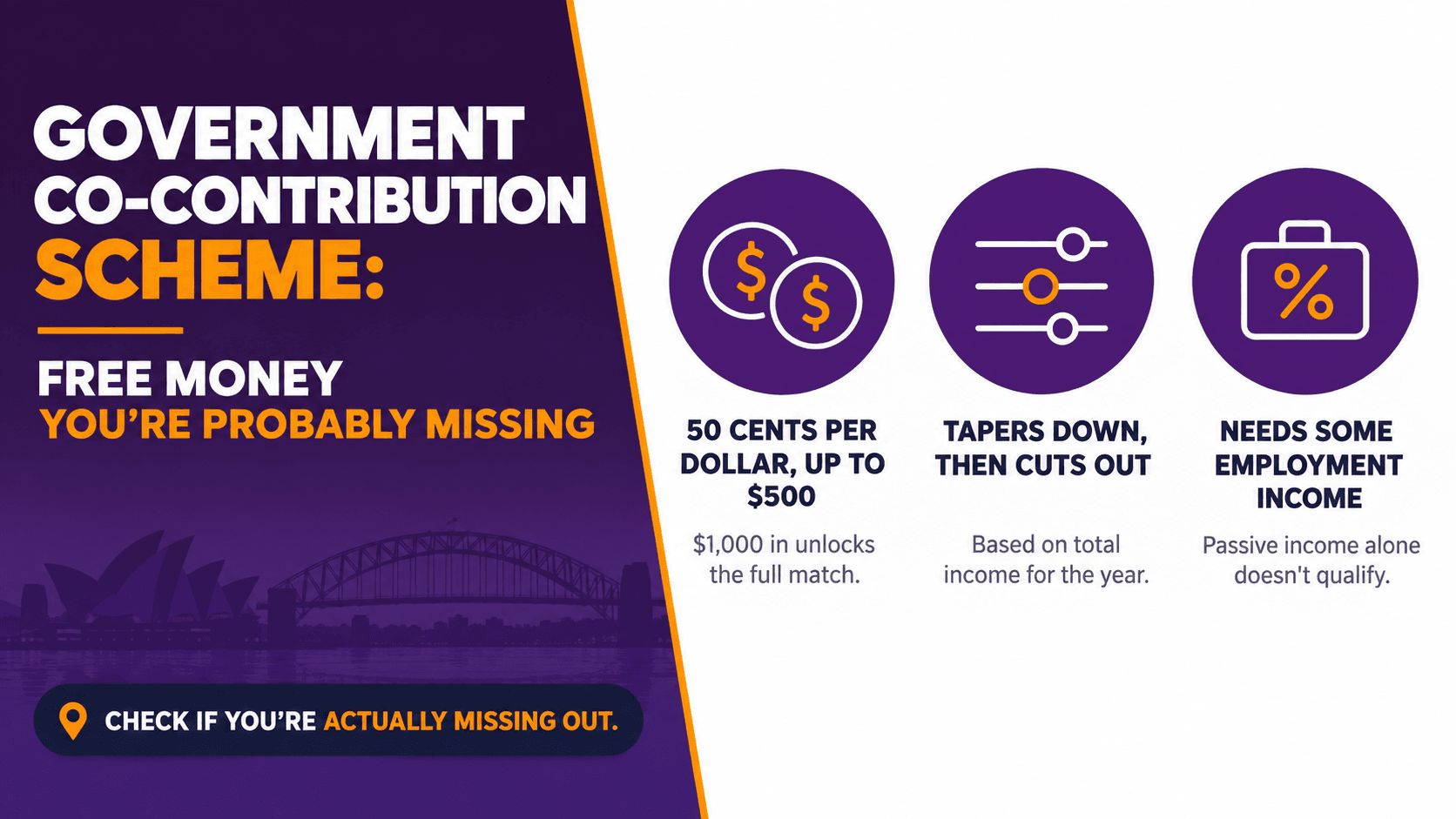
The government can contribute up to $500 into your super, matched against your own personal after-tax (non-concessional) contribution.
To get the maximum $500 match, you generally need to personally contribute $1,000, matched at a rate of 50 cents per dollar.
Eligibility is based on total income, with the co-contribution tapering down as income rises and cutting out entirely above an upper threshold.
You must earn at least 10% of your total income from employment or self-employment to be eligible, meaning this generally doesn't apply to someone with no employment income at all.
Salary sacrifice contributions don't count toward this scheme, only personal after-tax contributions made from your own take-home pay are eligible.
You don't need to apply separately, the ATO generally calculates and pays the co-contribution automatically based on your tax return and super contribution information, provided eligibility is met.
This is particularly relevant for lower-income earners, part-time workers, and anyone with a genuinely low-income year, since eligibility is based on income for that specific financial year.
Bottom line: this is one of the only places in the entire super system where the government directly matches your own money, and it's specifically the personal after-tax contribution, not salary sacrifice, that qualifies.
On This Page
How the Matching Actually Works
The Income Test and Taper
The 10% Employment Income Rule
Why Salary Sacrifice Doesn't Count
How to Actually Claim It
Worked Example: Two Contribution Amounts, Two Outcomes
Common Mistakes
FAQ
How the Matching Actually Works
The scheme works as a direct match: for every dollar of eligible personal (after-tax) super contribution made, the government contributes 50 cents, up to a maximum government contribution of $500. This means the maximum benefit is achieved by personally contributing $1,000 in a financial year, which unlocks the full $500 match. Contributing less than $1,000 still attracts a match, just proportionally smaller, calculated at the same 50-cent rate.
Not sure whether you or a family member's income this year makes you eligible for this? A free 15-minute chat with WIAA can check it. Call 1800 942 843 or book online.
Bottom line: $1,000 is the number that unlocks the full $500 match, contributing less still helps, just proportionally less.
The Income Test and Taper
Eligibility is based on your total income for the financial year, generally including assessable income, reportable fringe benefits, and reportable super contributions combined. Below a lower income threshold, the full match is potentially available (subject to meeting the $1,000 contribution for the maximum). Between the lower and upper thresholds, the available co-contribution tapers down progressively as income rises. Above the upper threshold, no co-contribution is available at all, regardless of how much is personally contributed.
These specific income thresholds are indexed and reviewed periodically, so the current figures should always be verified directly with the ATO before relying on them for a specific financial year.
Bottom line: this scheme is squarely aimed at lower and middle-income earners, and the benefit tapers away entirely once income rises past the upper threshold.
The 10% Employment Income Rule
To be eligible, at least 10% of your total income for the year must come from employment or carrying on a business (self-employment). This rule generally excludes someone whose income is entirely from investment returns, rental income, or other non-employment sources with no employment or business income component at all. It's a rule aimed at ensuring the scheme benefits working Australians on lower incomes, rather than, for example, someone living entirely off investment income with a low headline income figure but no employment connection.
Confirming whether your specific income mix meets this 10% employment test is a quick check worth making before contributing. A free 15-minute chat can walk through it. Email clientservices@whatifadvice.com.au or book online.
Bottom line: this scheme is specifically for people earning at least some meaningful income from work, not purely passive income earners, regardless of how low that passive income might be.
Why Salary Sacrifice Doesn't Count
This is the detail that catches out people who've heard of super strategies generally but not this specific scheme: only personal, after-tax (non-concessional) contributions count toward the co-contribution match. Salary sacrifice contributions, made before tax from your employer, are concessional contributions and don't attract this match at all, regardless of the amount sacrificed. This means someone maximising their salary sacrifice contributions, while a genuinely sound strategy in its own right, is doing something entirely separate from what this scheme rewards, and may be missing the co-contribution opportunity entirely if they're not also making an eligible after-tax contribution.
Bottom line: salary sacrifice and the co-contribution are two different mechanics rewarding two different kinds of contribution, and maximising one doesn't automatically capture the other.
How to Actually Claim It
In most cases, there's no separate application required. Provided a personal after-tax super contribution has been made and a tax return has been lodged for that financial year, the ATO generally calculates eligibility and pays the co-contribution automatically, deposited directly into the eligible super fund. The main practical steps are ensuring the contribution is correctly made and reported as a personal (non-concessional) contribution by the super fund, not miscategorised, and that a tax return is lodged for the relevant year.
Bottom line: the process is largely automatic once the right kind of contribution is made and the tax return is lodged, the main risk is the contribution itself being miscategorised or the eligibility criteria not being met in the first place.
Worked Example: Two Contribution Amounts, Two Outcomes
Maria earns $42,000 for the year, working part-time, comfortably meeting the 10% employment income test and sitting below the lower income threshold for this scheme.
Scenario A: Maria personally contributes $1,000 (after-tax) into her super. Since she meets all eligibility criteria and has contributed the full $1,000, she receives the maximum government co-contribution of $500, deposited automatically into her super account after she lodges her tax return.
Scenario B: Maria instead contributes $400. At the same 50-cent matching rate, she receives a $200 government co-contribution, proportionally smaller, reflecting the smaller personal contribution made.
Outcome: identical eligibility, but a $600 difference in personal contribution between the two scenarios produced a $300 difference in the government's matching contribution, purely based on how much Maria personally put in.
Bottom line: reaching the full $1,000 personal contribution is what unlocks the maximum $500 match, and it's a genuinely achievable figure for many eligible lower and middle-income earners.
Common Mistakes
Assuming salary sacrifice contributions count toward this scheme. Only personal after-tax contributions are eligible, salary sacrifice is a separate mechanic entirely.
Not checking the 10% employment income rule before assuming eligibility. Someone with genuinely low total income but no employment or business income component doesn't qualify.
Contributing less than $1,000 without realising the match scales down proportionally. Every dollar below $1,000 reduces the potential match at the same 50-cent rate.
Assuming a separate application is required. The ATO generally calculates and pays this automatically, provided the contribution and tax return are correctly in place.
Overlooking this scheme entirely for a lower-earning family member. A spouse, adult child, or family member on a genuinely lower income for a particular year may be eligible even if the main household earner isn't.
This is genuinely free money for eligible Australians, and it's specifically missed by people focusing purely on salary sacrifice strategies. A free 15-minute chat can check who in your household might actually qualify. Call 1800 942 843.
FAQ
How much can the government contribute to my super through this scheme? Up to $500, matched at 50 cents per dollar of eligible personal contribution, meaning a $1,000 personal contribution unlocks the maximum match.
Do I need to apply for the government co-contribution? Generally not separately, the ATO calculates eligibility and pays the co-contribution automatically, provided an eligible contribution has been made and a tax return has been lodged.
Does salary sacrifice count toward the co-contribution? No. Only personal, after-tax (non-concessional) contributions are eligible, salary sacrifice contributions are concessional and don't attract this match.
What income counts toward the eligibility test for this scheme? Generally total income including assessable income, reportable fringe benefits, and reportable super contributions combined, assessed against the current income thresholds.
Do I need to be employed to be eligible? You need to earn at least 10% of your total income from employment or carrying on a business, someone with no employment or business income component generally doesn't qualify.
Can a family member with low income benefit from this, even if I earn a lot? Yes, eligibility is based on the individual making the contribution, so a lower-earning spouse or family member could be personally eligible even if others in the household earn considerably more.
Is there a minimum contribution needed to get any co-contribution at all? There's no strict minimum to receive some match, but the amount received scales with the contribution made, up to the $1,000 figure that unlocks the maximum $500.
Does this scheme change every year? The specific income thresholds are indexed and periodically reviewed, so current figures should always be verified with the ATO for the relevant financial year rather than assumed from a prior year.
Can I get the co-contribution multiple years in a row? Yes, generally, provided eligibility criteria are met each specific financial year based on that year's income and contributions.
Is the co-contribution taxed when it's paid into my super? Generally, the co-contribution itself is not taxed going in, since it's a government contribution rather than a personal or employer contribution subject to contributions tax, though this should be confirmed for your specific circumstances.
Ready to Check If You're Missing Out on This?
If you or someone in your household is on a lower income this year, this scheme could mean genuinely free money added to super for a relatively small personal contribution. A free 15-minute chat can check eligibility.
Call us: 1800 942 843
Book online: free 15-minute chat, no cost, no pressure
Still asking what if.
WIAA has helped Australians identify super strategies they didn't know they were eligible for, across Toowong, Grange, and Melbourne CBD. WIAA operates under AFSL 528250 as an Authorised Representative of Beryllium Advisers Pty Ltd.
General Advice Disclaimer: This article contains general information only and does not take into account your personal objectives, financial situation, or needs. It is not personal financial advice or tax advice and should not be relied upon as such. Income thresholds, matching rates, and eligibility rules are subject to change and should be verified with the ATO for the current financial year before acting.