Looking for specific financial advice?
This blog provides general educational content. For personalized advice tailored to your unique situation, book a free consultation with our team of ASIC-licensed financial advisers.
What If Hiring Your First Employee Comes With More Paperwork Than You Expect?
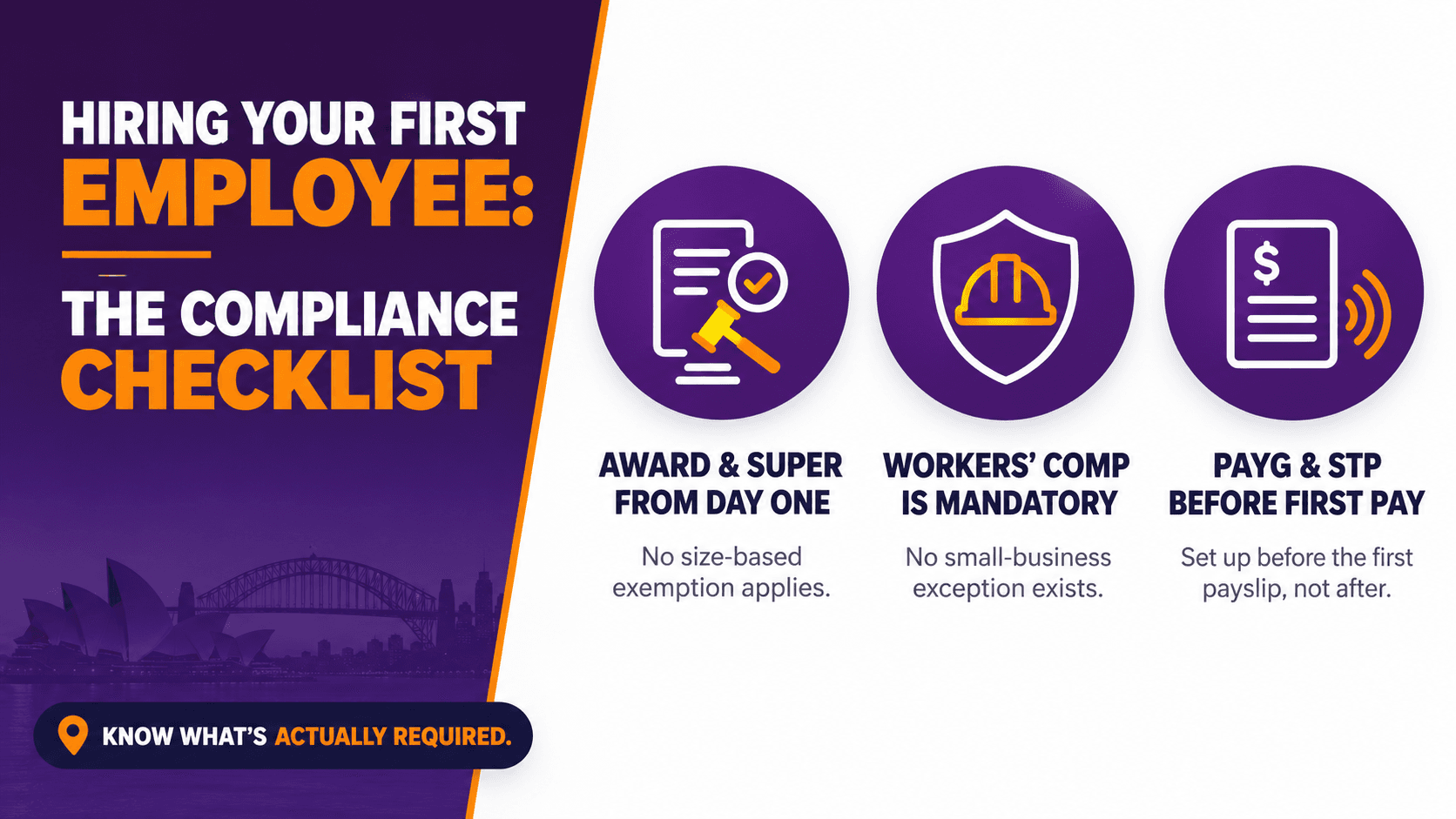
Taking on a first employee is a genuine milestone for a small business, and it also flips a switch on a long list of legal and compliance obligations that don't apply to a sole operator. Award coverage, superannuation, PAYG withholding, workers' compensation insurance, and payroll reporting all become mandatory the moment someone else is on the payroll, regardless of the business's size. This guide covers the checklist most first-time employers don't realise they need until they're already partway through it. Some of what follows, tax registration, superannuation, and payroll reporting, sits squarely within accounting and tax territory WIAA can help with directly. Other items, Fair Work award coverage, workers' compensation insurance, and employment contract drafting, are workplace relations and general insurance matters best handled with Fair Work, a workplace lawyer, or an insurance broker. This piece flags all of them so nothing gets missed, and is clear about which is which.
TL;DR
Fair Work award coverage applies from the first hire, determining minimum pay rates, hours, and entitlements based on the type of work, regardless of business size.
Superannuation guarantee (SG) contributions are mandatory on an employee's ordinary time earnings, currently legislated to reach a set percentage over coming years, and this obligation applies from the very first pay.
PAYG withholding registration is required before the first pay run, so tax can be correctly withheld and remitted to the ATO.
Workers' compensation insurance is a legal requirement in every state and territory once an employee is engaged, with no small-business exemption.
Single Touch Payroll (STP) reporting is mandatory for employers, requiring payroll software that reports pay and super information to the ATO each pay cycle.
A written employment contract, while not always strictly mandated in every circumstance, is strongly recommended to clearly document pay, hours, leave entitlements, and role expectations from day one.
Employee vs contractor classification needs to be genuinely correct from the outset, since misclassifying an employee as a contractor carries specific, ATO-enforced consequences.
Bottom line: the compliance obligations that come with a first employee are the same ones that apply to a business with fifty staff, there's no size-based grace period, which is exactly why most first-time employers are caught off guard by how much needs to be in place before day one.
On This Page
Fair Work Award Coverage: Getting Pay Rates Right
Superannuation Guarantee Obligations
Registering for PAYG Withholding
Workers' Compensation Insurance
Single Touch Payroll Setup
Employment Contracts and Getting Classification Right
Worked Example: A Sole Trader's First Hire
Common Mistakes
FAQ
Fair Work Award Coverage: Getting Pay Rates Right
Most Australian employees are covered by a Modern Award specific to their industry or occupation, setting minimum pay rates, penalty rates, allowances, and other entitlements. This applies regardless of business size, a business hiring its first employee is subject to exactly the same award coverage rules as a much larger competitor. Identifying the correct award, and the correct classification level within that award, is the starting point for setting a legally compliant pay rate, since paying below the applicable award minimum is a compliance breach regardless of whether it was intentional. This specific area, award identification and classification, is Fair Work territory rather than something WIAA advises on directly. The Fair Work Ombudsman's website and a workplace relations specialist are the right starting points.
Bottom line: award coverage isn't optional or scaled to business size, identifying the correct award and classification is the first compliance step, before anything else is set up.
Superannuation Guarantee Obligations
Employers are required to pay superannuation guarantee (SG) contributions on an employee's ordinary time earnings, into a fund of the employee's choice (or a default fund if none is nominated), generally on a quarterly basis at minimum. The specific SG percentage rate is periodically increased by legislation and should be verified for the current financial year rather than assumed from a prior year's figure. This obligation applies from the very first dollar of eligible earnings, there's no size-based exemption or grace period for a business's first hire.
Not sure how superannuation guarantee obligations apply to your first hire's specific pay structure? A free 15-minute chat with WIAA can help work through it. Call 1800 942 843 or book online.
Bottom line: superannuation guarantee obligations begin with the very first pay, not after some size or revenue threshold is reached.
Registering for PAYG Withholding
Before the first pay run, an employer generally needs to be registered for PAYG (Pay As You Go) withholding with the ATO, enabling correct income tax withholding from employee wages and its remittance to the ATO on the required schedule. This registration is separate from other business registrations like an ABN, and needs to be actioned before wages are actually paid, not after the fact.
Getting PAYG withholding registration and setup right before the first pay run avoids a scramble afterwards. A free 15-minute chat can walk through the registration process. Email tax@whatifadvice.com.au or book online.
Bottom line: PAYG withholding registration is a separate, mandatory step that needs to happen before, not after, the first payslip is issued.
Workers' Compensation Insurance
Workers' compensation insurance is a legal requirement in every Australian state and territory once a business engages an employee, covering workplace injury and illness. There's no small-business or first-employee exemption, this obligation applies immediately upon engaging staff, and the specific scheme, provider, and premium calculation vary by state. Operating without required workers' compensation cover is a compliance breach with potentially serious consequences if a workplace injury occurs while uninsured. WIAA doesn't arrange workers' compensation insurance directly, this is general insurance, generally sourced through your state's scheme or a licensed insurance broker, and is worth actioning early given it's mandatory from day one of engaging staff.
Not sure where to start arranging workers' compensation cover for your state? Book a free 15-minute chat online and we can at least point you toward the right scheme and next steps.
Bottom line: workers' compensation insurance isn't optional or scaled by business size, it's a legal requirement from the moment a first employee is engaged.
Single Touch Payroll Setup
Single Touch Payroll (STP) is the mandatory reporting framework requiring employers to report payroll information, including wages, PAYG withholding, and superannuation, to the ATO each pay cycle through STP-enabled payroll software. This means a first-time employer generally needs compliant payroll software set up before the first pay run, rather than manually calculating and separately reporting pay information after the fact.
Setting up STP-compliant payroll from the start avoids a compliance gap on day one. A free 15-minute chat can help identify a setup that suits a first-time employer. Call 1800 942 843.
Bottom line: STP reporting requires the right software in place before the first payslip is issued, not a manual process retrofitted afterwards.
Employment Contracts and Getting Classification Right
While the specific legal requirement for a written contract can depend on the circumstances, having a clear, written employment contract from day one is strongly recommended, documenting pay, hours, leave entitlements, probation terms, and role expectations, reducing the risk of disputes down the track. Drafting the contract itself is a legal document best prepared or reviewed by a solicitor or workplace relations specialist. Equally important is correctly classifying the working relationship as employment rather than an independent contractor arrangement where the substance of the relationship is genuinely one of employment, since the ATO and Fair Work both apply specific tests to this distinction, and misclassification carries real consequences, including back-payment of super, PAYG, and potential penalties. The tax and super side of getting this classification right, superannuation guarantee and PAYG obligations flowing from it, is where WIAA can help directly.
Bottom line: a written contract and a genuinely correct employee-versus-contractor classification are both foundational, not optional extras to sort out later.
Worked Example: A Sole Trader's First Hire
Priya runs a small graphic design business as a sole trader and is taking on her first employee, a junior designer working 25 hours a week. Before the employee's first day, Priya needs to: identify the correct Modern Award and classification level for the role (with Fair Work or a workplace relations specialist), confirm the legally compliant minimum pay rate for that classification, register for PAYG withholding with the ATO, set up STP-compliant payroll software, arrange workers' compensation insurance through her state's scheme, prepare a written employment contract covering pay, hours, and leave entitlements (ideally reviewed by a solicitor), and confirm her superannuation guarantee obligations are set up to begin from the employee's first pay.
Outcome: by working through this checklist before the employee's start date, and knowing which items are tax/accounting matters versus workplace relations or insurance matters, Priya avoids the common scenario of a first-time employer realising these obligations exist only after already being non-compliant on day one.
Bottom line: every item on this checklist needs to be actioned before the first pay run, not discovered afterwards through a compliance gap, and knowing which professional handles which item matters as much as knowing the checklist exists.
Common Mistakes
Assuming compliance obligations scale up with business size. Award coverage, super, workers' comp, and PAYG withholding all apply from the very first employee, with no size-based exemption.
Classifying a genuine employee as a contractor to simplify obligations. This is a substance-over-form test, not a label choice, and misclassification carries real financial consequences.
Setting up payroll software after the first pay run instead of before. STP reporting requires compliant software in place from day one.
Assuming a verbal agreement is sufficient instead of a written contract. While not always strictly mandated, a written contract significantly reduces dispute risk and is considered best practice.
Not confirming the correct award and classification level before setting a pay rate. Paying below the applicable award minimum is a compliance breach regardless of intent.
Getting the tax and super side of every item on this checklist right before day one avoids inheriting a compliance problem along with a new employee. A free 15-minute chat can help review your specific situation. Call 1800 942 843.
FAQ
Do I need to register for anything before hiring my first employee? Yes, generally including PAYG withholding registration with the ATO and arranging workers' compensation insurance, both of which should be in place before the first pay run.
Is superannuation guarantee required from the very first pay, even for a casual or part-time employee? Generally, yes, superannuation guarantee obligations apply based on ordinary time earnings from the first eligible pay, regardless of whether the employee is full-time, part-time, or casual, subject to the standard eligibility rules.
Do I need workers' compensation insurance even if I only have one employee? Yes, this is a legal requirement in every state and territory from the moment a business engages an employee, with no exemption based on the number of staff. This is arranged through your state's scheme or an insurance broker, not something WIAA arranges directly.
How do I know which Modern Award applies to my first employee? This depends on the specific industry and role, and can require checking Fair Work's award coverage guidance or seeking advice from a workplace relations specialist, since applying the wrong award or classification can result in underpayment.
Is a written employment contract legally required? Specific requirements can vary by circumstance, but a written contract is strongly recommended regardless, prepared or reviewed by a solicitor, since it clearly documents terms and significantly reduces the risk of later disputes.
What happens if I classify an employee as a contractor by mistake? This can result in back-payment of superannuation, PAYG withholding, and potential penalties, since classification is based on the actual substance of the working relationship, not simply the label used.
Do I need special payroll software, or can I calculate pay manually? Single Touch Payroll reporting is mandatory for employers, generally requiring STP-compliant payroll software rather than manual calculation and separate reporting.
Does hiring a casual employee change any of these obligations? Most obligations, including award coverage, superannuation, PAYG withholding, and workers' compensation, still apply to casual employees, though some specific entitlements and calculations differ from full-time or part-time arrangements.
How long before my employee's start date should I complete this checklist? Generally, all registrations, insurance, payroll setup, and contract preparation should be finalised before the employee's first day, since several of these obligations begin from the very first pay.
Can WIAA help with all of this, or just some of it? WIAA can help directly with the tax and accounting side, PAYG registration, superannuation guarantee setup, and Single Touch Payroll. Award coverage and classification, workers' compensation insurance, and employment contract drafting sit with Fair Work, an insurance broker, and a solicitor respectively, and we're happy to point you in the right direction for those.
Ready to Get the Tax and Payroll Side Compliant From Day One?
Taking on a first employee brings a full set of legal obligations that apply regardless of business size. A free 15-minute chat can help make sure the tax, super, and payroll side is set up correctly, and point you toward the right specialist for the rest.
Call us: 1800 942 843
Email: tax@whatifadvice.com.au
Book online: free 15-minute chat, no cost, no pressure
Still asking what if.
WIAA has helped Australian small business owners get their tax and payroll obligations compliant before their first employee's start date, not after, across Toowong, Grange, and Melbourne CBD. WIAA operates under AFSL 528250 as an Authorised Representative of Beryllium Advisers Pty Ltd.
General Advice Disclaimer: This article contains general information only and does not take into account your personal objectives, financial situation, or needs. It is not personal financial, tax, or legal advice and should not be relied upon as such. Award classifications and Fair Work obligations should be verified with the Fair Work Ombudsman or a workplace relations specialist; workers' compensation insurance should be arranged through your state's scheme or a licensed insurance broker; employment contracts should be prepared or reviewed by a solicitor. Superannuation guarantee rates, PAYG withholding requirements, and Single Touch Payroll obligations are subject to change and should be verified with the ATO or a registered tax agent for your specific circumstances.