Looking for specific financial advice?
This blog provides general educational content. For personalized advice tailored to your unique situation, book a free consultation with our team of ASIC-licensed financial advisers.
How Much Super Should I Have at 40, 50, and 60? (Australia 2026)
You log into your super account, see the balance, and immediately wonder: is this enough? Are you behind? Are you ahead? What does "on track" even look like at your age?
You're not the only one asking. Most Australians have no idea what a healthy super balance looks like at 40, 50, or 60, and the silence from super funds doesn't help.
This guide cuts through it. We'll show you what the ATO data actually says about average balances by age, what the ASFA Retirement Standard says you should be aiming for, and exactly what to do if you're falling short.
Quick Answer
If you're wondering how much super you should have at 40, 50, and 60 in Australia in 2026, here are the headline numbers:
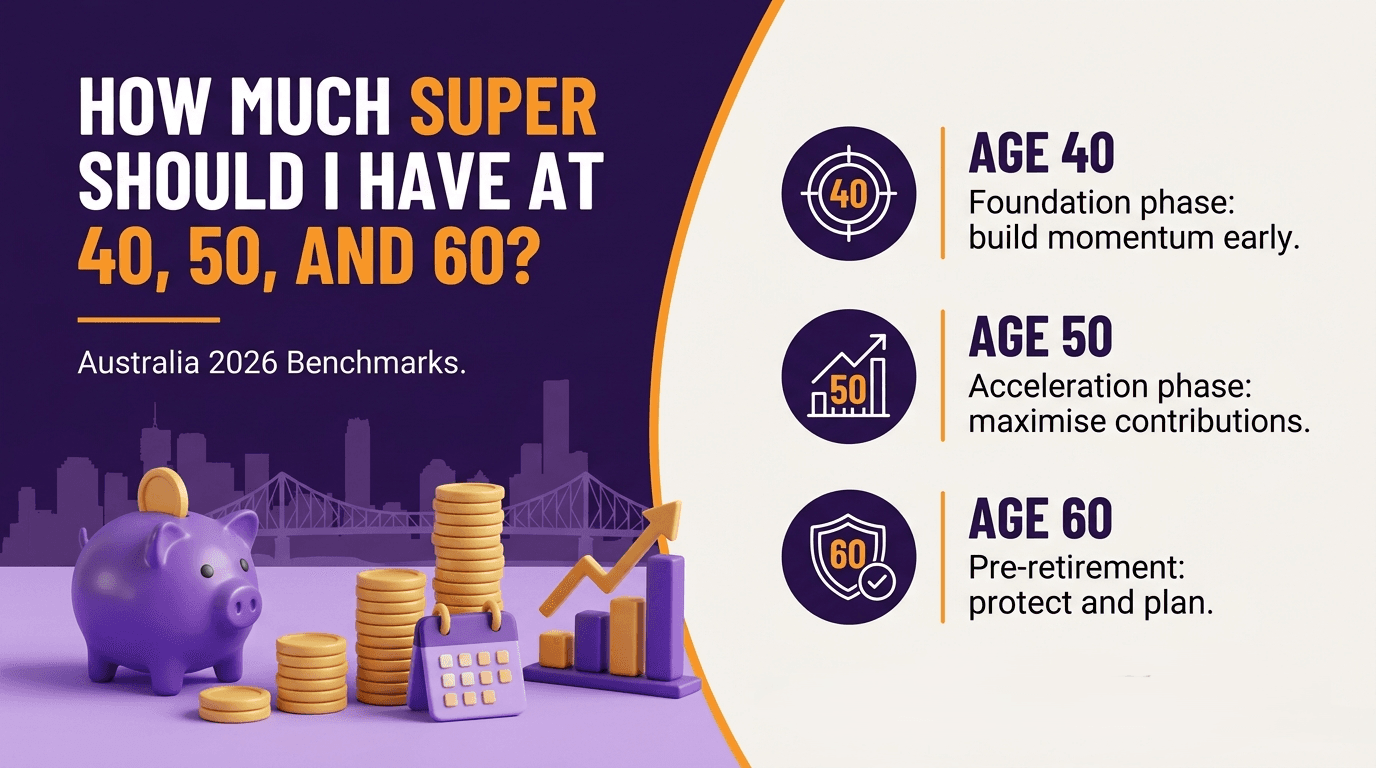
By age 40: Around $150,000 to $200,000 to stay on track for a comfortable retirement
By age 50: Around $280,000 to $370,000 is the comfortable-track range
By age 60: Around $500,000 to $600,000+ to fund a comfortable retirement at 67
The ASFA comfortable retirement target at age 67 is now $630,000 for singles and $730,000 for couples- updated February 2026
Average Australian balances are well below these benchmarks, especially for women, so don't panic if you're behind- you have more levers than you think
Bottom line: Average is not the same as on track. Use the benchmarks to know where you stand, then use the strategies in this guide to close the gap.
Where the Numbers Come From
There are two different ways to answer "how much super should I have?", and confusing them is a recipe for either complacency or panic.
The first is what other Australians have at your age (the average). The second is what you need to have at your age to retire comfortably (the benchmark). They're rarely the same number.
Source | What It Tells You | Use It For |
ATO/ASFA average balances | The middle of the pack at each age bracket | Comparing yourself to your peers |
ASFA Retirement Standard | The lump sum needed at 67 for a comfortable retirement | Setting your actual target |
ASFA comfortable-track benchmarks | What you should have at each age to land at the target | Knowing if you're on track |
The latest ASFA February 2026 update set the lump sum benchmarks at $630,000 for singles and $730,000 for couples for a comfortable retirement at 67. That's the destination. The age-based benchmarks below show the milestones along the way.
Bottom line: Comparing yourself to averages can be misleading. Most Australians aren't on track for a comfortable retirement. Compare yourself to the benchmark, not the crowd.
How Much Super Should I Have at 40?
Forty is the inflection point. You've been working long enough that compounding has started to do real work, but you still have 25+ years until retirement. Mistakes made now show up loudly later.
Here's where things stand:
Average super balance for Australians aged 40–44: approximately $131,792 for men and $102,227 for women
ASFA comfortable-track benchmark at 40: around $150,000 to $200,000
What it means: the average Aussie 40-something is modestly behind the comfortable track, and the gap is wider for women due to career breaks and lower lifetime earnings
If you're at 40 with less than $100,000 in super, you're not doomed, but you'll need to start being deliberate. If you're at $200,000+, you're tracking well.
What to focus on at 40:
Consolidate multiple accounts: around 4 million Australians hold two or more accounts, paying duplicate fees
Check your investment option: most people are still in the default "balanced" option, which may be too conservative for someone with 25+ years until retirement
Start salary sacrificing: even an extra $200 to $400 per month compounds dramatically over 25 years
Review your insurance inside super : you may be paying for cover you don't need, which erodes your balance
Bottom line: At 40, time is still your biggest asset. A small contribution increase now beats a big one in your 50s.
How Much Super Should I Have at 50?
Fifty is when the panic tends to set in and when the maths starts getting urgent. You've got roughly 15 to 17 years until retirement, which sounds like a lot but isn't, especially if your balance is light.
Here's the picture:
Average super balance for Australians aged 50–54: approximately $237,084 for men and $176,824 for women
ASFA comfortable-track benchmark at 50: around $280,000 to $370,000
What it means: most 50-somethings are behind track, especially women, but this is also the age where strategic moves create the biggest wins
The good news? At 50, you're entering the prime window for catch-up contributions, carry-forward concessional caps, and strategic salary sacrificing.
What to focus on at 50:
Use carry-forward concessional contributions: if your total super balance is under $500,000, you can use unused cap amounts from the past 5 years (subject to current ATO rules)
Maximise the concessional cap: currently $30,000 from 1 July 2024, rising to $32,500 from 1 July 2026
Consider non-concessional contributions: if you've had a windfall- inheritance, business sale, downsizer
Get serious about your investment mix: you still have 15+ years of growth runway, so don't switch to "cash" out of fear
Run the numbers: at 50, modelling your retirement gap is no longer optional
Bottom line: Fifty is the last decade where catch-up strategies move the needle dramatically. Don't waste it.
How Much Super Should I Have at 60?
Sixty is the home stretch. You're within 5 to 7 years of preservation age and full retirement, and the strategies shift from "growing" to "structuring."
Here's where you should be:
Average super balance for Australians aged 60–64: roughly $340,000 for men and $250,000 for women (ATO data, subject to ongoing updates)
ASFA comfortable-track benchmark at 60: around $500,000 to $600,000+ for singles, more for couples combined
The retirement target at 67: $630,000 for singles and $730,000 for couples
If you're at 60 with $400,000 or less, you'll likely need to either keep working longer, adjust lifestyle expectations, or rely more heavily on the Age Pension. None of those are disasters, but they need to be planned, not stumbled into.
What to focus on at 60:
Consider a Transition to Retirement (TTR) pension: this lets you draw super income while still working, often with significant tax savings
Maximise concessional contributions: every dollar in counts, and at 60 the after-tax efficiency is excellent
Plan your retirement income strategy: account-based pensions, lump sums, drawdown rates, longevity
Check Age Pension eligibility: even partial entitlements can be worth $10,000+ per year (subject to Services Australia rules)
Review estate planning: binding death benefit nominations, beneficiaries, reversionary pensions
The 1 July 2026 changes also matter at this age. The concessional cap rises to $32,500, the non-concessional cap to $130,000, and the bring-forward maximum to $390,000. If you're 60 with capacity to contribute, these are your last big tax-effective windows.
Bottom line: At 60, strategy beats hustle. Structure your contributions, drawdowns, and tax position carefully, small decisions now have outsized impact.
The Average vs On-Track Gap
Let's compare the average balance against the ASFA comfortable-track target at each milestone age:
Age | Average (Men) | Average (Women) | ASFA Comfortable Track | Gap |
40 | ~$131,800 | ~$102,200 | $150,000–$200,000 | Modest — closeable |
50 | ~$237,100 | ~$176,800 | $280,000–$370,000 | Significant for women |
60 | ~$340,000 | ~$250,000 | $500,000–$600,000+ | Large — needs strategy |
67 (target) | — | — | $630,000 single / $730,000 couple | Final destination |
The gap widens with age. That's not a coincidence. It's the cost of compounding working against you when contributions are too low for too long.
Bottom line: Most Australians are tracking below the comfortable benchmark. The earlier you spot the gap, the more painlessly you can close it.
Practical Examples
Example 1: Lisa, 42, Single Mum from Brisbane
Lisa earns $95,000 as a project manager and has $98,000 in super- about $30,000 below the ASFA track at her age. She has 25 years until retirement and feels behind.
Her strategy:
Salary sacrifice $300 per month ($3,600/year)
Consolidate two old accounts she'd forgotten about (saves $400/year in fees)
Switch from the default balanced option to a higher-growth option appropriate for her timeline
Use carry-forward concessional contributions in years she gets a bonus
Modelled outcome: by 67, Lisa is on track for roughly $620,000 instead of the $410,000 she'd hit on autopilot. That's an extra $210,000 for the cost of $300/month and one consolidation form.
Example 2: Greg and Sue, Both 55, Couple from Melbourne
Greg earns $140,000 and has $310,000 in super. Sue earns $85,000 and has $190,000 — $500,000 combined, behind the comfortable-track benchmark for a couple.
Their strategy:
Greg uses carry-forward concessional contributions to claim deductions on personal contributions of around $45,000 in one year, drawing down unused caps from prior years (his TSB is below $500,000, so he qualifies- subject to current ATO rules)
Sue salary sacrifices an extra $10,000 per year to lift her balance and balance the couple's overall position
Both start a TTR pension at 60 to maximise tax efficiency in their final working years
They model Age Pension eligibility for age 67 and structure assets accordingly
By 67, their combined balance is on track for around $1.05M to $1.15M; comfortably above the couple's benchmark and giving them flexibility on retirement timing.
Common Mistakes That Wreck Your Super Trajectory
Ignoring carry-forward concessional caps. If your total super balance is under $500,000, you can use unused cap amounts from up to five previous years. Most people have no idea this exists (subject to current ATO rules).
Defaulting to "balanced" forever. The default option is designed for the average member, not you. At 40 with 25+ years to go, "balanced" can leave hundreds of thousands on the table.
Chasing returns at the wrong age. Switching to "cash" at 55 because markets feel scary, then switching back after recovery, is one of the most expensive mistakes Australians make.
Forgetting binding death benefit nominations. Without one, the trustee decides who gets your super, and that decision can override your will. Family conflict and tax disasters follow.
Holding multiple super accounts. Around 4 million Australians hold two or more accounts, paying duplicate fees. Consolidation takes 10 minutes online via myGov.
Underestimating the gender super gap. Women retire with significantly less super on average due to career breaks, part-time work, and lower lifetime earnings. Spouse contributions and contribution splitting can help close it.
Leaving TTR strategies untapped. The Transition to Retirement pension is one of the most under-used tools in Australian retirement planning. If you're 60+ and still working, it's worth modelling.
FAQ
What's the average super balance in Australia in 2026? Average superannuation balances have risen to a record high of $172,834 across nearly 18 million members. For those approaching retirement, aged 65–69, the average is around $420,934. These are averages, not benchmarks — most members are below the comfortable retirement target.
How much super does ASFA say I need to retire comfortably? The latest February 2026 update from ASFA puts the lump sum at $630,000 for singles and $730,000 for couples, assuming you own your home outright and receive a partial Age Pension.
Is the Age Pension enough to retire on? For a modest lifestyle, mostly yes. ASFA's modest standard estimates how much money is needed for the basics, and the Age Pension covers most of it. For a comfortable lifestyle; with travel, dining out, private health insurance, you'll need significant super on top (subject to Services Australia rules).
What's changing on 1 July 2026? Three big changes. The concessional cap rises to $32,500, the non-concessional cap to $130,000, and the bring-forward maximum to $390,000. Payday super also begins, requiring employers to pay SG within 7 business days of payday. Division 296 (extra 15% tax on earnings on balances above $3M) also commences.
I'm behind. How fast can I catch up? Faster than you think if you're under 55. Carry-forward concessional contributions, increased salary sacrifice, and a properly aligned investment option can add $200,000 to $500,000+ to your balance over 15–25 years. After 60, the levers shrink but TTR and contribution maximisation still help.
Should I have an SMSF? Probably not unless your combined balance is over $500,000 and you have a specific reason. Like buying business premises or running a complex investment strategy. SMSFs cost $2,000 to $5,000+ per year to run. Below the threshold, a quality industry or retail fund is cheaper and just as effective.
How much should a couple have in super combined? The ASFA target at 67 is $730,000 for couples. By 50, you should be tracking around $500,000 combined. By 60, around $900,000 to $1.1M combined to land on target.
Ready to Find Out If You're On Track?
You don't need to guess. Book a free 15-minute consultation with the team at What If Advice and find out exactly where you stand against the benchmarks, and what to do about any gap.
No jargon, no pressure, just a clear conversation. Visit whatifadvice.com.au to book.
General Advice Disclaimer: This information is general in nature and does not take into account your personal financial situation, needs, or objectives. You should consider whether it is appropriate for you and seek personal financial advice before making any decisions.