Looking for specific financial advice?
This blog provides general educational content. For personalized advice tailored to your unique situation, book a free consultation with our team of ASIC-licensed financial advisers.
What If the Mistake on Your Tax Return Costs More the Longer You Leave It?
You lodged, got your refund, and moved on. Then a bank interest statement turns up, or you remember the shares you sold, or a receipt for a deduction you forgot. The ATO lets you fix this, but the clock matters. Correct a $1,600 shortfall yourself and you might pay around $1,780 in total. Wait for the ATO to find it through data matching and the same mistake could cost $2,180 or more. Missed deductions have a deadline too. Once the amendment window closes, that refund is gone for good.
TL;DR
You can amend a lodged return through myTax, through a registered tax agent, or by paper form.
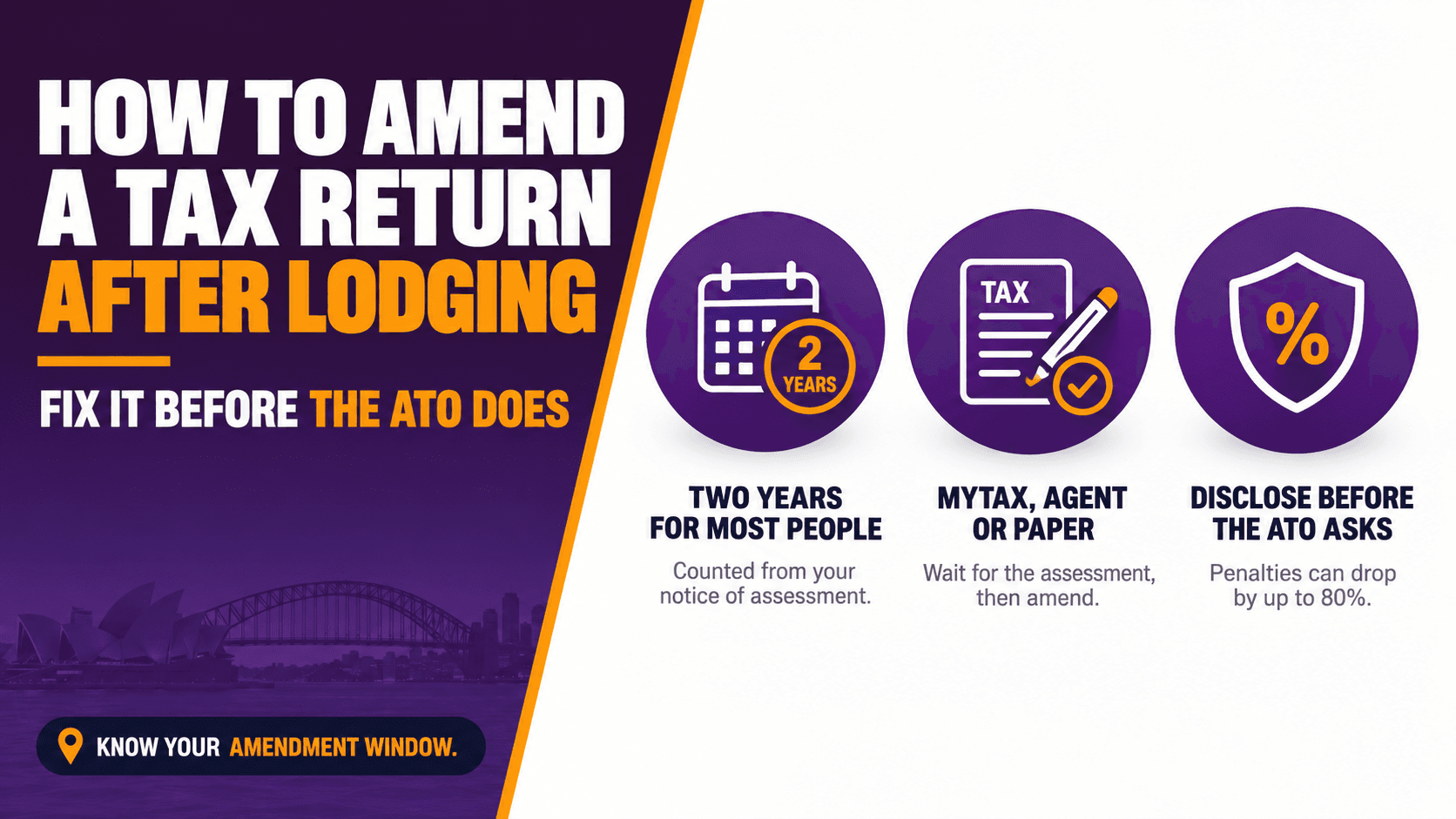
Most individuals have two years from their notice of assessment to amend. Some taxpayers with more complex affairs have four years.
Wait for your notice of assessment before amending. The ATO needs to process the original return first.
If you owe more, you’ll generally pay shortfall interest from the original due date, and possibly a penalty.
Fixing it before the ATO contacts you can reduce a penalty by up to 80% through voluntary disclosure, and to nil for shortfalls under $1,000.
If you missed deductions, amending can get you a larger refund, but only inside the amendment period.
If you disagree with the ATO’s decision, that’s an objection, which is a separate process from an amendment.
Bottom line: amending is usually simple, and fixing a mistake early, before the ATO does it for you, almost always costs less.
On This Page
When You Should Amend a Tax Return
How Long You Have to Amend
How to Amend: myTax, Tax Agent, or Paper
What Happens If You Owe More: Interest and Penalties
Voluntary Disclosure: Why Timing Matters So Much
Amending vs Objecting: Not the Same Thing
Worked Example 1: Ahmed’s Forgotten Share Sale
Worked Example 2: Grace’s Missed Deductions and a Closing Window
Common Mistakes
FAQ
When You Should Amend a Tax Return
You should amend if your lodged return was wrong in a way that changes the tax result. The usual reasons are:
Income you forgot or got wrong:
Bank interest or dividends
A second job, or an income statement that wasn’t finalised when you lodged
Rental income
Capital gains from selling shares, crypto, or property
Foreign income
Deductions you missed or over-claimed:
Work-related expenses, self-education, union fees, or donations you forgot
Claims you made that you later realise don’t qualify
Other details:
Private health insurance or Medicare levy details
Spouse or dependant information that affects offsets or the Medicare levy surcharge
If the ATO has already corrected the error and issued an amended assessment, you generally don’t need to amend it again yourself.
Bottom line: if the mistake changes your tax payable or refund, amend it, whichever direction it goes.
How Long You Have to Amend
The time limit generally runs from the date on your notice of assessment, not the date you lodged.
Taxpayer type | General amendment period |
Most individuals and small businesses | 2 years from the notice of assessment |
Individuals with more complex affairs (for example, some trust beneficiaries) | 4 years |
Cases involving fraud or evasion | No time limit for the ATO |
Which period applies to you can depend on your circumstances in that year. Check with the ATO or a registered tax agent if you’re unsure. The rules can change, so verify the current periods before relying on them.
Not sure if your amendment window is still open? WIAA’s tax team can check your assessment dates. Email tax@whatifadvice.com.au for a free 15-minute chat.
Bottom line: for most people the window is two years from the notice of assessment, and once it closes, missed refunds can’t be recovered.
How to Amend: myTax, Tax Agent, or Paper
1. myTax (if you lodged yourself online). Sign in to myGov, open your linked ATO account, find the relevant year’s tax return under your lodgments, and select the option to amend. You change the affected items and submit. The ATO’s online menus change from time to time, so follow the current on-screen steps.
2. Through a registered tax agent. If an agent lodged your original return, they can lodge the amendment for you. This is often the better route if the change involves capital gains, rental property, or anything you’re not confident about.
3. Paper form. The ATO has a paper form for individuals requesting an amendment. It’s slower and generally a fallback option.
Whichever route you use, explain what you’re changing and why, and keep the supporting records. Amendments generally take a few weeks to process. Check the ATO’s current processing timeframes.
Bottom line: if you lodged yourself, myTax is usually the fastest route, and for anything complex, an agent reduces the risk of fixing one error and creating another.
What Happens If You Owe More: Interest and Penalties
If your amendment increases the tax you owe, three things can apply:
The extra tax itself. This is your tax shortfall.
Shortfall interest charge (SIC). This is interest on the shortfall from the original due date until the ATO issues the amended assessment. It compounds daily, and the rate is set quarterly.
A possible shortfall penalty. This depends on why the mistake happened.
If you don’t pay the amended amount by its due date, the general interest charge (GIC) applies from then on. GIC is charged at a higher rate than SIC. Both rates change quarterly, so verify current rates with the ATO.
Base penalty amounts under the ATO’s general framework:
Behind the mistake | Base penalty (% of shortfall) |
Took reasonable care | Generally no penalty |
Failure to take reasonable care | 25% |
Recklessness | 50% |
Intentional disregard | 75% |
These are base amounts. They can be increased or reduced depending on circumstances, and the ATO has discretion to remit penalties and interest. Your amended notice of assessment will show the amount and the payment due date. If the bill is more than you can pay in one go, our guide to dealing with ATO debt covers your options.
Bottom line: the extra tax is unavoidable, but the interest and penalty depend heavily on how and when the mistake is fixed.
Voluntary Disclosure: Why Timing Matters So Much
If you tell the ATO about a mistake before it notifies you of an audit or review, that’s a voluntary disclosure. The reductions are significant:
Before notification: a penalty can generally be reduced by 80%.
Before notification, shortfall under $1,000: the base penalty is generally reduced to nil.
After notification, but before the audit gets going: the reduction is generally only 20%.
The nil-penalty rule matters for small forgotten items. Say you forgot $1,500 of bank interest on a 32% marginal rate. That’s a $480 shortfall. Disclose it yourself first and you’d generally pay the $480 plus shortfall interest, with no penalty. The threshold and reductions can change, so verify the current rules with the ATO.
The ATO’s data matching draws on banks, share registries, employers, crypto exchanges, and property records. Much of this flows into prefill, which means many forgotten income items are visible to the ATO well before you remember them. Voluntary disclosure is also a factor the ATO considers when deciding whether to remit shortfall interest.
Found a mistake and want to fix it before the ATO does? Call 1800 942 843 for a free 15-minute chat about the cleanest way to disclose it.
Bottom line: fixing a mistake yourself, before the ATO asks, is one of the few things that reliably reduces what an error ends up costing.
Amending vs Objecting: Not the Same Thing
An amendment is when you correct your own return because you got something wrong.
An objection is a formal dispute when you disagree with an ATO decision, such as an amended assessment it issued or a deduction it disallowed.
Objections have their own time limits and procedures. If the ATO has adjusted your return and you think it’s wrong, lodging an amendment generally isn’t the right tool. Get advice on whether to object.
Bottom line: amend your own mistakes, and object to the ATO’s decisions you disagree with.
Worked Example 1: Ahmed’s Forgotten Share Sale
Ahmed is on a 32% marginal rate including the Medicare levy. After lodging, he realises he forgot a share sale that produced a $5,000 net capital gain after the 50% CGT discount. Amendments use the rules that applied in the year being amended, so announced changes to the CGT discount (announced but not yet legislated) don’t affect a past-year amendment like this one. For the mechanics of CGT on shares, see Tax Implications of Selling Shares.
The extra tax is $5,000 × 32% = $1,600. For illustration, assume shortfall interest of 7.5% a year (verify the current rate) and a finding of failure to take reasonable care.
Ahmed amends himself (10 months after the due date) | ATO finds it first (18 months after the due date) | |
Extra tax | $1,600 | $1,600 |
Shortfall interest | ≈ 100(1,600 × 7.5% × 10/12) | ≈ 180(1,600 × 7.5% × 18/12) |
Base penalty (25%) | $400 | $400 |
Voluntary disclosure reduction | −80% → $80 | No disclosure → $400* |
Total cost | ≈ $1,780 | ≈ $2,180 |
*If Ahmed disclosed after being notified of a review but before it progressed, the 20% reduction would generally bring the penalty to $320, for a total of about $2,100.
Outcome: the same mistake costs Ahmed about $400 more if the ATO finds it first. The ATO may also remit some or all of the penalty or interest, particularly for a genuine oversight. Because SIC compounds daily, these simple-interest figures are approximations. They’re illustrative only, and actual outcomes depend on the ATO’s assessment.
Bottom line: Ahmed can’t avoid the $1,600, but acting first saves him money on everything around it.
Worked Example 2: Grace’s Missed Deductions and a Closing Window
Grace lodged her own return for an earlier year, and her notice of assessment arrived 23 months ago. She has just found receipts for deductions she forgot:
Missed item | Amount |
Union fees | $640 |
Self-education textbooks and course materials | $820 |
Work laundry and protective gear | $380 |
Total | $1,840 |
At her 32% marginal rate, amending gives her an extra refund of $1,840 × 32% = $588.80. For what qualifies in each category, see Claiming Self-Education Expenses Correctly and Tax Deductions for Tradies and Manual Workers.
Outcome: if Grace has the standard two-year period, she has about a month left, so she needs to amend now. If she waits, the window closes and she loses the $588.80 for good. The ATO can still review her claims after she amends, so she should keep the receipts.
Bottom line: missed deductions don’t wait forever, and if your notice of assessment is close to two years old, the window may be closing right now.
Think you’ve got missed deductions from an earlier year? We can check what’s still within the amendment period. Book a free 15-minute chat online or email tax@whatifadvice.com.au.
Common Mistakes
Lodging a second tax return instead of amending. Use the amendment process for a year you’ve already lodged.
Amending before the notice of assessment arrives. The original return needs to be processed first.
Ignoring a forgotten income item and hoping it goes unnoticed. Data matching makes that a poor bet, and it removes your chance at the voluntary disclosure reduction.
Assuming the window is always four years. Most individuals have two.
Fixing one item and introducing another error. A capital gain, for example, can affect other items. Review the whole return.
Amending when you mean to object. If the ATO has made a decision you disagree with, an objection is generally the right route.
Not paying the amended amount by its due date. Once it’s overdue, the higher general interest charge kicks in.
Not keeping records for the amended items. An amended claim can be reviewed just like an original one.
Sitting on a mistake and not sure where to start? Call 1800 942 843 for a free 15-minute chat with WIAA’s tax team.
FAQ
Can I amend my tax return after it’s been lodged?
Yes. You can amend through myTax, through a registered tax agent, or by paper form, generally within the amendment period.
How long do I have to amend my tax return?
For most individuals, two years from the date of the notice of assessment. Some taxpayers with more complex affairs have four years. Check which applies to you.
Should I wait for my notice of assessment before amending?
Yes. The ATO needs to process your original return before it can process an amendment.
Will I get a penalty for amending my tax return?
Not necessarily. If you took reasonable care, there’s generally no penalty, though shortfall interest may still apply if you owe more. If you disclose before the ATO contacts you and the shortfall is under $1,000, the base penalty is generally reduced to nil.
What is the shortfall interest charge?
Interest on extra tax owing, calculated from the original due date to the date of the amended assessment. It compounds daily and the rate is updated quarterly, so verify the current rate with the ATO.
Does fixing a mistake before the ATO finds it help?
Yes. Voluntary disclosure before you’re notified of an audit can generally reduce a penalty by 80%. After notification, the reduction is generally 20%.
Can I amend my return to claim deductions I forgot?
Yes, if you’re still within the amendment period and you have records to support the claims.
How long does an ATO amendment take to process?
Generally a few weeks, but processing times vary. Check the ATO’s current timeframes.
What’s the difference between an amendment and an objection?
An amendment fixes your own mistake. An objection disputes an ATO decision you disagree with, and it has its own process and time limits.
My tax agent lodged my return. Can I amend it myself?
You can, but it’s usually simpler to ask your agent, who has your full return and can lodge the amendment for you.
Ready to Fix It Before It Costs You More?
Whether you’ve forgotten income or missed a refund, the sooner an amendment goes in, the better the outcome tends to be. A free 15-minute chat can help you work out what to change, and whether your window is still open.
Call us: 1800 942 843
Email: tax@whatifadvice.com.au
Book online: free 15-minute chat, no cost, no pressure
Still asking what if?
WIAA helps Australians correct and lodge accurate tax returns across Toowong, Grange, and Melbourne CBD. WIAA is a registered tax agent practice with the Tax Practitioners Board and operates under AFSL 528250 as an Authorised Representative of Beryllium Advisers Pty Ltd.
General Advice Disclaimer: This article contains general information only and does not take into account your personal objectives, financial situation, or needs. It is not personal tax or financial advice and should not be relied upon as such. Amendment periods, shortfall interest and general interest charge rates, penalty rules and thresholds, processing times, and ATO online processes can change. Any reference to changes to the CGT discount reflects measures that are announced but not yet legislated. Verify current rules and rates with the ATO or a registered tax agent. Worked examples are illustrative and simplified, and actual outcomes depend on ATO assessment and discretion. Seek professional advice for your own circumstances.