Looking for specific financial advice?
This blog provides general educational content. For personalized advice tailored to your unique situation, book a free consultation with our team of ASIC-licensed financial advisers.
How to Legally Structure Family Income to Reduce Tax in Australia
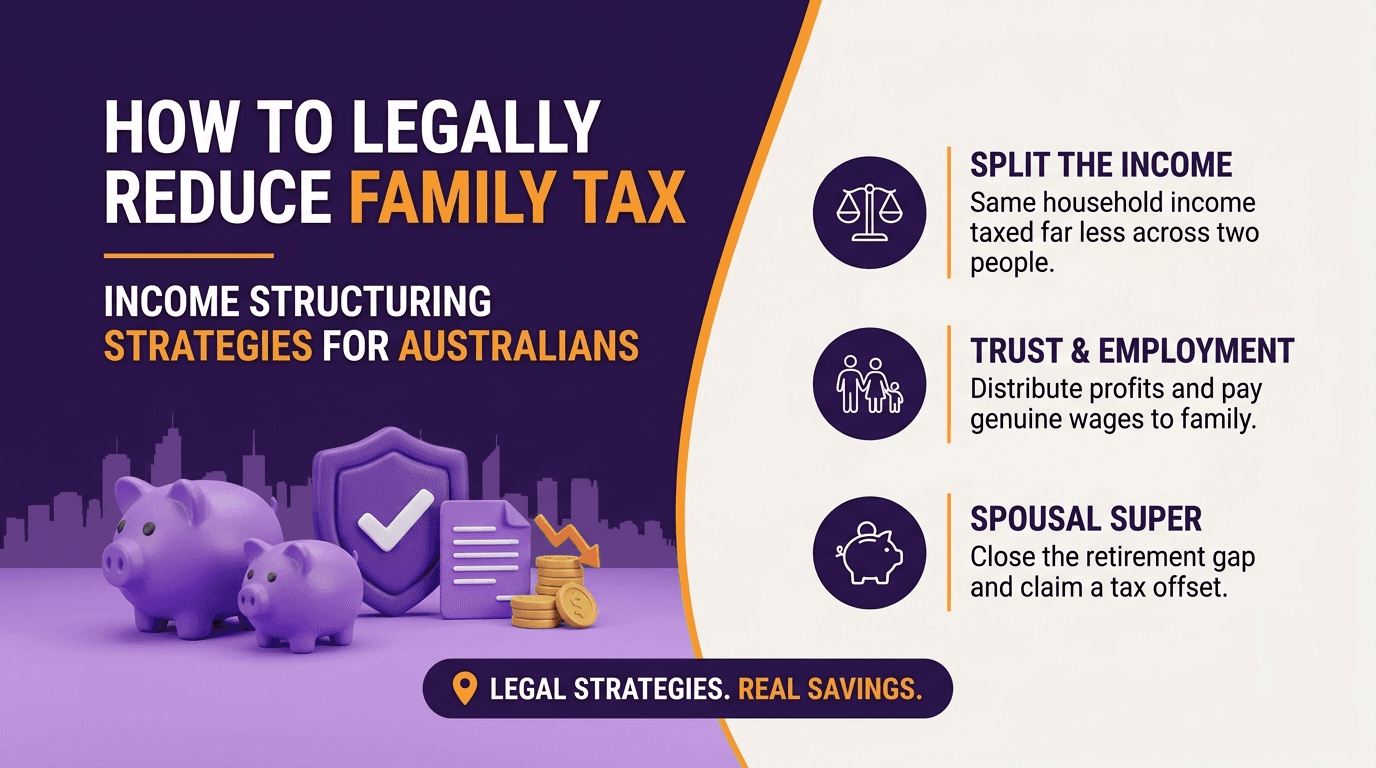
Australia's progressive tax system means the more you earn, the higher the rate applied to each additional dollar. A single high-income earner in a household pays substantially more tax on the same total income than two moderate-income earners splitting that same amount. That gap is not accidental, and closing it legally is one of the most consistent ways Australian families and business owners reduce their overall tax burden.
Income structuring is not a loophole. It is the deliberate use of legal arrangements, super contributions, investment ownership, business structures, and family employment to distribute income more efficiently across a household. Done correctly, with proper advice and documentation, it is entirely within the law. Done without advice, or with arrangements the ATO considers artificial, it creates risk.
This is territory where tax and financial advice genuinely overlap. As registered tax agents and financial advisers (AFSL 528250), we see it most often in family business owners running a trust, a spouse on payroll, and a super balance gap that has never quite been closed. This guide covers the main legal strategies available to Australian families, the conditions each one requires, and the 2026 Budget changes that affect family trust distributions and the CGT discount.
TL;DR: The Key Points
Here is the short version before you get into the detail:
Australia's progressive tax system rewards income spreading across two or more people rather than concentrating it with one high earner
Spousal superannuation contributions can reduce tax and build the lower-income partner's retirement savings simultaneously
Investment assets held in the lower-income partner's name can direct income and capital gains to a lower marginal rate
Employing a family member in a genuine business role at a commercially reasonable wage is a legitimate tax strategy
Discretionary (family) trusts allow income to be distributed across family members at the trustee's discretion, subject to ATO rules
The 2026 Budget has announced a 30% minimum tax on trust distributions to adult beneficiaries from 2028 (announced, not yet legislated)
The 2026 Budget has also announced a replacement for the 50% CGT discount from 2027 (announced, not yet legislated)
All strategies require genuine substance, commercial terms, and proper documentation to withstand ATO scrutiny
Getting specific advice from a registered tax agent or financial adviser before implementing any structure is essential
Jump to a Section
Why Family Income Structuring Matters
Strategy 1: Spousal Superannuation Contributions
Strategy 2: Holding Investments in the Lower-Income Partner's Name
Strategy 3: Employing a Family Member
Strategy 4: Family Trusts and Discretionary Income Distribution
Strategy 5: Family Trust Distributions and the 2026 Budget Change
Strategy 6: Capital Gains Tax Planning for Families
What the ATO Watches For
How These Strategies Work Together
FAQ
Why Family Income Structuring Matters
Australia's marginal income tax rates create a significant financial incentive to spread income across household members. The difference in tax paid on the same total household income, concentrated in one person versus distributed across two, can be tens of thousands of dollars per year at professional income levels.
A simple illustration:
Household Structure | Taxable Income | Estimated Tax Payable |
Single earner | $200,000 | Approximately $65,000 |
Two earners at $100,000 each | $100,000 each | Approximately $25,000 each ($50,000 combined) |
The combined saving in this example is approximately $15,000 per year from the same household income, purely from distribution. Across a working career, that difference compounds significantly.
The strategies below are legal tools for achieving this kind of distribution within the rules the ATO has set. None of them require complicated schemes. Most of them require planning, documentation, and appropriate professional advice.
Bottom line: The tax benefit of spreading income across a family is real and substantial. The legal strategies for doing it are well-established. The risk is in implementing them without understanding what conditions they require.
Strategy 1: Spousal Superannuation Contributions
If your spouse earns below the income threshold set by the ATO, you may be able to make after-tax super contributions on their behalf and claim a tax offset of up to $540 per year, subject to current ATO rules and eligibility conditions.
This strategy achieves two things simultaneously: it reduces your tax bill and builds your partner's super balance, which matters significantly for couples where one partner has spent time out of paid work.
Key conditions to be aware of:
The receiving spouse must be under the relevant age limit and meet other eligibility conditions
The contribution must be made from your after-tax money (non-concessional)
The receiving spouse's total income, including reportable fringe benefits, must be below the threshold at which the offset begins to phase out
The contribution counts toward the receiving spouse's non-concessional contributions cap
Beyond the offset itself, super contributions for a lower-income spouse also benefit from the concessional tax treatment inside super, which can be more favourable than investing the same money in personal names. This is financial advice territory as much as tax territory, which is where having both a registered tax agent and a financial adviser (AFSL 528250) review the same contribution actually earns its keep.
Bottom line: Spousal super contributions are one of the simplest legal income-structuring tools available to couples. The tax offset is modest but the long-term super balance effect can be significant, particularly where one partner has accumulated less super due to career breaks.
Strategy 2: Holding Investments in the Lower-Income Partner's Name
Investment income follows ownership. If the higher-income earner holds all the family's investments in their own name, all the income and capital gains are taxed at their marginal rate. If investments are held in the lower-income partner's name, the same income is taxed at a lower rate.
This strategy works best when:
There is a meaningful gap between the two partners' marginal tax rates
Investments are being purchased with new money rather than transferred from existing ownership (transferring assets between spouses can trigger CGT)
The investment structure supports the income genuinely flowing to the lower-income earner
Practical applications:
New share portfolios or managed funds purchased in the lower-income partner's name
Term deposits and savings accounts in the lower-income partner's name
Rental property ownership structured to reflect the lower-income partner's ownership share
Important limitation: the ATO's Part IVA general anti-avoidance rules apply where an arrangement is designed purely to avoid tax without genuine substance. Purchasing an investment in a spouse's name using genuinely shared or separate funds is legitimate. Having a spouse nominally hold an asset while the higher-income earner retains full control and economic benefit is not.
What if the way you currently hold your investments is costing your family thousands in unnecessary tax every year? Ownership structure is one of the easiest things to get right before you invest, and one of the hardest to unwind after the fact.
Strategy 3: Employing a Family Member
If you operate a business, employing a spouse, adult child, or other family member in a genuine role at a commercially reasonable wage is a legitimate tax strategy. The wage is deductible to the business, and the family member pays income tax at their own marginal rate, which may be significantly lower than yours.
The conditions are non-negotiable:
The family member must perform genuine work for the business
The wage must be commercially reasonable for the work performed (neither inflated above market rate nor token)
PAYG withholding, payroll tax (where applicable), and superannuation guarantee obligations must be met correctly
Records must demonstrate the work was actually done and the payments were actually made
The ATO scrutinises family employment arrangements, particularly where the wage appears to have no relationship to the work performed. A spouse receiving $80,000 for occasional bookkeeping in a small business will attract attention. A spouse receiving $60,000 for a genuine 30-hour-per-week role managing administration, client liaison, and accounts is a different matter entirely.
Where the arrangement is genuine and commercially supportable, it is entirely legitimate. The business gets a tax deduction, the family member uses their own tax-free threshold and lower marginal rates, and the household's overall tax position improves.
Superannuation: you are required to pay superannuation guarantee contributions for employed family members at the same rate as any other employee. This adds to the cost but also builds the family member's retirement savings.
Bottom line: Employing family members in genuine roles is a well-established small business tax strategy. The conditions it requires are clear and the ATO's expectations are not ambiguous. Get the documentation right and the arrangement is sound.
Wondering whether your current family employment or business structure is as tax-efficient as it could be? The registered tax agents at What If Advice work with small business owners across Brisbane and Melbourne on exactly these questions. Call 1800 942 843 or email tax@whatifadvice.com.au.
Strategy 4: Family Trusts and Discretionary Income Distribution
A discretionary trust, commonly called a family trust, is the most flexible income-structuring tool available to Australian families and business owners. The trustee has discretion each year to decide which beneficiaries receive income from the trust and in what proportions.
This discretion allows a trust to distribute income to family members in lower tax brackets each year, reducing the household's overall tax liability.
How a discretionary trust works:
A trustee (often a company) holds assets on behalf of a class of beneficiaries (typically family members and related entities)
Each year, the trustee resolves how much income each beneficiary receives
Beneficiaries pay income tax on the distributions they receive at their own marginal rates
The trust itself generally pays tax at the top marginal rate on any undistributed income, which creates a strong incentive to distribute before year end
Common uses in family income structuring:
A family business run through a trust allows business profits to be distributed to lower-income family members each year
An investment portfolio held in a trust generates income and capital gains that can be allocated to the family member with the lowest marginal rate
Franking credits on Australian shares can be allocated to beneficiaries who can best use them
Trust establishment and ongoing obligations: establishing a trust requires a properly drafted trust deed, a trustee entity, and registration with the ATO. Trusts require annual accounting, tax returns, trustee resolutions before the end of each financial year, and sound documentation of distributions. The upfront and ongoing costs are real. For smaller amounts of investment income or business profit, the cost may outweigh the tax saving. For significant family wealth or business profit, a trust is frequently the most tax-effective structure available.
Considering whether a trust actually makes sense for your situation? Trust setup is one of the highest-stakes decisions in this entire list, and getting the structure wrong costs far more to unwind than it does to set up properly the first time. The registered tax agents at What If Advice can model the real numbers before you commit. Call 1800 942 843 or email tax@whatifadvice.com.au.
Strategy 5: Family Trust Distributions and the 2026 Budget Change
This is the most significant legislative development affecting family income structuring in several years.
The 2026-27 Budget has announced that from 2028, trust distributions to adult beneficiaries will be subject to a minimum 30% tax rate. The stated policy intent is to prevent trusts from distributing income to adult beneficiaries on low marginal rates, which has been a primary use of discretionary trusts in family tax planning.
What this means in practice (if the announced measures proceed as legislation):
Distributions to an adult beneficiary currently on a 0% or 19% marginal rate will be taxed at a minimum of 30%, removing a significant portion of the tax advantage
Distributions to beneficiaries on higher marginal rates are less affected, as 30% is already below their marginal rate
The strategy of distributing to adult children on low incomes, a very common trust distribution approach, will lose much of its effectiveness
What it does not change:
Distributions to the trustee company (assessed at the corporate tax rate) are not affected by this announcement as currently understood
Distributions to a spouse on a marginal rate above 30% remain fully taxed at that spouse's rate
The general flexibility and capital gains benefits of discretionary trusts are not removed by this measure
These changes are announced but not yet legislated. The final form of the legislation, including any transitional provisions, may differ from the announcement. Seek specific professional advice before making decisions about trust structures based on these announcements.
What if the structure that has been reducing your tax for the last decade is about to become less effective? Understanding the change before it lands is the right time to review the strategy and consider adjustments, not after.
Strategy 6: Capital Gains Tax Planning for Families
CGT creates significant opportunities for family tax planning, particularly for families with assets that have grown substantially in value.
Key strategies:
Timing of asset sales. Capital gains are assessed in the financial year of sale. If one partner has a low-income year due to career break, parental leave, or reduced hours, selling a capital gain asset in that year can significantly reduce the tax on the gain.
CGT discount. Assets held for more than 12 months by individuals or trusts currently attract a 50% CGT discount. Ensuring assets are held for the required period before sale is basic but meaningful tax planning. Important: the 2026-27 Budget has announced a replacement for the 50% CGT discount from 2027. This measure is announced but not yet legislated, and the final structure of any replacement is not yet confirmed. Any CGT planning built around the current 50% discount should be reviewed against the final legislation once it lands, not assumed to hold indefinitely.
Loss harvesting. Capital losses can be used to offset capital gains in the same or future years. Reviewing a portfolio for unrealised losses before a significant gain is crystallised can reduce the net taxable gain.
Timing between spouses. Where a capital gain can be timed to fall in a year where one spouse has lower income and a larger available tax-free threshold or lower marginal rate, the same gain produces less tax.
CGT and trusts. Trusts pass the CGT discount through to individual beneficiaries (subject to conditions). A gain on an asset held in a trust for more than 12 months, distributed to a low-income beneficiary, attracts the current 50% discount and is then taxed at the beneficiary's marginal rate, which can be a highly tax-effective outcome, subject to the same 2027 discount changes noted above.
Bottom line: CGT planning is not about avoiding tax on investment growth. It is about ensuring the unavoidable tax is paid at the lowest legitimate rate, by the right person, in the right year, and about not assuming today's discount rules will still apply unchanged from 2027.
Not sure how the announced CGT discount changes affect assets you are already holding? This is exactly the kind of question worth asking before you time a sale around rules that may not exist in their current form much longer. Call 1800 942 843 or email tax@whatifadvice.com.au.
What the ATO Watches For
Legal tax minimisation is explicitly permitted in Australia. Artificial arrangements designed to produce a tax benefit that Parliament did not intend are not. The ATO uses several tools to scrutinise family income arrangements.
Part IVA. The general anti-avoidance provision applies to schemes where the dominant purpose is obtaining a tax benefit that would otherwise not be available. Genuine income splitting through legitimate structures, employment, and investment ownership does not trigger Part IVA. Artificial arrangements that have no commercial rationale beyond tax reduction can.
Trust distribution integrity rules. The ATO has issued guidance on trust distribution arrangements it considers problematic, particularly where distributions are made to low-income beneficiaries but the economic benefit is effectively returned to a higher-income individual through loans, unpaid present entitlements, or other arrangements. The Trustee Beneficiary Declaration and associated rules reinforce the requirement that distributions represent genuine economic entitlements.
Division 7A. Where a private company lends money to a shareholder or their associate, or makes a payment that is not a genuine dividend, wage, or loan on commercial terms, Division 7A can treat the amount as an unfranked dividend. This is particularly relevant for family business owners who move money between a company and personal accounts.
The core test: the ATO's scrutiny generally comes down to whether the arrangement has genuine commercial substance beyond the tax outcome. Employing a family member who genuinely works in the business passes this test. Employing a family member who does nothing for a substantial wage does not.
How These Strategies Work Together
No single strategy produces the best outcome in isolation. The most effective family tax structures typically combine several approaches in a way that reflects the family's actual circumstances.
A common combination for a family business owner might look like:
Business run through a discretionary trust, allowing profit to be distributed to lower-income family members
Spouse employed in a genuine role at a commercial wage, with superannuation paid
Spousal super contributions made from trust income to build the lower-income partner's retirement balance
Investment portfolio accumulated in the lower-income partner's name, directing dividend and interest income to a lower marginal rate
Capital gains managed carefully across financial years to minimise the rate at which they are taxed
This exact combination, trust, spouse on payroll, super gap to close, is one of the most common structures we see across family business clients in Brisbane and Melbourne. Each element is legal on its own. Combined with proper documentation and professional advice, they create a genuinely tax-effective family financial structure.
FAQ
Is income splitting legal in Australia?
Yes, where it is done through legitimate means. Employing a family member at a commercial wage, holding investments in a lower-income partner's name, distributing trust income to family members, and making spousal super contributions are all legal. The key requirement is that the arrangement has genuine commercial substance and is not a purely artificial arrangement designed to avoid tax with no other purpose. The ATO's Part IVA general anti-avoidance rule can apply where the dominant purpose of an arrangement is obtaining a tax benefit rather than any genuine commercial rationale.
Can I transfer assets to my spouse to reduce tax?
You can hold future investments in your spouse's name when purchasing new assets. Transferring existing assets between spouses can trigger CGT on any gains accumulated during your period of ownership, even though the transfer is between related parties. The CGT event occurs at the time of transfer. This is a common and significant mistake that should be discussed with a registered tax agent before any transfer is made.
How much can a discretionary trust save in tax?
It depends entirely on the amount of income, the number of available beneficiaries, and their respective marginal tax rates. A trust distributing $200,000 in annual profit to two beneficiaries each on a 32.5% marginal rate rather than concentrating it with one person on a 47% rate can save a substantial amount annually. Against this saving, the ongoing accounting, trustee company, and compliance costs of a trust must be weighed. For most families, a registered tax agent can model the net position before you commit to the structure.
What is the ATO's position on paying family members wages through a business?
The ATO accepts that employing family members at commercial wages for genuine work is a legitimate business arrangement. It scrutinises arrangements where the wage bears no relationship to the work performed, where work is not genuinely done, or where the arrangement appears designed purely to shift taxable income to a lower-rate family member without genuine employment substance. The key requirements are genuine work, commercial wages, and proper PAYG and super compliance.
How does the 2026 Budget trust distribution change affect family tax planning?
The announced measure, if legislated, introduces a minimum 30% tax rate on trust distributions to adult beneficiaries from 2028. This reduces the effectiveness of distributing trust income to adult children or a spouse on very low marginal rates. It does not eliminate the tax advantages of trusts entirely, particularly for capital gains, distributions to a corporate trustee, or distributions to beneficiaries already on marginal rates above 30%. These changes are not yet legislated and the final form may differ from the announcement. Seek specific advice before restructuring.
Can I put my investment property in my spouse's name to save tax?
If you are purchasing a new investment property, taking title in your lower-income spouse's name allows the rental income and any eventual capital gain to be assessed at their marginal rate. This is legal and commonly used. Transferring an existing property from your name to your spouse's name triggers a CGT event on any accrued gain at the time of transfer, which may produce an immediate tax cost that outweighs the future benefit. Stamp duty may also apply depending on the state. Both implications should be assessed before any transfer.
Does the tax-free threshold change how these strategies work?
Yes. Where a family member has no other income, the tax-free threshold (currently $18,200) means that the first $18,200 of income or trust distribution they receive is tax-free. This makes distributing income to a family member who is not otherwise working, such as a non-working adult child or a partner on parental leave, particularly effective where those arrangements are legitimate. The low-income tax offset extends the effective tax-free amount further for individuals on low total incomes.
Should I set up a family trust just to reduce tax?
Not necessarily. A family trust is a useful structure for the right family and business situation, but it involves real ongoing costs, compliance obligations, and structural complexity. Tax saving is one reason to consider a trust, but the decision should also account for asset protection, estate planning, succession planning, and business structure. A discretionary trust set up purely for tax reduction on a modest investment portfolio may not produce a net benefit once costs are included. A trust used to hold a growing business or significant investment portfolio often does. The right answer depends on your specific situation.
Can I split income with my adult children the same way I would with a spouse?
Partially, and the rules differ depending on the mechanism. Employing an adult child at a genuine, commercially reasonable wage works the same way as employing a spouse. Distributing trust income to an adult child on a low marginal rate has historically been effective, but this is precisely the arrangement targeted by the announced 2028 minimum 30% trust distribution tax, so its future effectiveness is uncertain pending legislation. Simply gifting money or assets to an adult child does not shift ongoing income tax liability on future earnings from those assets unless ownership is genuinely and properly transferred, which can itself trigger CGT.
What is the difference between tax avoidance and tax minimisation?
Tax minimisation is the legal use of available structures, concessions, and entitlements to reduce the amount of tax paid, such as claiming a legitimate deduction, making a spousal super contribution, or distributing trust income to a family member in a genuine arrangement. Tax avoidance refers to artificial or contrived arrangements that technically comply with the letter of the law but exist purely to obtain a tax benefit Parliament did not intend, which the ATO can challenge under Part IVA regardless of technical compliance. The distinction is substance, not paperwork. Every strategy in this guide is intended to sit on the minimisation side of that line, provided it is implemented with genuine commercial substance.
Is your family's income structured as tax-efficiently as it could be?
The gap between what a well-structured family pays in tax and what a poorly structured one pays can be significant, year after year, without any aggressive schemes or complicated arrangements. Just legal planning, implemented correctly.
The registered tax agents and financial advisers (AFSL 528250) at What If Advice work with families and business owners across Brisbane and Melbourne to review income structure, identify what is being left on the table, and implement the strategies that actually apply to your situation.
Call 1800 942 843 or email tax@whatifadvice.com.au to start the conversation.
Still asking what if about your family's tax position? That question is worth answering with your actual numbers. The team at What If Advice can help.
General Advice Disclaimer: This information is general in nature and does not take into account your personal financial situation, needs, or objectives. Tax laws and ATO interpretations change, and the 2026-27 Budget measures discussed in this article, including the proposed trust distribution changes and the proposed CGT discount replacement, are announced but not yet legislated. You should seek advice from a registered tax agent or financial adviser before implementing any income structuring strategy. What If Advice Accounting Pty Ltd is a registered tax agent. Financial advice is provided as an authorised representative under AFSL 528250.