Looking for specific financial advice?
This blog provides general educational content. For personalized advice tailored to your unique situation, book a free consultation with our team of ASIC-licensed financial advisers.
What If the Hardest Part of Investing $10,000 Isn't Choosing What to Buy?
A $10,000 lump sum, a bonus, an inheritance, a tax refund, or simply savings that have finally built up, creates a genuinely common moment of decision paralysis for a first-time investor. The sheer number of options, shares, ETFs, property, super, crypto, micro-investing apps, can make the actual first step feel harder than it needs to be. The real starting point isn't picking the "best" investment, it's working through a sequence of questions that narrows the field considerably before any specific product decision needs to be made at all.
TL;DR
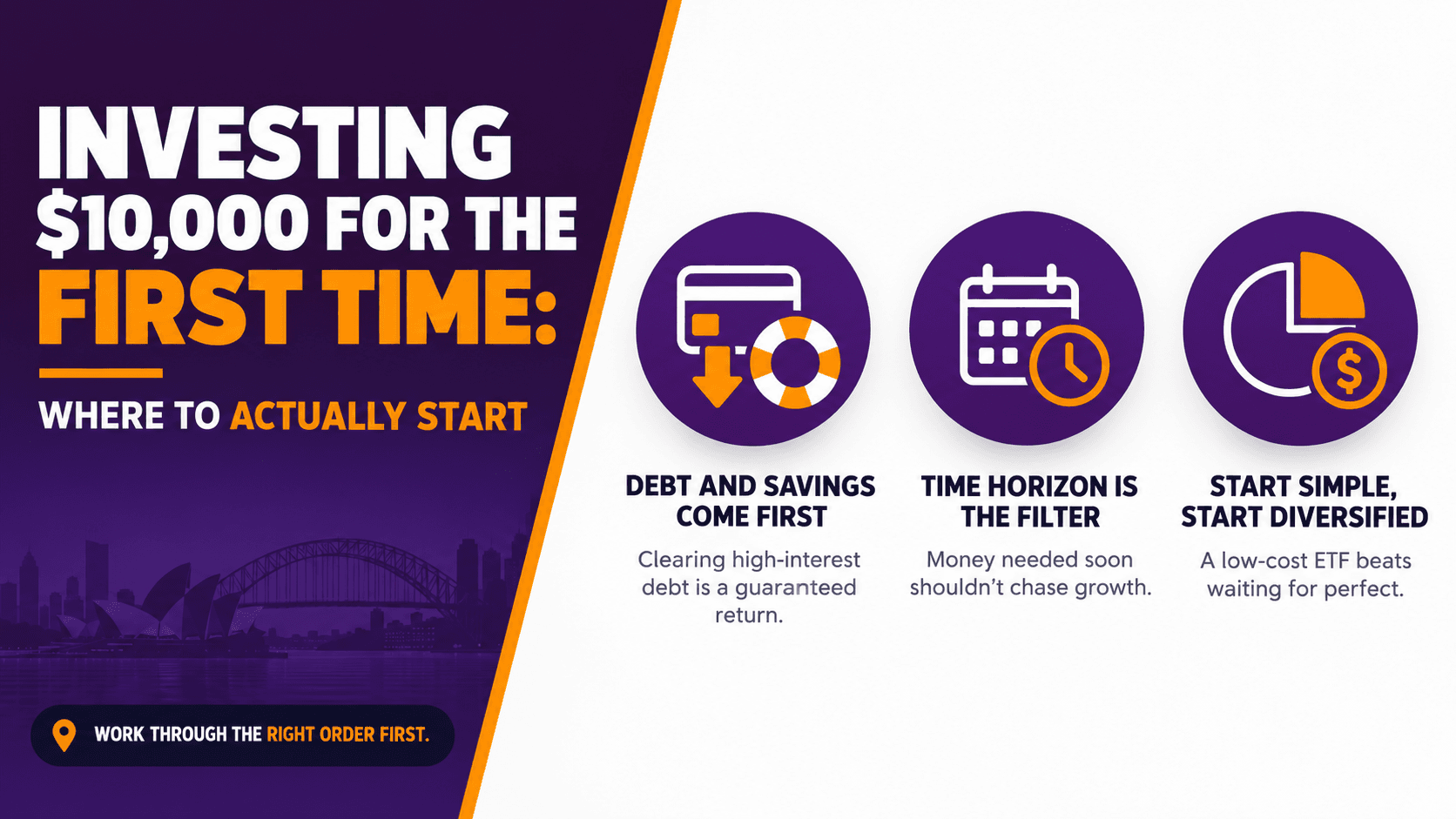
Before investing anything, check two things first: do you have a genuine emergency fund, and is there any high-interest debt that should realistically be paid down first, since both generally take priority over starting to invest.
Time horizon matters more than the dollar amount. Money needed within the next few years generally shouldn't go into volatile growth assets, regardless of how much it is.
A diversified, low-cost ETF is a genuinely reasonable, well-trodden starting point for a first-time investor who doesn't want to pick individual shares, offering broad exposure in a single purchase.
Lump sum versus staged investing is a legitimate choice worth understanding, each with different risk and behavioural trade-offs, covered in full in our dedicated DCA guide.
Superannuation is already an investment, and additional voluntary contributions are worth considering as one genuine option alongside investing outside super, not a separate, unrelated decision.
Starting small and building confidence matters more than getting the "perfect" first investment choice, a reasonable, well-diversified first step beats an optimal-on-paper choice that never actually gets made.
Fees, both ongoing and transactional, matter more than people expect at this stage, since they compound over a long investment horizon in the same way returns do.
Bottom line: the decision tree before "what should I buy" (debt, emergency fund, time horizon) usually matters more than the specific product choice itself, and working through it in order avoids the most common first-time investing mistakes.
On This Page
Step One: Check Debt and Emergency Savings First
Step Two: Work Out Your Actual Time Horizon
Step Three: Decide Between Super and Investing Outside Super
Step Four: Choosing a Starting Investment Approach
Lump Sum vs Staged Investing
Worked Example: Working Through the Decision Sequence
Common Mistakes
FAQ
Step One: Check Debt and Emergency Savings First
Before any investment decision, two questions should generally be answered first: is there a genuine emergency fund in place, commonly a few months of essential living expenses held in an easily accessible account, and is there any high-interest debt, credit card debt in particular, that would realistically cost more in interest than an investment would reasonably be expected to return. Paying down high-interest debt is, in effect, a guaranteed "return" equal to the interest rate being avoided, which is difficult for most investments to reliably beat.
Not sure whether your current situation is actually ready for investing, or whether debt or savings should come first? A free 15-minute chat with WIAA can help you work through it. Call 1800 942 843 or book online.
Bottom line: investing $10,000 while carrying high-interest debt or no emergency buffer is generally a step taken out of order, both usually deserve attention first.
Step Two: Work Out Your Actual Time Horizon
How the $10,000 should be invested depends heavily on when it might actually be needed. Money likely to be needed within the next few years, a house deposit, a planned expense, generally shouldn't be exposed to the volatility of growth assets like shares, since a market downturn at exactly the wrong time could mean needing to sell at a loss. Money genuinely not needed for five, ten, or more years has considerably more room to ride out market volatility and benefit from longer-term growth. This single question, "when might I actually need this money," does more to narrow down an appropriate investment choice than almost anything else.
Bottom line: time horizon, not just risk tolerance in the abstract, should be the first real filter applied to how $10,000 gets invested.
Step Three: Decide Between Super and Investing Outside Super
Superannuation is itself a long-term investment vehicle, and making additional voluntary contributions is a genuine option worth weighing alongside investing outside super, particularly given the tax-effective treatment of concessional contributions. The trade-off is accessibility, money contributed to super is generally locked away until retirement, while money invested outside super remains accessible if needed sooner. For a first-time investor with a long time horizon and no pressing need for earlier access, splitting a decision between some additional super contribution and some investment outside super is a genuinely reasonable approach, rather than treating it as an either-or choice.
Whether super or an investment outside super (or both) makes more sense depends on your specific goals and timeline. A free 15-minute chat can help you think through the split. Email clientservices@whatifadvice.com.au or book online.
Bottom line: super isn't a separate consideration from "investing," it's one of the options on the table, and a first-time investor's $10,000 decision should genuinely weigh it alongside investing outside super.
Step Four: Choosing a Starting Investment Approach
For a first-time investor without a strong preference for picking individual shares, a diversified, low-cost index ETF, spreading exposure across a broad range of companies in a single purchase, is a genuinely reasonable, well-established starting point. This avoids the concentration risk of picking individual shares without the research or experience to properly assess them, while still providing genuine market exposure and long-term growth potential. This isn't the only reasonable starting approach, but it's a sensible default for someone who wants to start simply rather than spend considerable time researching individual investment options before making any decision at all.
Bottom line: a diversified ETF is a genuinely sensible default starting point for a first-time investor, simple enough to actually get started with, while still providing real, broad market exposure.
Lump Sum vs Staged Investing
A first-time investor with $10,000 can choose to invest the full amount at once, or spread it into the market in smaller amounts over several months (dollar-cost averaging). In short: lump sum investing has, on average over long historical periods, tended to produce a better outcome, since markets have generally trended upward over time, while staging it in can reduce the specific risk of poor timing and suit a nervous first-time investor's comfort level better. Our dedicated DCA guide covers this trade-off, and the actual numbers behind it, in full.
Bottom line: lump sum investing has a statistical edge on average, but staged investing can genuinely suit a first-time investor's comfort level better, the right choice depends partly on behavioural fit, not just the numbers alone.
Worked Example: Working Through the Decision Sequence
Jamie receives a $10,000 work bonus and wants to invest it for the first time. Working through the decision sequence: Jamie has $8,000 in credit card debt at a high interest rate, no genuine emergency fund, and hasn't thought about a specific time horizon for the money beyond "eventually, for the future."
Rather than investing the full $10,000 immediately, Jamie uses $6,000 to clear the credit card debt entirely, a guaranteed return equal to the interest rate being avoided, and puts $2,000 into a separate account as the start of a genuine emergency fund. The remaining $2,000, money Jamie genuinely doesn't need for several years and is comfortable not touching, goes into a diversified, low-cost ETF as a first investment, staged in over a few months rather than all at once, given Jamie's initial nervousness about investing for the first time.
Outcome: by working through the decision sequence rather than jumping straight to "what should I invest in," Jamie addressed a higher-priority debt and savings gap first, and invested a smaller, genuinely appropriate amount with a clear time horizon, rather than investing the full $10,000 immediately while carrying high-interest debt.
Bottom line: Jamie's actual investment decision ended up being a smaller part of the full $10,000 than expected, once debt and emergency savings were properly accounted for first, exactly the kind of outcome the decision sequence is designed to surface.
Common Mistakes
Jumping straight to "what should I invest in" without first checking debt and emergency savings. These generally deserve priority and change how much is actually available to invest.
Investing money needed within the next few years into volatile growth assets. Time horizon should be the first real filter applied to any investment decision.
Overcomplicating the first investment choice. A diversified, low-cost ETF is a genuinely reasonable starting point, it doesn't need to be the "perfect" or most sophisticated choice to be a sound one.
Treating super and investing outside super as entirely separate, competing decisions. Both are genuinely worth weighing together as part of the same overall allocation decision.
Letting decision paralysis delay getting started at all. A reasonable, well-considered first step taken now generally beats an optimal-on-paper plan that keeps getting postponed.
Working through debt, emergency savings, and time horizon first makes the actual investment decision considerably simpler than it feels at the outset. A free 15-minute chat can help you work through the sequence. Call 1800 942 843.
FAQ
Should I pay off debt before investing $10,000? Generally, yes, particularly high-interest debt like credit cards, since paying it down is effectively a guaranteed return equal to the interest rate being avoided, difficult for most investments to reliably beat.
How much should I keep in an emergency fund before investing? Commonly a few months of essential living expenses, though the specific amount depends on individual circumstances like job stability and other financial obligations.
Is it better to invest a lump sum all at once or spread it out over time? Lump sum investing has, on average over long historical periods, tended to produce a better outcome, though staging the investment in can reduce the specific risk of poor timing and may suit a nervous first-time investor's comfort level better. Our DCA guide covers this comparison in full.
Should I put my first $10,000 into super or invest it outside super? This depends on your specific goals and timeline, super offers tax-effective growth but reduced accessibility, while investing outside super remains more flexible, many people reasonably split between both.
What's a reasonable first investment for someone who's never invested before? A diversified, low-cost index ETF is a commonly reasonable starting point, providing broad market exposure in a single purchase without needing to research and select individual shares.
How long should I plan to leave $10,000 invested before I might need it? Ideally, money intended for growth investing should have a time horizon of at least several years, ideally longer, shorter time horizons generally suit more conservative options instead.
Is $10,000 enough to properly diversify an investment portfolio? Yes, generally, a single diversified ETF can provide broad exposure across many companies and sectors with an amount this size, without needing to purchase many individual holdings separately.
Should I consider property instead of shares with my first $10,000? $10,000 generally isn't sufficient as a deposit for direct property investment on its own, though it could form part of a broader savings plan toward that goal, worth weighing against other options for this specific amount.
What if I'm too nervous to invest it all at once? Staging the investment into the market over several months is a genuinely reasonable approach for managing this discomfort, rather than letting nervousness delay getting started entirely.
Should I get professional advice before investing my first $10,000? It can genuinely help, particularly for working through the full decision sequence, debt, emergency savings, time horizon, and super versus outside-super allocation, properly before committing to a specific investment choice.
Ready to Work Through Your Own Decision Sequence?
The hardest part of investing your first $10,000 usually isn't picking a product, it's working through debt, savings, and time horizon first. A free 15-minute chat can help you work through it properly.
Call us: 1800 942 843
Book online: free 15-minute chat, no cost, no pressure
Still asking what if.
WIAA has helped first-time investors work through the full decision sequence before committing to a specific investment choice, across Toowong, Grange, and Melbourne CBD. WIAA operates under AFSL 528250 as an Authorised Representative of Beryllium Advisers Pty Ltd.
General Advice Disclaimer: This article contains general information only and does not take into account your personal objectives, financial situation, or needs. It is not personal financial advice and should not be relied upon as such. Investment decisions, including the choice between super and investing outside super, should be made considering your specific circumstances and, where appropriate, with guidance from a qualified financial adviser.