Looking for specific financial advice?
This blog provides general educational content. For personalized advice tailored to your unique situation, book a free consultation with our team of ASIC-licensed financial advisers.
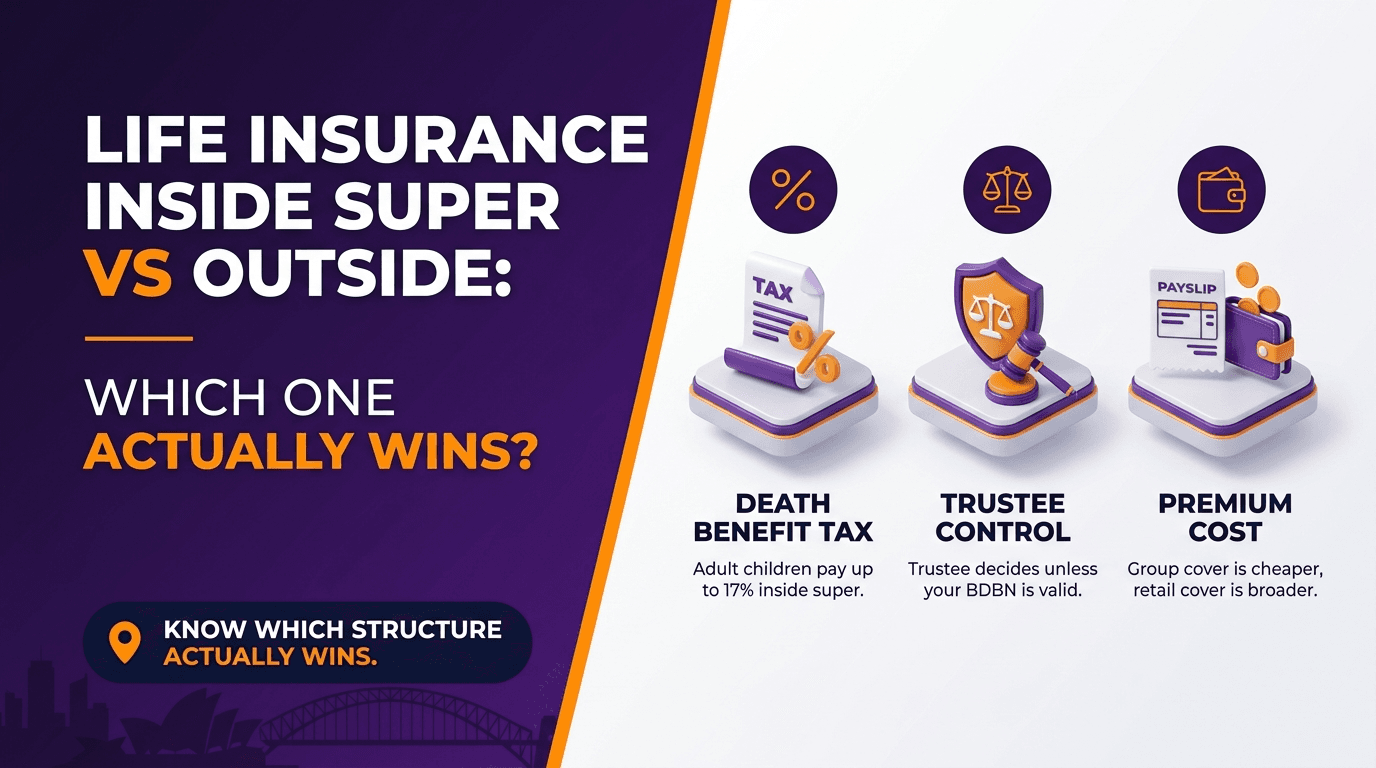
Life Insurance Inside Super vs Outside: Which One Wins?
Most Australians with superannuation have some life insurance. Most of them have no clear idea how it works, who controls the payout, whether the proceeds will reach the people they intend, or what tax their family will pay when a claim is made.
The question of whether to hold life insurance inside or outside super sounds like a technical one. In practice it determines whether your family receives the full insurance benefit or a reduced amount after tax, whether the payout arrives quickly or is subject to trustee discretion and estate administration, and whether the premium comes from pre-tax super contributions or after-tax personal income.
There is no universal answer to which structure wins. There is a correct answer for your specific circumstances, and for most people it turns out to be some of both. This guide explains what drives that answer.
TL;DR: The Key Points
Here is the short version before the detail:
Life insurance held inside super means premiums are paid from your super balance, which can be funded by concessional contributions. Premiums are not directly tax deductible to you personally, but the cost is effectively funded with pre-tax dollars where concessional contributions cover the deduction
Life insurance held outside super means premiums are paid from your after-tax personal income. Life insurance premiums outside super are not tax deductible (unlike income protection premiums, which are)
The most significant structural difference is the tax treatment of death benefits to non-dependants: inside super, adult children pay up to 17% on the taxable component of the benefit; outside super, the death benefit is generally tax-free to any beneficiary
Inside super, the payout goes to the trustee first, who then distributes it. Without a current binding death benefit nomination, the trustee exercises discretion. Outside super, the benefit goes directly to the nominated beneficiary or the estate
Group cover inside super is cheaper and requires no medical underwriting for default amounts, but uses broader disability definitions and provides less flexibility than a retail policy
TPD cover inside super typically requires an occupation definition. Retail TPD outside super can use own occupation definitions, which are far more favourable at claim time
From 1 April 2020, default insurance in super does not apply to members under 25, members with balances under $6,000, or members with accounts inactive for 16 months, unless they opt in
The super stapling rules from November 2021 mean new employees keep their existing super fund and its insurance rather than receiving new default cover through an employer fund
A combined structure holding life insurance inside super and TPD or trauma outside super is a common approach that captures cost advantages where they exist and avoids structural disadvantages where they matter most
Jump to a Section
How Life Insurance Inside Super Works
How Life Insurance Outside Super Works
The Tax Difference That Changes Everything
Premiums: What You Actually Pay Under Each Structure
Trustee Control vs Direct Beneficiary
Estate Planning: Where the Structures Diverge
TPD Inside Super: The Definition Problem
Group Cover vs Retail Cover in 2026
Super Stapling and the Insurance Continuity Question
Opt-In Requirements: Who No Longer Has Default Cover
The Combined Approach
Which Structure Suits Which Situation?
Common Mistakes People Make
FAQ
How Life Insurance Inside Super Works
When life insurance is held inside superannuation, the policy is owned by the super fund and the premiums are deducted from the member's account balance. The fund pays the insurer from the member's super, funded by whatever contributions flow into the account.
Most Australians encounter this through default group cover arranged by their super fund. When you join a super fund and meet certain eligibility conditions, the fund automatically provides a level of life cover (and often TPD and income protection cover) without requiring you to apply or undergo medical underwriting. This is the entry point to inside-super life insurance for the majority of Australian workers.
The flow of money on a claim: when the insured member dies, the insurer pays the death benefit to the super fund, not directly to the beneficiary. The fund trustee then determines how to distribute the benefit based on the member's nominations and the trust deed. The payout reaches the family only after the trustee has resolved the distribution.
The fund owns the policy. The policy is an asset of the super fund. The member is not the policy owner. This distinction has direct consequences for who controls the payout and how it is taxed.
Funding the premium through super contributions: where a member makes concessional contributions (employer SG, salary sacrifice, or personal deductible contributions), those contributions are taxed at 15% inside the fund. The premiums are then paid from the account, effectively funded by pre-tax contributions. For a member on a 47% marginal rate, funding the premium through concessional contributions rather than from after-tax income can reduce the effective cost of the premium significantly. The maths depends on the marginal rate and the amount of available concessional cap.
Bottom line: life insurance inside super is generally cheaper and requires no upfront medical underwriting for default cover amounts. The trade-offs are trustee control over the payout, potential tax on death benefits paid to non-dependants, and the erosion of the super balance through ongoing premium deductions.
How Life Insurance Outside Super Works
When life insurance is held outside superannuation, the member owns the policy personally and pays premiums from after-tax personal income. The insurer pays the death benefit directly to the nominated beneficiary, or to the estate if no beneficiary is named.
Retail life insurance: outside-super life insurance is almost always a retail policy arranged through a financial adviser or directly with an insurer. The member chooses the cover amount, the policy features, and the beneficiary. Unlike group super cover, a retail policy requires full underwriting at application, which means medical history, family history, occupation, and lifestyle factors are all assessed before cover is granted.
Premiums from after-tax income: life insurance premiums outside super are paid from personal after-tax income. Unlike income protection premiums outside super, which are generally tax deductible, life insurance premiums outside super are not tax deductible. The full premium cost is borne from personal income with no tax offset.
The death benefit goes directly to the beneficiary: where the policy nominates a beneficiary, the death benefit is paid directly to that person by the insurer without going through a trustee or the estate. For a policy that nominates the spouse, the spouse receives the money directly and promptly. For a policy that nominates adult children, the adult children receive it directly.
Tax treatment of the death benefit outside super: life insurance death benefits paid outside superannuation are generally not subject to income tax for the beneficiary, regardless of who receives them. A spouse, adult child, or any other beneficiary named on an outside-super policy receives the full benefit without tax consequences in most circumstances.
This is the most important structural difference between the two approaches and the one that most directly affects families with adult children as intended beneficiaries.
What if the life insurance your family is counting on pays out to the trustee of your super fund, and the trustee distributes it in a way that differs from your intentions? The difference between inside and outside super is not just academic. It is the difference between your family receiving the benefit you intended and the benefit a trustee determines.
The Tax Difference That Changes Everything
The single most important factor in the inside-versus-outside comparison is the tax treatment of the death benefit when it reaches the hands of a non-dependant, which in practice means most adult children.
Tax dependants receive super death benefits tax-free. A spouse, a child under 18, or a person in an interdependency relationship with the deceased is a tax dependant and receives super death benefits entirely free of tax. For these beneficiaries, the inside-versus-outside distinction has no tax consequence. The benefit arrives tax-free regardless of structure.
Non-dependants pay tax on super death benefits. An adult child who is financially independent is a non-tax dependant. When a super fund pays a death benefit to a non-tax dependant, the taxable component of the benefit is subject to a death benefits tax of 15% plus the 2% Medicare levy, totalling 17%.
The taxable component of most Australians' super balances is substantial. Employer contributions, salary sacrifice, and personal deductible contributions all form the taxable component. For many members, 80% to 90% of their balance, including any insurance proceeds added to it, sits in the taxable component.
The outside-super death benefit: a life insurance death benefit paid outside superannuation is generally not subject to tax in the hands of the beneficiary, regardless of whether they are a spouse, an adult child, or any other person. The full amount reaches the beneficiary without reduction.
A practical comparison:
David holds $1,000,000 of life insurance. He intends for the proceeds to be split equally between his two adult children, $500,000 each.
Structure | Benefit to Each Adult Child | Tax Payable | Net Received |
Inside super (taxable component) | $500,000 | $85,000 (17%) | $415,000 |
Outside super | $500,000 | $0 | $500,000 |
The difference per child is $85,000. Across both children, the inside-super structure costs the family $170,000 in avoidable tax on the same insurance policy.
For families where the intended beneficiaries are adult children, this tax difference is the dominant consideration in the structure decision. Where the only intended beneficiary is a spouse, the tax difference disappears and other factors drive the comparison.
Bottom line: if your life insurance proceeds are intended primarily for adult children, holding that insurance inside super creates a tax liability of up to 17% on the taxable component that does not exist under an outside-super structure. For a spouse beneficiary, this distinction is irrelevant.
Not sure how much of your current super death benefit would reach your adult children after tax? The financial advisers at What If Advice can model the component split and the tax outcome under your current structure. Call 1800 942 843 or email clientservices@whatifadvice.com.au.
Premiums: What You Actually Pay Under Each Structure
The premium difference between inside-super group cover and a retail policy outside super is real and material. So is the after-tax cost comparison, which is more nuanced than it first appears.
Inside super: the pre-tax funding advantage. Group life insurance inside super is almost always cheaper on a headline premium basis than an equivalent retail policy outside super. The reasons include:
Group pricing applies lower rates based on the pooled risk of the fund's membership
No individual underwriting means the insurer does not price your specific health risk into the premium
Insurer distribution costs are lower for group policies than for individually advised retail policies
Beyond the headline price, where the premium is funded from concessional contributions, the effective pre-tax cost is lower than the gross premium suggests. A member on a 47% marginal rate who funds a $2,000 annual premium through salary sacrifice pays an effective after-tax cost of approximately $1,060 (the pre-tax dollar is taxed at 15% inside the fund). Paying the same premium from after-tax income costs $2,000.
The super balance erosion: premiums deducted from inside super reduce the account balance available for retirement. Over a long career, the compounding effect of premium deductions from a super balance that would otherwise have grown can be material. This is particularly relevant for younger members who have decades of compounding ahead of them.
Outside super: higher gross premium, no deduction. A retail life insurance policy outside super typically costs more in gross premium terms than the equivalent group cover amount inside super. Life insurance premiums outside super are not tax deductible, so the full cost is borne from after-tax income.
The comparison that actually matters is not gross premium inside super versus gross premium outside super. It is the after-tax cost of each, accounting for:
The effective cost of premiums funded through concessional contributions
The tax saving on death benefits for non-dependant beneficiaries
The value of features available in retail policies that group cover does not provide
The long-term super balance erosion from inside-super premiums
For many Australians, inside-super group cover wins on cost for smaller cover amounts, and the retail outside-super policy wins on total net value once the tax treatment of the death benefit is factored in.
Trustee Control vs Direct Beneficiary
One of the most practically significant differences between the two structures is who controls the payout and how quickly it reaches your family.
Inside super: trustee discretion applies. When a super fund member dies, the death benefit does not automatically go to anyone. It goes to the trustee. The trustee is legally responsible for determining who receives the benefit, in what proportions, and in what form (lump sum or pension). The trustee makes this determination based on:
Any valid binding death benefit nomination (BDBN)
Any non-binding (preferred) nomination
The trust deed
The relevant laws and regulations
Without a valid BDBN, the trustee exercises discretion. The trustee will generally consider the member's stated preferences and the circumstances of potential dependants, but is not legally bound to follow non-binding nominations. In a blended family, a disputed estate, or where personal circumstances have changed since the last nomination was made, trustee discretion can produce outcomes the member did not intend.
The binding death benefit nomination. A BDBN removes trustee discretion and legally requires the trustee to pay the benefit to the nominated beneficiaries in the specified proportions. To be valid, a BDBN must:
Be in writing and signed by the member
Be witnessed by two adults who are not nominated beneficiaries
Be renewed every three years for lapsing nominations (non-lapsing BDBNs do not expire but must still be reviewed)
Comply with the fund's trust deed requirements
Only nominate eligible beneficiaries (legal personal representative or super dependants)
The administration delay: even with a valid BDBN, the trustee must process the death benefit claim. The insurer pays the benefit to the fund, the trustee verifies the nomination and the member's circumstances, and the fund then makes the payment. This process can take weeks to months depending on the fund and the complexity of the situation.
Outside super: direct payment to the beneficiary. A life insurance policy outside super pays the death benefit directly to the nominated beneficiary on the policy, bypassing the super trustee entirely. The insurer assesses the claim and pays the proceeds directly to the named person or persons.
The advantages are:
No trustee discretion over who receives the benefit
Generally faster payment directly to the family
The payout does not form part of the super account balance and is not subject to super fund rules
Where the nominated beneficiary is an adult child, the full benefit arrives without passing through super tax
Where no beneficiary is nominated on the policy, the benefit is paid to the estate and distributed under the will. This is a reason to ensure a beneficiary is always nominated on an outside-super policy rather than relying on the estate distribution process.
What if your binding death benefit nomination in your super fund lapsed two years ago and you are unaware of it? The trustee's discretion may not produce the outcome you assumed was already locked in.
Estate Planning: Where the Structures Diverge
The structural differences between inside and outside super have direct consequences for estate planning, particularly in blended families, estates with multiple intended beneficiaries, and situations where super and non-super assets need to work together in a coordinated plan.
Super does not automatically form part of the estate. Super is not automatically dealt with by a will. It sits in a trust structure managed by the fund trustee, and only flows into the estate if the BDBN nominates the legal personal representative (the estate) as beneficiary. This is both a strength and a complexity.
Where inside-super life insurance flows into the estate: where a BDBN directs the super death benefit to the legal personal representative, the benefit becomes part of the estate and is distributed under the will. This allows the member to coordinate the super benefit with other estate assets through the will. The disadvantage is that estate assets may be subject to claims from creditors, challenges under family provision legislation, or delays in estate administration.
Where inside-super life insurance is paid directly to dependants via BDBN: where the BDBN nominates dependants directly, the benefit bypasses the estate entirely. This is faster and less vulnerable to estate challenges, but limits the recipients to those who qualify as super dependants (spouses, children under 18, interdependants, and financial dependants). An adult child who is not financially dependent cannot be nominated directly under a BDBN. The benefit would need to go via the estate or be structured another way.
Outside-super life insurance and the estate: an outside-super policy that nominates a beneficiary directly also bypasses the estate. The named beneficiary receives the proceeds directly. This can be an advantage where estate challenges are a concern and the intended beneficiary is an adult child who cannot be nominated directly under a super BDBN.
Testamentary trusts: where a will establishes a testamentary trust, life insurance proceeds that flow through the estate (either from an outside-super policy with no named beneficiary, or from super paid to the estate) can be captured by the testamentary trust. This provides tax advantages for beneficiaries who receive investment income through the trust, particularly where adult children with lower marginal rates receive ongoing income rather than a lump sum.
Bottom line: coordinating life insurance nominations with the will, superannuation nominations, and any trust structures in the estate requires looking at all instruments together. A life insurance policy and a super nomination that point in different directions, or that are inconsistent with the will, can produce unintended outcomes for beneficiaries.
Wondering whether your current life insurance nominations are consistent with your will and superannuation nominations? The financial advisers at What If Advice can review all three instruments together and identify any inconsistencies. Call 1800 942 843 or email clientservices@whatifadvice.com.au.
TPD Inside Super: The Definition Problem
Total and permanent disability insurance is commonly held alongside life insurance inside super. The definition problem inside super is one of the most significant and least understood gaps in Australian insurance cover.
The any occupation definition. For TPD cover to be held inside superannuation, the ATO requires that the policy definition aligns with the super fund's conditions of release. This means TPD inside super must generally use any occupation definition: you must be unable to ever work in any occupation for which you are reasonably suited by education, training, or experience.
Any occupation test is significantly harder to meet than an own occupation test. A specialist surgeon who loses fine motor control and can never perform surgery again may not qualify for a TPD benefit under any occupation definition if they are capable of working in a clinical advisory, teaching, or administrative capacity. The same surgeon with own occupation TPD outside super would qualify because they can no longer perform surgery.
Own occupation TPD outside super. A retail TPD policy outside super can use its own occupation definition. The insured is assessed against their specific occupation rather than any occupation. For professionals with highly specialised skills, this distinction at claim time can be the difference between receiving the benefit and receiving nothing.
The split TPD structure. A common approach for professionals and those in specialised occupations is to hold any occupation TPD inside super (funded from super contributions at lower cost) and top up with own occupation TPD outside super (funded from personal income at higher cost). The any occupation portion provides a threshold benefit funded efficiently. The own occupation portion provides the coverage that actually matches the insured's real risk.
Tax treatment of TPD payments inside super. A TPD benefit paid inside super is paid to the super fund and then to the member. The tax treatment depends on the member's age and whether the super fund's conditions of release are satisfied:
Where the member is under 60 and satisfies the permanent incapacity condition of release, the payment is taxed as a super lump sum with a tax-free component and a taxable component
The taxable component of a TPD payment to a member under 60 may attract tax depending on the member's age and the amount involved
TPD benefits paid outside super are generally received by the insured member tax-free. The proceeds are a capital payment, not income, and are not subject to income tax in the hands of the recipient in most circumstances.
What if you hold TPD cover inside super with an any occupation definition, become unable to perform your specific profession due to a medical condition, and the insurer determines you are capable of working in a different role? The definition you hold is the determining factor in whether a claim succeeds or fails.
In a specialised occupation and not sure whether your current TPD cover would actually pay out if you needed it? This is exactly the kind of gap that only shows up at claim time, when it is too late to fix. The financial advisers at What If Advice can review your current TPD definitions against your actual occupation before that happens. Call 1800 942 843 or email clientservices@whatifadvice.com.au.
Group Cover vs Retail Cover in 2026
The difference between group cover arranged through a super fund and a retail policy purchased through an adviser is not just a price difference. It is a coverage difference that manifests most clearly at claim time.
Feature | Group Cover Inside Super | Retail Cover Outside Super |
Premium level | Lower (group pricing) | Higher (individually underwritten) |
Medical underwriting | None for default amounts | Full underwriting at application |
Life cover definition | Standard death and terminal illness | Standard death and terminal illness |
TPD definition | Any occupation | Own occupation available |
Income protection benefit period | Often 2 years | Up to age 65 available |
Partial disability | Often limited | Commonly available |
Portability | May cease on leaving employer or fund | Portable across employers |
Policy ownership | Super fund | Individual member |
Beneficiary control | Trustee (subject to BDBN) | Direct nomination on policy |
Death benefit tax (adult child) | Up to 17% on taxable component | Generally nil |
Premium tax efficiency | Effectively pre-tax via concessional contributions | After-tax, not deductible for life cover |
Indexation | Often limited or nil | Typically available |
The automatic acceptance advantage. Default group cover inside super does not require medical underwriting for the standard cover amount. A member who has a pre-existing health condition that would result in exclusions, loadings, or outright decline at retail underwriting can still hold a meaningful level of default group cover. For Australians with health conditions that limit their options in the retail market, inside-super group cover may be the primary or only source of life insurance available.
The underwriting timing risk. The other side of the automatic acceptance advantage is that some group policies conduct what is called post-claims underwriting: the insurer investigates the member's full medical history at claim time rather than at application. This can result in a claim being declined based on a pre-existing condition that the member was unaware would be relevant, even though they never made a disclosure or received an exclusion at application. Retail policies that fully underwrite at application provide greater certainty that an accepted application means a claim will be considered on its merits.
Super Stapling and the Insurance Continuity Question
From 1 November 2021, the Your Future, Your Super super stapling reforms changed how super accounts work when Australians change employers.
Previously, a new employee who did not nominate a super fund was typically defaulted into the employer's chosen fund, often receiving new default insurance cover in that fund. Under stapling, new employees who do not nominate a super fund are instead stapled to their existing super fund. Their contributions flow to their existing fund, and they do not receive default cover in the new employer's fund.
The implications for group life insurance:
A member who had no default cover in their existing fund, perhaps because they opted out or never had cover, does not receive default cover through the new employer
A member who had cover in their previous super fund retains it, provided contributions continue to the stapled fund
New employees who want life insurance in their super must actively review their existing cover or arrange retail cover outside super
The continuity risk: the stapling rules protect existing cover for those who have it. They create a gap for those who assumed they would receive default cover in a new employer's fund and did not. Reviewing life insurance cover when changing employers is now an important step that many Australians overlook.
Opt-In Requirements: Who No Longer Has Default Cover
From 1 April 2020, APRA's reforms to insurance in super changed who automatically receives default cover. The reforms were designed to prevent insurance premiums from eroding small or inactive super balances.
Default insurance does not apply to:
Members under 25 years of age, unless they actively opt in
Members with account balances under $6,000, unless they actively opt in
Members whose accounts have been inactive for 16 consecutive months (no employer or personal contributions received), unless they actively opt in
What this means in practice: a 22-year-old entering the workforce for the first time is not automatically covered by life or TPD insurance in their super fund. If they are injured or become ill in those early working years, they have no group cover unless they have opted in. Many young Australians are unaware of this change and are uninsured inside super as a result.
Similarly, someone who has taken a career break and has had no contributions flowing for over 16 months may have lost their default cover without realising it. Checking the insurance status on a super account after any extended period without contributions is essential.
Opting in is typically a simple process through the fund's online portal or a paper form. The member must actively choose to opt in, and the fund may apply some limited health questions before confirming cover.
What if a career break of 18 months means your super fund's default life insurance has lapsed, and you have not noticed because the premiums simply stopped being deducted? Checking the current insurance status on your super account takes five minutes and matters considerably more than that.
The Combined Approach
For most Australians, the answer to inside versus outside super is not an either-or choice. It is a deliberate combination that captures the advantages of each structure where they apply.
A common combined structure:
Life insurance inside super: holds the base level of life cover funded from super contributions at group pricing rates. Where the primary beneficiary is a spouse (who receives super death benefits tax-free), the inside-super tax disadvantage does not apply and the cost advantage is captured.
Additional life insurance outside super: where adult children are co-beneficiaries alongside a spouse, an outside-super policy directed to the adult children's share avoids the 17% taxable component tax on that portion.
Any occupation TPD inside super: funded from concessional contributions at lower cost, providing a threshold TPD benefit.
Own occupation TPD outside super: provides the coverage that aligns with the insured's actual occupational risk where the any occupation definition inside super would not pay on the most likely claim scenario.
Trauma insurance outside super: trauma (critical illness) cover cannot be held inside super under superannuation law. Where this cover is relevant, it must be held outside super.
The structure should reflect the beneficiary intention. Where a spouse will receive the majority of the life insurance benefit, inside super is generally cost-effective and the tax disadvantage does not apply. Where adult children are significant intended beneficiaries, an outside-super policy for that portion eliminates the 17% tax cost on the taxable component. The optimal structure depends on who the beneficiaries are and in what proportions.
Reviewing the combination periodically: the right combination is not static. As family circumstances change, as super balances grow, as beneficiaries change, and as premiums inside super erode the balance, the optimal structure changes with them. An annual review of the insurance structure alongside the super and estate plan keeps all elements aligned.
Which Structure Suits Which Situation?
Inside super tends to suit where:
The primary or sole intended beneficiary is a spouse, removing the tax disadvantage entirely
Cost is a primary consideration and the headline premium difference between group and retail cover is significant
The member has a pre-existing health condition that limits retail underwriting options and group cover is the primary or only accessible source of insurance
The member is younger and is comfortable with the any occupation TPD definition at lower cost while building an emergency savings buffer
Available cash outside super is limited and funding premiums from super balance is the more practical option
Outside super tends to suit where:
Adult children are significant intended beneficiaries and the 17% tax on the taxable component would produce a material reduction in the benefit they receive
The insured has a specialised occupation where an own occupation TPD definition is important
The member values direct control over who receives the death benefit without super trustee involvement
Estate planning requires the benefit to flow to beneficiaries who cannot be nominated directly under a super BDBN
The insured already has significant super balance and does not want further premium erosion of that balance
Neither structure suits all situations, and the benefit of working through the comparison with a financial adviser lies in modelling the actual dollar outcomes under each approach for your specific income, super balance, beneficiary intentions, and estate plan.
Common Mistakes People Make
Assuming group super cover is adequate without checking the amount. Default group cover amounts are often set at a fixed multiple of salary (such as one or two times annual salary) and may not reflect the cover level actually needed. A family with a mortgage, young children, and one primary earner typically needs significantly more than one or two years of income replacement.
Not checking whether default insurance is currently active. The post-2020 opt-in rules mean that young members, those with small balances, and those who have had an inactive account may no longer have default cover without realising it. Checking the current insurance status on the super fund's app or statement takes minutes.
Holding all life insurance inside super where adult children are the intended beneficiaries. The 17% taxable component tax on super death benefits paid to adult children is a substantial and avoidable cost. Holding at least the portion intended for adult children outside super eliminates this liability.
Allowing a binding death benefit nomination to lapse. A lapsing BDBN expires after three years. Many super fund members made a BDBN years ago and have not renewed it. The result is trustee discretion, which may not produce the intended distribution. Setting a calendar reminder for BDBN renewal is a simple safeguard.
Nominating a non-dependant directly in a super BDBN. A BDBN can only validly nominate legal personal representatives or super dependants. Nominating an adult child who is not financially dependent on the member directly in a BDBN is not valid and the trustee will not be bound by it. The benefit reverts to trustee discretion. Understanding who can be nominated before completing the form prevents this error.
Changing employers without checking insurance continuity. Super stapling means the existing super fund follows the member to a new employer, but it does not guarantee that insurance cover continues unchanged. Cover may be affected by gaps in contributions, changes in employment category, or the fund's terms around active employment. Checking insurance status whenever employment changes prevents unintended gaps.
Not reviewing the insurance structure when personal circumstances change. Marriage, divorce, the birth of children, children reaching adulthood, changes in income, paying off the mortgage, and approaching retirement all change the appropriate level and structure of life insurance. A policy set up at 35 and never reviewed at 52 is almost certainly misaligned with current needs and beneficiary intentions.
Overlooking the super balance erosion over time. A $2,000 annual premium deducted from super from age 30 to age 65 costs more than $70,000 in nominal terms and potentially far more in lost compound growth. For younger members with long investment horizons, the compounding impact of premium deductions from super is a real cost that the headline premium figure understates.
What if the life insurance structure you set up when you first joined a super fund at 26 has never been reviewed, your children are now adults, your beneficiary nomination has lapsed, and the amount covered is less than two years of your current income? That is not an unusual situation. It is the default position for many Australians who have not actively managed their insurance.
FAQ
Is life insurance inside super tax deductible?
Premiums for life insurance inside super are not directly tax deductible to you personally. They are paid from your super balance. Where the premiums are funded from concessional contributions (employer SG, salary sacrifice, or personal deductible contributions), those contributions are taxed at 15% inside the fund rather than at your marginal rate, which reduces the effective cost for higher income earners. Premiums for life insurance outside super are also not tax deductible. This is different from income protection premiums outside super, which are generally deductible.
Does my family pay tax on a life insurance payout from super?
It depends on who receives it. A spouse, child under 18, or person in an interdependency relationship (a tax dependant) receives super death benefits tax-free. An adult child who is financially independent (a non-tax dependant) pays up to 17% tax on the taxable component of the super death benefit. Life insurance death benefits paid outside superannuation are generally tax-free to any beneficiary regardless of relationship.
What happens to my super life insurance if I change jobs?
Under the super stapling rules introduced in November 2021, your existing super fund follows you when you change employers. Your contributions and insurance remain with the existing fund rather than defaulting to the new employer's fund. However, insurance cover may be affected by gaps in contributions, the fund's terms around active employment status, or changes in cover amounts. Checking your insurance status after any change in employment is important.
Can I nominate my adult child directly on my super BDBN?
Only if they qualify as a super dependant. An adult child who is financially dependent on you qualifies. An adult child who is financially independent does not qualify for direct nomination under a BDBN. You can direct the benefit to your legal personal representative (estate) and then distribute to the adult child under your will, but this involves the estate administration process and may reduce the speed and certainty of the payout.
Do I still have default life insurance in my super fund?
Not necessarily. From 1 April 2020, default insurance does not apply automatically to members under 25, members with balances under $6,000, or members whose accounts have been inactive for 16 months. If you fall into any of these categories and have not actively opted in, you may have no life insurance inside your super fund. Check your current insurance status directly through the fund.
What is the difference between a lapsing and non-lapsing binding death benefit nomination?
A lapsing BDBN expires after three years unless renewed. A non-lapsing BDBN does not expire automatically but must still be reviewed when personal circumstances change. Not all super funds offer non-lapsing nominations. Where your fund offers only lapsing nominations, a calendar reminder for renewal every three years prevents the nomination from expiring without your knowledge.
Can I hold trauma insurance inside super?
No. Trauma (critical illness) insurance cannot be held inside superannuation. Superannuation law restricts the types of insurance that can be held inside super to life insurance, TPD, and income protection. Trauma cover, which pays a lump sum on diagnosis of a specified medical condition regardless of ability to work, must be held outside super.
What is trauma insurance and do I actually need it?
Trauma insurance, also called critical illness cover, pays a lump sum on diagnosis of a specified serious medical condition, such as cancer, heart attack, or stroke, regardless of whether you are able to keep working. This is different from TPD, which requires a permanent inability to work, and from income protection, which replaces a portion of income during a period of incapacity. Trauma cover is worth considering where a serious diagnosis, even one you eventually recover from and return to work after, would still create a significant financial shock: time off work during treatment, medical costs not covered by Medicare or private health insurance, or the cost of home modifications during recovery. Because it cannot be held inside super, it is always an after-tax, outside-super cost, which is worth factoring into the broader premium comparison.
Is it worth paying for retail life insurance outside super if I already have group cover inside super?
It depends on your beneficiary intentions, the cover amount inside super relative to your actual needs, and whether the any occupation TPD definition inside super is adequate for your occupation. For a member whose sole beneficiary is a spouse, inside-super group cover may be sufficient and cost-effective. For a member with adult children as intended beneficiaries, or with a specialised occupation where own occupation TPD matters, retail cover outside super addresses gaps that group cover does not.
What is the right amount of life insurance to hold?
The right amount depends on your specific obligations: the mortgage balance, income replacement needed by dependants, education costs for children, and any other financial commitments your family would face if you were no longer earning. A common starting point is calculating the lump sum needed to pay off the mortgage and provide an income stream for dependants for a defined period, then comparing that figure to current cover. A financial adviser can model this based on your actual numbers.
How often should I review my life insurance arrangements?
At a minimum, review life insurance when major life events occur: marriage, divorce, the birth of a child, a child reaching adulthood, a significant income increase or decrease, paying off the mortgage, or approaching retirement. In addition, lapsing BDBNs must be renewed every three years. An annual insurance and estate planning review as part of a broader financial review catches changes that might otherwise be missed between major life events.
Not sure whether your current life insurance structure is actually going to deliver what you intend for your family?
Most Australians have some life insurance and most have not reviewed it recently. The gap between what a default group super policy provides and what a well-structured combination of inside and outside super cover achieves can be significant, particularly when adult children are involved and the 17% taxable component tax is in play.
The financial advisers at What If Advice work with Australians across Brisbane, Melbourne, and virtually across Australia to review life insurance structures, model the tax treatment of death benefits under current arrangements, assess whether nominations are current and valid, and coordinate life insurance with the broader estate plan.
Call 1800 942 843 or email clientservices@whatifadvice.com.au to book a review.
Still asking what if about what your family actually receives from your life insurance? The answer depends on the structure, the nominations, and the tax treatment of the payout. The team at What If Advice can tell you exactly what your family would receive today and what changes would improve that outcome. AFSL 528250.
General Advice Disclaimer: This information is general in nature and does not take into account your personal financial situation, needs, or objectives. Life insurance structures, superannuation death benefit tax treatment, binding death benefit nominations, and related rules are complex and subject to change. Individual policy terms, super fund rules, and estate planning considerations vary significantly. You should seek advice from a licensed financial adviser before making any decisions about life insurance structure or superannuation nominations. What If Advice is an Authorised Representative under Beryllium Advisers Pty Ltd, AFSL 528250.