Looking for specific financial advice?
This blog provides general educational content. For personalized advice tailored to your unique situation, book a free consultation with our team of ASIC-licensed financial advisers.
What If the App That Got You Investing Is Now the Thing Holding You Back?
Micro-investing apps have done something genuinely useful: they've gotten people who'd never otherwise touch the share market to start investing spare change from everyday purchases. That's a real win. What these apps aren't always upfront about is what happens once the novelty of round-ups wears off and the balance actually starts to matter, where flat monthly fees can quietly eat a disproportionate chunk of a small portfolio, and where the simplified, pre-set investment options start to look thin compared to what a properly built portfolio could offer. This guide covers what micro-investing apps are genuinely good for, and the point at which it's worth outgrowing them. If the behavioural side of building an investing habit interests you more broadly, our dollar-cost averaging guide covers a related angle on making investing feel manageable rather than overwhelming.
TL;DR
Micro-investing apps generally work by rounding up everyday purchases to the nearest dollar and investing the difference, often into a small number of pre-set diversified portfolios.
Flat monthly fees are the biggest hidden cost. A fee that looks negligible in dollar terms can represent a very high percentage of a small balance, sometimes several percent annually.
The investment options are usually limited to a handful of pre-built portfolios, offering far less control and customisation than building a portfolio directly.
They're genuinely effective for building the habit of investing, particularly for people who'd otherwise never start, which is a real behavioural win worth acknowledging.
The fee-to-balance ratio improves as the balance grows, meaning a flat fee that's expensive on $500 becomes far less significant on $15,000, so the "right time to switch" depends on the specific numbers.
Building a portfolio directly, through a standard brokerage account and low-cost ETFs, generally offers materially lower percentage fees at scale and far more control over diversification.
The two aren't mutually exclusive as a starting point, using a micro-investing app to build the habit while transitioning to a direct portfolio as the balance grows is a genuinely reasonable path.
Bottom line: micro-investing apps are a legitimate way to start, but flat fees mean they get proportionally more expensive to outgrow the longer you stay, so working out your own numbers matters more than the marketing suggests.
On This Page
How Micro-Investing Apps Actually Work
The Fee Structure Problem: Flat Fees on Small Balances
What You Give Up: Limited Investment Options
What They Get Genuinely Right
The Maths on When to Switch
Worked Example: The Same $50 a Month, Two Fee Structures
Common Mistakes
FAQ
How Micro-Investing Apps Actually Work
Most micro-investing apps operate on a simple mechanic: they link to a bank account or card, round up everyday purchases to the nearest dollar, and invest that rounded-up difference into a small number of pre-built portfolios, generally diversified across a mix of asset classes at different risk levels (conservative, balanced, aggressive, and similar labels). Some also allow manual lump-sum or recurring contributions beyond just round-ups.
The underlying investments are usually a mix of ETFs, meaning the portfolios themselves aren't inherently a bad product, they're often built on the same underlying index exposure an investor could access directly. The difference lies in the fee structure and the level of control on top of that underlying exposure.
Not sure whether your current micro-investing balance would be better off restructured directly? A free 15-minute chat with WIAA can run the actual numbers. Call 1800 942 843 or book online.
Bottom line: the underlying investments are often reasonable, it's the wrapper, the fee structure and limited options, where the real difference from a direct portfolio shows up.
The Fee Structure Problem: Flat Fees on Small Balances
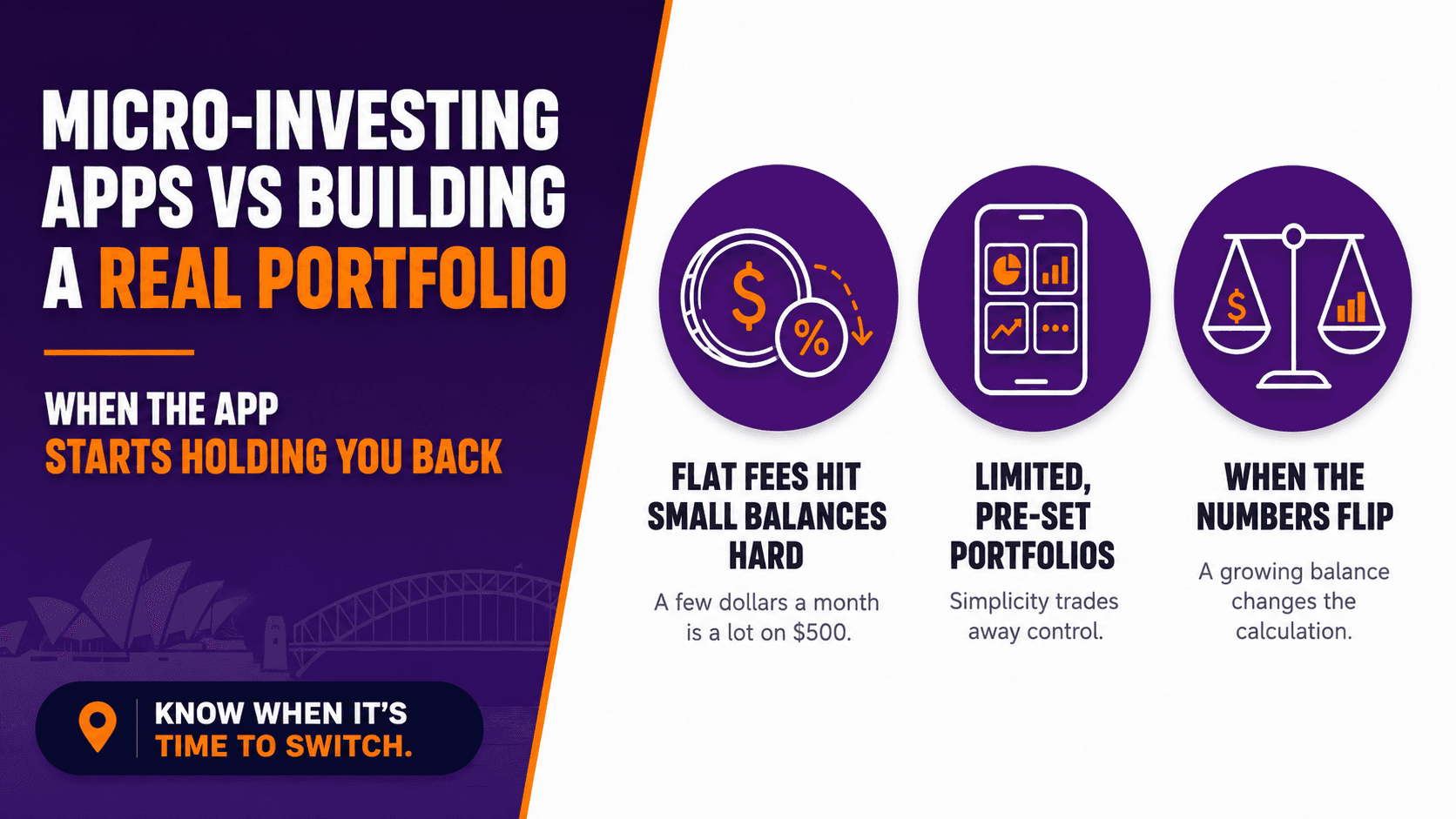
Many micro-investing apps charge a flat monthly fee, commonly a few dollars, rather than a percentage of the balance invested. This structure is genuinely fine, even negligible, at low balances relative to what it buys in convenience, but it becomes proportionally expensive as a fixed cost against a small base. A flat fee of $4.50 a month works out to $54 a year, a manageable cost against a $10,000 balance (0.54%), but a genuinely significant cost against a $500 balance (10.8%).
This is the core mechanic worth understanding: the flat fee doesn't scale down with a small balance, it scales down as a percentage only once the balance itself grows large enough to absorb it.
Bottom line: a flat monthly fee isn't expensive or cheap in isolation, it's expensive or cheap entirely relative to how much money is actually invested against it.
What You Give Up: Limited Investment Options
Most micro-investing apps offer a small number of pre-built portfolio options, generally labelled by risk level, with little to no ability to select specific ETFs, weight sectors differently, or exclude particular holdings. This works well for someone who wants simplicity and doesn't want to make individual investment decisions, but it's materially less flexible than building a portfolio directly through a standard brokerage account, where an investor can choose specific low-cost ETFs, weight international versus domestic exposure deliberately, and adjust holdings as circumstances change.
Bottom line: simplicity and control are a genuine trade-off, micro-investing apps optimise heavily for the former, at the cost of the latter.
What They Get Genuinely Right
It's worth being fair to what micro-investing apps actually do well, rather than treating them purely as a stepping-stone to something better:
They lower the barrier to starting, removing the intimidation factor of opening a full brokerage account for someone who's never invested before.
The round-up mechanic builds a genuine habit, turning small, painless amounts into a recurring investment behaviour without requiring active discipline.
They provide instant diversification even on very small amounts, something that's genuinely harder to achieve buying individual shares directly with limited capital.
They're a reasonable way to test risk tolerance with small amounts before committing larger sums to a more deliberately built strategy.
Starting with a micro-investing app isn't a mistake, and building the habit matters. A free 15-minute chat can help map out what the next step looks like once the balance grows. Email clientservices@whatifadvice.com.au or book online.
Bottom line: for building the habit and lowering the barrier to entry, micro-investing apps genuinely do what they're designed to do.
The Maths on When to Switch
There's no single balance figure that universally marks the right time to move to a direct portfolio, since it depends on the specific app's fee structure, the investor's contribution rate, and their comfort with managing a portfolio directly. The more useful approach is calculating the effective percentage fee at the current balance, and comparing it against what a low-cost ETF held directly through a standard brokerage account would cost in percentage terms (often a fraction of a percent annually for a simple, diversified index approach).
Once the flat fee's percentage impact drops close to, or below, what a direct low-cost alternative would cost, the fee argument for switching weakens considerably, though control and flexibility preferences remain a separate, personal consideration beyond just fees.
Bottom line: the right time to switch is a calculation specific to your own balance and contribution pattern, not a fixed dollar figure that applies to everyone.
Worked Example: The Same $50 a Month, Two Fee Structures
Chloe invests $50 a month, entirely through round-ups and manual top-ups, into a micro-investing app charging a flat $4.50 monthly fee.
At month 12 (balance approximately $600, ignoring returns for simplicity), her annual fee of $54 represents roughly 9% of her balance, a genuinely high cost relative to what's invested.
At month 36 (balance approximately $1,800), her annual fee of $54 now represents roughly 3% of her balance, still high compared to a low-cost direct ETF option, but considerably improved from the first year.
At month 60 (balance approximately $3,000, plus modest investment growth, say $3,400), her annual fee of $54 represents closer to 1.6%, approaching but still generally above what a comparable low-cost ETF held directly might cost in percentage terms.
If Chloe instead moved her contributions to a direct brokerage account investing in a low-cost diversified ETF once her balance passed roughly $2,000 to $3,000, and given the relatively small dollar cost of a handful of buy trades a year, she'd likely reduce her ongoing percentage fee drag considerably from that point forward, while giving up the built-in round-up automation.
Outcome: the flat fee structure was proportionally reasonable at the start given the convenience of simply starting, but became an increasingly avoidable cost as her balance grew.
Bottom line: what starts as a sensible entry point can quietly become an expensive habit to keep once the balance is large enough that a direct alternative would cost meaningfully less.
Common Mistakes
Not checking the actual dollar fee against the current balance. A flat fee that felt trivial at $200 can be a genuinely significant drag by the time the balance sits at $1,000.
Assuming the underlying investments are the problem. Often the underlying ETFs are reasonable, it's the fee wrapper and limited flexibility on top that's worth reassessing.
Staying purely out of habit or inertia once the balance has grown substantially. The convenience that justified the fee at a small balance may no longer justify it at a larger one.
Switching too early, before the habit is established. For someone new to investing, giving up the automated round-up mechanic before the habit is genuinely built can undo the behavioural benefit these apps provide.
Assuming a direct brokerage account is too complicated. For a simple, diversified ETF strategy, the ongoing complexity of managing it directly is often lower than people assume.
Working out whether your current micro-investing setup still makes sense at your current balance is a straightforward calculation. A free 15-minute chat can run it for you. Call 1800 942 843.
FAQ
Are micro-investing apps a bad way to start investing? No, generally the opposite. They lower the barrier to entry and build a genuine investing habit, particularly for people who'd otherwise never start, which is a real benefit worth acknowledging.
Why do micro-investing app fees feel so small but add up so much? Because many charge a flat monthly fee rather than a percentage of the balance, meaning the fee's proportional impact is much higher on a small balance than a large one.
At what balance should I switch from a micro-investing app to a direct portfolio? There's no universal figure, it depends on the specific app's fee structure and your contribution pattern, but comparing the current effective percentage fee against a low-cost direct ETF alternative gives a concrete answer for your own numbers.
Are the underlying investments in micro-investing apps bad? Not necessarily. Many are built on reasonable, diversified ETF exposure, the main difference from a direct portfolio is usually the fee structure and level of control, not the underlying investment quality.
Can I use a micro-investing app and a direct brokerage account at the same time? Yes, this is a genuinely reasonable transitional approach, continuing the habit-building round-up mechanic while directing larger, more deliberate contributions elsewhere.
Do micro-investing apps offer the same diversification as building a portfolio myself? Generally, yes, in terms of underlying asset exposure through the pre-built portfolio options, though with far less ability to customise or adjust that diversification directly.
Is it complicated to move from a micro-investing app to a standard brokerage account? Not inherently. Opening a brokerage account and investing in a simple, diversified ETF is often less complex than people assume, though it does require more active decision-making than an automated app.
Do micro-investing apps have the same tax reporting as a standard investment account? Generally, yes, capital gains and any distributions are still taxable and need to be reported, regardless of which platform or app the investment was held through.
Is the round-up mechanic itself a good investing strategy? It's a genuinely effective behavioural tool for building a habit and starting from very small amounts, though it's a modest contribution mechanism on its own and generally isn't sufficient as a full investing strategy at larger balances.
Should I stop using a micro-investing app entirely once I have significant savings elsewhere? Not necessarily immediately, this depends on the specific fee impact at your current balance and whether the automated habit still adds value, which is worth calculating rather than assuming either way.
Ready to Work Out Whether You've Outgrown Your Micro-Investing App?
If your balance has grown past the point where a flat monthly fee still makes sense, it's worth running the actual numbers rather than staying on autopilot. A free 15-minute chat can help.
Call us: 1800 942 843
Book online: free 15-minute chat, no cost, no pressure
Still asking what if.
WIAA has helped Australians work out when a simple starting point has become an expensive habit, across Toowong, Grange, and Melbourne CBD. WIAA operates under AFSL 528250 as an Authorised Representative of Beryllium Advisers Pty Ltd.
General Advice Disclaimer: This article contains general information only and does not take into account your personal objectives, financial situation, or needs. It is not personal financial advice and should not be relied upon as such. Fee structures, investment options, and features referenced are general in nature and vary between providers and change over time, and should be verified directly with the relevant provider before making any decision.