Looking for specific financial advice?
This blog provides general educational content. For personalized advice tailored to your unique situation, book a free consultation with our team of ASIC-licensed financial advisers.
Offset Account vs Redraw: What’s the Difference?
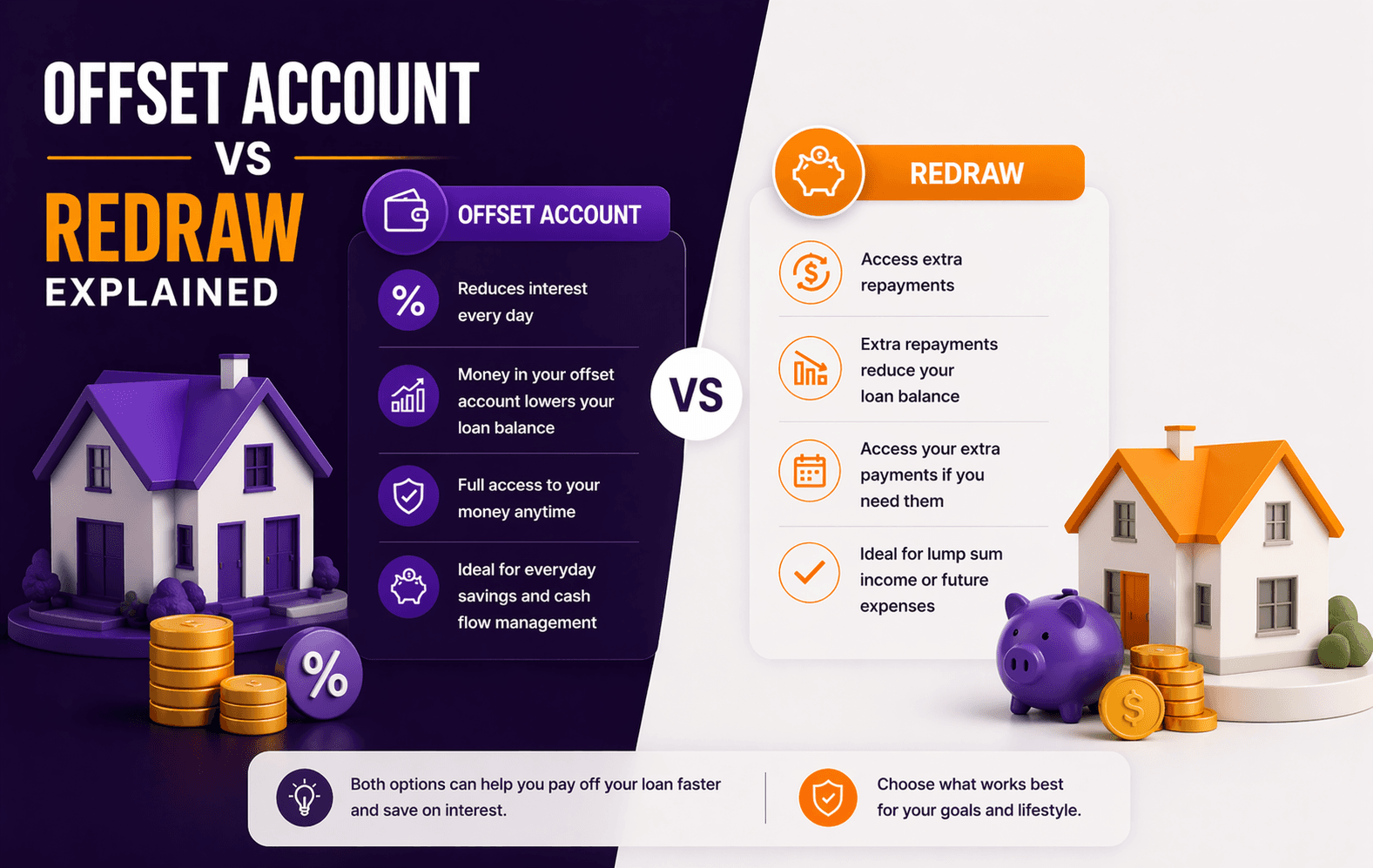
Offset and redraw accounts both help reduce the interest you pay on your home loan.
The short answer:
Offset = more flexibility and control
Redraw = simpler, but with limitations
They may look similar, but the way they work can have very different outcomes, especially over time.
What Is an Offset Account?
An offset account is a transaction account linked to your home loan.
The balance in the account reduces the interest charged on your loan.
Example:
Loan: $600,000
Offset balance: $100,000
You’re only charged interest on:
$500,000
Key Features:
Works like a normal bank account
Full access to your money anytime
Reduces interest daily
What Is a Redraw Facility?
A redraw facility allows you to access extra repayments you’ve made on your loan.
Instead of sitting in a separate account, the money goes directly into your loan.
Example:
Loan: $600,000
You’ve paid an extra $50,000
Loan balance becomes:
$550,000
You may be able to “redraw” that $50,000 later.
Key Features:
Reduces your loan balance
Access to funds may be restricted
Usually no separate account
Offset vs Redraw: Side-by-Side Comparison
Feature | Offset Account | Redraw Facility |
Access to funds | Immediate | May be restricted |
Structure | Separate account | Built into loan |
Flexibility | High | Moderate |
Fees | Often higher | Usually lower |
Tax implications | Cleaner | Can be complex |
Bank control | Low | Higher |
Key Difference #1: Access and Control
With an offset account:
Your money is sitting in your account
You can withdraw it instantly
With redraw:
The money is technically paid into your loan
Access depends on lender policies
Some lenders:
Limit redraw amounts
Restrict frequency
May freeze access in certain situations
Key Difference #2: Tax Implications (Important for Investors)
This is where things quietly get serious.
Offset Account:
Your loan balance doesn’t change
Funds are clearly separate
Simpler from a tax perspective
Redraw Facility:
You reduce your loan balance
If you redraw for personal use, it can:
Affect tax deductibility
Create mixed-purpose loans
Subject to current ATO rules, this can complicate things significantly for investment properties.
Key Difference #3: Interest Savings
Both reduce interest, but in different ways:
Offset reduces the amount interest is calculated on
Redraw reduces the loan balance itself
In most cases, the interest outcome is similar if used consistently.
When an Offset Account May Be Better
You want full flexibility
You’re planning future investments
You want clean loan structuring
You value immediate access to funds
When Redraw May Be Suitable
You want a simpler setup
You’re focused on paying down your loan
You don’t need frequent access to funds
You want to avoid higher account fees
The Hidden Risk with Redraw
Many people treat redraw like a savings account.
It’s not.
Lenders can:
Change redraw terms
Limit access
In rare cases, restrict withdrawals
Your money is sitting inside the loan, not in your control in the same way as an offset account.
Real-Life Scenario
Chris (Owner-occupier):
Uses redraw:
Makes extra repayments
Occasionally redraws for emergencies
Works well because:
No complex tax implications
Focus is on reducing debt
Sarah (Investor):
Uses offset:
Keeps savings separate
Plans to use funds for future investments
Outcome:
Maintains tax clarity
Preserves flexibility
Cost Consideration
Offset accounts often come with:
Package fees
Higher loan costs
Redraw facilities:
Usually included
Lower cost overall
So the decision isn’t just functional, it’s also financial.
Key Question: Which Is Better?
There’s no universal winner.
Offset = flexibility + cleaner structure
Redraw = simplicity + lower cost
The right choice depends on:
Your financial goals
Whether the loan is for personal or investment use
How you plan to use the funds
Choosing based only on “what saves interest” misses the bigger picture.
FAQs
1. Does an offset account reduce repayments?
Not directly. It reduces interest, which may shorten your loan term or reduce interest paid.
2. Is redraw the same as an offset?
No. Redraw is part of your loan, while offset is a separate account.
3. Can banks restrict redraw access?
Yes, depending on lender policies and conditions.
4. Which saves more interest?
Both can save similar amounts if used effectively.
5. Is an offset account worth the fees?
Often yes, if you maintain a meaningful balance.
6. Can I have both offset and redraw?
Yes, many loans offer both features.
7. Is redraw bad for investment properties?
It can create tax complications if not structured properly (subject to ATO rules).
Not Sure Which Loan Features You Should Use?
Offset and redraw accounts can both reduce interest, but the way they’re structured can have long-term implications, especially if you’re investing or planning to access funds later.
Choosing the right setup can help:
Improve flexibility
Maintain tax efficiency
Support future financial decisions
A structured review of your loan can help ensure your features are working for you, not against you.
Disclaimer
This information is general in nature and does not take into account your personal objectives, financial situation, or needs. You should consider whether it is appropriate for your circumstances and seek professional financial advice. Information is subject to current ATO and Services Australia rules and may change over time.