Looking for specific financial advice?
This blog provides general educational content. For personalized advice tailored to your unique situation, book a free consultation with our team of ASIC-licensed financial advisers.
What If Growing Your Business Triggers a Tax You've Never Had to Think About?
Payroll tax is one of the more misunderstood taxes for growing Australian businesses, largely because it doesn't apply at all until a business crosses a specific wage threshold, at which point it applies to the full wage bill above that threshold, state by state, with different rates and rules depending on where the business operates. A business that's never paid it can find itself registering, calculating, and lodging for the first time the moment it takes on enough staff or wage growth to cross the line, often without much warning. This piece focuses on Queensland and Victoria specifically, reflecting WIAA's client base across Brisbane and Melbourne. If your business operates in another state or territory, the same general mechanics apply, but the specific thresholds and rates will differ and should be checked against that jurisdiction's revenue office. If growing headcount is on your mind, our guide to hiring your first employee covers the parallel compliance obligations that come with taking on staff in the first place.
TL;DR
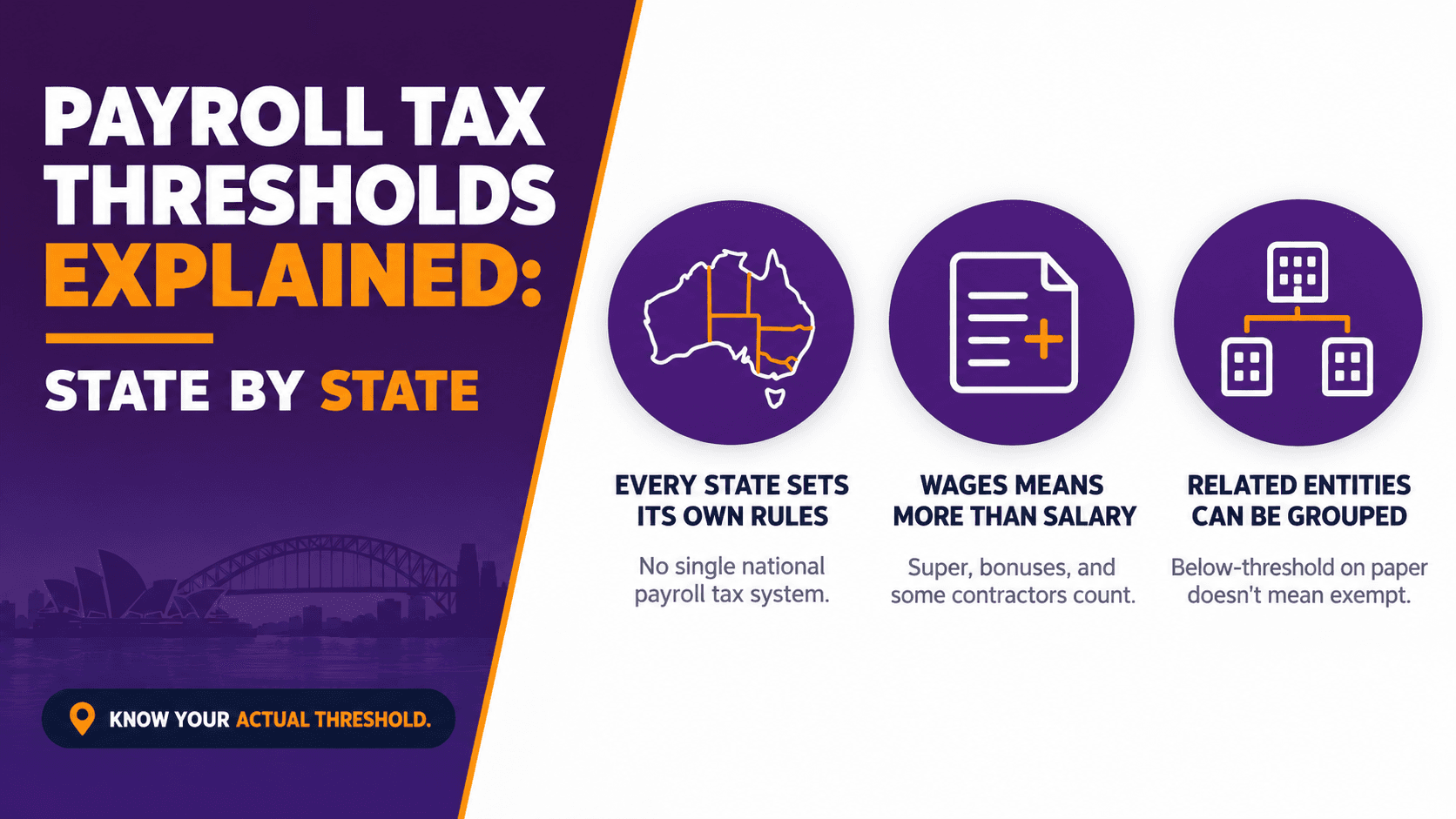
Payroll tax is a state and territory tax, not federal, meaning thresholds, rates, and rules differ across every jurisdiction in Australia.
It applies once a business's total Australian wages exceed a state-specific threshold, and the tax generally applies to wages above that threshold, not the whole wage bill.
Queensland and Victoria are the two most relevant jurisdictions for WIAA's client base, each with its own threshold and rate structure that should be verified directly for the current financial year.
"Wages" for payroll tax purposes is broader than just salary, generally including superannuation, some contractor payments, fringe benefits, and bonuses.
Grouping provisions can combine the wages of related businesses (common ownership or control) for threshold purposes, meaning a business might be liable even if its own individual wage bill sits below the threshold.
Multi-state businesses need to apportion wages and thresholds across each state they operate in, adding real complexity to the calculation.
Rates and thresholds change periodically by state, and figures should always be verified directly with the relevant state revenue office rather than relied on from a prior year.
Bottom line: payroll tax is a state-based tax that catches growing businesses by surprise specifically because it doesn't exist at all below the threshold, and applies in full above it, with the rules varying meaningfully depending on which state or states the business operates in.
On This Page
Why Payroll Tax Catches Businesses Off Guard
How the Threshold and Rate Structure Works
What Actually Counts as "Wages"
Grouping Provisions: When Related Businesses Are Combined
Queensland and Victoria: What WIAA's Clients Need to Know
Worked Example: Crossing the Threshold
Common Mistakes
FAQ
Why Payroll Tax Catches Businesses Off Guard
Unlike income tax, which applies from the first dollar of profit, payroll tax has a threshold-based structure: a business with total wages below the relevant state threshold has no payroll tax obligation at all, while a business that crosses that threshold generally becomes liable on wages above it. This creates a specific risk for growing businesses, a business that's never had to think about payroll tax can cross the threshold through ordinary growth, a new hire, a round of pay rises, or taking on more staff, without necessarily realising registration and lodgement obligations have now been triggered.
Not sure whether your current or projected wage bill is approaching a payroll tax threshold? A free 15-minute chat with WIAA can check your specific position. Call 1800 942 843 or book online.
Bottom line: payroll tax doesn't scale in gradually, it activates as a genuine obligation the moment a threshold is crossed, and ordinary business growth is exactly what tends to trigger it.
How the Threshold and Rate Structure Works
Each state and territory sets its own threshold and rate, meaning the exact figures differ depending on where a business operates. Generally, a business calculates its total Australian wages, compares this against the relevant state's threshold, and if it exceeds that threshold, pays tax at the applicable rate on the wages above that threshold (the specific calculation mechanics, including any deduction or phase-in provisions, vary somewhat by state). Because these thresholds and rates are reviewed and adjusted periodically by each state government, current figures should always be verified directly with the relevant state revenue office (Queensland Revenue Office or the Victorian State Revenue Office, for WIAA's client base) rather than relied on from a prior year.
Bottom line: the threshold and rate are entirely state-specific and periodically updated, meaning a figure that applied last year isn't a safe assumption for this year.
What Actually Counts as "Wages"
For payroll tax purposes, "wages" is generally a broader definition than take-home salary, commonly including:
Gross salary and wages, including overtime and allowances.
Superannuation contributions, including compulsory superannuation guarantee amounts.
Bonuses and commissions.
Fringe benefits, generally grossed up in a manner similar to FBT calculations.
Certain contractor payments, where the relationship is deemed to be sufficiently employee-like under the specific state's rules, even where the contractor holds an ABN.
This broader definition means a business's actual payroll tax wage base can be meaningfully larger than its headline salary expense, particularly once super and contractor arrangements are factored in.
The broader "wages" definition for payroll tax purposes is a common area businesses underestimate. A free 15-minute chat can check what your actual wage base looks like under this definition. Email tax@whatifadvice.com.au or book online.
Bottom line: the payroll tax wage base is generally wider than just salary, and underestimating it by excluding super, bonuses, or certain contractor payments is a common way businesses miscalculate their position.
Grouping Provisions: When Related Businesses Are Combined
Grouping provisions exist across state payroll tax legislation to prevent businesses from artificially splitting operations into multiple smaller entities purely to stay under the individual threshold. Where businesses are related through common ownership, common control, or certain other connections defined by the specific state's legislation, their combined wages can be assessed together for threshold purposes, meaning a business with a wage bill comfortably below the threshold on its own might still be liable if it's grouped with a related business that pushes the combined total over the line.
Running more than one related business entity and not sure how grouping provisions might apply to your combined position? Book a free 15-minute chat online and we'll help you work through it.
Bottom line: threshold assessment isn't always based on a single business in isolation, related businesses can be grouped together, which is a genuinely easy thing to overlook in a multi-entity structure.
Queensland and Victoria: What WIAA's Clients Need to Know
Given WIAA's client base across Brisbane (Toowong and Grange) and Melbourne CBD, both Queensland and Victoria payroll tax regimes are directly relevant, and businesses operating across both states need to apportion wages and assess thresholds separately for each jurisdiction, since a business meeting Queensland's threshold doesn't automatically have the same position in Victoria, and vice versa. Both states periodically review and adjust their specific thresholds, rates, and any regional or industry-specific concessions, which is exactly why current, jurisdiction-specific figures need to be checked directly rather than assumed to match between states or carried over from a previous year.
Bottom line: a Brisbane-based business and a Melbourne-based business are assessed against genuinely different threshold and rate figures, and a business operating in both cities needs a separate calculation for each.
Worked Example: Crossing the Threshold
Marcus runs a growing marketing agency based in Brisbane. For several years, his total Queensland wages sat comfortably below the state's payroll tax threshold, meaning he had no payroll tax obligation at all. Over the past 18 months, he hired three additional staff and gave the existing team a round of pay increases, and his total wage bill (including superannuation and a discretionary bonus round) has now crossed the Queensland threshold.
Marcus hadn't previously registered for payroll tax, since it had never applied to his business before, and only became aware of the obligation when reviewing his finances for a broader business planning conversation. Once registered, he's liable for payroll tax on the portion of his wages above the threshold, calculated at Queensland's applicable rate, going forward from the point the threshold was crossed, and needs to establish ongoing monthly or periodic lodgement as required by the Queensland Revenue Office.
Outcome: ordinary business growth, more staff and higher pay, quietly moved Marcus from having no payroll tax obligation at all to a genuine, ongoing compliance requirement, without any single dramatic change triggering it.
Bottom line: crossing a payroll tax threshold often happens gradually through normal growth, not a single obvious event, which is exactly why it's easy to miss until a review catches it.
Common Mistakes
Assuming payroll tax only applies to large businesses. The threshold can be crossed by a genuinely small business through ordinary hiring and pay growth.
Underestimating the "wages" definition. Superannuation, bonuses, fringe benefits, and certain contractor payments can all form part of the payroll tax wage base.
Not accounting for grouping provisions in a multi-entity structure. Related businesses can be assessed together even if individually below the threshold.
Assuming the same threshold and rate apply across every state. Each state and territory sets its own figures, and a multi-state business needs separate assessments for each.
Relying on last year's threshold or rate figures. These are periodically reviewed and adjusted, and current figures should always be verified directly with the relevant state revenue office.
Ordinary business growth is exactly what tends to trigger a payroll tax obligation, and it's easy to miss until it's already overdue. A free 15-minute chat can check your current position. Call 1800 942 843.
FAQ
Does payroll tax apply to every business with employees? No, only once a business's total wages (as defined for payroll tax purposes) exceed the relevant state's threshold, businesses below that threshold have no payroll tax obligation.
Is payroll tax a federal or state tax? It's a state and territory tax, meaning thresholds, rates, and specific rules differ across every Australian jurisdiction, there's no single national payroll tax system.
Does superannuation count toward my payroll tax wage base? Generally, yes, superannuation guarantee contributions are typically included in the broader "wages" definition used for payroll tax purposes.
Can contractor payments trigger payroll tax? Potentially, yes, where a contractor relationship is deemed sufficiently employee-like under the specific state's rules, even where the contractor holds their own ABN.
What are grouping provisions and how do they affect my business? Grouping provisions can combine the wages of related businesses (common ownership or control) for threshold assessment purposes, meaning a business might be liable even if its own wage bill alone is below the threshold.
Do I need to register separately in each state I operate in? Generally, yes, if a business has wages in multiple states, it typically needs to apportion its wage base and assess its position against each relevant state's specific threshold and rules.
How often do payroll tax thresholds and rates change? This varies by state, but thresholds and rates are periodically reviewed and can be adjusted, so current figures should always be verified with the relevant state revenue office rather than assumed from a prior year.
What happens if I don't realise I've crossed the threshold? Late registration or lodgement can result in penalties and interest, and the state revenue office can identify unregistered liabilities through data matching or audit activity, similar to other state and federal tax compliance risks.
Is payroll tax calculated on the whole wage bill or just the amount above the threshold? Generally on wages above the threshold, though the specific calculation mechanics, including any deduction or phase-in provisions, vary by state and should be confirmed for the relevant jurisdiction.
Can WIAA help me work out my payroll tax position across Queensland and Victoria? Yes, reviewing wage bases and thresholds across both jurisdictions is a common area of support for clients operating in Brisbane and Melbourne.
Ready to Check Your Payroll Tax Position?
If your business has grown through hiring or pay increases, it's worth checking whether you've crossed a payroll tax threshold you didn't know existed. A free 15-minute chat can review your current position.
Call us: 1800 942 843
Email: tax@whatifadvice.com.au
Book online: free 15-minute chat, no cost, no pressure
Still asking what if.
WIAA has helped Queensland and Victorian businesses stay ahead of payroll tax obligations as they grow, across Toowong, Grange, and Melbourne CBD. WIAA operates under AFSL 528250 as an Authorised Representative of Beryllium Advisers Pty Ltd.
General Advice Disclaimer: This article contains general information only and does not take into account your personal objectives, financial situation, or needs. It is not personal financial, tax, or legal advice and should not be relied upon as such. Payroll tax thresholds, rates, and grouping provisions differ by state and territory and are subject to change, and should be verified directly with the relevant state revenue office for your specific circumstances.