Looking for specific financial advice?
This blog provides general educational content. For personalized advice tailored to your unique situation, book a free consultation with our team of ASIC-licensed financial advisers.
Personal Services Income Rules: Are You Actually Running a Business?
A lot of Australians who work for themselves assume that operating through a company or trust gives them automatic flexibility over how their income is treated for tax purposes. The Personal Services Income (PSI) rules exist specifically to test that assumption.
PSI legislation targets a straightforward situation: an individual earning income primarily through their own skills and effort, who then routes that income through a business structure to access deductions or split income with associates. If the income is genuinely personal services income and the business does not pass the ATO's tests, the tax concessions that come with a business structure largely disappear.
The PSI rules do not apply to every contractor or consultant. Many sole traders, companies, and trusts are completely unaffected. But getting the classification wrong, in either direction, creates real compliance risk. Claiming deductions you are not entitled to is a common ATO audit trigger. Incorrectly concluding PSI rules apply when they do not means paying more tax than necessary.
This guide explains what PSI is, how the tests work, what the 80% rule means in practice, and what changes when the PSI rules apply to your income.
TL;DR: The Key Points
Here is the short version before you get into the detail:
PSI is income that is mainly a reward for an individual's personal effort or skills, regardless of what business structure receives it
PSI rules can apply to sole traders, companies, partnerships, and trusts equally
If PSI rules apply, income is attributed to the individual and certain deductions are disallowed
To escape PSI rules, a business must qualify as a Personal Services Business (PSB) by passing one of four tests
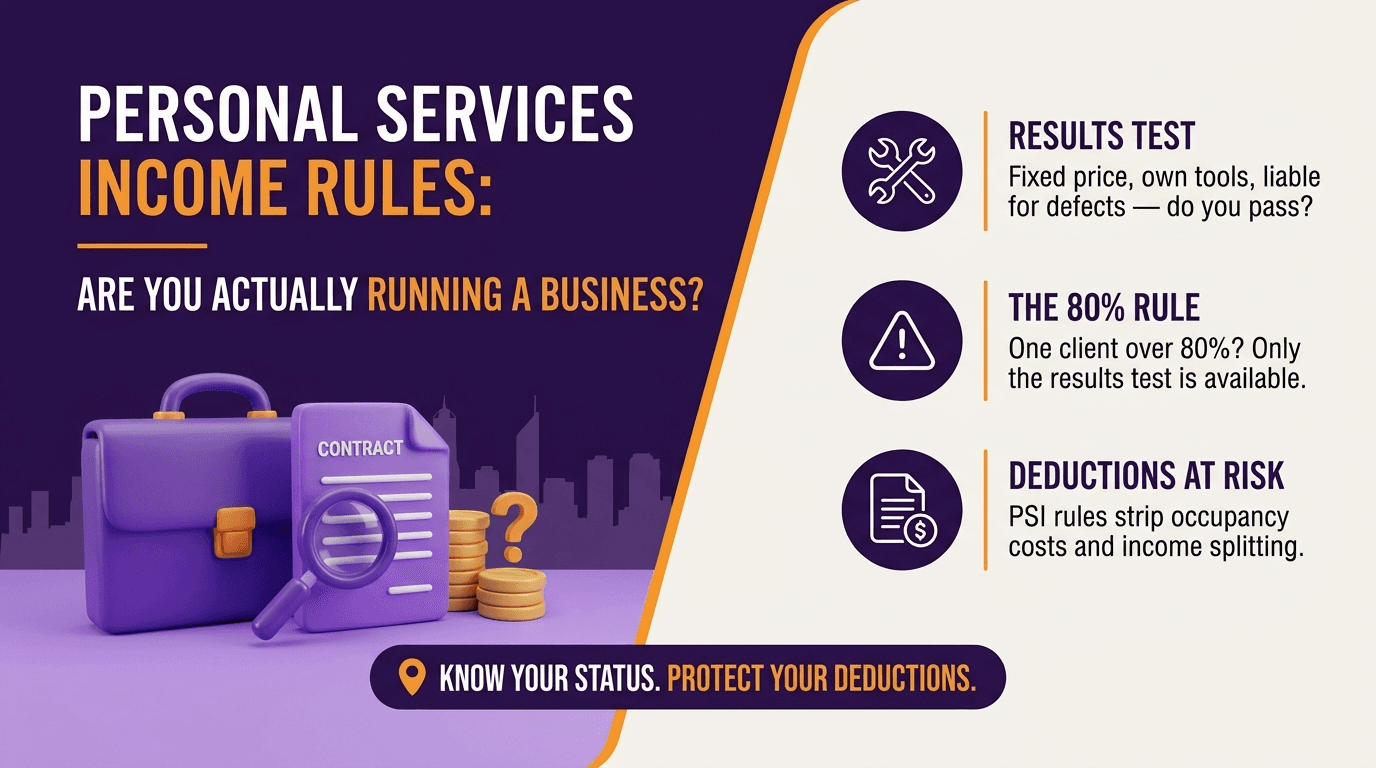
The results test is the most reliable: 75% or more of PSI from contracts where work produces a result, your own tools are used, and you are liable for defects
The 80% rule restricts which tests you can rely on if most of your income comes from a single client
Income splitting with associates through a company or trust is specifically prohibited where PSI rules apply
An ATO Personal Services Business determination can provide certainty where the tests are unclear
Getting this wrong in either direction has real tax consequences
Jump to a Section
What Is Personal Services Income?
Does It Matter What Structure You Use?
The Four PSB Tests Explained
The 80% Rule: When Your Options Narrow
What Happens When PSI Rules Apply?
Deductions You Lose Under PSI Rules
The ATO's PSB Determination
Common Scenarios and How the Rules Apply
Common Mistakes People Make
FAQ
What Is Personal Services Income?
Personal Services Income is income that is earned mainly as a reward for an individual's personal efforts or skills. The ATO looks at the substance of what is generating the income, not the label on the invoice or the entity receiving the payment.
The test is whether more than 50% of the income from a contract relates to the individual's personal efforts or skills. If it does, that income is PSI.
Common examples of work that typically produces PSI:
IT contractors and developers engaged by one client on a project basis
Engineers, architects, and technical specialists operating through a company or trust
Management consultants and business advisers billing through a personal entity
Freelance designers, writers, and creative professionals
Tradespeople operating through a company where their personal work generates the revenue
PSI does not include income from genuinely business-like activity where the income is more attributable to the business assets, systems, or risk rather than the individual's personal effort. A cleaning business that employs a team of cleaners and where the owner manages rather than personally performs the work is less likely to generate PSI than a sole practitioner cleaning contractor doing all the work personally.
The PSI assessment is always about the substance of the income, not the form of the arrangement.
Bottom line: If your income is primarily a reward for what you personally do rather than what your business infrastructure delivers, the PSI rules are relevant to you regardless of whether you operate as a sole trader, company, or trust.
Does It Matter What Structure You Use?
Yes, in terms of the tax consequences. No, in terms of whether the rules apply.
This is the part most people get wrong. Many contractors and consultants assume that operating through a company or trust means PSI rules do not apply. That assumption is incorrect.
The ATO's PSI framework applies to income that is PSI regardless of the entity that receives it. If a contractor operates through a company and all the income is generated by their personal effort, the PSI rules can still apply to that company's income. The income is attributed back to the individual as if the company or trust did not exist, for the purposes of determining the tax treatment.
Where the PSI rules do apply, the primary consequences are:
Income is assessed to the individual, not the entity
The ability to split income with a spouse, family members, or associates through the entity is removed
Certain deductions the entity might otherwise claim are disallowed
Where the PSI rules do not apply, because the business qualifies as a Personal Services Business, the entity's income is taxed in the normal way and the usual flexibility around deductions and income distribution within the entity applies.
The structure matters for what is at stake. Whether PSI rules apply depends entirely on the nature of the income and whether the PSB tests are passed.
What if the company or trust you set up to receive your contracting income is providing less tax protection than you assumed? The PSI rules are specifically designed for that situation.
The Four PSB Tests Explained
If income qualifies as PSI, the next question is whether the individual or entity qualifies as a Personal Services Business. A PSB is not subject to the PSI attribution rules. Qualifying as a PSB means the income can be taxed in the entity normally, with the full range of business deductions available.
There are four tests. Passing any one of them (subject to the 80% rule discussed below) qualifies the business as a PSB for that income year.
The results test. The results test is the most straightforward and the most commonly relied upon. To pass it, 75% or more of PSI must come from contracts where all three of the following are true:
The work is done to produce a result, not simply to make the individual available
The individual provides their own tools and equipment needed to produce the result
The individual is liable to fix defects at their own cost if the work is not done correctly
The results test reflects genuine business risk. A contractor who quotes on a project, delivers a defined outcome, uses their own equipment, and wears the cost of fixing mistakes is behaving more like a business than an employee. The test is designed to identify that behaviour.
What typically passes: a software developer who quotes fixed-price projects, uses their own computer and tools, and is contractually responsible for defects in their code. A building designer who delivers drawings on completion of the project and must redo defective work without additional charge.
What typically fails: a contractor engaged on an hourly or daily rate to make themselves available at a client's site, using client-supplied equipment, where the client bears the risk of unsatisfactory work. This arrangement looks like employment, not a results-based business.
The unrelated clients test. To pass the unrelated clients test, PSI must come from two or more unrelated clients (unrelated to each other and to the individual), and the clients must have been obtained through public advertising or canvassing.
This test reflects the idea that a genuine business markets itself and serves a range of clients, whereas an employee-equivalent contractor is typically engaged by one principal and has not obtained that engagement through independent business activity.
Key conditions:
The clients must be genuinely unrelated: a contractor billing two entities controlled by the same person does not pass this test
The clients must have been obtained as a result of advertising to the public or actively seeking business, not through a recruitment agency placing the individual with one end client
The test looks at the whole income year
The employment test. The employment test is passed where the individual's business employs one or more workers who perform at least 20% of the entity's principal work during the income year.
This test recognises that a genuine business typically has people other than the principal doing the core work. Where an individual has employed staff or engaged subcontractors who perform a material share of the income-producing work, the arrangement is more consistent with a business than a personal services arrangement.
The 20% threshold is measured by reference to the principal work of the business, not ancillary activities. Administrative support or bookkeeping does not count toward the 20%.
The business premises test. The business premises test is passed where the individual maintains business premises that are:
Used exclusively or primarily for the individual's income-producing activities
Separate from any private residence of the individual and their associates
Separate from any premises of the client where the individual performs the work
A dedicated office or commercial workspace that the individual leases and uses solely for their business, not a home office or a client's workplace, is the target of this test.
In practice, the business premises test is the hardest to satisfy. Most contractors and consultants either work from home or at their client's site. A genuine separate commercial premises is not the norm for individual service providers.
Bottom line: The results test is the most useful for most contractors and consultants. If your work is project-based, you use your own tools, and you bear the risk of defects, you have a strong basis for passing it. If your arrangements look more like employment, the other three tests are harder to satisfy.
Unsure which PSB tests your contracting or consulting arrangements pass? The registered tax agents at What If Advice can review your contracts and income structure and give you a clear answer. Call 1800 942 843 or email tax@whatifadvice.com.au.
The 80% Rule: When Your Options Narrow
The 80% rule is the most significant constraint on the PSB tests and the one that most frequently catches contractors off guard.
If 80% or more of your PSI in an income year comes from a single client (or from one client and their associates), you can only qualify as a PSB by passing the results test. The unrelated clients test, the employment test, and the business premises test are all unavailable.
This matters enormously in practice. The majority of contractors and consultants who operate through a company or trust tend to work predominantly for one client at a time. If that client represents 80% or more of their PSI in the year, their ability to qualify as a PSB rests entirely on whether the results test is satisfied.
If the 80% threshold is triggered and the results test is also failed, the entity does not qualify as a PSB and the PSI rules apply in full.
The 80% calculation includes clients associated with the primary client. If a contractor bills $150,000 to Company A and $30,000 to Company B, and Company B is a subsidiary of Company A, the combined amount ($180,000) is treated as coming from a single source. The practical effect of the associated entity rules is that the 80% threshold is easier to trigger than it first appears.
Doing the mental math right now on whether you're sitting at or over 80% with one client? That calculation, including whether a second client actually counts as separate under the associated entity rules, is exactly what the registered tax agents at What If Advice can run for you before it becomes an ATO question instead of yours. Call 1800 942 843 or email tax@whatifadvice.com.au.
What Happens When PSI Rules Apply?
Where PSI rules apply and the business does not qualify as a PSB, the consequences are specific and significant.
Income attribution. The PSI is attributed to the individual, not the entity. Even if the income was received by a company or trust, it is treated as the individual's assessable income for that year. The individual pays income tax at their personal marginal rate.
Income splitting is prohibited. The PSI rules specifically prevent splitting PSI with associates through a company or trust. A consultant operating through a family trust cannot distribute PSI to a spouse on a lower marginal rate. A contractor operating through a company cannot pay a spouse a salary from the PSI proceeds to shift income to a lower bracket. The income belongs to the individual for tax purposes and must be assessed accordingly.
The entity's obligations. Where income is attributed to the individual from a company or trust that received the PSI, the entity has withholding and payment obligations. The rules require the entity to pay the attributed amount to the individual and withhold tax accordingly, as if the individual had received the income directly.
Bottom line: PSI attribution removes the primary tax advantage of using a company or trust structure for personal services income. Where the rules apply, the structure adds cost and complexity without the income tax benefit.
Deductions You Lose Under PSI Rules
Where PSI rules apply, certain deductions that would otherwise be available to a business entity are disallowed. These are the deductions that reflect genuine business activity, and the ATO's position is that an individual earning PSI is not entitled to claim them in the same way as a genuine business.
Deductions that are not available where PSI rules apply:
Rent, mortgage interest, rates, and land tax on premises used to generate PSI (whether home or other premises)
Payments to associates for work not directly related to generating the PSI
Superannuation contributions for associates, such as a spouse who does administrative work, unless those contributions relate to work directly involved in producing the PSI
Any other payment to an associate that would not be deductible if the individual were an employee
Deductions that remain available under PSI rules:
Deductions that an employee in the same role could claim, such as work-related tools, professional subscriptions, and self-education costs related to the income-producing activity
Superannuation contributions for the individual themselves
Deductions directly related to producing the PSI, such as materials required for a specific project
The practical effect is that the PSI rules strip out the deductions that make a business structure attractive and leave the individual with roughly the deduction profile of an employee. Combined with income attribution, this substantially removes the tax advantage of operating through an entity where PSI rules apply.
The ATO's PSB Determination
Where it is genuinely unclear whether a business passes the PSB tests, the ATO offers a formal determination process. An individual or entity can apply to the ATO for a Personal Services Business determination, which is a formal ruling on whether the PSB tests are satisfied.
A positive determination provides protection against the PSI rules applying for the period covered by the determination. It gives certainty where the facts might otherwise be arguable.
The determination process requires a full application setting out the business's arrangements, contracts, client relationships, and how they satisfy the relevant tests. It is not a rubber stamp. The ATO assesses the facts against the tests and issues a binding determination.
A determination is worth considering where:
The results test outcome is arguable based on the terms of the contracts
The unrelated clients test is borderline due to the number or relationship of clients
The 80% threshold is close and the available tests are limited
There is significant tax at stake and certainty is worth the cost of the application process
The determination is forward-looking. It does not resolve historic years where the PSI rules may already have applied incorrectly. For past years, a voluntary disclosure or amended return process is the appropriate path.
Common Scenarios and How the Rules Apply
IT contractor through a company, one client. A software developer operates through a company. Their sole client is a large corporation. They work on-site, using the client's equipment, on an hourly rate. The client absorbs the risk of any defects.
Analysis: PSI rules apply. The income is PSI. The 80% rule applies (one client, 100% of income). The results test is the only available test. The developer does not pass the results test because the client provides the tools and bears the defect risk. Income is attributed to the individual.
Management consultant, fixed-price projects, multiple clients. A management consultant operates through a trust. They work on discrete fixed-price engagements, use their own tools and software, and are contractually liable for defective deliverables. They have four unrelated clients in the year, no single client representing more than 50% of income.
Analysis: PSB status confirmed, PSI rules do not apply. The income is PSI. The 80% rule does not apply. The results test is likely satisfied: fixed price, own tools, defect liability. Even without the results test, the unrelated clients test is also satisfied. Income can be distributed through the trust in the normal way.
Trades contractor, one builder client, own tools, defect liability. A carpenter operates through a company. They work exclusively for one building company. They use their own tools, quote on sections of projects at a fixed price, and are required to fix defects at their own cost.
Analysis: PSB status confirmed, PSI rules do not apply. The income is PSI. The 80% rule applies. The results test is the only available test. Based on own tools, fixed pricing, and defect liability, the results test is likely satisfied.
The facts matter. Two contractors in apparently similar situations can reach different conclusions based on the precise terms of their contracts. The results test is fact-specific and the details of each engagement determine the outcome.
Common Mistakes People Make
Assuming the company or trust structure automatically excludes PSI rules. The structure is irrelevant to whether PSI rules apply. Income is assessed based on the nature of the income and whether the PSB tests are passed, not the entity type.
Not applying the 80% rule to associated clients. A contractor who bills two companies believing they have multiple unrelated clients may be triggering the 80% rule if the two companies are related. The associated entity definition is broader than most people expect.
Splitting income with a spouse through a company or trust where PSI rules apply. This is specifically prohibited under PSI legislation and is one of the most common errors the ATO identifies in contractor compliance reviews.
Claiming home office occupancy costs where PSI rules apply. Rent, mortgage interest, and rates on home premises are not deductible where PSI rules apply. Claiming them anyway creates an overstated deduction that the ATO can reverse on audit.
Relying on the results test without reviewing the actual contract terms. The results test depends on the contractual reality, not the preference of the contractor. A contract that places defect risk with the client, or requires the contractor to use client-supplied tools, fails the results test regardless of how the contractor describes the arrangement.
Not seeking an ATO determination where the tests are genuinely uncertain. Operating in a grey zone without a determination means the ATO can assess historic years with interest and potentially penalties if they disagree with the position taken.
Mixing PSI and non-PSI income without keeping them separate. Where an individual has some PSI and some genuine business income, the two must be assessed separately. PSI rules apply only to the PSI component. Blending the two creates accounting and compliance complexity.
What if the tax return your accountant has been lodging for the past three years includes deductions that the PSI rules disallow? The ATO can amend assessments and apply interest. Understanding your position now is considerably less expensive than correcting it later.
Recognise your own arrangement somewhere on that list? The registered tax agents at What If Advice can check your contracts and past returns against these exact mistakes before the ATO does it for you. Call 1800 942 843 or email tax@whatifadvice.com.au.
FAQ
What is Personal Services Income?
PSI is income that is mainly a reward for an individual's personal effort or skills. More than 50% of the income from a contract must relate to the individual's personal efforts or skills for it to be PSI. It applies regardless of the structure through which the income is received. A company, trust, or sole trader arrangement can all generate PSI.
What is the actual difference between PSI and running a genuine small business?
The difference is what is actually generating the income. A genuine small business earns income from its assets, systems, staff, or brand as much as from any one person's personal effort, so no individual's personal work is the dominant source of the revenue. PSI is the opposite: the income exists because a specific person personally did the work, and it would not have been earned without them. A sole consultant billing for their own time and expertise is the clearest PSI case. A business with staff, equipment, and clients that would keep generating revenue even if the owner took a month off looks far more like a genuine business. The PSB tests exist to draw that line with more precision than "does it feel like a business."
Does PSI apply to sole traders?
Yes. PSI rules apply to sole traders as well as entities. For a sole trader, the practical consequences are less significant because there is no separate entity to attribute income back through. The main impact for sole traders is the disallowance of certain deductions, particularly occupancy costs for home premises used to generate PSI.
Can I split PSI income with my spouse through a trust or company?
No. Where PSI rules apply, distributing PSI to associates through a company or trust is specifically prohibited. The income must be assessed to the individual who earned it. This prohibition is one of the primary targets of PSI legislation and is actively enforced by the ATO.
What is the 80% rule in PSI?
The 80% rule applies where 80% or more of an individual's PSI in an income year comes from a single client or a client and their associates. When the 80% rule applies, only the results test can be used to qualify as a PSB. The unrelated clients test, employment test, and business premises test are all unavailable, regardless of whether they would otherwise be satisfied.
What is the results test?
The results test is satisfied where 75% or more of PSI comes from contracts that meet all three criteria: the work is done to produce a result, the individual supplies their own tools and equipment, and the individual is liable to fix defects at their own cost. It is the most commonly relied upon PSB test and the only one available where the 80% rule applies.
What deductions do I lose if PSI rules apply?
Deductions that are disallowed include occupancy costs such as rent, mortgage interest, rates, and land tax on premises used for PSI work, payments to associates for work not directly related to producing the PSI, and superannuation contributions for associates in non-income-producing roles. Deductions available to an equivalent employee, such as work-related tools and professional memberships, remain deductible.
Can I get certainty from the ATO about whether PSI rules apply to me?
Yes. You can apply to the ATO for a Personal Services Business determination. A positive determination provides formal confirmation that the PSB tests are satisfied and protects against the PSI rules applying for the period covered. The determination process requires a detailed application and assessment by the ATO. It is worth considering where the tests are genuinely arguable and the tax at stake is material.
How much does a PSB determination cost and how long does it take?
The ATO does not charge a fee to lodge a Personal Services Business determination application, but preparing it properly, including gathering contracts, client history, and evidence against the relevant tests, takes real time and is usually done with a registered tax agent, which carries its own professional cost. Processing times vary depending on the complexity of the arrangement and how clear-cut the evidence is, and can extend to several weeks or longer where the facts are genuinely arguable. Given the determination is forward-looking and cannot fix past years, timing the application well ahead of when certainty is actually needed matters more than most applicants expect.
Do PSI rules affect superannuation contributions?
The individual can still make superannuation guarantee contributions for themselves where PSI rules apply. Contributions for associates, such as a spouse doing administrative work, are disallowed to the extent they relate to non-income-producing activity. Contributions for genuine employees of the entity, where the employment test is met, are deductible in the normal way.
Can my arrangement change from year to year?
Yes. PSI status is assessed each income year based on the facts of that year. A contractor who passes the results test in one year because they have a fixed-price contract with defect liability may fail it the next year if their engagement terms change to an hourly rate. PSI status should be reviewed each year, particularly where client arrangements, contract terms, or the proportion of income from different clients changes.
What should I do if I think PSI rules have been applied incorrectly in past years?
Seek advice from a registered tax agent. If PSI rules should have applied and were not, deductions may have been overclaimed and income may have been incorrectly distributed. If PSI rules were applied when they should not have been, deductions may have been unnecessarily forgone. Both situations can be corrected through amended returns or voluntary disclosure, with advice on the best approach for your specific circumstances.
Not sure whether the PSI rules apply to your contracting or consulting arrangements?
Getting this wrong creates real exposure. Overclaiming deductions and incorrectly splitting PSI income are among the ATO's most common contractor audit targets. Getting it right, with a clear view of which PSB tests you satisfy and what deductions you are entitled to, is a straightforward conversation with the right adviser.
The registered tax agents at What If Advice work with contractors, consultants, and business owners across Brisbane and Melbourne to assess PSI status, review contract terms, and ensure income and deductions are reported correctly.
Call 1800 942 843 or email tax@whatifadvice.com.au to book a review.
Still asking what if about whether your business structure is actually protecting you? That is exactly the right question. The answer depends on your contracts, your client mix, and your income sources. The team at What If Advice can work through it with you.
General Advice Disclaimer: This information is general in nature and does not take into account your personal financial situation, needs, or objectives. PSI rules are complex and highly fact-specific. The application of the PSB tests depends on the precise terms of your contracts and income arrangements. You should seek advice from a registered tax agent before making any decisions about your business structure or PSI status. What If Advice Accounting Pty Ltd is a registered tax agent.