Looking for specific financial advice?
This blog provides general educational content. For personalized advice tailored to your unique situation, book a free consultation with our team of ASIC-licensed financial advisers.
What If the Government Would Pay Back Over 40 Cents of Every Dollar You Spend on Real Innovation?
A small company spending $300,000 on eligible R&D could receive a cash refund of around $130,500 through the R&D Tax Incentive, even in a year when it’s making a loss. For a startup burning cash on a new product, that can be the difference between another hiring round and running out of runway. But the incentive only rewards genuine experimental work. It has strict registration deadlines, and it’s an area the ATO and industry regulators review closely. The rules are also mid-reform, with major changes proposed in the 2026-27 Budget.
TL;DR
The RDTI is a tax offset for eligible R&D spending, available to companies, not sole traders or most trusts.
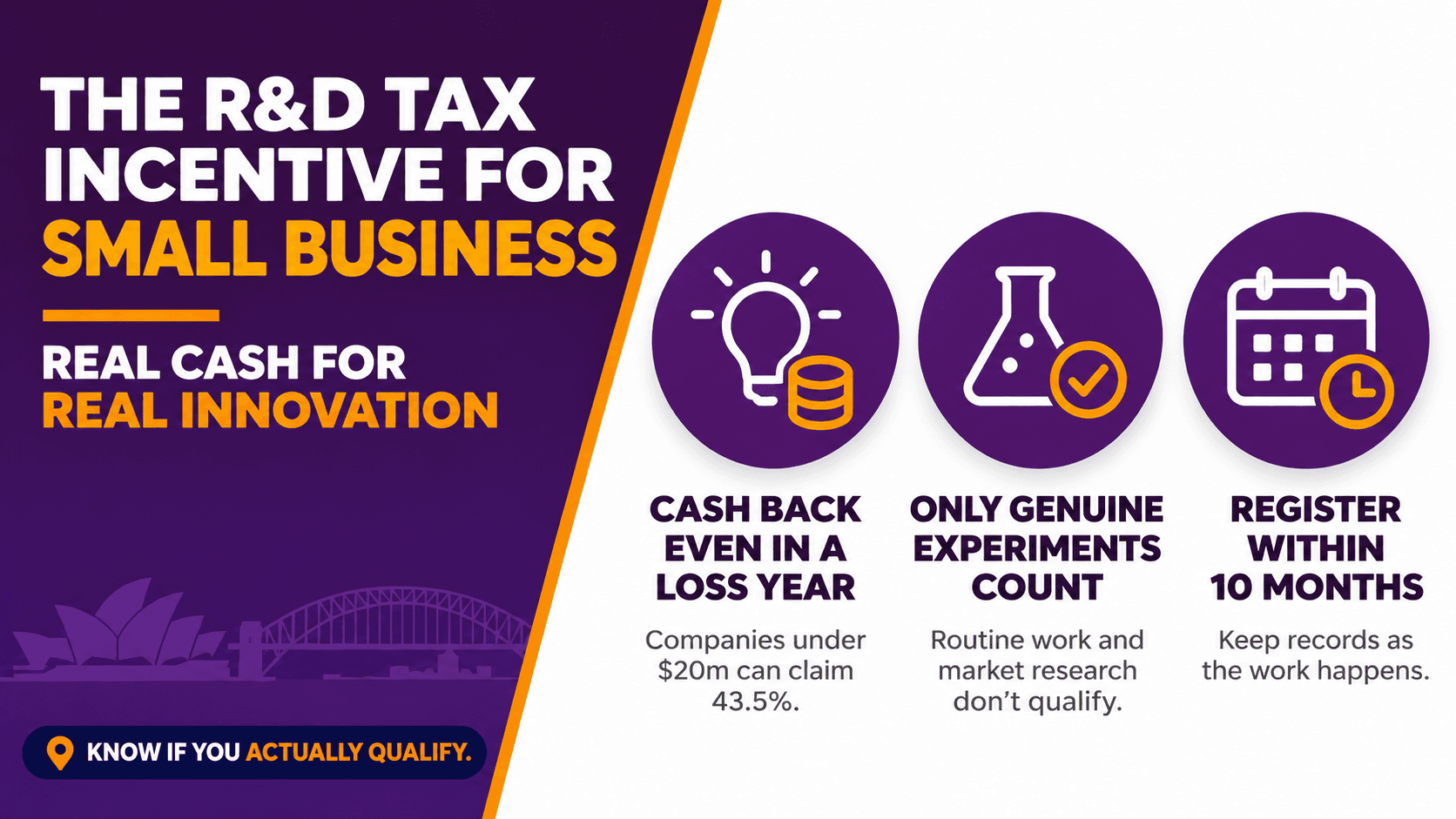
Small companies (aggregated turnover under $20 million) can generally claim a refundable offset of their corporate tax rate plus 18.5%. For a 25% base rate entity, that’s 43.5%.
The real benefit is the premium above the normal deduction. That’s about 18.5 cents per eligible dollar for a profitable base rate entity, plus cash upfront if the company is in a loss.
Only genuine experimental activity counts as core R&D, where the outcome can’t be known in advance and a systematic, hypothesis-driven approach is used.
You must register your R&D activities, generally within 10 months after the end of the income year, before claiming in your company tax return.
Contemporaneous records are essential. Claims without evidence of the experimental process are vulnerable on review.
The 2026-27 Budget proposed major changes, including a $50 million refundable threshold and higher rates, but also removing supporting R&D and limiting refundability by company age. These are announced but not yet legislated.
Bottom line: the RDTI can deliver a substantial cash benefit to small innovative companies, but only for genuine R&D that’s registered on time and properly documented.
On This Page
What the R&D Tax Incentive Actually Is
Who Can Claim (and Who Can’t)
What Counts as R&D, and What Doesn’t
How the Offset Works: The Real Value Is the Premium
Refundable vs Non-Refundable Offsets
Registration, Deadlines, and Records
Proposed Changes From the 2026-27 Budget
Red Flags: Promoters and Overclaiming
Worked Example 1: A Brisbane Software Startup in a Loss Year
Worked Example 2: A Growing Manufacturer and the Proposed Changes
Common Mistakes
FAQ
What the R&D Tax Incentive Actually Is
The RDTI is a government program, jointly administered by the ATO and the Department of Industry, Science and Resources, that encourages companies to invest in research and development. Instead of claiming a normal tax deduction for eligible R&D spending, a company claims a tax offset at a higher rate.
For smaller companies, the offset can be refundable. If the offset is bigger than the company’s tax bill, the difference can be paid out in cash. That’s why the RDTI matters so much to startups and early-stage businesses that aren’t yet profitable.
Bottom line: the RDTI swaps a normal deduction for a more generous offset, and for small companies it can turn R&D spending into a cash refund.
Who Can Claim (and Who Can’t)
Generally eligible:
Companies incorporated in Australia.
Certain foreign companies that are Australian residents for tax, or that carry on business through a permanent establishment in Australia.
Generally not eligible:
Sole traders
Partnerships
Most trusts, including family and discretionary trusts. Some public trading trusts are treated as companies for tax and may be an exception.
Other requirements:
Minimum spend. A minimum of $20,000 on eligible R&D in the income year generally applies, unless the work is done through a registered Research Service Provider, a Cooperative Research Centre, or certain other arrangements.
Excluded industries. Legislation that received Royal Assent on 30 June 2026 excludes gambling, gambling-like practices, tobacco, and nicotine-related activities from the RDTI. It applies to income years starting on or after 1 July 2025, so it already affects 2025-26 claims being prepared now. Unlike other excluded activities, these can’t qualify as supporting R&D either. Activities carried out solely for harm minimisation are carved out.
If your business operates through a trust and is planning significant R&D, the structure question matters before the spending starts. Our Best Business Structure in Australia guide covers the trade-offs.
Not sure whether your business structure can access the R&D Tax Incentive? Email tax@whatifadvice.com.au for a free 15-minute chat.
Bottom line: if your business isn’t a company, you generally can’t claim the RDTI, however innovative the work.
What Counts as R&D, and What Doesn’t
The RDTI currently recognises two kinds of activities.
Core R&D activities are experimental activities that meet three conditions:
The outcome can’t be known or determined in advance, based on current knowledge, information, or experience available to a competent professional.
They follow a systematic progression of work: hypothesis, experiment, observation and evaluation, then logical conclusions.
They’re conducted to generate new knowledge, including new or improved materials, products, devices, processes, or services.
Supporting R&D activities are directly related to core activities. Some must be undertaken for the dominant purpose of supporting the core R&D to qualify. The 2026-27 Budget proposes removing this category altogether (see below).
Generally excluded from core R&D:
Market research, market testing, and sales promotion.
Routine testing and quality control.
Prospecting and exploration for minerals.
Management studies and efficiency surveys.
Developing, modifying, or customising software mainly for your own internal administration.
Activities for complying with statutory requirements.
Reproducing an existing product or process.
The common grey area is software. Building a product that applies known technology in a new market isn’t R&D just because it’s new to you. Solving a genuine technical uncertainty that existing knowledge can’t answer might be.
Bottom line: if a competent professional could have worked out the answer without experimenting, it’s generally not core R&D, however hard the work was.
How the Offset Works: The Real Value Is the Premium
Under current rules, the offset for small companies (aggregated turnover under $20 million) is generally:
Company tax rate | Refundable R&D offset | Normal deduction value | Net benefit per $1 of eligible R&D |
25% (base rate entity) | 43.5% | 25% | 18.5 cents |
30% | 48.5% | 30% | 18.5 cents |
The premium is the real benefit. Without the RDTI, the R&D spending would generally be deductible anyway. So for a profitable base rate entity, the incentive is worth about 18.5 cents per eligible dollar above the normal deduction.
For a loss-making company the picture changes. A normal deduction just adds to carried-forward tax losses, which only help once the company becomes profitable. The refundable offset can instead be paid out as cash in the current year.
Grants or government funding received for the same R&D, and amounts paid to associates, can reduce or claw back part of the offset. Rates and thresholds can change, so verify the current figures with the ATO and the Department of Industry, Science and Resources.
Bottom line: for profitable companies the RDTI is a premium on top of a deduction they’d already get, and for loss-making companies it can be cash now instead of a loss carried forward.
Refundable vs Non-Refundable Offsets
Refundable offset | Non-refundable offset | |
Who generally gets it (current rules) | Aggregated turnover under $20m | Aggregated turnover of $20m or more |
Current rate | Company tax rate + 18.5% | Company tax rate + 8.5%, or + 16.5% for R&D intensity above 2% |
If the offset exceeds tax payable | Excess can be refunded in cash | Excess can generally be carried forward |
Most useful for | Startups and loss-making companies | Profitable larger companies |
R&D intensity is the company’s eligible R&D spending as a share of its total expenses. Higher intensity attracts a higher premium for non-refundable claimants. Eligible R&D spending above the maximum threshold (currently $150 million a year) doesn’t attract the premium.
Planning R&D spending this year and want to estimate the offset? Our tax team can help you model it. Call 1800 942 843 or book online.
Bottom line: refundability is the headline benefit for small companies, because it pays cash even when there’s no tax bill to offset.
Registration, Deadlines, and Records
1. Register first. Companies must register their R&D activities with the Department of Industry, Science and Resources, generally within 10 months after the end of the income year. For a 30 June year-end, that’s generally 30 April of the following year. Late registration can mean losing the offset for that year.
2. Claim in the company tax return. Once registered, the company claims the offset through its tax return, with the R&D tax incentive schedule.
3. Keep contemporaneous records. Records made at the time the work happened, not reconstructed later, are critical. They should include:
Hypotheses and technical uncertainties.
Experiment design, testing, results, and conclusions.
Timesheets for staff working on R&D.
Invoices and expense records linked to specific R&D activities.
Evidence that existing knowledge couldn’t resolve the uncertainty.
Both the ATO and the Department can review claims. Registration doesn’t mean the activities have been accepted as eligible, so a claim can be challenged after it’s paid. Deadlines and processes can change, so verify current requirements before relying on these dates.
Bottom line: register on time and document as you go, because a claim is only as strong as the records behind it.
Proposed Changes From the 2026-27 Budget
These changes are announced but not yet legislated. Do not treat them as certain.
The measures are part of the tax reform package announced in the 2026-27 Budget, and are the first stage of the government’s response to the Ambitious Australia: Strategic Examination of Research and Development report. Exposure draft legislation was released for consultation, and submissions to Treasury closed on 28 September 2026. Changes are possible before the measures are introduced.
Key proposals:
Supporting R&D removed. Supporting activities would no longer be eligible unless they independently meet the definition of a core R&D activity. This is arguably the most significant change.
Refundable turnover threshold: would increase from $20 million to $50 million.
Refundable offset rate: the premium would rise from 18.5% to 23% above the corporate tax rate.
Non-refundable offset rates: the base premium would increase from 8.5% to 13%, and the higher intensity premium from 16.5% to 21%. The intensity threshold for the higher premium would fall from 2% to 1.5% of total expenses.
Refundability limited by company age: the refundable offset would generally be limited to the first 10 years after the company starts carrying on its enterprise or first registers for the RDTI. Eligible companies doing R&D related to therapeutic goods would get up to 15 years. Companies below the $50 million threshold that fall outside those windows would keep the highest rate, but on a non-refundable basis.
Expenditure thresholds: the minimum R&D spend would rise from $20,000 to $50,000, and the maximum threshold from $150 million to $200 million.
Commencement: proposed for income years starting on or after 1 July 2028, subject to legislation. The removal of supporting R&D is designed not to apply retrospectively to supporting activities from earlier years.
Bottom line: the proposed changes could help some small companies and hurt others, especially those with significant supporting activity, and none of them apply until they’re legislated, so plan for flexibility rather than certainty.
Red Flags: Promoters and Overclaiming
The R&D space attracts aggressive promoters, and regulators are watching. The government has said the ATO will undertake additional targeted compliance activity over the two years from 2026-27 to address fraud in the system, including in relation to the RDTI. The ATO has also flagged warning signs such as cold calls from tax professionals claiming they can increase the offset, with no verification of facts or examination of records.
Be cautious of anyone who:
Promises a specific refund before understanding your activities.
Charges a large percentage of the refund as a fee without reviewing your records.
Suggests reclassifying ordinary business activities as R&D.
Doesn’t ask for evidence of experimentation.
If a claim is later found ineligible, the company generally has to repay the offset, and penalties and interest may apply.
Been approached about an R&D claim and want a second opinion? WIAA’s tax team can review it independently. Email tax@whatifadvice.com.au for a free 15-minute chat.
Bottom line: a legitimate R&D claim starts with your evidence, not a promised refund figure.
Worked Example 1: A Brisbane Software Startup in a Loss Year
Lumen Labs Pty Ltd is a three-year-old Brisbane software company with turnover of $1.2 million. It’s a 25% base rate entity and is in a tax loss this year. It spends $300,000 on registered, eligible R&D to solve a genuine technical problem in real-time data compression that existing methods couldn’t resolve.
Without the RDTI | With the RDTI (refundable) | |
Treatment of $300,000 | Normal deduction, adding to the tax loss | Refundable offset at 43.5% |
Benefit | $75,000 in future tax savings, only once profitable | $130,500 potentially payable in cash this year |
Timing | Uncertain, future years | After lodgement and processing |
Outcome: the refundable offset could give Lumen Labs $130,500 in cash to reinvest, instead of a carried-forward loss worth $75,000 at some uncertain point in the future. The deduction-equivalent part ($75,000) is replaced by the offset, so the true premium is $55,500. The cash timing is what makes the difference for a startup. Adviser fees, any grants for the same work, and the integrity of its records would all affect the final result. At three years old, Lumen would sit comfortably inside the proposed 10-year refundability window if the changes proceed. These figures are simplified and illustrative only.
Bottom line: for a loss-making startup, the RDTI’s value is as much about cash timing as about the extra 18.5%.
Worked Example 2: A Growing Manufacturer and the Proposed Changes
Ironbark Fabrication Pty Ltd is 14 years old, has aggregated turnover of $30 million, and is a 25% base rate entity. It spends $400,000 on eligible R&D developing a new welding process, with R&D intensity below 1.5%. It has tax payable this year.
Current rules | Proposed rules (all $400,000 still eligible) | Proposed rules ($100,000 of it is supporting R&D) | |
Offset type | Non-refundable | Non-refundable (outside 10-year window) | Non-refundable (outside 10-year window) |
Eligible R&D | $400,000 | $400,000 | $300,000 |
Offset rate | 33.5% (25% + 8.5%) | 48% (25% + 23%) | 48% (25% + 23%) |
Offset value | $134,000 | $192,000 | $144,000 |
Less normal deduction value on eligible R&D (25%) | $100,000 | $100,000 | $75,000 |
Net premium | $34,000 | $92,000 | $69,000 |
Outcome: under the proposed rules, Ironbark’s premium could nearly triple, from $34,000 to $92,000. But that assumes all its R&D survives the removal of supporting activities. If a quarter of the claim is supporting work that doesn’t independently qualify as core R&D, the premium drops to $69,000, with that $100,000 only getting a normal deduction. The more of its claim is supporting work, the more the rate increase gets eaten away.
Refundability doesn’t change Ironbark’s numbers this year, because it has tax to absorb the offset. It would only matter in a loss year. A company within its first 10 years could get the excess back in cash, while Ironbark, at 14 years old, would carry it forward. All proposed figures are announced but not yet legislated, with a proposed start for income years from 1 July 2028, and could change.
Bottom line: the proposed changes could significantly increase the benefit for companies between $20 million and $50 million in turnover, but how much of your claim is supporting activity will decide who actually wins.
Common Mistakes
Claiming through a trust or sole trader structure. The RDTI is generally only available to companies.
Missing the registration deadline. If you don’t register within the 10-month window, you can lose the offset for that year.
Treating business-as-usual work as R&D. Development that applies known techniques isn’t core R&D, however difficult it was.
Reconstructing records at year-end. Claims supported only by after-the-fact documents are vulnerable on review.
Including excluded activities. Common examples are market research, routine testing, and internal administration software.
Ignoring grant clawback rules. Government funding for the same R&D can reduce the offset.
Trusting promoters who guarantee refunds. If the claim fails later, the company repays the offset, not the promoter.
Planning around the proposed changes as if they’re law. They’re announced but not yet legislated.
Ignoring how much of your claim is supporting activity. If the proposals pass, that’s the part most at risk.
Want a realistic view of what your R&D claim is worth, now and after the proposed changes? Call 1800 942 843 for a free 15-minute chat with WIAA’s tax team.
FAQ
What is the R&D Tax Incentive?
A government program that gives eligible companies a tax offset for eligible R&D spending, instead of a normal deduction. For smaller companies, the offset can be refundable as cash.
Can a sole trader or trust claim the R&D Tax Incentive?
Generally no. The RDTI is generally only available to companies, with limited exceptions such as some public trading trusts.
How much is the R&D tax offset for small business?
Under current rules, companies with aggregated turnover under $20 million can generally claim a refundable offset of their corporate tax rate plus 18.5%, which is 43.5% for a 25% base rate entity.
Is the R&D tax offset paid in cash?
For eligible smaller companies, any offset in excess of tax payable can generally be refunded in cash. Larger companies generally receive a non-refundable offset.
What is the minimum spend to claim the RDTI?
Generally $20,000 of eligible R&D expenditure in the income year under current rules, unless the work is done through a registered Research Service Provider or Cooperative Research Centre. Under the proposed changes, the minimum would rise to $50,000, and R&D below that threshold would generally need to go through a Research Service Provider or Cooperative Research Centre to be eligible. This is announced but not yet legislated.
When do I need to register R&D activities?
Generally within 10 months after the end of the income year. For a 30 June year-end, that’s generally 30 April of the following year.
Does software development count as R&D?
Sometimes. It needs to involve genuine technical uncertainty that can’t be resolved using existing knowledge, approached through systematic experimentation. Software mainly for internal administration is generally excluded.
What records do I need for an R&D claim?
Contemporaneous records of hypotheses, experiments, results, and conclusions, plus staff timesheets and expense records linked to the registered activities.
What changes were announced in the 2026-27 Budget?
Proposals include removing supporting R&D activities, a higher refundable turnover threshold of $50 million, higher offset rates, a lower intensity threshold, limiting refundability to a company’s first 10 years (15 for eligible therapeutic goods R&D), and higher minimum and maximum spend thresholds. These are announced but not yet legislated, with a proposed start for income years from 1 July 2028.
Can my R&D claim be reviewed after I’ve been paid?
Yes. Both the ATO and the Department of Industry, Science and Resources can review claims, and an ineligible claim generally has to be repaid, with possible penalties and interest.
Ready to Find Out Whether Your Innovation Qualifies?
The R&D Tax Incentive can turn genuine innovation into real cash flow, but eligibility, timing, and evidence all have to line up. A free 15-minute chat can help you work out whether your activities are likely to qualify, and what records to start keeping now.
Call us: 1800 942 843
Email: tax@whatifadvice.com.au
Book online: free 15-minute chat, no cost, no pressure
Still asking what if?
WIAA helps small and growing companies with tax planning and structuring across Toowong, Grange, and Melbourne CBD. WIAA is a registered tax agent practice with the Tax Practitioners Board and operates under AFSL 528250 as an Authorised Representative of Beryllium Advisers Pty Ltd.
General Advice Disclaimer: This article contains general information only and does not take into account your personal objectives, financial situation, or needs. It is not personal tax or financial advice and should not be relied upon as such. R&D Tax Incentive rates, thresholds, eligibility criteria, and registration requirements can change. Measures announced in the 2026-27 Budget and released as exposure draft legislation are announced but not yet legislated, and may change or not proceed. Verify current rules with the ATO, the Department of Industry, Science and Resources, or a registered tax agent. Worked examples are illustrative and simplified. Seek professional advice for your own circumstances.