Looking for specific financial advice?
This blog provides general educational content. For personalized advice tailored to your unique situation, book a free consultation with our team of ASIC-licensed financial advisers.
What If Your Toolbox Is Worth More at Tax Time Than You Think, or Less Than Your Mate Told You?
According to the ATO, car expenses are the biggest work-related deduction category in Australia, with almost $12 billion claimed in a single recent year, and the ATO has said it is watching those claims more closely than ever. Tradies and manual workers sit right in the middle of that. Many under-claim because they didn't keep receipts. Others over-claim on things the ATO knocks back every year, like driving to work with tools in the ute. From the 2026-27 income year, a new $1,000 standard deduction also changes the maths on whether itemising is worth the effort.
This guide is for employed tradies and manual workers paid through PAYG. If you run your own trade business with an ABN, read our Tax Deductions for Small Business Owners guide for the business-side rules. Office and hybrid workers should see Tax Deductions for Remote and Hybrid Workers in 2026.
TL;DR
Every claim has to pass three tests. You paid for it and weren't reimbursed, it relates directly to earning your income, and you have a record.
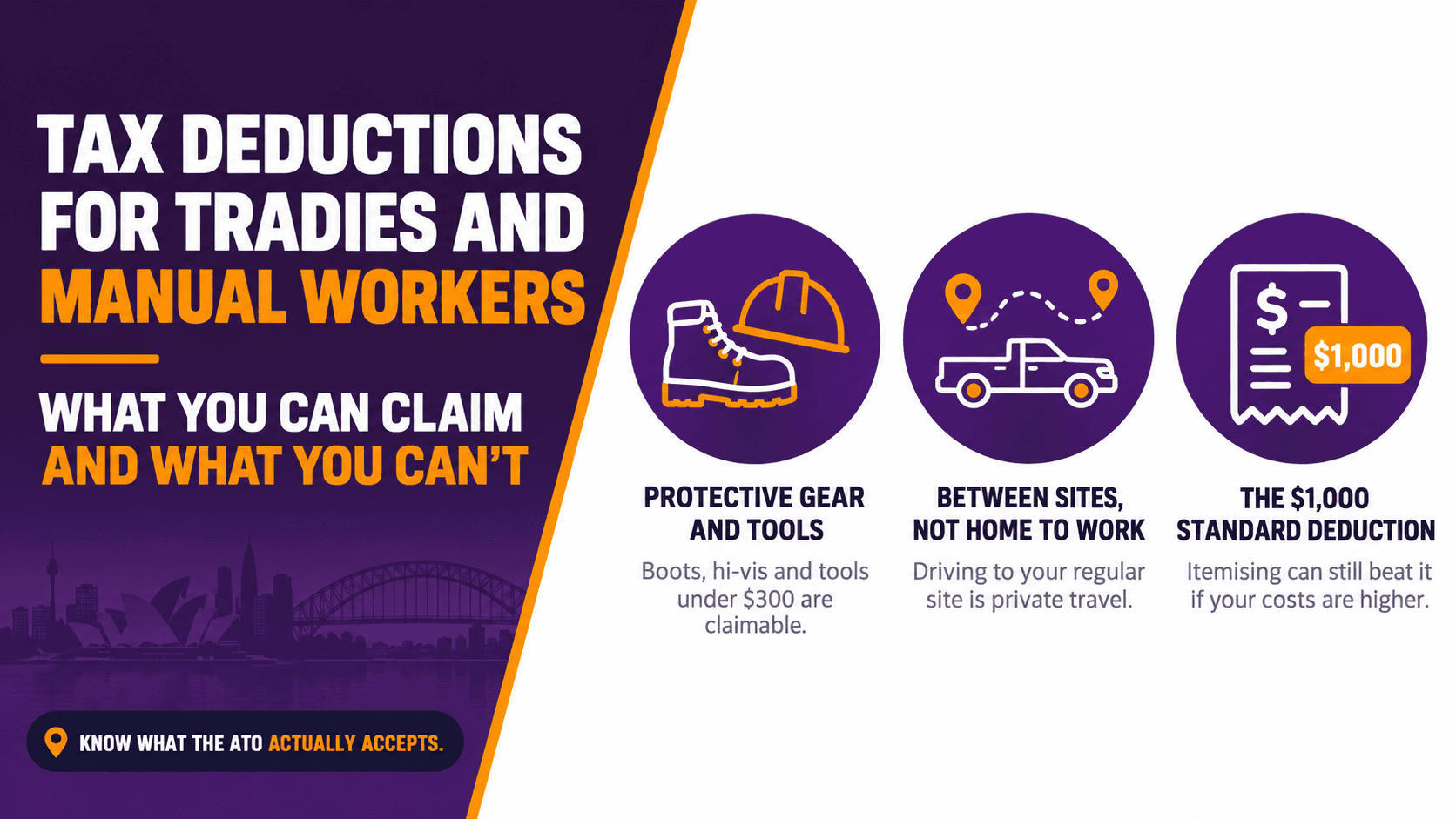
Protective and occupation-specific gear is generally deductible. That includes steel-capped boots, hi-vis, safety glasses, and sun protection for outdoor work. Plain clothing like jeans or black trousers is not.
Tools costing $300 or less (and not part of a set) can generally be claimed in full in the year you buy them. Dearer tools are claimed over their effective life.
Driving from home to your regular workplace is generally not deductible, even with tools in the car, except in narrow circumstances.
Travel between sites, union fees, licence renewals, and work phone use are common legitimate claims.
From 2026-27, a $1,000 standard deduction applies without receipts. If your real expenses are higher, itemising can still save you hundreds or more, as our carpenter example shows (about $1,069 a year).
Bottom line: tradies often have more legitimate deductions than average, but the money is in claiming the right things with records, not claiming everything and hoping.
On This Page
The Three Rules Every Claim Has to Pass
Clothing, Boots, and Laundry
Tools and Equipment
Car and Travel: Where Most Tradie Claims Go Wrong
Licences, Union Fees, Phones, and Other Claims
What You Can't Claim (Even Though Everyone Thinks You Can)
The $1,000 Standard Deduction From 2026-27
Worked Example 1: Jake, the Employed Carpenter
Worked Example 2: Chloe, the Warehouse Worker
Common Mistakes
FAQ
The Three Rules Every Claim Has to Pass
The ATO applies three tests to every work-related deduction:
You spent the money yourself and weren't reimbursed. If your employer paid for it or reimbursed you, you can't claim it.
It relates directly to earning your income. If something is used for both work and personal purposes, only the work-use portion counts.
You have a record to prove it, such as a receipt, bank statement, or diary, depending on the claim.
One extra point matters for tradies. Allowances like a tool or clothing allowance must be declared as income. Receiving an allowance doesn't automatically mean you can claim a matching deduction. You still need to have spent the money on eligible items.
Bottom line: if a claim fails any one of the three tests, it fails, no matter how common it is on your worksite.
Clothing, Boots, and Laundry
Generally deductible:
Protective clothing and gear such as steel-capped boots, hi-vis vests, safety glasses, gloves, overalls, and hard hats.
Sun protection for outdoor workers, including sunscreen, sunglasses, and sun-protective hats and clothing (work-use portion).
Compulsory uniforms with your employer's logo.
Occupation-specific clothing that isn't everyday wear.
Laundry: if you wash eligible work clothing at home, the ATO accepts $1 per load for work clothes only, or 50 cents per load if mixed with other washing. At two work-only loads a week for 46 weeks, that's 92 loads × $1 = $92. Laundry claims up to $150 don't need written evidence under current rules, but you still need to show how you worked the figure out.
Not deductible: plain clothing, even if you only wear it to work. That includes jeans, work shorts that aren't protective, black trousers, and standard runners.
Not sure which of your work gear the ATO will actually accept? WIAA's registered tax agents can check before you lodge. Email tax@whatifadvice.com.au for a free 15-minute chat.
Bottom line: protective and occupation-specific gear is in, everyday clothing is out, and laundry is small but legitimate if you do the maths properly.
Tools and Equipment
How you claim a tool depends on what it cost:
Tool cost | How it's generally claimed |
$300 or less (and not part of a set totalling more than $300) | Immediate deduction in the year purchased |
More than $300 | Decline in value over the tool's effective life |
Used partly for personal use | Only the work-use percentage is claimable |
Tool repairs, sharpening, and insurance on work tools may also be deductible. A tool your employer supplies, or reimburses you for, is not.
The law that introduced the $1,000 standard deduction also updated substantiation and capital allowance rules from 2026-27, which can affect how some lower-cost work assets are claimed. Confirm the current rules with the ATO or your tax agent before claiming a tool purchase in 2026-27 or later.
Bottom line: cheap tools are a straightforward same-year claim, while dearer ones are spread out over time, so keep the receipt for every tool, big or small.
Car and Travel: Where Most Tradie Claims Go Wrong
This is where tradie claims most often fail.
Generally not deductible:
Driving from home to your regular workplace and back. This counts as private commuting, even if you carry tools.
The narrow tools exception. Home-to-work travel may be deductible only if all of these apply:
The tools or equipment are bulky, meaning they can't reasonably travel any other way.
Your employer requires you to bring them.
There's no secure storage at the workplace.
A toolbox that fits on a passenger seat usually doesn't qualify.
Generally deductible:
Travel between two jobs or worksites on the same day.
Travel from your regular workplace to another site and back.
Travel to alternative workplaces that aren't your regular one.
Travel for itinerant work, where the work regularly moves between sites.
Two ways to claim:
Method | How it works | Best for |
Cents per kilometre | A set ATO rate per work kilometre (88 cents for 2025-26, 91 cents for 2026-27), capped at 5,000 km per car. Needs a reasonable estimate of work kilometres. | Moderate work travel |
Logbook | Work-use percentage from a 12-week logbook, applied to actual car costs | High work-use cars |
The cents per kilometre rate is set by the ATO and can change each year, so verify the current rate before lodging. If your employer provides the vehicle, such as a work ute, you generally can't claim car expenses for it.
Driving between sites every week and not sure if your claim stacks up? Call 1800 942 843 for a free 15-minute chat with our tax team.
Bottom line: home-to-work driving is almost never deductible, but travel between sites often is, and that's where legitimate money usually goes unclaimed.
Licences, Union Fees, Phones, and Other Claims
Licence and ticket renewals needed for your current job are generally deductible. The cost of obtaining an initial licence generally isn't. Check with your tax agent if you're unsure which applies.
Union fees and professional association memberships are deductible.
Phone and data: the work-use percentage. For example, 30% work use on a $780 annual plan is $234.
Self-education directly related to your current role, such as a course that upgrades skills you use now.
Overtime meals, where you received an overtime meal allowance under an award or agreement.
Overnight travel costs, including accommodation, where your employer requires you to stay away from home.
Income protection insurance held outside super, plus tax agent fees and eligible donations.
Bottom line: the smaller claims add up, especially union fees, renewals, and phone use, which tradies regularly forget.
What You Can't Claim (Even Though Everyone Thinks You Can)
Commuting from home to your regular workplace, with or without tools (outside the narrow exception).
Plain clothing and everyday footwear.
Gym memberships or general fitness costs, even in a physical job.
Fines and penalties, including parking and speeding fines.
Meals on a normal workday.
Anything your employer paid for or reimbursed.
The full cost of items used for both work and personal purposes.
Bottom line: "everyone on site claims it" isn't a test the ATO recognises, and data matching makes over-claims easier to spot than ever.
The $1,000 Standard Deduction From 2026-27
From the 2026-27 income year, eligible taxpayers are entitled to a standard deduction of up to $1,000 for work-related expenses, without needing to have spent the money or kept records. It applies to 2026-27 returns, lodged from mid-2027. Your 2025-26 return still follows the existing rules.
How it works in practice:
It's a default, not a bonus. Any work-related expenses you claim reduce the standard deduction, so your total work-related deduction is whichever is higher: $1,000 or your actual itemised claim. The two don't stack.
Eligibility: Australian tax residents who earn labour income. If your labour income is under $1,000, the standard deduction is capped at that amount.
Some claims sit on top. Union and professional association fees, charitable donations, investment expenses, and income protection insurance premiums can still be claimed in addition.
Records cut both ways. If you claim more than $1,000 in work-related expenses, you need records for all of them, not just the amount above $1,000.
The standard deduction is a big win if your real expenses are small. If they're well above $1,000, as they often are for tradies, defaulting to it can quietly cost you money. You still need records to know which side of $1,000 you're on.
The standard deduction became law in 2026. How the ATO applies it, including which expenses sit outside it, may be refined in guidance before the first 2026-27 returns are lodged. Verify the current rules with the ATO or a registered tax agent.
Bottom line: the $1,000 standard deduction is a floor, not a ceiling, and for many tradies itemising will still win.
Worked Example 1: Jake, the Employed Carpenter
Jake earns $85,000 as an employed carpenter, which puts him on a 30% marginal rate plus the 2% Medicare levy (32% combined). His 2025-26 claims:
Item | Claim |
Steel-capped boots | $220 |
Protective clothing and hi-vis | $180 |
Sun protection (sunscreen, safety sunglasses, hat) | $150 |
Laundry (92 loads × $1) | $92 |
Hand tools, each under $300 and not part of a set | $640 |
Licence renewal | $95 |
Phone (30% of $780) | $234 |
Travel between sites (3,000 km × 88c) | $2,640 |
Work-related subtotal | $4,251 |
Union fees | $600 |
Tax agent fee | $220 |
Total deductions | $5,071 |
Tax saving: $5,071 × 32% = $1,622.72.
From 2026-27: with the cents per km rate at 91 cents, the same 3,000 km is worth $2,730, lifting his work-related subtotal to $4,341. If Jake defaults to the $1,000 standard deduction instead of itemising, he gives up $3,341 in deductions ($4,341 − $1,000). That costs him about $1,069 a year ($3,341 × 32%). His union fees sit outside the standard deduction either way, and his tax agent fee generally does too, because it's a cost of managing his tax affairs rather than a work-related expense. Confirm that treatment with your tax agent.
Outcome: for Jake, keeping receipts and itemising clearly wins, mostly because of his legitimate between-site travel. This is the trap CPA Australia has warned about: workers taking the no-receipts option when an itemised claim would give them a bigger deduction.
Bottom line: tradies with regular between-site travel or heavy tool spending are likely to lose money by defaulting to the standard deduction.
Want to know whether itemising or the standard deduction works better for you? Book a free 15-minute chat online or email tax@whatifadvice.com.au.
Worked Example 2: Chloe, the Warehouse Worker
Chloe earns $62,000 as a warehouse worker, also on 32% including Medicare. Her employer supplies her hi-vis and most equipment. Her own expenses are modest:
Item | Claim |
Steel-capped boots | $180 |
Extra hi-vis | $60 |
Laundry | $50 |
Phone (work-use portion) | $120 |
Total work-related | $410 |
2025-26: her claim saves $131.20 ($410 × 32%).
From 2026-27: the standard deduction lifts her work-related deduction to $1,000 whether or not she lists her $410, saving her $320 ($1,000 × 32%). That's $188.80 more, with no receipts needed.
Outcome: for Chloe, the standard deduction wins, and she can stop chasing receipts for small items. If she later buys an expensive tool or starts travelling between sites, the maths could flip, which is why some record keeping is still worthwhile.
Bottom line: there's no clean winner across all tradies and manual workers, and the right choice depends on what you actually spend.
Common Mistakes
Claiming home-to-work travel because you carry tools. Unless you meet the narrow bulky tools exception, this is private travel.
Claiming plain work clothes. Jeans and black trousers don't qualify, even if they're your designated work wear.
Not declaring tool or clothing allowances as income. Allowances are assessable, and the ATO matches them against employer data.
Claiming items your employer paid for or reimbursed. No out-of-pocket cost means no deduction.
Throwing out receipts because of the $1,000 standard deduction. If your real expenses exceed $1,000, you'll need records for all of them.
Forgetting the smaller claims. Union fees, licence renewals, laundry, and phone use often go unclaimed.
Claiming 100% of a dual-use item. A phone or tool used personally needs to be split.
Lodging this year and want a second set of eyes on your claims? Book a free 15-minute chat with WIAA's tax team.
FAQ
Can I claim steel-capped boots on tax?
Generally yes. Protective footwear required for your work is deductible if you paid for it and weren't reimbursed.
Can I claim the drive to work if I carry my tools?
Generally no. It's only deductible where the tools are bulky, your employer requires you to bring them, and there's no secure storage at work.
Can I claim travel between worksites?
Generally yes. Travel between two workplaces, or from your regular workplace to another site, is usually deductible.
How much can I claim for washing work clothes?
The ATO accepts $1 per load for work clothing only, or 50 cents per load if mixed with other washing, for eligible protective or occupation-specific clothing.
Can I claim tools my employer gave me?
No. You can only claim tools you paid for yourself and weren't reimbursed for.
Do I need receipts for tradie deductions?
Generally yes. Under current rules, some small claims, such as laundry up to $150, don't need written evidence, but you must still be able to show how you calculated them. From 2026-27, substantiation rules were updated alongside the standard deduction, so check the current position with your tax agent.
What is the $1,000 instant tax deduction?
It's the standard deduction of up to $1,000 for work-related expenses, with no receipts required, from the 2026-27 income year. If your actual expenses are higher, you can itemise instead, but you then need records for everything.
Can I claim union fees as well as the $1,000 standard deduction?
Yes. Union and professional association fees are claimed on top of the standard deduction.
Is the $1,000 standard deduction the same as the $250 Working Australians Tax Offset?
No. A deduction reduces your taxable income, while a tax offset reduces your tax directly. The $250 Working Australians Tax Offset was part of the same tax reform package and is scheduled to start later, from 2027-28. Verify its current status with the ATO before relying on it.
Can I claim sunscreen and sunglasses?
Generally yes, if you work outdoors and they protect you from the sun while working. Only the work-use portion is claimable.
I'm a self-employed tradie with an ABN. Does this guide apply to me?
Partly. Business deductions work differently, including vehicle and asset rules. Our Tax Deductions for Small Business Owners guide covers the business side.
Ready to Claim What You're Actually Entitled To?
Most tradies either leave legitimate deductions on the table or claim things the ATO knocks back. With the $1,000 standard deduction arriving in 2026-27, it's worth knowing which side of the line you're on before you lodge.
Call us: 1800 942 843
Email: tax@whatifadvice.com.au
Book online: free 15-minute chat, no cost, no pressure
Still asking what if?
WIAA helps tradies and manual workers lodge accurate, maximised tax returns across Toowong, Grange, and Melbourne CBD. WIAA is a registered tax agent practice with the Tax Practitioners Board and operates under AFSL 528250 as an Authorised Representative of Beryllium Advisers Pty Ltd.
General Advice Disclaimer: This article contains general information only and does not take into account your personal objectives, financial situation, or needs. It is not personal tax or financial advice and should not be relied upon as such. Tax rates, the cents per kilometre rate, substantiation thresholds, depreciation rules, and the standard deduction for work-related expenses can change, and ATO guidance on new measures may be updated. Verify current rules with the ATO or a registered tax agent before lodging. Worked examples are illustrative and simplified. Seek professional advice for your own circumstances.