Looking for specific financial advice?
This blog provides general educational content. For personalized advice tailored to your unique situation, book a free consultation with our team of ASIC-licensed financial advisers.
What If Selling Your Shares Triggers a Bigger Tax Bill Than You Expected?
Selling shares feels like a simple transaction, click sell, funds land in the account a few days later. The tax consequences behind that click are considerably less simple, cost base calculations, discount eligibility tied to exact holding periods, and a choice about which specific parcel of shares you're actually selling when you've bought the same company at different times and prices. Getting any of these wrong doesn't just mean a miscalculated return, it can mean paying tax you didn't need to, or under-reporting a gain the ATO can independently see.
TL;DR
Selling shares is a CGT event, triggering a capital gain or loss calculated as sale proceeds minus the cost base
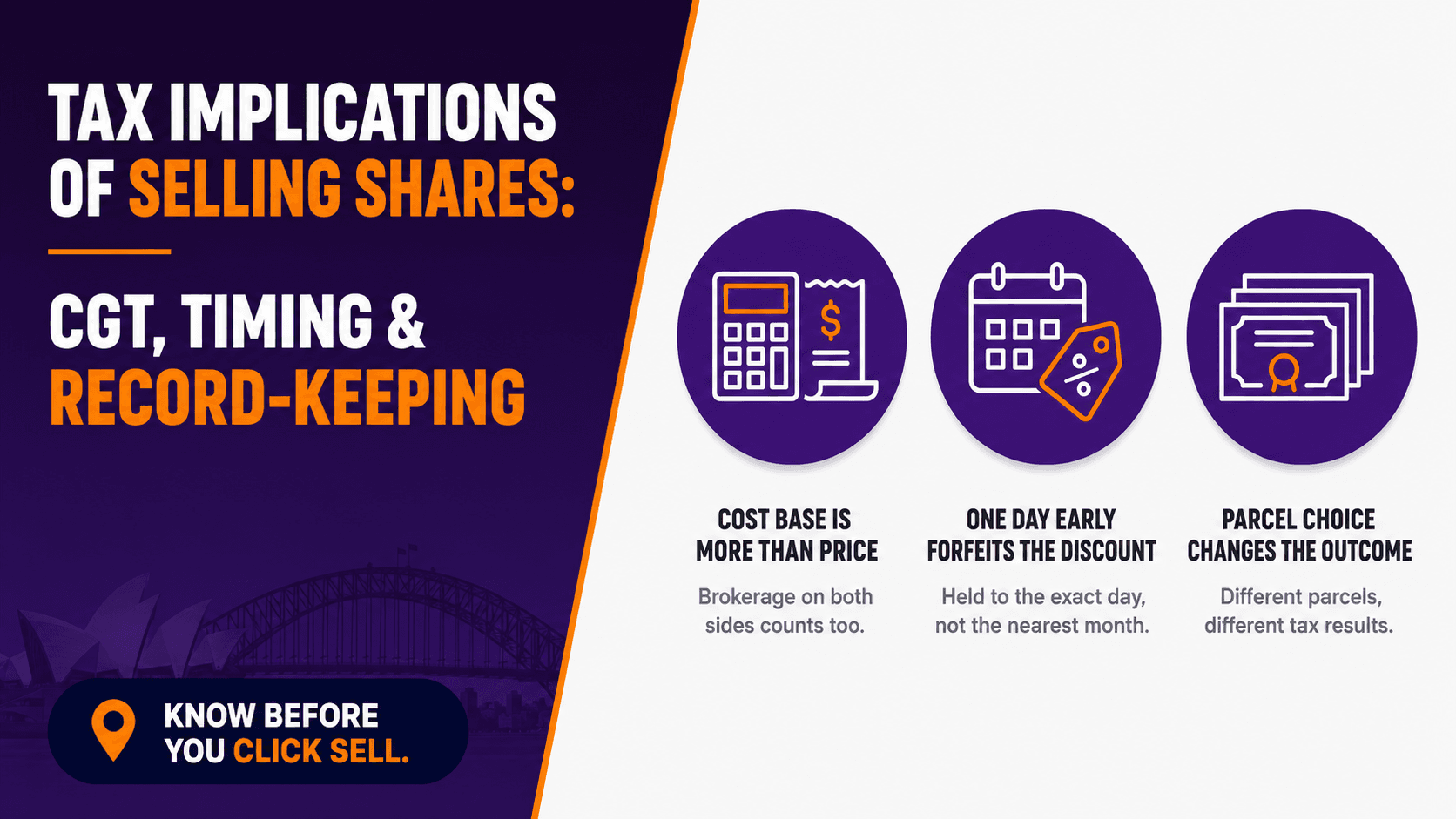
Cost base includes more than the purchase price, incidental costs like brokerage on both the buy and sell side generally form part of it
The 12-month CGT discount applies to individuals who hold shares for more than 12 months before selling, generally reducing the taxable portion of the gain by 50%
Exact holding period matters down to the day. Selling even slightly before the 12-month mark forfeits the discount entirely on that gain
When you've bought the same share at different times and prices, you generally choose which specific parcel you're selling, and that choice can materially change the resulting gain or loss
Capital losses can offset capital gains, including gains from other assets, and can generally be carried forward to future years if not fully used
The ATO receives data directly from brokers and share registries, meaning share sale information is frequently already visible to the ATO independent of what's declared
Bottom line: the tax on a share sale depends on the cost base, the exact holding period, and which parcel is treated as sold, none of which are automatically calculated correctly without deliberate record-keeping.
On This Page
What Counts as a CGT Event for Shares
Calculating the Cost Base Properly
The 12-Month Discount and Why the Exact Date Matters
Choosing Which Parcel to Sell
Using Capital Losses to Offset Gains
Worked Example: Three Parcels, One Sale Decision
Common Mistakes
FAQ
What Counts as a CGT Event for Shares
Selling shares triggers what's called a CGT event, the point at which a capital gain or loss is calculated and becomes relevant for tax purposes. This is calculated as the sale proceeds minus the cost base, the total cost of acquiring and holding the asset. If proceeds exceed the cost base, the result is a capital gain. If the cost base exceeds proceeds, the result is a capital loss. This calculation happens per parcel of shares sold, not as a single blended figure across an entire portfolio, which is why keeping track of individual purchases matters.
Not sure exactly how your specific share sales this year will affect your tax position? A free 15-minute chat with WIAA can run the numbers before you lodge. Call 1800 942 843 or book online.
Bottom line: every share sale is its own CGT event, calculated against that specific parcel's own cost base, not a general average across everything held.
Calculating the Cost Base Properly
The cost base isn't just the original purchase price. It generally includes:
The purchase price of the shares
Brokerage fees paid on the purchase
Brokerage fees paid on the eventual sale (though this is technically deducted from proceeds rather than added to cost base, the practical effect on the resulting gain is the same)
Any other incidental costs directly related to acquiring or disposing of the shares
Missing these incidental costs, particularly brokerage on both sides of the transaction, generally results in an overstated capital gain, since the true cost of the transaction is understated.
Bottom line: a cost base built purely from the headline purchase price, without incidental costs, generally overstates the actual taxable gain.
The 12-Month Discount and Why the Exact Date Matters
Individuals who hold shares for more than 12 months before selling are generally eligible for the CGT discount, reducing the taxable portion of the capital gain by 50%. This is one of the most valuable mechanics in share investing, but it's also one of the most literally applied, the holding period is measured to the exact day, not rounded to the nearest month or calculated loosely from memory.
Selling even a single day before the 12-month mark generally forfeits the discount entirely on that specific parcel, turning what would have been a 50% discounted gain into a fully taxable one. This makes the exact purchase date, not an approximate one, a genuinely important piece of information to have on hand before deciding when to sell.
A sale made a few days too early can double the taxable portion of a gain. A free 15-minute chat can check your exact eligible dates before you sell. Email tax@whatifadvice.com.au or book online.
Bottom line: the CGT discount is an all-or-nothing outcome tied to an exact date, and getting the timing wrong by even a day can meaningfully change the tax result.
Choosing Which Parcel to Sell
Investors who've bought the same company's shares at different times, at different prices, generally need to identify which specific parcel is being sold when only some of the total holding is disposed of. This matters because different parcels can have very different cost bases and holding periods, an earlier parcel bought at a lower price and held longer might trigger a larger discounted gain, while a more recent parcel bought at a higher price might trigger a smaller gain or even a loss, and might not yet qualify for the 12-month discount at all.
Generally, an investor can choose which specific parcel to treat as sold (commonly using methods like first-in-first-out, or specifically identifying particular parcels), provided the choice is applied consistently and the records support the identification. This choice can materially change the resulting tax outcome, and it's a genuine planning decision, not just an administrative formality.
Bottom line: which parcel is treated as sold isn't automatically decided, it's a choice that can materially shift the resulting gain, loss, and discount eligibility.
Using Capital Losses to Offset Gains
Capital losses, arising when a parcel sells for less than its cost base, can generally offset capital gains, including gains from entirely different asset types like property or other investments, within the same financial year. Losses that exceed the gains available to offset in a given year can generally be carried forward to offset gains in future years, though they generally can't be used to offset ordinary income like salary or wages.
This creates a legitimate planning consideration around timing, deliberately realising a loss on an underperforming holding in the same year as a significant gain elsewhere can reduce the overall tax payable on that gain, though this decision should be based on genuine investment reasoning, not purely engineered for tax purposes without regard to the shares' actual merit.
Bottom line: a capital loss isn't just a bad outcome to write off, it's a genuine offset against gains elsewhere, and the timing of realising it can be a deliberate part of overall tax planning.
Worked Example: Three Parcels, One Sale Decision
Sarah owns 300 shares in the same company, acquired in three separate parcels:
Parcel 1: 100 shares bought 3 years ago at $20 each ($2,000 cost base plus $50 brokerage)
Parcel 2: 100 shares bought 18 months ago at $35 each ($3,500 cost base plus $50 brokerage)
Parcel 3: 100 shares bought 6 months ago at $45 each ($4,500 cost base plus $50 brokerage)
The current share price is $50. Sarah wants to sell 100 shares and needs to decide which parcel to treat as sold.
Selling Parcel 1 (held over 12 months): proceeds of $5,000 minus cost base of $2,050 minus sell-side brokerage of $50 gives a gain of $2,900, eligible for the 50% CGT discount, taxable gain of $1,450.
Selling Parcel 3 (held under 12 months): proceeds of $5,000 minus cost base of $4,550 minus sell-side brokerage of $50 gives a gain of $400, not eligible for the discount, since it's held under 12 months, taxable gain of the full $400.
Outcome: choosing Parcel 1 produces a larger raw gain but a smaller taxable amount after the discount, while choosing Parcel 3 produces a smaller raw gain that's fully taxable with no discount, an outcome that genuinely depends on Sarah's broader tax position that year, not a universally "better" choice.
Bottom line: the same 100-share sale can produce meaningfully different taxable outcomes purely based on which parcel is nominated as sold, which is a decision worth making deliberately rather than defaulting to whichever the broker happens to show first.
Common Mistakes
Forgetting to include brokerage costs in the cost base calculation. This generally overstates the actual taxable gain
Selling a day or two before the 12-month mark without realising the discount is forfeited entirely. The exact date matters, not an approximate holding period
Not tracking which parcel was bought when, particularly for shares purchased through a regular investment plan or dividend reinvestment. This makes accurate CGT calculation genuinely difficult without a proper record
Assuming capital losses can offset ordinary income like salary. They generally can't, they only offset capital gains
Not considering the deliberate parcel selection choice available when only partially selling a holding. Defaulting to whatever the broker displays first can produce a worse tax outcome than a deliberate choice
A share sale's tax outcome depends heavily on decisions made before you actually click sell. A free 15-minute chat can help plan the timing and parcel choice properly. Call 1800 942 843.
FAQ
Do I pay tax every time I sell shares, even at a small gain?
Yes, generally every sale that results in a capital gain needs to be declared, regardless of the size of the gain.
What happens if I sell shares at a loss?
The capital loss can generally offset capital gains elsewhere in the same year, or be carried forward to offset gains in future years, though it can't offset ordinary income like salary.
Does the 12-month CGT discount apply automatically?
It applies where the holding period exceeds 12 months and other eligibility requirements are met, but it needs to be correctly calculated and claimed, it isn't automatically applied without the sale being properly reported.
Can I choose which shares to sell if I bought the same company at different times?
Generally, yes, when only part of a holding is being sold, the specific parcel being treated as sold can generally be chosen, provided it's applied consistently and properly recorded.
What costs can I include in my share cost base?
Generally the purchase price plus incidental costs like brokerage fees paid on acquisition, with sell-side brokerage effectively reducing the sale proceeds in the final calculation.
Does selling shares affect my franking credits?
Franking credits relate to dividends received while holding the shares, separate from the capital gain or loss calculated on the eventual sale, though both are relevant to your overall investment tax position.
How does the ATO know if I've sold shares and not declared it?
Brokers and share registries generally report transaction data to the ATO, meaning share sale information is frequently already visible independent of what's declared in a tax return.
Should I sell shares before or after the 12-month mark if I'm close to it?
This depends on your specific numbers, but selling even a day before the 12-month mark forfeits the discount entirely, so confirming the exact eligible date before deciding is worth doing.
Can I deliberately sell an underperforming share to offset a gain elsewhere?
Yes, this is a legitimate tax planning approach, generally referred to informally as tax-loss selling, though the decision should still be grounded in genuine investment reasoning.
Do I need to keep records of every share purchase, even from years ago?
Yes, generally for as long as you hold the shares plus the required record retention period after disposal, since the cost base and holding period both depend on those original purchase records.
Ready to Understand the Tax Impact Before You Sell?
The tax outcome of a share sale depends heavily on decisions made before the transaction, cost base records, exact dates, and parcel selection. A free 15-minute chat can help you plan it properly.
Call 1800 942 843 · Email tax@whatifadvice.com.au · Book online
Still asking what if.
WIAA has helped Australians plan share sales with the tax consequences properly accounted for, across Toowong, Grange, and Melbourne CBD. WIAA operates under AFSL 528250 as an Authorised Representative of Beryllium Advisers Pty Ltd.
General Advice Disclaimer: This article contains general information only and does not take into account your personal objectives, financial situation, or needs. It is not personal financial advice or tax advice and should not be relied upon as such. Capital gains tax rules, discount eligibility, and record-keeping requirements are subject to change and should be verified with the ATO or a registered tax agent for your specific circumstances.