Looking for specific financial advice?
This blog provides general educational content. For personalized advice tailored to your unique situation, book a free consultation with our team of ASIC-licensed financial advisers.
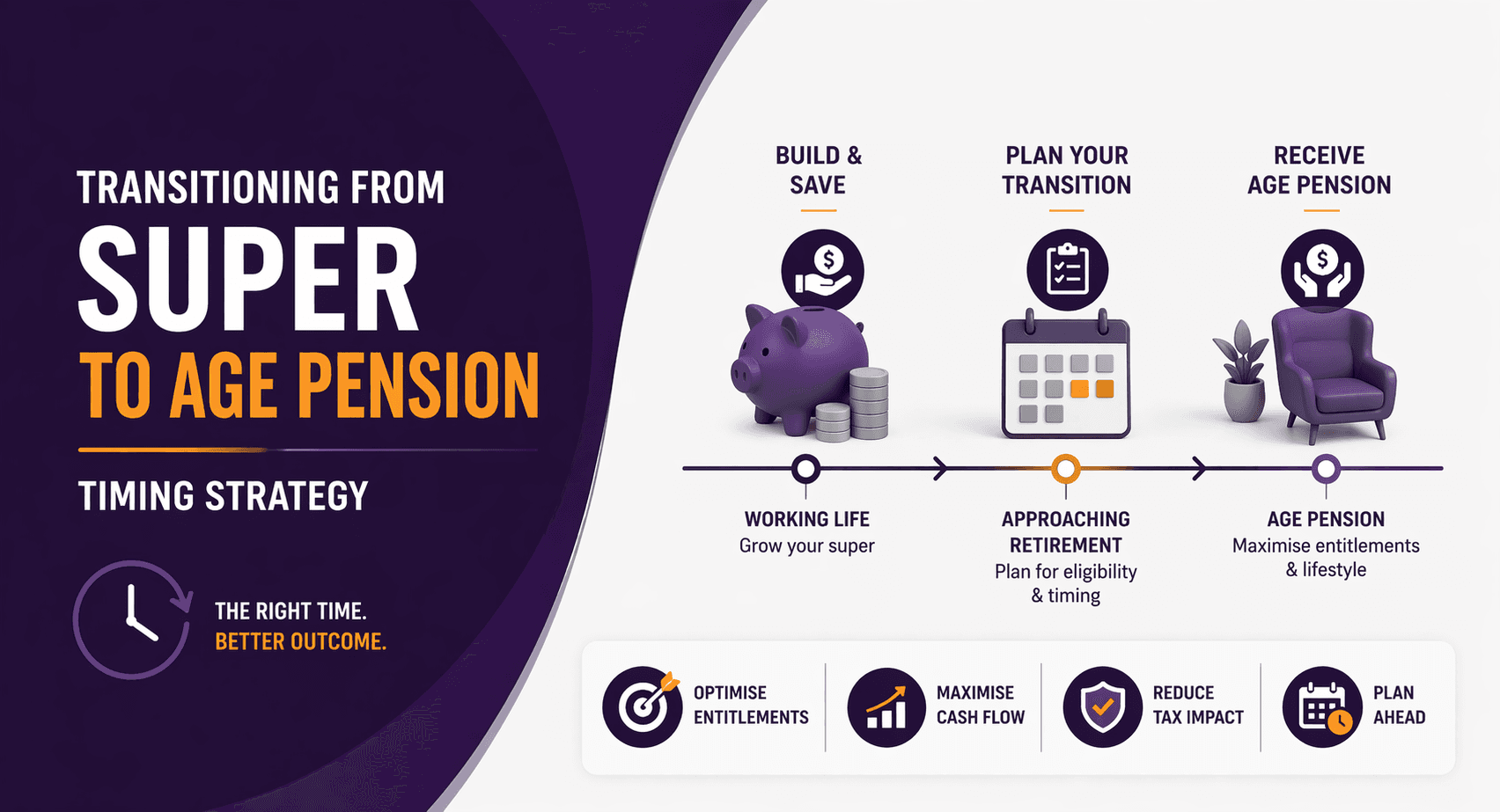
Transitioning from Super to Age Pension: Timing Strategy for Australians
The transition from superannuation to the Age Pension is one of the most important financial decisions in retirement.
Get the timing right, and you can maximise your income and preserve your wealth. Get it wrong, and you could miss out on entitlements or draw down your super faster than necessary.
Here’s how the transition actually works and how to approach it strategically.
When Does the Age Pension Start?
You can apply for the Age Pension when you reach Age Pension age, which is currently:
67 years old (subject to current Services Australia rules)
But eligibility isn’t automatic.
You must pass:
The assets test
The income test
Residency requirements
What Happens Before Age Pension Age?
Before 67:
Your super is your primary income source
You may be drawing from:
Account-based pensions
Transition to Retirement (TTR) strategies
Important:
Super in accumulation phase is generally not counted under the assets test before Age Pension age
Once you reach pension age, it becomes assessable
This is where timing starts to matter.
The Key Transition Point: Turning 67
At Age Pension age:
Your super is assessed under Centrelink rules
Your eligibility is recalculated
This creates three possible outcomes:
1. Full Age Pension
If your assets and income are below thresholds.
2. Part Age Pension
Most common scenario.
You combine:
Super withdrawals
Partial government support
3. No Pension
If your assets/income exceed limits.
Timing Strategy: When Should You Apply?
Option 1: Apply Immediately at 67
Best if:
You’re already below thresholds
You want to access benefits early
You need additional income
Pros:
Immediate cash flow
Access to concession cards
Cons:
May not be optimal if assets are still high
Option 2: Delay Application Strategically
Sometimes waiting is smarter.
Example:
You retire at 67 with $600,000 in super
Above threshold = no pension
Over 2–3 years, you draw down = balance drops
You become eligible later
This can result in:
Higher pension entitlement when you do apply
Option 3: Stage Your Drawdown
Instead of random withdrawals:
Plan how much super you draw each year
Goal:
Gradually reduce assets to:
Qualify for part pension
Eventually reach optimal balance
This is where actual strategy lives.
Super Drawdown vs Age Pension: Finding the Balance
You’re balancing two forces:
Strategy | Outcome |
High super balance | Lower pension |
Lower super balance | Higher pension |
Balanced approach | Optimised total income |
The objective is not:
👉 “Get the biggest pension”
It’s:
👉 “Maximise total retirement income”
Example Scenario
Stage | Super Balance | Pension | Total Income |
Age 67 | $650,000 | $0 | $40,000 (super only) |
Age 70 | $500,000 | $300/fortnight | Higher combined |
Age 75 | $350,000 | Near full pension | Stable income |
Same person. Different outcomes based on timing and drawdown.
Key Factors That Affect Your Transition
1. Asset Structure
Not all assets are treated equally.
Super = assessable after pension age
Home = generally exempt
Financial assets = deemed income
2. Income Test (Deeming Rules)
Centrelink assumes your assets generate income:
Even if they don’t
This impacts:
Your pension entitlement
Your optimal withdrawal strategy
3. Life Expectancy & Spending Needs
You need to balance:
Sustainability
Lifestyle
Government support
Too conservative = miss lifestyle
Too aggressive = run out of funds
Common Mistakes to Avoid
1. Applying too early without strategy
You might qualify later for more.
2. Drawing super randomly
No structure = inefficient outcomes.
3. Ignoring deeming rates
These affect your pension more than expected.
4. Not reviewing annually
Rules, thresholds, and your finances change.
Strategic Insight: This Is a Planning Exercise, Not a Switch
This isn’t:
“Super stops = Pension starts”
It’s:
A multi-year transition strategy
Done properly, it can:
Extend your retirement savings
Increase lifetime income
Improve cash flow stability
When Should You Get Advice?
You should consider professional advice if:
You’re within 3–5 years of Age Pension age
Your super balance is near thresholds
You want to optimise income, not just qualify
This is where structured planning makes a measurable difference.
FAQs
1. Can I receive super and Age Pension at the same time?
Yes. Many Australians receive a part Age Pension while drawing income from super.
2. Should I spend my super to qualify for the pension?
Not necessarily. The goal is to maximise total income, not just pension eligibility.
3. When should I apply for the Age Pension?
Usually at or after Age Pension age, but timing depends on your asset position and strategy.
4. Does my home affect my Age Pension?
Your principal residence is generally exempt (subject to current Services Australia rules).
5. How is super treated after Age Pension age?
It becomes assessable under the assets and income tests.
6. Can delaying the pension increase my benefits?
Yes, in some cases, if your assets reduce over time.
7. What is the biggest mistake people make?
Treating the transition as automatic instead of strategic.
Planning Your Transition to the Age Pension?
The difference between a good retirement and a great one often comes down to timing.
At What If Advice, we help Australians:
Structure super drawdowns effectively
Understand Centrelink rules clearly
Maximise total retirement income
Book a strategy session to map out your transition with clarity and confidence.
Disclaimer
This information is general in nature and does not take into account your personal objectives, financial situation, or needs. You should consider whether it is appropriate for your circumstances and seek professional advice. Rules relating to Centrelink, the ATO, and Services Australia are subject to change.