Looking for specific financial advice?
This blog provides general educational content. For personalized advice tailored to your unique situation, book a free consultation with our team of ASIC-licensed financial advisers.
Is a Good Super Balance at Retirement? (Australia 2026)
Approaching retirement raises one question above all others: is the super balance enough? It is the figure that determines whether retirement looks like comfortable independence or careful budgeting from one Age Pension payment to the next.
The challenge is that "good" is not a single number. It depends on home ownership, lifestyle expectations, longevity, marital status, and how much of the retirement income comes from the Age Pension.
This guide outlines the most current Australian benchmarks for 2026, explains how the figures are calculated, and shows what different balance levels actually fund in retirement.
Quick Answer
A good super balance at retirement in Australia in 2026 sits within these benchmarks:
A single homeowner retiring at 67 needs approximately $630,000 for a comfortable lifestyle
A couple homeowner retiring at 67 needs approximately $730,000 combined for a comfortable lifestyle
A modest lifestyle requires only $110,000 (single) or $120,000 (couple) because the Age Pension covers most expenditure
These figures assume home ownership and a partial Age Pension supplementing super drawdown
Early retirees (before age 67) typically need significantly more, as they cannot yet access the Age Pension
Bottom line: A balance between $630,000 and $730,000 is the widely accepted benchmark for a comfortable retirement at 67. Anything less is workable but requires either lifestyle adjustment, working longer, or greater Age Pension reliance.
Where the Numbers Come From
The Australian retirement industry generally relies on the ASFA Retirement Standard, published by the Association of Superannuation Funds of Australia. ASFA updates its annual income benchmarks quarterly and revised its lump sum benchmarks in February 2026 for the first time in three years.
The two benchmark lifestyles are:
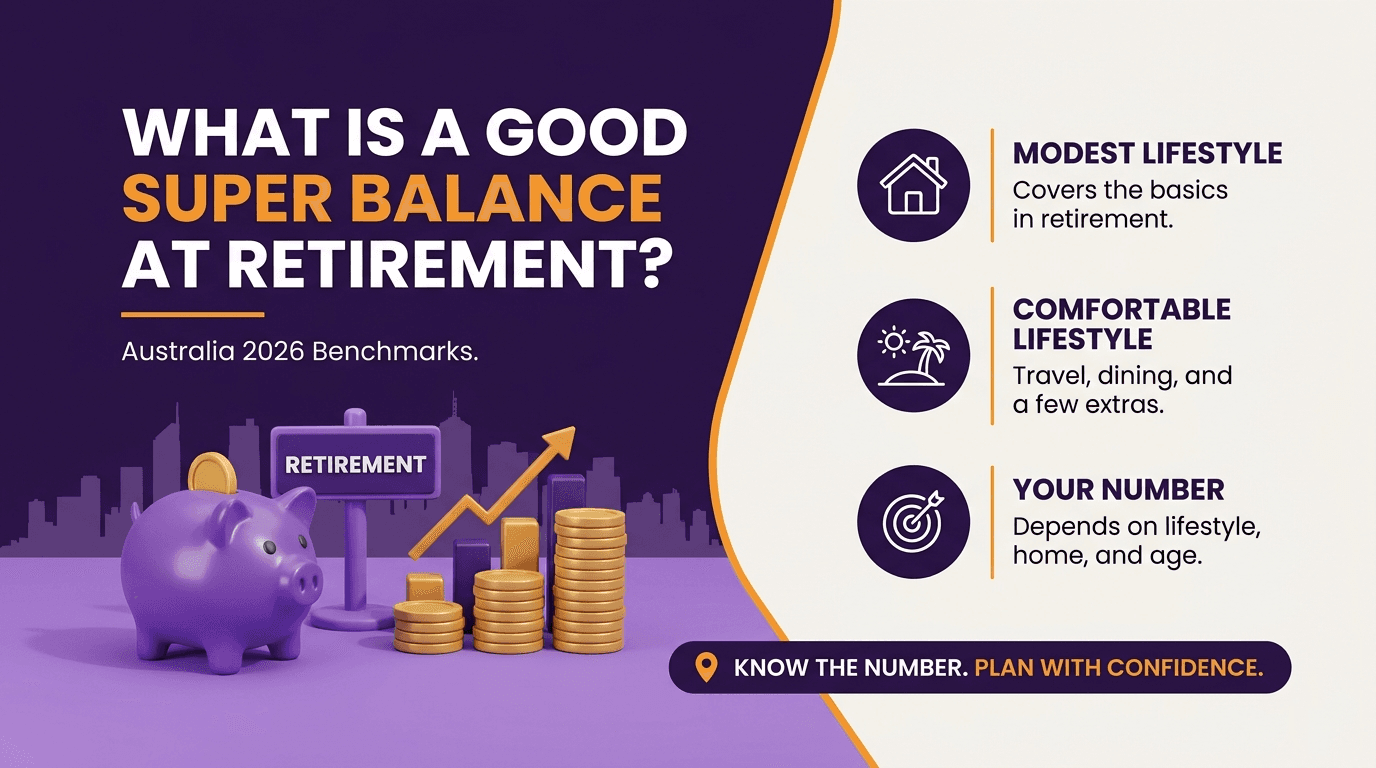
Modest retirement: Covers the basics. Slightly above the Age Pension alone but limits travel, dining, and discretionary spending.
Comfortable retirement: Allows for private health insurance, a reliable car, occasional international travel, regular domestic holidays, dining out, and broader recreational activities.
Lifestyle | Single (Annual Income) | Couple (Annual Income) | Single Lump Sum at 67 | Couple Lump Sum at 67 |
Modest | ~$36,700 | ~$52,800 | $110,000 | $120,000 |
Comfortable | ~$54,837 | ~$77,375 | $630,000 | $730,000 |
The February 2026 update raised the comfortable lump sums from the previous $595,000 (single) and $690,000 (couple) figures. ASFA cited rising living costs and the fact that Age Pension increases have not kept pace with retiree expenses.
Bottom line: The current benchmark for a "good" super balance at retirement is $630,000 for a single homeowner and $730,000 for a couple homeowner. These figures are current as of February 2026 and assume a partial Age Pension supplementing super drawdown.
What Each Balance Level Actually Funds
Numbers without context are meaningless. Here is what different balance levels practically support in retirement.
Under $300,000
A balance under $300,000 effectively means relying primarily on the full Age Pension with super used for occasional larger expenses such as a car replacement, home maintenance, or medical costs. Lifestyle is modest by ASFA standards, with limited travel and discretionary spending.
$300,000 to $600,000
This range supports a lifestyle between modest and comfortable. Couples in particular can fund a reasonable retirement with careful budgeting and a partial Age Pension. Singles in this range typically need to scale back travel or other discretionary expenses.
$600,000 to $1,000,000
This is the target zone for a comfortable retirement, particularly for singles. Couples at the upper end of this range can travel, replace cars regularly, and maintain private health insurance without anxiety. A partial Age Pension still applies for most retirees in this band (subject to Services Australia rules).
$1,000,000 to $1,500,000
Provides a comfortable retirement with greater flexibility. International travel becomes routine rather than occasional. Asset thresholds may reduce or eliminate Age Pension entitlements depending on assets held outside super.
Above $1,500,000
A high-comfort retirement, generally without Age Pension entitlement under the assets test. This range typically supports retirees who want significant discretionary spending, support for adult children or grandchildren, or substantial bequest goals.
Bottom line: Most Australians aiming for a comfortable retirement need between $600,000 and $1,000,000 in super. Above that level, the question shifts from sufficiency to lifestyle and legacy planning.
How the Age Pension Changes the Maths
The ASFA lump sum benchmarks assume a partial Age Pension supplementing super drawdown over time. This is critical to understand, because the Age Pension dramatically reduces the super balance required.
Three points worth knowing:
The Age Pension is indexed twice yearly by the higher of CPI or wage growth, providing a real income floor that grows with the economy
Deeming rates changed on 20 March 2026, with the lower rate rising to 1.25% and the upper rate rising to 3.25%, which can reduce Age Pension payments for retirees with significant financial assets
As a retiree's super balance reduces over time, Age Pension entitlement typically increases, supporting a smooth income trajectory in later retirement
For most retirees with balances between $300,000 and $1,000,000, the Age Pension will eventually contribute a significant portion of their income. The exact amount depends on assets, income, and partner status (subject to Services Australia rules).
Bottom line: A "good" super balance is not the figure that funds your entire retirement alone. It is the figure that, combined with a partial Age Pension over time, supports your chosen lifestyle until life expectancy.
The Early Retirement Adjustment
The ASFA benchmarks assume retirement at 67, the current Age Pension eligibility age. Retiring earlier changes the maths significantly.
Recent modelling indicates:
A single retiring at 60 would need approximately $525,000 in typical markets (rising to $720,000 in poor market conditions) to fund a comfortable lifestyle
A couple retiring at 60 may need around $955,000 to retire safely through poor market sequences over a 32-year horizon to age 92
Each year of retirement before 67 effectively requires super to replace the Age Pension entirely for that year
Practically, a retiree leaving the workforce at 60 needs roughly $215,000 more in super than someone retiring at 67 for the equivalent lifestyle. This is the cost of seven years without Age Pension support.
Bottom line: Early retirement is achievable but expensive. Plan for an additional 30 to 40 percent in super if retirement is targeted before 67.
Practical Examples
Example 1: Margaret, 67, Single Homeowner from Geelong
Margaret retires at 67 with $640,000 in super and a fully owned home worth $720,000. She targets the ASFA comfortable lifestyle of approximately $54,837 per year.
Her income strategy:
Convert super into an account-based pension, drawing approximately $45,000 per year initially
Receive a partial Age Pension of approximately $9,800 per year initially, growing as her balance reduces (subject to Services Australia rules)
Total annual income: approximately $54,800, matching the comfortable benchmark
Modelled balance trajectory: super likely to last until late 80s, after which she relies primarily on the Age Pension
By age 85, her super balance has reduced to roughly $180,000 and her Age Pension has increased to near full entitlement, maintaining her income at the comfortable level throughout retirement.
Example 2: Robert and Helen, Both 67, Couple from Adelaide
Robert and Helen retire together with $780,000 combined in super and a paid-off home in suburban Adelaide. They target the ASFA comfortable couple lifestyle of approximately $77,375 per year.
Their strategy:
Both convert super to account-based pensions, drawing approximately $62,000 combined per year initially
Receive a partial Age Pension of approximately $15,000 combined initially, increasing over time
Total annual income: approximately $77,000, aligned with the comfortable benchmark
Plan to downsize from their four-bedroom home into a smaller villa at age 75, freeing up additional capital for later retirement
Their modelling indicates a high probability of maintaining the comfortable lifestyle through to age 92, with Age Pension increases bridging any gap as their super reduces.
Common Mistakes Pre-Retirees Make
Assuming the comfortable benchmark applies to everyone. The ASFA comfortable standard reflects a specific lifestyle. Some retirees genuinely need more (high health costs, significant travel goals), while others are content with less. The benchmark is a guide, not a destination.
Forgetting the Age Pension in retirement modelling. Many pre-retirees calculate retirement needs without factoring in the Age Pension, dramatically inflating the required balance. The Age Pension is a meaningful income source for most Australian retirees.
Switching to overly conservative investments at 60. A 67-year-old retiree may have 25 to 30 years of investment horizon ahead. Moving entirely to cash at retirement risks running out of money in late retirement.
Ignoring the impact of early retirement. Retiring at 60 instead of 67 typically requires 30 to 40 percent more super. Pre-retirees who target an early exit without modelling the gap often face an unwelcome surprise.
Not planning for the second-to-die scenario. Couples should model what happens when one partner passes, as Age Pension entitlements and household expenses both change. The surviving partner's super and income trajectory matters.
Overlooking home ownership. The ASFA benchmarks assume retirees own their home outright. Renters need significantly more super or rental assistance support to achieve equivalent lifestyles.
Treating the lump sum as a fixed target. The ASFA figures are based on specific assumptions about returns, inflation, and longevity. Personal circumstances, including health, family, and lifestyle goals, can shift the actual target up or down meaningfully.
FAQ
Is $500,000 enough to retire on in Australia? For a single, $500,000 sits below the ASFA comfortable benchmark of $630,000 but well above the modest figure. It can support a reasonable retirement when combined with a partial Age Pension and home ownership. Couples with $500,000 combined will likely need to adjust expectations toward the modest standard.
How much super does a couple need to retire comfortably? According to the ASFA Retirement Standard February 2026 update, a couple needs $730,000 combined at age 67 for a comfortable retirement. This assumes home ownership and a partial Age Pension supplementing drawdown over time.
What is a comfortable retirement income in Australia in 2026? The current ASFA comfortable retirement income figures are approximately $54,837 per year for singles and $77,375 per year for couples, based on the February 2026 update. These figures cover private health insurance, a reliable car, occasional international travel, regular domestic holidays, and general lifestyle expenses.
Do these benchmarks include the Age Pension? Yes. The ASFA lump sum figures explicitly assume a partial Age Pension will supplement super drawdown over the course of retirement. Without Age Pension support, the required balance would be significantly higher.
What if I retire before 67? Retiring before Age Pension eligibility means super must fund the entire income gap. Recent modelling suggests retiring at 60 instead of 67 requires roughly $215,000 more in super for an equivalent lifestyle. The earlier the retirement, the higher the required balance.
How long should my super last in retirement? Most modelling assumes super needs to last from retirement age to approximately age 90 to 92. A 67-year-old retiree should plan for a 25 to 30 year retirement horizon. Drawdown rates of 4 to 5 percent are commonly used as sustainable benchmarks.
Does the ASFA benchmark apply if I rent in retirement? No. The standard benchmarks assume home ownership. ASFA has published separate figures for renters, which require higher super balances or greater rental assistance support to fund equivalent lifestyles.
Ready to See If Your Super Is on Track?
A clear understanding of where your super balance sits against the benchmarks is the foundation of any retirement plan. Book a free 15-minute consultation with the team at What If Advice and find out exactly what your retirement looks like based on your current trajectory.
Visit whatifadvice.com.au to book.
Disclaimer: This information is general in nature and does not take into account your personal financial situation, needs, or objectives. You should consider whether it is appropriate for you and seek personal financial advice before making any decisions.