Looking for specific financial advice?
This blog provides general educational content. For personalized advice tailored to your unique situation, book a free consultation with our team of ASIC-licensed financial advisers.
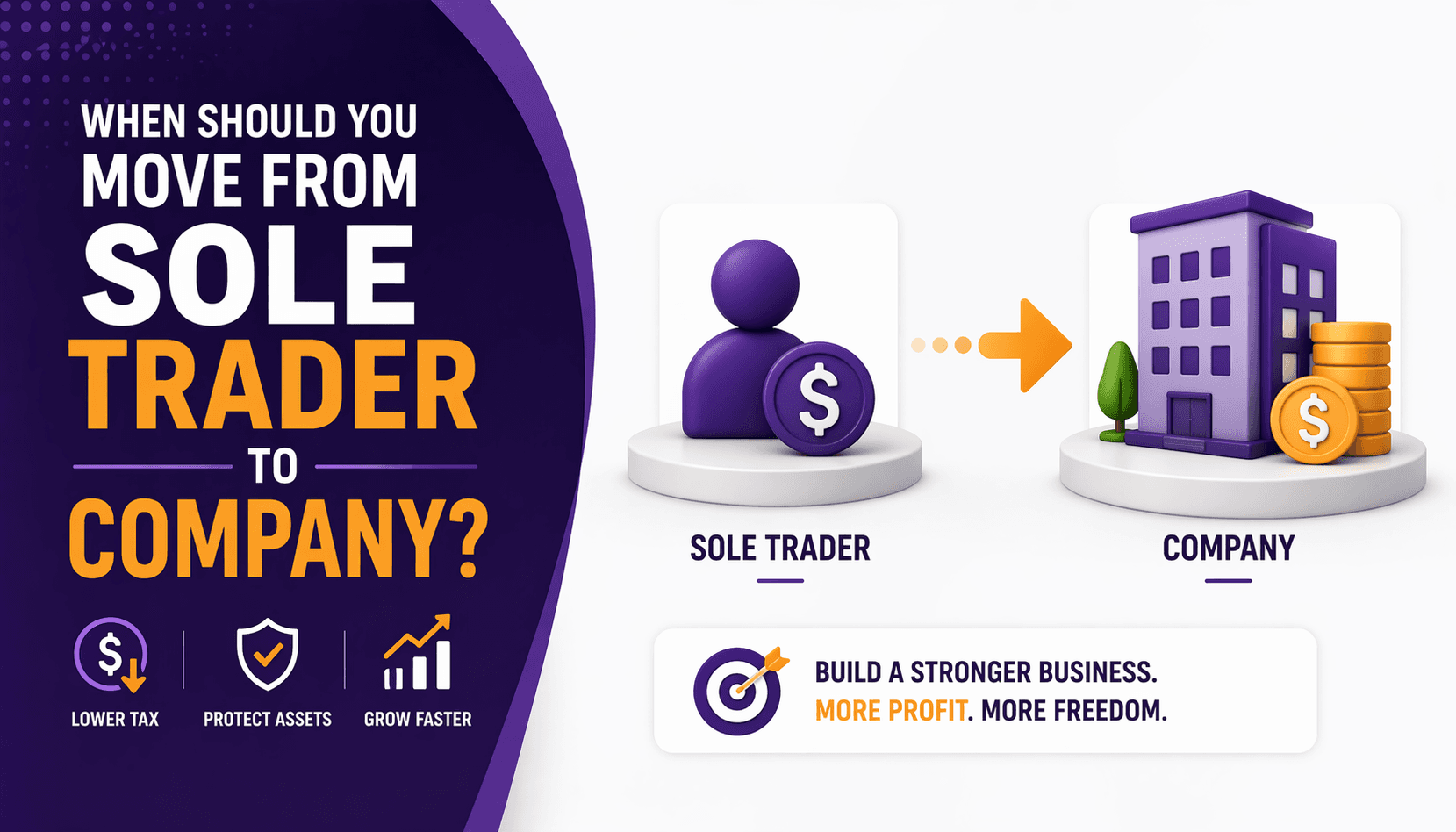
When Should You Move From Sole Trader to Company in Australia?
There’s no fixed point where you must switch from sole trader to company.
But there are clear signals that staying a sole trader is starting to cost you — in tax, risk, or missed opportunities.
If you’re asking the question, you’re probably already close.
Sole Trader vs Company: The Core Difference
Feature | Sole Trader | Company |
Tax rate | Personal rates (up to 45% + Medicare) | Company rate (typically 25%) |
Legal status | You = the business | Separate legal entity |
Liability | Unlimited personal liability | Limited liability |
Complexity | Simple | More compliance |
This isn’t about “better.” It’s about fit for your stage.
The Key Trigger: Your Income Level
If You’re Earning Under ~$80,000–$100,000
Sole trader is usually fine
Lower admin
Tax differences are minimal
If You’re Earning $120,000+
Now it gets interesting.
You’re likely in higher tax brackets
Company structure may allow:
Tax deferral
Income distribution
Profit retention
This is often the tipping point.
(Exact thresholds depend on your situation and ATO rules.)
Trigger #1: You’re Paying Too Much Tax
As a sole trader:
All profit = personal income
Example:
Profit: $180,000
Taxed at marginal rates
With a company:
Profits taxed at ~25% (if retained)
Dividends can be timed strategically
You gain control over when you pay personal tax.
Trigger #2: You Want to Retain Profits
Sole trader:
No separation
Profits taxed immediately
Company:
Retain profits at lower tax rate
Reinvest in business
Essential for scaling.
Trigger #3: You Need Asset Protection
As a sole trader:
You are personally liable
Your personal assets are exposed
As a company:
Liability is limited (in most cases)
Important if:
You deal with risk
You employ staff
You operate in higher-liability industries
Trigger #4: You’re Growing or Hiring
Growth creates complexity:
Employees
Contracts
Larger revenue
Companies are better suited for:
Scaling operations
Managing risk
Structuring ownership
Trigger #5: You Want Flexibility in Income
With a company (and potentially a trust):
Income can be distributed
Dividends can be timed
Family tax planning becomes possible
Sole trader:
No flexibility
All income taxed to you
Example Scenario
Sole Trader
Profit: $150,000
Taxed at personal rates
Company Structure
Profit: $150,000
$80,000 paid as salary
$70,000 retained in company
Outcome:
Lower immediate tax
Capital retained for growth
Costs and Trade-Offs
Let’s not pretend it’s all upside.
Company Downsides
ASIC fees
Accounting costs
Compliance requirements
Director responsibilities
Also Important: Division 7A
If you take money out improperly:
It can be taxed as a dividend
Companies require:
Proper planning, not guesswork
When You Should NOT Switch Yet
Stay as a sole trader if:
Income is still low or inconsistent
You need simplicity
You’re testing a business idea
You’re not reinvesting profits
Switching too early:
Adds cost without real benefit
How to Transition Properly
Moving to a company isn’t just “register and go.”
You need to:
Set up correct structure
Transfer assets (if needed)
Register for tax obligations (ATO)
Update contracts and clients
Done poorly, it creates:
Tax issues
Compliance headaches
Strategic Insight: Timing Matters More Than Structure
Most people ask:
“Should I have a company?”
Better question:
“When does a company actually benefit me?”
Because:
Too early = unnecessary cost
Too late = lost tax savings
When Should You Get Advice?
You should seek advice if:
You’re earning $100k–$200k+
Your business is growing
You want to reduce tax legally
You’re unsure how to structure properly
Because the transition point is where:
Most of the long-term benefit is decided
FAQs
1. At what income should I switch to a company?
Often around $100,000–$150,000+, but it depends on your situation and goals.
2. Is a company always better than a sole trader?
No. It depends on income, risk, and business stage.
3. Can I reduce tax by switching to a company?
Yes, particularly through profit retention and timing strategies.
4. Is it expensive to run a company in Australia?
There are ongoing costs (ASIC fees, accounting), but these may be outweighed by tax benefits.
5. Do I pay less tax immediately with a company?
Not always. Benefits often come from timing and structure, not instant reduction.
6. Can I move from sole trader to company easily?
Yes, but it should be done correctly to avoid tax and legal issues.
7. What is the biggest mistake when switching?
Doing it without a clear strategy.
Not Sure If It’s Time to Switch to a Company?
The right structure can significantly impact your tax, risk, and long-term growth.
At What If Advice, we help business owners:
Decide the right time to restructure
Set up companies correctly
Build tax-efficient strategies
Book a strategy session to get clarity on your next move.
Disclaimer
This information is general in nature and does not take into account your personal objectives, financial situation, or needs. You should consider whether it is appropriate for your circumstances and seek professional advice. Taxation laws and ATO rules are subject to change.